The Director General of the Environmental Protection Agency (EPA), Laura Burke; and the Chief Justice, the Hon Mr Justice Frank Clarke, will provide the opening addresses at this year’s virtual conference on Environmental Law Enforcement: Emerging Challenges 2020 which will take place on Wednesday on November 11th 2020, with the event timed for 9.00am until 1.15pm.
Note: Advance registration for this event is essential. To view the full conference programme, please use the link shown HERE. To register for this event, please use the link shown HERE.
The conference, which is co-hosted by the EPA and the Irish Centre for European Law (ICEL), will explore some of the challenges and potential opportunities that are emerging through experience with environmental enforcement; recent developments in the case law; as well as new policy initiatives.
Commenting on the conference, Ms Laura Burke(EPA Director General), stated: “This conference is an important opportunity for practicing legal professionals, leading academics and researchers, policy makers, concerned stakeholders as well as professional regulators to come together to explore emerging challenges in Ireland with regard to enforcement of environmental law. It also has an important role in supporting the development of competency and capacity in environmental law and its enforcement.”
The conference will explore experience, challenges and recent case law in relation to the Environmental Impact Assessment Directive; the Environmental Liability Directive and the Habitats Directive; as well as the implications of the recent judgment of the Supreme Court in ‘Climate Case Ireland’ for climate and wider environmental protection.
There will also be contributions providing different perspectives and experience in the context of establishing a specialist court for planning and the environment.
Dr Áine Ryall, (ICEL and Centre for Law and the Environment UCC) stated: “The conference is very timely. The Programme for Government includes a commitment to establish a Planning and Environmental Law Court managed by specialist judges. There is also a commitment to reform the judicial review process. These proposals raise important issues concerning the right of access to justice and merit close attention. Furthermore, the pandemic has created challenges for the exercise of rights guaranteed under the Aarhus Convention, in particular the right to participate in environmental decision-making. The conference provides a forum for informed debate. It will explore how to use the law to protect the environment and improve environmental quality.”
300 lung cancer cases in Ireland each year are linked to exposure to radon.
The risk of developing radon related lung cancer is particularly high for smokers. In fact, smokers are at about twenty-five times greater risk than non-smokers.
It is easy to test your home for this indoor air pollutant and to reduce high levels.
The highest level home tested in Ireland this year had over 22 times the acceptable level. This level could give a radiation dose equivalent to receiving 15 chest X-rays a day.
On European Radon Day, 7th November, the Environmental Protection Agency(EPA) are calling on all householders to test their homes for this cancer-causing radioactive gas. Radon is the second biggest cause of lung cancer after smoking. In Ireland, it is estimated that about 300 lung cancer cases each year are linked to radon exposure.
What is Radon?
Radon is a radioactive gas formed in the ground from the radioactive decay of uranium which is present in all rocks and soils. It has no smell, colour or taste and can only be detected using radon detectors. Outdoors, radon quickly dilutes to harmless levels but when it enters an enclosed space, such as a house or other building, it can accumulate to unacceptably high levels. Radon is a lung carcinogen and is linked to some 300 lung cancer cases each year in Ireland making it a serious public health hazard.
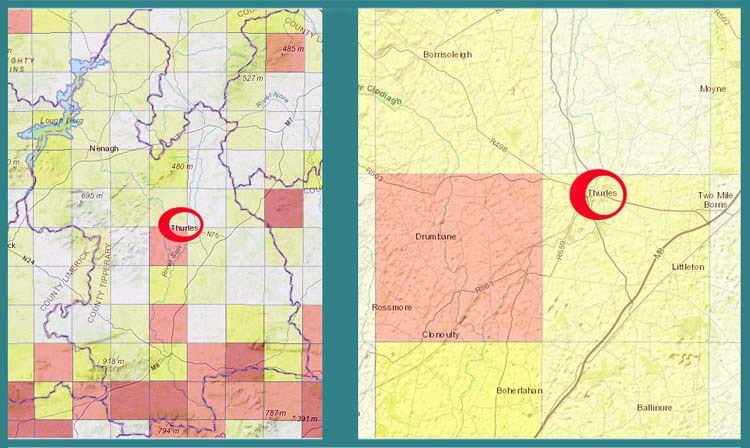
About a third of Ireland is classified as a high radon area by the EPA. However, the EPA recommends that homeowners in all areas of Ireland test their homes for radon. You can check if you are living in a high radon area on the EPA’s interactive radon risk map on www.radon.ie. Ireland has relatively high indoor radon levels, with an average indoor level of 77 Bq/m3, compared to the worldwide average of 39 Bq/m3.
Radon gas can seep into your home through small cracks and gaps in the foundations of the building or openings around service pipes. It comes from the rocks and soil in the ground under your home. Radon has no colour, taste or smell, so the only way to know how much of this pollutant is in your home is to carry out a radon test.
The test costs about €50 and is all done by post using one of the services registered with the EPA. The test kit includes two radon detectors – one should be placed in the bedroom and one in the living room. After three months, the detectors are posted back to the provider and analysed to see how much radon they have been exposed to in your home. The results are posted back to you, with advice on how to deal with any high radon readings.
Stephanie Long, (Manager of the EPA’s Radon programme) has stated: “Exposure to high levels of radon can cause lung cancer and many families are unknowingly living with this indoor air pollutant. Earlier this year, one home was found to have over 22 times the acceptable level. Living with this level of radon gives a radiation dose equivalent to getting 15 chest x-rays a day.”
You can visit www.radon.ie to find out how to test your home and keep you and your family safe. Reducing radon levels is simple and inexpensive and will immediately reduce the risk of developing lung cancer.
For moderate levels of radon, improving indoor ventilation may reduce the level by up to half, the cost of which is low. For higher levels, a fan assisted ‘sump’ can be installed which can reduce radon levels by over 90 per cent. The sump can be installed in a day by a contractor with little disruption to the home.
Alison Dowdall(EPA) has stated, “Radon is everywhere but is only a problem if it is ignored. Testing for radon – where high levels are found – and fixing the problem are both relatively straightforward and easy to do. Now more than ever, as people spend more time at home, we would urge everyone to take action on radon, improve your indoor air quality and keep your home safe from this cancer-causing gas.”
We are informed online that during our present Covid-19 Virus Pandemic, our Clothes Pods (Textile Recycling Facilities) are being serviced as normal.
The clothespod.ie website also informs us that they have been advised by numerous County Councils that their service offered, across over 1,200 convenient locations in our Republic of Ireland, is considered part of the Waste Management Structure and currently Waste Management, both nationally and locally, is considered an essential service.
Clothes Pods In Parnell Street Car Park Thurles, Co. Tipperary.
Here in Thurles clothespod.ie; using a rather outdated website, and in an effort to direct us to our nearest Clothes Pods in Thurles, identify only two locations; namely Ardeen Nursing Home, Abbey Rd, Thurles and Thurles Greyhound Stadium.
There is no mention of the six (6) Clothes Pods available in the Parnell Street, Carpark, Thurles. This error may answer the question as to why Clothes Pods, in the latter vicinity, are not being emptied.
Note: There is also one Clothes Pod also in the front of Aldi Shopping Centre, on Kickham Street, and two others at the junction of Mitchel Street and Borroway in the town; latter three filthy dirty looking Pods, which should get an early mention in the next Thurles Tidy Towns report.
[Please do note: If clothes pods are full, you can phone one of the following Telephone Numbers: 087 222 1077 or 087 631 1698 or 01 4642676, to have same emptied.
To demonstrate the sad life we lead during this virus lockdown, we have been keeping an eye on these Clothes Pods over the past few days, to discover that same are being used as uncontrolled “charity thrift swap shops”.
People arrive to deposit their unwanted textiles, to find them packed to capacity. Having attempted to push items further in and failing in their efforts, full plastic bags are then pulled out and the now available space filled by the new depositor. Contents of the bag initially pulled out are then examined and items donated by an earlier depositor are often taken away.
The photograph above was taken on Saturday last, Oct.24th. Today anything that could be removed within easy reach in three of these clothes pods have been removed, some no doubt will end up for sale on Facebook.
We won’t even discuss or highlight the discarded single mattresses, also on view dumped between two Pods in the picture shown above.
“Season of mists and mellow fruitfulness”. Extract from a poem ‘To Autumn’ by Poet John Keats
Autumn officially began here in Ireland this year on Tuesday, September 22nd 2020 (Astronomer’s calender) and will end on Monday, December 21st when nature takes on its winter sleep until once again to be awoken by spring in March 2021. [Note: September 1st to November 30th per traditional Meteorological calendar.]
As each year passes, we are wont to discuss our seasons metaphorically with regards to human living; someone is described as “being in the autumn of their years”, or someone is “no spring chicken”, or someone is “in the winter of their time” and “Summer is a time for the tasting of new melodies”.
This season, synonymous with ripened apples, multicoloured Fountain Grasses, Michaelmas and Black Eyed Susie Daisies, is most often referred to as “the fall of the year” since it coincides with the time when leaves fall from our abundance of trees, both native and foreign born.
In the past, as a boy, autumn always appeared to close that curtain, as it were, on our stage presentation of summer. While it was regrettably ‘back to school time’, for me back in the mid-20th century, it still remains my favourite season.
There were hazel nuts to collect. There were horse chestnuts (conkers) to be gathered, hardened (by soaking in vinegar), then the drilling/piercing and cording of same, in preparation for that anticipated conker fight. There were orchards to be raided and with Halloween on the horizon, there were turnips to be carved (few pumkins back then for such pleasures) and of course buttered barmbrack to be eaten.
The leaves on the trees in each late September begin to turn different colours, some to sepia tone brown; others to red, to gold, as the branches holding them, waving in our prevailing south-westerly breezes, took on a more skeleton look once more. Year after year these leaves pirouette downward to form mother nature’s rich colourful collage on our green grassy earth or on our cement coloured pavements below.
LUC and TCC are encouraging all members of the community to complete the survey and would welcome the involvement of schools and students. Submissions are accepted online at the above link and also are available in the Thurles MD office in paper form.
If you would like any further information regarding this project or would like to book a face to face meeting, please contact our partners at LUC via the engagement lead Ms Julie Hyslop Email: julie.hyslop@landuse.co.uk or Tel: 0161 537 5960.”
This website uses cookies to improve your experience. We'll assume you're ok with this, but you can opt-out if you wish.AcceptRead More
Privacy & Cookies Policy
Privacy Overview
This website uses cookies to improve your experience while you navigate through the website. Out of these, the cookies that are categorized as necessary are stored on your browser as they are essential for the working of basic functionalities of the website. We also use third-party cookies that help us analyze and understand how you use this website. These cookies will be stored in your browser only with your consent. You also have the option to opt-out of these cookies. But opting out of some of these cookies may affect your browsing experience.
Necessary cookies are absolutely essential for the website to function properly. This category only includes cookies that ensures basic functionalities and security features of the website. These cookies do not store any personal information.
Any cookies that may not be particularly necessary for the website to function and is used specifically to collect user personal data via analytics, ads, other embedded contents are termed as non-necessary cookies. It is mandatory to procure user consent prior to running these cookies on your website.






Recent Comments