A major expansion of Cloverhill Prison is set to begin, following the signing of a construction contract for a new accommodation block at the west Dublin facility.
The project, awarded to JJ Rhatigan & Co., is expected to take 22 months to complete. Once finished, it will increase Cloverhill’s capacity from 433 places to more than 700, adding 267 spaces to an institution that has faced sustained pressure from overcrowding.
At the centre of the development will be a four-storey extension to Block D. The new building will contain 143 cells and will be designed to accommodate up to 270 prisoners. It represents the largest construction project undertaken by the Irish Prison Service in several years and forms a central part of the State’s wider programme to modernise and expand the prison estate. The expansion is intended to provide safer, more suitable accommodation for people in custody while improving working conditions for prison staff. It is also expected to support rehabilitation services by creating a more modern environment in which education, healthcare and structured prison programmes can be delivered. Cloverhill is one element of a broader capital plan that aims to provide more than 1,500 additional prison spaces between 2024 and 2031. The programme has been developed in response to rising prisoner numbers, overcrowding and the need to replace or extend ageing facilities.
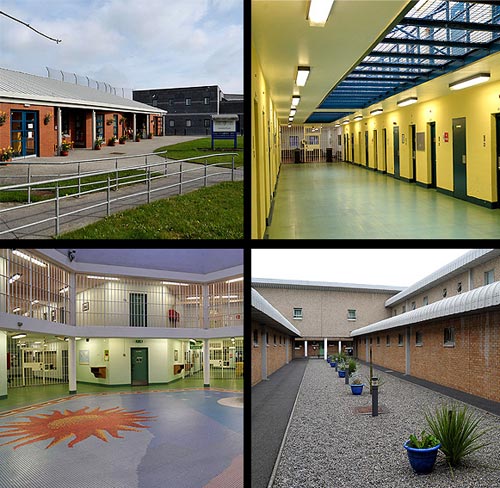
Cloverhill Prison.
Since 2024, some 265 spaces have been completed across the prison system. This includes 126 places delivered in 2024, 106 in 2025 and 33 during the first part of 2026. A further 32 spaces are due to be completed before the end of this year, followed by another 70 in 2027.
Other major projects planned under the programme include a substantial extension to Cork Prison on the site of the former prison, a new accommodation block at Wheatfield Prison and an additional block extension at the Midlands Prison. Further capacity is also being developed at Castlerea, Mountjoy, the Dóchas Centre and Limerick Male Prison.
The Government has allocated €67.9 million in capital funding to the Irish Prison Service for 2026. This forms part of a €528 million investment package covering the period from 2026 to 2030, with €495 million earmarked for prison construction and expansion projects. The investment also reflects a shift toward long-term capacity planning, rather than relying solely on short-term measures to manage growing pressure throughout the prison system.
Planning work is also due to advance on a new prison at the Thornton site in north County Dublin. A master plan is expected to determine how the site will be shared by the Irish Prison Service, International Protection Accommodation Services and An Garda Síochána. Construction work at Thornton is currently planned to begin in 2030.
The Cloverhill contract marks a significant step in the prison building programme. With construction now moving forward, the project is expected to deliver badly needed capacity and help reshape the prison estate for the demands of the coming decade.
County Tipperary Chamber is calling on every business in Thurles and the surrounding area to complete the Thurles Bypass Business Impact Survey before Friday, 7 August 2026.
For decades, the people and businesses of Thurles have heard proposals, commitments and political assurances regarding essential road infrastructure. However, the town is still waiting for the completed Inner Relief Road and the long-promised Outer Ring Road or Thurles Bypass.
As recently highlighted by Thurles.info, announcements and expressions of political support are not the same as approved funding, a binding construction programme or a completed road.
Thurles businesses need delivery, certainty and measurable progress. Traffic congestion is not merely an inconvenience. It imposes real and continuing costs on local employers. It delays deliveries, wastes staff time, disrupts logistics, restricts customer access and makes it more difficult for businesses to plan, invest and expand. Every delayed journey affects productivity. Every customer discouraged by congestion represents a potential loss to the local economy. Every infrastructure project that remains uncertain can influence future investment and employment decisions.
This aforementioned survey provides businesses with an opportunity to transform those daily experiences into clear, credible and representative evidence. County Tipperary Chamber recently welcomed Thurles native Mr John O’Shaughnessy CDir MBA LL.B (Hons) Dip IOD, Managing Director of Clancy, as its new President. Mr O’Shaughnessy has taken on the presidency at a critical time for business confidence and regional competitiveness. His focus on delivery, effective advocacy and ensuring that the voice of Tipperary business is heard consistently at local and national level is particularly relevant to the infrastructure challenges facing Thurles.
Under his leadership, the Chamber is determined to ensure that the concerns of local businesses are supported by strong evidence and presented directly to Government and other decision-makers.
That effort now requires the support of the Thurles business community. Whether you operate a retail shop, hospitality venue, professional practice, manufacturing company, transport business or family enterprise, your experience matters.
The survey is open to Chamber members and non-members and to businesses of every size and sector.
Government departments require more than general expressions of concern. They require evidence showing how congestion affects operating costs, staffing, deliveries, customer access, competitiveness, investment and future growth.
The greater the response, the stronger the Chamber’s case will be.
This is not about creating another report that sits on a shelf. It is about establishing a compelling business case for action and demonstrating that Thurles cannot continue to compete effectively without modern, dependable transport infrastructure.
A sincere thanks to every business that has already participated. Your time and first-hand knowledge are all helping to build the evidence needed to secure meaningful progress. To those who have not yet responded, please do not assume that another business will speak for you. Every completed survey adds weight, credibility and urgency to this campaign.
Thurles deserves roads, investment and delivery, not more uncertainty or political promises.
McDonald’s has confirmed that its new drive-thru restaurant in Thurles, Co. Tipperary, is scheduled to open on Wednesday, August 19th, 2026.
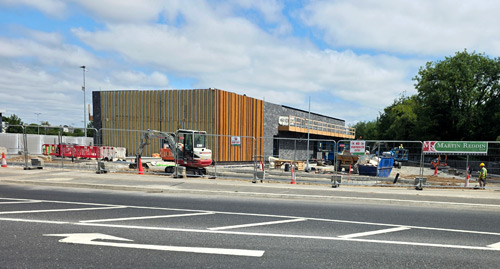
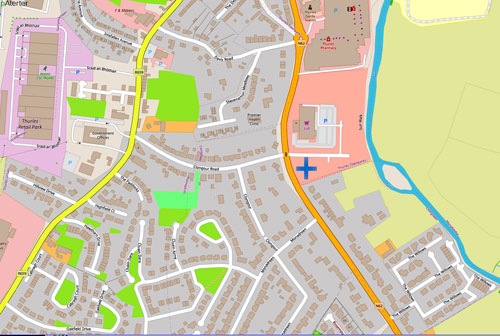
The opening will come almost one year after An Coimisiún Pleanála issued its final approval for the controversial development, bringing a lengthy planning process and months of local debate to an end. The new restaurant is being constructed on a former industrial site at the junction of Slievenamon Road and the now once again delayed “Thurles Relief Road“, close to the Lidl supermarket and approximately 700 metres from Thurles town centre.
Plans provide for a single-storey restaurant measuring almost 479 square metres, together with a drive-thru lane, customer-ordering points, digital menu boards, car parking, accessible spaces, electric-vehicle charging bays and bicycle parking. The development will also include outdoor seating, landscaping, lighting, signage, an electricity substation and changes to the existing vehicle entrance from the relief road.
Recruitment Begins Ahead of August Launch. McDonald’s has begun recruiting full-time and part-time staff members for the new Thurles restaurant. The recruitment advertisement confirms the August 19th opening date and states that successful applicants will receive paid training at other nearby McDonald’s restaurants during the weeks leading up to the launch. Advertised hourly pay for some adult employees is up to €14.25, depending on age and the terms of the new positions. The recruitment drive is expected to create a significant number of new low paid hospitality jobs in the Thurles area, although the company has not publicly confirmed the restaurant’s total anticipated workforce.
Plans Attracted More Than 20 Objections. McDonald’s Restaurants of Ireland submitted its planning application for the Thurles development in September 2024. The proposal proved controversial from the beginning, attracting more than 20 objections from residents and other interested parties. Concerns raised during the initial planning process included the location of the outlet, traffic levels, road safety, litter, noise, opening hours and the proximity of the proposed restaurant to residential properties and childcare facilities. Some objectors also raised public-health concerns relating to fast food and childhood obesity. The development was originally intended to operate around the clock. However, permission ultimately restricted its opening hours to between 6am and 10pm, meaning the Thurles restaurant will not be permitted to trade on a 24-hour basis.
Tipperary County Council initially sought additional information from the applicant, including further details concerning traffic and the proposed operation of the development. Documents submitted during that stage included an analysis indicating that the site would have space for a queue of approximately 32 vehicles, before waiting traffic would potentially reach the adjoining public road.
Council Permission Was Appealed Tipperary County Council granted permission for the restaurant, subject to conditions, on April 9th, 2025. That decision was subsequently appealed to the national planning authority by a third party, while a number of additional observations were submitted for consideration. An Coimisiún Pleanála examined issues including traffic and pedestrian safety, flood risk, residential amenity, visual impact, town-centre development and the site’s proximity to the River Suir and the Lower River Suir Special Area of Conservation. The Commission issued its decision on August 26th, 2025, upholding the council’s decision and granting permission with revised conditions. In its formal order, the planning body determined that the development would not seriously damage the amenities of nearby properties or create unacceptable risks in relation to public health, flooding, traffic, pedestrian safety or visual amenity. It also considered the mixed-use zoning of the former industrial land, Thurles’s status as a key regional town and the planning policies applying to the area.
Construction Work Underway Site-clearance activity began in early 2026, allowing construction of the restaurant and associated infrastructure to proceed. Information published locally indicated that the principal works were expected to take place between February and July, leaving several weeks for completion, staff training and final preparations before the planned August opening. The development represents the latest chapter in efforts to bring a McDonald’s outlet to the former Erin Foods lands. A previous application connected to a proposed drive-thru restaurant at the wider site was submitted as far back as 2020 but was deemed incomplete shortly afterwards.
While the current project has continued to divide opinion locally, the August opening will introduce one of the world’s largest fast-food brands to Thurles and hopefully provide new employment opportunities for the town For supporters, the development represents investment, additional consumer choice and the productive reuse of former industrial land. For critics, concerns about traffic, litter, public health, late-evening activity and the effect of drive-thru development on the character of the area remain.
Barring any construction or operational delays, the first customers are expected to be welcomed through the doors of the new Thurles McDonald’s on August 19th.
Aspiring screen performers and anyone curious about life on a television set are being invited to apply as extras for the second season of a major historical drama filming in County Wicklow.
The Amazon Prime production, currently operating under the codename “Bluetooth,” has been described as an epic “swords and shields” saga. Its first season has already been filmed and is expected to premiere early next year, while production on the second instalment is due to run from August until November 2026.
Casting organisers hope to recruit thousands of people from across Ireland for a wide variety of scenes. No previous acting experience is required, and applications are welcomed from people of different ages, appearances, ethnicities, religions and cultural backgrounds.
The team is also interested in applicants with distinctive skills or experience, including musicians, athletes, tradespeople, animal handlers and speakers of different languages. However, the organisers have stressed that this is not an exhaustive list and that everyone who meets the basic eligibility requirements is encouraged to attend.
Following an earlier casting session in Newtownmountkennedy, the remaining open calls will be held at the Camden Court Hotel, Camden Street Lower, Dublin 2, on Monday, 13th July and Tuesday, 14th July, from 10am until 5pm each day.
No appointment is necessary, and applicants only need to attend one session. The process is expected to take approximately 20 minutes and will involve completing an application form and having a photograph taken. The opportunity is open to adults and young people aged 16 years or over. Applicants must be living in Ireland on a full-time basis and must have a valid PPS number and permission to work in the country.
Parents or guardians interested in applying on behalf of children under 16 can request a separate application form by emailing extras@btproductions.ie.
Successful applicants could be offered paid work during the production period, although some people may be contacted at short notice to attend filming or costume fittings.
For anyone interested in history, film, television or acting, or simply looking for an unusual experience, the chance to meet new people and earn some extra money, the open casting call offers an opportunity to become part of a large-scale historical production filmed against some of Ireland’s most striking scenery.
Thurles, Co. Tipperary did not decline overnight. It has been weakened over decades by the loss of major employers, the failure to replace them at scale, and town-centre decisions that have made Liberty Square less convenient for the very businesses it is supposed to support.
Over the past 50 years, Thurles, has lost some of the employers that once gave the town real economic strength. The Sugar Factory closure remains one of the deepest blows in local memory. Later came further losses: GMX, BSN Medical, Erin Foods and others. In the Seanad in 2007, the pattern was described clearly; since the loss of the Sugar Factory, Thurles had suffered repeated job losses in Barlow, BSN Medical, GMX and Erin Foods.
These were not minor losses. BSN Medical announced in 2006 that it would cease manufacturing in Thurles, with 80 jobs to go. Erin Foods, which had operated in Thurles for 46 years, was then marked for closure with the loss of 95 jobs. The closure of GMX / Moulinex had already removed around 230 jobs from the town. When these losses are added to the Sugar Factory and smaller vanished industries, the picture is obvious: Thurles lost a serious employment base and never got it back.
Yes, there have been minor replacements announced and some investment. Dew Valley Foods, Lidl, smaller enterprise supports, the university presence and the ThurlesShopping Centre have all brought activity. But they have not replaced the scale or quality of what was lost. A town cannot lose major factories and long-standing employers and then be told that scattered retail jobs, short-term construction work and small-scale schemes are the same thing. They are not.
[Song hereunder ,“Rust & Rain”, is AI-generated entirely by Dallas Ray Little(operating under the label Crusty Records)]
Even An Taoiseach Mr Micheál Martin appeared to acknowledge this failure in Dáil Éireann on June 10th 2026, when he said he had “often thought Thurles would have done better because of its location” and noted that not everywhere near the motorway had received the same degree of foreign direct investment. That single comment says a great deal. For decades, Thurles was told that its central location, rail access and proximity to major routes should be an advantage. Yet the town watched major employers disappear, while replacement investment went elsewhere. If even the Taoiseach is surprised that Thurles has not benefited properly from its location, then local people are entitled to ask why successive governments, state agencies and elected representatives allowed that failure to continue for so long.
Tipperary County Council’s own Thurles Local Area Plan confirms the weakness of the employment base. It states that Thurles has a relatively low jobs ratio of 1.01 compared with Clonmel at 1.39 and Nenagh at 1.22. It also records that just under half of resident workers are employed in Thurles, while many others work elsewhere in Tipperary or outside the county. That is not the profile of a town that has been properly protected or rebuilt after decades of industrial loss.
The same plan says Thurles is a “Key Town” and speaks of supporting employment, prosperity, regeneration and revitalisation. But people in Thurles have heard plans, strategies and promises for years. What they can see with their own eyes is different; empty premises, weakened footfall, businesses struggling, and employment lands that have not delivered the kind of jobs once provided by the town’s former industrial base.
Liberty Square is the clearest example of the problem. Tipperary County Council’s Phase 2 public realm proposal includes wider footpaths, raised crossings, road-layout changes, a one-way system on Cuchulain Road, and the relocation of 12 parking bays from the central island car park. The Council presents this as enhancement. Many traders see it differently. For a rural market town, convenient short-stay parking is not a luxury; it is part of how the town trades.
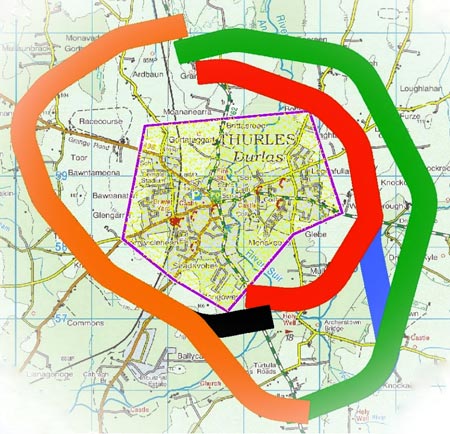
The long-awaited Thurles bypass is another example of how the town has been pushed down the road for decades. The need is obvious; heavy traffic and HGVs continue to pass through the heart of Thurles, including Liberty Square, while the town centre is simultaneously expected to become a more attractive public realm. Those two aims are in conflict. Press reported in November 2025 that the “long awaited and badly needed” bypass was back on the Government agenda, noting that it would ease congestion in the heart of the town where heavy goods vehicles regularly clog Liberty Square. Yet Tipperary County Council’s own 2026 budget material stated that while a route had been selected and a reserved corridor was in place, the Council would continue lobbying for the project to be included in the National Development Plan. By March 2026, the project had only received a €50,000 allocation to progress early design work with TII. After so many years, that is not delivery; it is another promise pushed into the future.
Long awaited Thurles bypass selected route/reserved corridor still only receives early-stage funding/progression in 2026
A town centre like Thurles depends on easy access. People call in to collect prescriptions, go to the post office, visit the butcher, chemist, café, solicitor, barber, newsagent or bank, and then move on. If parking is removed, made awkward, pushed away, or controlled in a way that does not suit shoppers, people change habits. They go where parking is free, plentiful and easy. In Thurles, that increasingly means the shopping centre or edge-of-town retail or indeed another nearby town.
The pull of the shopping centre is not imaginary. Thurles Shopping Centre is marketed as having more than 55,000 visitors per week and 550 free multi-storey parking spaces. That is a huge advantage over Liberty Square with its parking charges. When the Council reduces or reconfigures central parking while the shopping centre offers hundreds of free spaces, it should surprise nobody that trade drifts away from the historic core.
Parking charges resulted in the relocation of the post office, seen as yet another major blow. In 2019, An Post moved from Liberty Square to Thurles Shopping Centre. Local concern at the time was that the move would reduce footfall in the town centre. An Post said the old building was not viable and that the new location would provide improved services, but the result for Liberty Square was still the loss of a key daily footfall generator.
This is the core issue; decisions may be justified one by one, but their combined effect has damaged the heart of Thurles. One decision removes jobs, while another fails to replace them. Another moves a key service while another reduces convenient parking and then another produces a plan promising regeneration at some later date. Over time, the town centre is weakened not by one single act, but by a long chain of decisions that fail to protect how a real town works.
It would be unfair to claim that every closure was caused by councillors, the Council or TII. Companies close for many reasons: restructuring, costs, competition, building condition, online shopping and changing consumer behaviour. But it is entirely fair to say that successive politicians, councillors, agencies and planners have failed to secure a proper replacement employment base for Thurles and have failed to protect Liberty Square as a practical commercial centre.
The people of Thurles do not need more glossy language about regeneration. They need jobs, occupied buildings, realistic parking, fair access, active streets and a town centre that serves local traders as well as public-realm theory. A square can look tidier on a drawing and still fail commercially. A plan can sound modern and still damage small businesses. A town can be called a “Key Town” in official documents and still be treated like an afterthought in practice.
Thurles deserves better than managed decline. It deserves leadership that understands the town’s history, its losses, its trading patterns and its people. After 50 years of industrial closures, weak replacement employment and the hollowing-out of Liberty Square, the question is not whether Thurles has been let down. The question is who is finally going to take responsibility for reversing the damage.
This website uses cookies to improve your experience. We'll assume you're ok with this, but you can opt-out if you wish.AcceptRead More
Privacy & Cookies Policy
Privacy Overview
This website uses cookies to improve your experience while you navigate through the website. Out of these, the cookies that are categorized as necessary are stored on your browser as they are essential for the working of basic functionalities of the website. We also use third-party cookies that help us analyze and understand how you use this website. These cookies will be stored in your browser only with your consent. You also have the option to opt-out of these cookies. But opting out of some of these cookies may affect your browsing experience.
Necessary cookies are absolutely essential for the website to function properly. This category only includes cookies that ensures basic functionalities and security features of the website. These cookies do not store any personal information.
Any cookies that may not be particularly necessary for the website to function and is used specifically to collect user personal data via analytics, ads, other embedded contents are termed as non-necessary cookies. It is mandatory to procure user consent prior to running these cookies on your website.





Recent Comments