Minister for Justice, Home Affairs and Migration Mr Jim O’Callaghan has announced the appointment of Enda O’Neill as Chief Inspector of Asylum Border Procedures.
His five-year term began on 11th September 2026 last, following an open competition and a recommendation from Publicjobs.
Mr O’Neill brings a substantial background in law and refugee protection to the position. He headed the Dublin office of the United Nations High Commissioner for Refugees (UNHCR) from 2015 to 2025. A graduate of King’s Inns, he was called to the Bar in 2007, with areas of practice including immigration and international protection law, judicial review, European law and criminal law.
This combination of legal practice and leadership within UNHCR provides a strong foundation for the responsibilities of the new office. His experience in international protection is directly relevant to asylum procedures, while his background in judicial review and European law should support scrutiny of whether those procedures meet the required legal standards. These connections indicate the relevance of his professional background to the role.
The Office of the Chief Inspector of Asylum Border Procedures was established under the International Protection Act 2026, which took effect on June12th. Its remit is to monitor asylum border procedures and compliance with EU and international law, including the EU Charter of Fundamental Rights, within designated asylum border facilities.
Mr O’Neill will also oversee the recording and handling of complaints originating at these facilities. The Minister has confirmed that the role includes inspections and the power to conduct formal investigations into potential breaches of fundamental rights. These responsibilities place legal accountability and the protection of people undergoing asylum border procedures at the centre of the new office’s work.
On the morning of September 11, 2001, (25 years ago today), two hijacked passenger planes struck the Twin Towers of New York’s World Trade Center. Both towers collapsed.
Together with the attacks at the Pentagon and the crash of another hijacked aircraft in Pennsylvania, that day claimed nearly 3,000 lives, leaving families and communities grieving across the world.
For Cappawhite, County Tipperary, that loss had a familiar name: Mr Martin Coughlan.
Mr Coughlan was 53 years old, a carpenter working in the South Tower. He had made his home in Queens with his wife, Catherine, and their four daughters. During the unfolding tragedy, he called his wife, Catherine to tell her that something terrible was happening and that he was trying to get out. He never came home.
Those who knew Mr Coughlan remembered his pride in his craft and the long hours he worked to support his family. He had spoken of perhaps returning to Ireland. In Cappawhite, Co. Tipperary, more than 1,000 people attended a memorial Mass in his memory; a community gathering to mourn one of its own.
TalentedKilkenny singer and guitarist Ms Nora Fogarty, in the video hereunder, remembers the USA Terrorist Attack On 11th September 2001.
“Shattered Dreams”
(Lyrics written by Co. Kilkenny poet Kathleen Blanchfield).
As we remember that terrible day, let us hold Mr Coughlan’s family in our thoughts, alongside all those whose loved ones were lost. Behind every name is a life full of relationships, ordinary joys and plans left unfinished. Remembering Mr Coughlan means making room for that life, as well as mourning its ending.
May Mr Coughlan’s memory be held with love in Cappawhite, in New York, and wherever your story is told.
Searches in Tipperary have brought a European investigation into suspected horse trafficking into focus, raising questions about animal identification, cross-border trading and the possible movement of unsuitable horses into the food chain.
The Irish searches formed part of coordinated action across Europe. According to press reports, eight searches took place in Ireland, covering counties Tipperary, Galway, Kilkenny, Kildare, Dublin and Donegal. Across Europe, authorities conducted 25 searches. Gardaí said seized evidence was being analysed and investigations remain ongoing.
While the initial Irish statement offered limited information about the suspected network, European reporting provided further context. Press sources report that police raided farms in four European Union countries as part of an investigation into possible horse trafficking. Authorities suspected that some animals might have been illegally sold for meat.
We understand the investigation involved Ireland, Belgium, France and the Netherlands, with Belgian authorities leading the inquiry. Traders have allegedly used falsified documents and manipulated microchips to present horses, latter excluded from human consumption, as suitable for slaughter. The report referred to thousands of potentially affected horses, including former racehorses, and three arrests in Belgium.
These allegations point to a central concern; whether an animal’s recorded identity accurately reflects its history. If identification records are deliberately altered, the information used to assess a horse’s suitability for slaughter could become unreliable. That possibility makes the suspected document manipulation a significant part of the investigation.
However, substantial gaps remain in the publicly available information. The Irish statement does not name the suspected network, identify its leaders or specify the Tipperary premises that have been searched. It also has announced no arrests or charges in Ireland. The material reviewed does not establish who, if anyone, will ultimately face prosecution here.
A search is an investigative step, and allegations must be distinguished from proven offences. It would therefore be premature to associate any unnamed local owner, trainer, dealer or business with criminal conduct, simply because searches occurred in their county.
For Tipperary readers, the clearest confirmed development is the county’s inclusion in a wider European inquiry. The questions now concern what the seized evidence establishes, how the suspected trading arrangements operated and whether investigators can substantiate the alleged identification fraud.
Further official updates will be needed before the network’s membership, the precise role of Irish locations and the full extent of any wrongdoing can be described with confidence. Until then, the investigation remains ongoing.
Congratulations to Thurles Councillor Mr Jim Ryan, who once again used Tipp FM local radio, this morning, to highlight the deplorable condition of the River Suir, as it passes through Thurles town centre.
Concerns about this important local waterway have reportedly been raised repeatedly since approximately November 2013. Yet, after almost 13 years, residents are still waiting for the sustained maintenance, environmental protection and accountability that the river urgently requires.
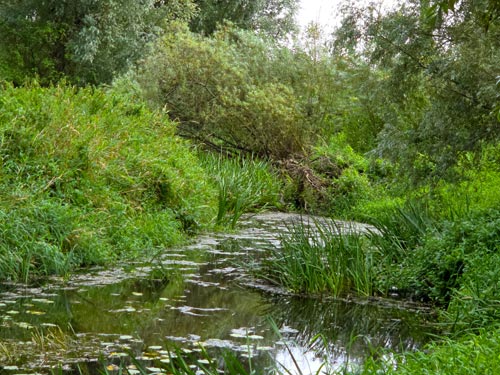
River Suir, for years, remains totally blocked by a fallen tree, reed and other vegetation.
Photographs and the short video hereunder, recorded yesterday, once again provide further evidence of the current situation. Shopping trolleys, bottles, discarded clothing and other litter, remain clearly visible, both in the riverbed and around affected sections of the river bank, totallydevoid of litter bins.
Years of excessive vegetation, severely restricted water flow and apparently uncontrolled effluent entering the river, provide stark evidence of prolonged and inexcusable neglect.
Short video hereunder, taken yesterday showing conditions recorded along the River Suir, with no action having taken place whatsoever, since contacted by EPA.
Thurles.Info has forwarded communications about the river to Tipperary County Council. The Environmental Protection Agency has also requested a written response from the said Council, outlining any action already taken or planned. According to the latest published update, that response remains awaited.
Despite the EPA’s intervention and continuing public complaints, no visible attempt had been made, up to yesterday, to remove the abandoned trolleys, bottles, clothing or other accumulated waste shown in the accompanying footage. This is not merely an appearance issue. The River Suir is an important natural habitat, public amenity and part of Thurles’s identity. Local people are entitled to know who is responsible, what work will be undertaken and when it will begin. Councillor Mr Jim Ryan deserves credit for continuing to raise the matter.
What Thurles now needs is a prompt, transparent and effective response from the responsible authorities.
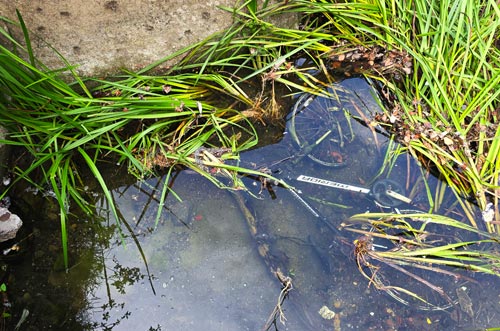
Anyone looking for a ride in Thurles, tonight, then an unwanted, submerged Crossway Merida bicycle could be your best bet.
Local wildlife was left baffled this week after a bicycle was discovered taking an unscheduled bath in the River Suir.
The bike, believed to be a Crossway Merida variety, was found lying beneath the water with all the dignity of a cyclist who had confidently shouted, “Watch this!” moments before disaster. As yet no body has been located.
Competition – Spot the Bike. Pic: G. Willoughby.
Witnesses say the bicycle may have entered the river after misunderstanding Ireland’s new transport policy. “It heard everyone talking about greener travel,” one duck explained, “and apparently decided to join the actual green overgrown rush bed.”
The River Suir is already famous for its salmon and brown trout. Now it can add mountain bikes to the list, although anglers are reminded that bicycles must be returned to the water if they are under eighteen gears. Fishing in Ireland has yet to confirm the correct bait, but experts recommend using a fluorescent jacket and shouting, “Who left this here?” The bicycle itself declined to comment, although one wheel appeared distinctly tired. Its chain is reportedly rusty, its brakes are feeling pressured, and the saddle has requested immediate relocation to somewhere less damp.
Thurles Municipal Council officials and local Councillors are considering several explanations; illegal dumping, a dramatic relationship breakup, or an ambitious attempt to cycle directly to France without paying ferry charges. Environmental campaigners “Refresh Thurles” have stressed that rivers are no place for unwanted bicycles. Anyone wishing to dispose of an old bike should use a proper recycling facility, or give it to someone who promises not to test whether it can swim.
At press time, and for several months previous the bicycle has remained submerged at low tide, awaiting rescue, repair, and a very stern lecture about not wearing its water wings.
Now with public transport prices being increased by 15% from January, an immediate rescue could be advantageous.
This website uses cookies to improve your experience. We'll assume you're ok with this, but you can opt-out if you wish.AcceptRead More
Privacy & Cookies Policy
Privacy Overview
This website uses cookies to improve your experience while you navigate through the website. Out of these, the cookies that are categorized as necessary are stored on your browser as they are essential for the working of basic functionalities of the website. We also use third-party cookies that help us analyze and understand how you use this website. These cookies will be stored in your browser only with your consent. You also have the option to opt-out of these cookies. But opting out of some of these cookies may affect your browsing experience.
Necessary cookies are absolutely essential for the website to function properly. This category only includes cookies that ensures basic functionalities and security features of the website. These cookies do not store any personal information.
Any cookies that may not be particularly necessary for the website to function and is used specifically to collect user personal data via analytics, ads, other embedded contents are termed as non-necessary cookies. It is mandatory to procure user consent prior to running these cookies on your website.






Recent Comments