Thurles Inner Relief Road: New Tender Documents Raise Serious Questions Over Timelines, Political Claims and the Destruction of the Great Famine Double Ditch.
The publication of new tender documents for the Thurles Inner Relief Road has been presented as a significant milestone for a long-delayed project. In one sense, it is. After years of promises, updates and political announcements, Tipperary County Council has now gone to the market seeking engineering technical consultancy services to progress the scheme.
But the detail contained in the newly published tender raises serious questions about the true timeline for delivery, the accuracy of previous political claims, and the destruction of the historic Great Famine “Double Ditch”, to facilitate a road that still appears to be years away from completion.
The official eTenders notice, published in July 2026, confirms that Tipperary County Council is seeking a multi-disciplinary technical consultancy team for the Thurles Inner Relief Road. The tender describes the work as including a review of existing documents, completion of outstanding deliverables for Stages 3 and 4, and preparation of deliverables through Stages 5 to 7. Crucially, the official notice gives the contract duration as 50 months.
That single figure changes the entire public understanding of this project.
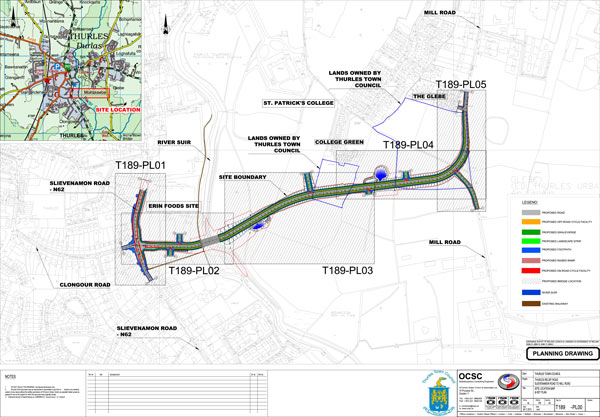
The proposed road is not simply waiting for diggers to arrive. Tipperary County Council’s own January 2026 management report described the scheme as an approximately 1.1km local link between the N62 and Mill Road, including a signalised junction at Slievenamon Road, a new priority junction with Mill Road, five intermediate access junctions, public lighting, flood alleviation works and a 50-metre tied bowstring arch crossing of the River Suir.
This is a substantial piece of infrastructure, and the new tender shows that major consultancy, design, approval, procurement, construction supervision, handover and defects processes still remain. The public therefore deserves honesty about the timeline.
That honesty is especially important because previous political messaging now appears highly questionable. In November 2025, press reported that Deputy Mr Ryan O’Meara said Minister for Transport Mr Darragh O’Brien expected construction to commence on the Thurles Inner Relief Road the following year;2026. The same report quoted Deputy O’Meara as saying that Department of Transport officials had advised him the project should be completed and opened in approximately 24 months from then.
How does that claim stand beside a 50-month consultancy contract published in July 2026?
If the tender process for the consultancy team is only now underway, and if that consultancy contract itself is expected to run for approximately 50 months, then completion by late 2027 is no longer credible. It is not enough to simply welcome “progress” while ignoring the contradiction. Deputy O’Meara should clarify exactly what he was told, by whom, and on what basis the public was led to believe that the road could be completed and opened in roughly two years.
This matters because Thurles people have heard promises about this project for far too long. Planning permission for the road was granted as far back as 2014, according to earlier press and local radio reporting. More than a decade later, the project is still moving through consultancy and design stages. Local frustration is understandable. But frustration should not be used as a cover for spin.
Nor should the traffic needs of Thurles be used to brush aside the heritage loss already caused by this scheme.
The planned route has been linked for years by local campaigners and heritage advocates to the Great Famine “Double Ditch” at Mill Road. In 2020, Thurles.info publicly asked whether the planned Inner Relief Road would negatively affect what it described as the 1846 Thurles Double Ditch, a right of way and Mass Path associated locally with famine-era history.
The warnings did not stop there. In February 2021, Thurles.info published commentary on an Archaeological Impact Statement, arguing that the proposed road would most likely impinge on the Great Famine Double Ditch in two locations. In March 2021, the same local outlet reported that Cllr Jim Ryan had confirmed the Double Ditch was to be destroyed to construct the Inner Relief Road. This was despite phone denials by Councillor Mr Micheál Lowry of the “Lowry Team”, who readers will remember inquired as to my standing in the community. {☺☺☺}
These are not minor matters. A famine-era pathway, Mass Path or heritage landscape is not just an inconvenience on a drawing. It is part of the physical memory of a town and its people. If warnings were made before destruction occurred, then the question must be asked clearly: why was the Double Ditch not protected, preserved, recorded more fully, or incorporated into the design?
Was every alternative route examined? Was the public given a full explanation? Was the heritage value properly weighed against the road design? Who decided that destruction was acceptable? And why is Thurles now being asked to accept the loss of a historic feature while the road itself may not be complete until around 2030 or later?
Nobody disputes that Thurles needs traffic solutions. The town has long suffered from congestion, poor circulation and pressure on its historic centre. A second river crossing and an improved link between Slievenamon Road and Mill Road may well bring benefits. But infrastructure should not be delivered through vague timelines, political overstatement and irreversible heritage loss. The publication of the new tender documents should therefore be treated as more than a procedural step. It should be treated as a moment of accountability.
Tipperary County Council should publish a clear and realistic delivery programme for the Thurles Inner Relief Road. Deputy Ryan O’Meara should explain the gap between his previously reported 24-month completion claim and the newly published 50-month consultancy timeline. The Council should also account for the treatment of the Great Famine Double Ditch, including what warnings were received, what assessments were carried out, and why destruction was permitted.
Thurles deserves roads. But it also deserves truth. It deserves progress, but not spin. And it deserves development that respects the town’s history rather than erasing it first and explaining later.







If the entire destruction of the famine workhouse (county home/ hospital of the assumption) didn’t raise so much as an eyebrow in elected officials then what chance does a relatively short piece of wall / walkway (double ditch) have. Which is unfortunate in both cases, local history and heritage should be preserved or at least acknowledged while also understanding the need for progress.