“When I am down and, oh my soul, so weary;
When troubles come and my heart burdened be;
Then, I am still and wait here in the silence,
Until you come and sit awhile with me.”
Lyrics by Brendan Graham
“You Raise Me Up,” first recorded by Secret Garden, featuring Brian Kennedy, has become one of the biggest selling songs in the history of popular music, with over three hundred recordings by some of the world’s biggest acts – Josh Groban, Westlife, IL Divo, Paul Potts, Celtic Woman, to name but a few, and has racked up sales of over 80 million copies. It has never been out of the charts somewhere in the world in the past eight years. It has also become one of the most successful songs of all time in sheet music sales, being continuously at No. 1 for the past seven years, in the USA’s Sheet Music Bestseller Charts, in four different categories: Pop, Adult Contemporary, Pop Choral and Downloads and it is the most downloaded song in sheet music format of all time.
All this said, few people in our county realise that the lyrics were written by county Tipperary man, Brendan Graham.
Brendan Graham, born in 1945 here in Nenagh, County Tipperary, was an Industrial Engineer by profession, before becoming a full-time songwriter, after being made redundant in 1993. He was also a former Irish Youth International basketball player, a student priest, a pig-boner in London and a recipient of Western Australia’s Lansing Bagnall State Award for business studies. Mr Graham now resides in County Mayo with his wife and five daughters.
Graham has composed two of Ireland’s winning entries in the Euro-vision Song Contest in the past: “Rock ‘n’ Roll Kids” which won in 1994, and “The Voice” the winner of the 1996 contest.
Irish songwriter and founding member of The Irish Music Rights Organisation (IMRO), Brendan Graham is officially included in an exclusive club with the world’s top songwriters, awarded “Million-Air ” status by the American Performing Rights Society, BMI. Only 3900 (0.06%) songs of the 6.5 million works, which BMI represent, have ever been awarded Million-Air certificates.
To be included in this exclusive roster, a song must have been broadcast over one million times on American radio. This definition equals at least 50,000 broadcast hours, or more than 5.7 years of continuous airplay. The songwriter joins previous ‘Million-Air’ recipients like song-writing legends John Lennon, Van Morrison, Enya, Eric Clapton, Elton John, Mick Jagger, Ben E King, Sting, Otis Redding and Roy Orbison.
The drop in literacy levels among secondary school kids in Ireland causes some concern. According to the Organisation for Economic Co-operation and Development’s latest Programme for International Student Assessment, the reading ability of Ireland’s 15-year-olds was ranked only 17th out of the 39 countries that were studied. Ten years ago, this figures placed Ireland as the fifth nation for literacy skills among this age group. However these new figures should not cause alarm, since they could be affected by the influx of large numbers of pupils into the Irish education system, who do not speak English as their first language.
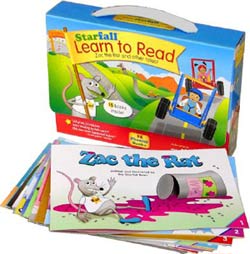
For Tipperary parents of very young children, note the reading of books aloud is one of the best ways you can help your child learn to read and this can also be fun for you. The more excitement you show when you read a book, the more your child will enjoy it. If you are looking for a fun way to start your child reading or to help your child to improve his/her reading skills, look no further than Zac the Rat and Other Tales.
Zac the Rat and Other Tales is a new set of books currently being hailed by Irish primary teachers, that make learning to read, learning letters, phonics and high frequency words, a fun experience for both parents and young children alike. These books comprise witty story lines and a whole host of quirky characters that will capture your children’s complete imagination.
The most important thing to remember is to let your children set their own reading pace and have fun learning.
Do The Following When Reading To Your Children
Use funny voices and animal noises. This will help your child get excited about the story.
If your child asks a question, do stop and answer it. The book being read may help your child to express his/her thoughts and begin the process of learning to solve their own problems.
Stop to talk about the pictures and ask your child to name things he/she sees in the pictures. Talk about how the pictures relate to the story.
Invite your child to join in whenever there is a repeated phrase in the text.
Keep reading to your child even after he/she learns to read.
Remember introducing your children to the world of books at an early age, gives them an enormous advantage and helps them to settle in more easily, when eventually they start at school.
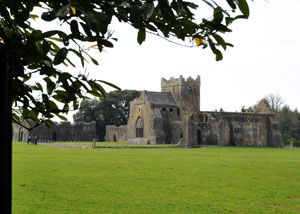
It is another part of our hidden Tipperary, but Sliabh-Ardagh Rural Development, based in the Heritage Centre in Killenaule, Thurles, Co Tipperary, are now poised to reveal Kilcooley Abbey’s architectural beauty, through the launch of a spectacular publication ‘Kilcooley Abbey’ by authoress Maura Barrett.
Kilcooley Abbey is a Cistercian Abbey close to the Village of Gortnahoe, here in Co Tipperary, located within the grounds of the Kilcooley Estate. This abbey dates from 1182 when Donal Mor O’ Brien granted lands to the Cistercians, to build an abbey here. The abbey which is a sister house to both Jerpoint Abbey and Holy Cross Abbey, is considered to be a hidden gem,tucked away in this remote corner of Co. Tipperary.
This book which has been written by Maura Barrett, latter Heritage Development Manager with Sliabh-Ardagh Rural Development and part time Librarian in Killenaule, is their second outing into the world of publishing on this topic, explains Chairperson Sr. Patricia Wall. In 2005 they republished ‘Kilcooley: Land and people in Tipperary,’ also.
The author Maura Barrett provides a unique understanding of the history of this abbey and an analysis of the medieval tombs and sculpture contained within and is a must for history lovers.
Kilcooley Abbey is popular with visitors, but it is one of the lesser known sites in Tipperary and it doesn’t have a guide on site. There are no leaflets to explain the history of the abbey and Sliabh-Ardagh Rural Development, in producing this book, attempts to break this barrier.
The book contains a history of the abbey, which spans one thousand years. Maura Barrett’s admiration for this site shines out through every page. She outlines a potted history of the abbey and goes to great pains to explain the medieval sculpture contained within the abbey. There are twenty pages of colour photographs depicting aspects of Kilcooley Abbey. Maura explains: “I have always been fascinated by Kilcooley Abbey, Maura, it gets in on you, every time I visit, I see something different, I was delighted to be able to write this book.”
Sliabh-Ardagh Rural Development is a community based charity, set up in the early 1990’s to develop the tourism and heritage potential of the Slieveardagh region of Tipperary. The Barony of Slieveardagh includes the the parishes of Glengoole, Gortnahoe, Killenaule,Moyglass, Ballingarry and Kilcooley. The region has many attributes and attractions, whose potential is underdeveloped. Little is known about the region outside the general locality, hence, it is often referred to as ‘another hidden corner of Tipperary’. The area is home to the Derrynaflan Chalice, the beautiful Kilcooley Abbey, the 1848 Famine War House and a rich flora and fauna habitat. Other notable features of the area include its bog-lands and the areas long tradition of coal-mining. The heritage and culture of the area is acknowledged as its key strength and the main challenge of Sliabh-Ardagh Rural Development is to exploit the commercial potential of these attributes, to create employment, stimulate investment in local businesses and above all to instill an awareness of the uniqueness of the area’s landscape.
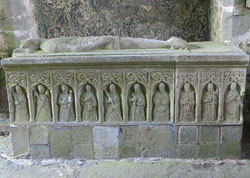
Kilcooley Abbey is best noted for its fine East Window which according to the author Maura Barrett, contains the ‘finest example flame tracery in Christendom’. There are a number of medieval tombs within the confines of the abbey, the most noted being the knight effigy tomb of the Butlers, latter progenitors to the present heirs to the British Crown, which is signed by the sculptor Rory O’ Tunney. “We are very lucky to have such an outstanding example of O’ Tunney’s work housed in Kilcooley, it is by far his most well known work.” explains Maura Barrett.
Sliabh-Ardagh Rural Development have developed three Loop Walks in the area, one at Derryvilla, and two at Grange called the Grange/Crag Loop walks. An angling facility at Lough Doire Bhile has been developed also and this is an area of special interest for biodiversity, as it is home to the Marsh Fritillary Butterfly.
The Heritage Centre in Killenaule houses an Internet cafe, a community based office secretarial service, an ICT Training facility and Killenaule Library. Sliabh-Ardagh Rural Development are currently renovating the Old School House in The Commons for multi purpose community use.
This book, entitled ‘Kilcooley Abbey’ by Maura Barrett, will be launched in Tipperary Institute here in Thurles on Saturday 11th of December next at 8.00pm by Br Anthony Keane of Glenstal Abbey.
Refreshments will be served and all are welcome. The book is available for sale at Saturday’s launch for a special launch price of €10.
Further queries please, to 052 – 9156165 and 085 – 1169650.
I believe the greatest gift you can give any child is the gift of reading. It is not surprising therefore that, every Christmas season, I systematically complain about the non availability of any good quality, modern and exiting reading for mature young adults, in the 15 to 18 year old bracket. This year I have been silenced with the launch of a novel by A.S.King.
The name Amy King is well known to residents in the lovely Co.Tipperary hamlet of Mullinahone, since she resided there for nearly a decade with her cabinet making husband, Topher. Amy taught adult literacy at the Word Aid center in Kilkenny City while writing her first novel, while simultaneously keeping an organic garden, breeding chickens, and restoring the old Maloney property in the towns-land of Modeshill.
Amy’s latest novel, targeting mature young adult readers and entitled “Please Ignore Vera Dietz“, was launched this week, to critical acclaim from major trade reviewers in the US.
A starred Publishers Weekly review starts, “This chilling and darkly comedic novel offers a gradual unfolding of secrets about troubled teenagers, their families and their town.”
Other reviews state,
“It is hard to describe how deeply affecting this story is. The writing is phenomenal, the characters unforgettable.”
“It is a gut-wrenching tale about family, friendship, destiny, the meaning of words, and self-discovery. It will glow in the reader for a long time after reading.”
“The book is deeply suspenseful and profoundly human” – Publishers Weekly.
“Brilliant, Funny, Really special.” – Ellen Hopkins, author of NYT bestselling Crank, Glass and Tricks”
This book is highly recommended for teenagers of 14 and older and indeed adults of all ages.
Speaking to www.thurles.info this morning Amy describes her time in Mullinahone as “The best years of my life.”
Amy said: “I had wonderful neighbours in Mullinahone and the most amazing job at ‘Word Aid’. I miss the students and fellow tutors there, so very much and I will always remain an avid Tipperary hurling supporter no matter where I live.”
This wonderful novel is not Amy’s first successful book release. Her first award winning novel “The Dust of 100 Dogs” published in 2009, the story of a Cromwell orphan girl-turned relentless Caribbean pirate reincarnated in 1970’s Pennsylvania with her memories intact, landed her on the American Library Association’s Best Books for Young Adults list.
Amy presently lives in rural Pennsylvania with Topher and their two children.
Perhaps a nice gift idea for Christmas, this year, would be a personal ‘Signed Copy‘ of Amy’s new book and you can order same by clicking HERE and save yourself 10%.
The town of Thurles enjoys quick and easy accessibility by both train and road and as Thurles Railway Station is on the Inter-City line, there is an excellent train service with hourly trains to and from Dublin and excellent services also to Cork, Limerick and Killarney. Express buses, presently operated by Bus Éireann, also call daily to the railway station trafficking passengers to the outer areas of the county.
For me long train and bus journeys can be boring so I always unsure to accompany myself with some light reading material.
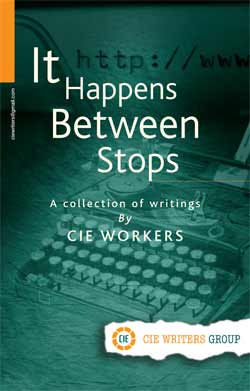
Talking of bus and train journeys and reading material, reminds me of the new splendid publication ‘It Happens Between Stops‘ which is a collection of short-stories, articles, essays, poems and a play written by current and former employees of the CIE group of companies. There is something for everyone in this collection and here is just a brief sample;
“The Eclipse on the Cheap” By John Bolton.
The morning news told of a full load of Concorde passengers who had paid some €2,000 for a figure of eight over Tenerife to see the eclipse. This way you got to see it from both sides of the plane twice.
For me, I loaded up my single decker to go to Dalkey. I got to Booterstown when I got this eerie feeling. I noticed the light change, but before I pulled back into the traffic, I noticed the start of the eclipse in the dark glass sun visor. The time was spot on between 11.18am and 11.22 am.
While watching this, an elderly lady asked if I was OK.
I replied, “It’s the eclipse, do you want to see it?”
She and all the rest queued up the centre aisle to see this from the drivers’ seat. I got a great round of applause at 11.25am, when it was all over.
I would be barking up the wrong tree to stick them for £2,000 each.
It Happens Between Stops
“Autumn Day” By Cathy Hickey
I am walking in the woods,
The Autumn wind takes the leaves from the trees,
They fall around me
And crunch beneath my feet.
I watch them dancing on the wind
And think of You.
You would wonder at this,
The sound of the river rushing by,
Breathing the sweet crisp air.
Absorbing the warmth of colour,
Enjoying the sight of a young squirrel
Busily preparing for Winter,
At the base of the magnificent old tree,
Simplistic, yet so complex,
This cycle of Life…….Nature…..
It saddens me to think, yet again,
You are missing this moment.
Then it occurs to me that you are not,
Because you are here, walking with me.
Sharing this joy !
I am not the only person to enjoy this fine witty publication, containing well observed and sometimes moving material.
It is, in the words of Lee Dunne, “As an entertaining well written, ‘dip in for a shot’ kind of book, this publication does not disappoint. So many tastes and flavours, none of them likely to give anybody indigestion.”
Irish Times journalist and RTE commentator Fintan O ‘Toole had this to say, “Witty and gritty, It Happens Between Stops is something rare in Irish fiction, a view of working life from the inside. It combines the freshness, vigour, humour and hard edge of everyday speech with the determination to transform the mundane with the power of imagination.”
‘It Happens Between Stops‘ is published by Original Writing. You can get further information on the Original Writings website or by emailing ciewriters@gmail.com
This website uses cookies to improve your experience. We'll assume you're ok with this, but you can opt-out if you wish.AcceptRead More
Privacy & Cookies Policy
Privacy Overview
This website uses cookies to improve your experience while you navigate through the website. Out of these, the cookies that are categorized as necessary are stored on your browser as they are essential for the working of basic functionalities of the website. We also use third-party cookies that help us analyze and understand how you use this website. These cookies will be stored in your browser only with your consent. You also have the option to opt-out of these cookies. But opting out of some of these cookies may affect your browsing experience.
Necessary cookies are absolutely essential for the website to function properly. This category only includes cookies that ensures basic functionalities and security features of the website. These cookies do not store any personal information.
Any cookies that may not be particularly necessary for the website to function and is used specifically to collect user personal data via analytics, ads, other embedded contents are termed as non-necessary cookies. It is mandatory to procure user consent prior to running these cookies on your website.



Recent Comments