|
|
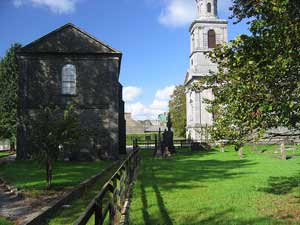 Bolton Library in the shadow of The Cathedral of St. John The Baptist, Cashel, Co. Tipp. An exceptional collection of literature, described by experts as the one of the most important of its kind in Ireland has been taken into the care of the State, by the Office of Public Works (OPW).
The Bolton Library in Cashel, Co Tipperary, was first established by an 18th century Church of Ireland Archbishop and skilled Canon Lawyer, Theophilus Bolton, (1678-1744), grandson of Sir Richard Bolton, Lord Chancellor of Ireland. Educated in Trinity College Dublin, Archbishop Bolton became Chancellor of St. Patrick’s Cathedral in 1714, Bishop of Clonfert and later Bishop of Elphin in 1724, before becoming Archbishop of Cashel in 1730. The Cashel Palace Hotel directly opposite Cashel Cathedral was originally built for his convenience, as a place of residence. His rare collection of some 11,000 books maps and pamphlets were bequeathed to the Cashel Diocese following his death.
This unique collection of antiquarian European books contain the thoughts, words and deeds of mankind for over 2,500 years, and include works by Dante, Machiavelli, Homer, Herodotus, and Plato. Amongst this collection can be found an interesting letter from a citizen of Athens to the then Roman Emperor, pleading for fair and reasonable treatment of Christians and amongst the maps a Geographical Survey of Ireland printed in Dublin in 1840, which warns of the disastrous effects of continuing to plant the potato crop.
The collection, currently securely housed in the Chapter House of the Cathedral of St. John The Baptist, has been traditionally cared for by the local Protestant Clergy and despite its immediate proximity to the Rock of Cashel, this rare collection is little-known and has attracted few visitors down the years.
Continue reading Bolton Library – An Exceptional Collection Of Rare Literature
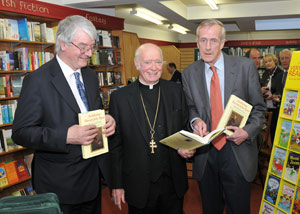 Archbishop Patrick John Ryan – His Life and Times – Ireland – St Louis – Philadelphia (1831-1911) was launched on May 7th by His Grace, Most Rev.Dr Dermot Clifford, Archbishop of Cashel and Emly in the Bookworm book store, here in Liberty Square, Thurles. Archbishop Patrick John Ryan – His Life and Times – Ireland – St Louis – Philadelphia (1831-1911) was launched on May 7th by His Grace, Most Rev.Dr Dermot Clifford, Archbishop of Cashel and Emly in the Bookworm book store, here in Liberty Square, Thurles.
Our photo shows His Grace, Archbishop Dermot Clifford, with Dr Martin Mansergh T.D. who wrote a review of the book and the author, Patrick Ryan, the latter himself a native of Thurles.
Book’s Contents
When Patrick John Ryan went to St Louis, Missouri, as a deacon in 1852, he was far better prepared for the life he chose to lead, than he could have imagined.
Here in Ireland, where being a Roman Catholic was seen as a badge of exclusion, he saw how the economic and legal powers were wielded by the Protestant minority as a means of suppressing the Roman Catholic majority. He saw at first hand the concessions achieved through the actions of the Roman Catholic Church under the political leadership of Daniel O’Connell, ‘The Liberator’, (1775 – 1847), who now became his role model. He had benefited from a primary school system that developed along denominational lines and as a teenager he had witnessed the horrors of the Great Famine and the mass emigration which followed.
All of these experiences were to become directly relevant to his life and his future endeavours in America.
Continue reading Archbishop Patrick John Ryan – His Life and Times
So your kids are not reading, I hear you say, stuck on the PlayStation and on the TV, on every conceivable occasion and you are worried. Want the cure ?
It’s simple – Buy a copy of “The Invention of Hugo Cabret” by Brian Selznick. Why, I hear you ask? Because it’s possibly the best children’s book produced in recent years and is categorized under the heading ‘must have’, if you want to stimulate your child’s imagination and get them into the habit of reading.
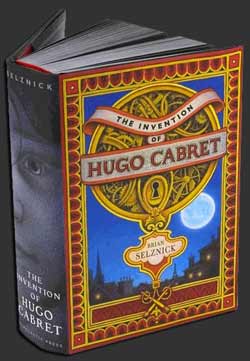 Winner of the prestigious Randolph Caldecott Medal in 2008, and like the writing’s of J.K. Rowling and Roald Dahl, both children and adults will be totally enthralled and captivated by the magical story of Hugo Cabret, an orphaned 11 year old clock keeper, living in a Parisian train station. Winner of the prestigious Randolph Caldecott Medal in 2008, and like the writing’s of J.K. Rowling and Roald Dahl, both children and adults will be totally enthralled and captivated by the magical story of Hugo Cabret, an orphaned 11 year old clock keeper, living in a Parisian train station.
In addition to a thrilling adventure, involving secrets, an automaton (mechanical robot) and an eccentric little girl, “The Invention of Hugo Cabret” delivers over 300 of the most marvellous hand drawn sketches, which accompany and elaborate upon the text. Click here to watch the opening sequence of drawings in this magical read.
“The Invention of Hugo Cabret” is not exactly a novel, and it’s not quite a picture book, and it’s not really a graphic novel, or a flip book, or a movie yet, but rather a combination of all things required to captivate young minds.
Each picture, and there are nearly three hundred pages of pictures, takes up an entire double page spread, and the story moves forward, as you turn each page for a glimpse of the next moment unfolding in text. Teachers take note, this is for the classroom.
ORPHAN, CLOCK KEEPER, AND THIEF, twelve-year-old Hugo lives in the walls of a busy Paris train station, where his survival depends on secrets and anonymity. But when his world suddenly interlocks with an eccentric girl and the owner of a small toy booth in the train station, Hugo’s undercover life, and his most precious secret, are put into jeopardy.
A cryptic drawing, a treasured notebook, a stolen key, a mechanical man, and a hidden message all come together so brilliantly, in “The Invention of Hugo Cabret“.
The Invention of Hugo Cabret can be ordered through Book Worm, Liberty Square, Thurles. This book is suitable for all children aged 6 – 60, and with its spellbinding pictures, the book encourages the less experienced readers. Although maybe at first glance, slightly expensive, this book is worth every solitary cent. Indeed, in its short lifespan, it has even attracted the attention of acclaimed director Martin Scorsese.
This is a book which children will want to possess, will want read at bedtime, discuss for hours, boast as to ownership, while loaning it to close friends, will be totally out of the question.
Meet the future successor to Harry Potter.
It happened 150 years ago this year and of the seventeen men publicly executed outside North Tipperary’s County Gaol in Nenagh, between 1842 and 1858, the true story of William and Daniel Cormack is one of the few that still remains fresh in folk memory, not just only here in County Tipperary and on the island of Ireland, but also in the USA, Australia, England and Canada.
I first heard about the Cormack Brothers as a small boy living in Co. Wexford and when I arrived here, to reside in Co.Tipperary in 1975, over the next 23 years, I listened intently to the constant and various arguments and debates, with regard as to their true guilt or innocent.
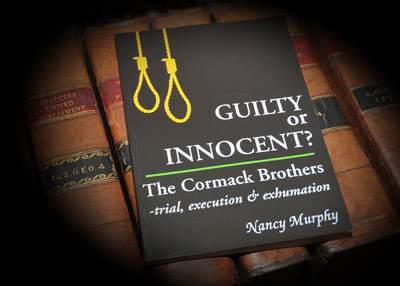 "Guilty or Innocent?" Reprinted Then in 1998, a marvelous book, entitled appropriately ‘Guilty or Innocent? by author and Tipperary historian Nancy Murphy, appeared on our book shelves. Now for the first time, lovers of history and Tipperary folklore, had compiled together and easily accessible to them, the full factual details of the Cormack Brothers trial, their execution and their exhumation.
The book was the outcome of years of extensive research, carried out painstakingly by the author, into newspapers, official and private correspondence, the Trant Papers, the Petitions for Reprieve, Parish Registers, Poor Law Rate Books and other land records. The book put together, accurately and for the very first time, the known truth, without bias. Not surprisingly the book was sold out within weeks of its original publication date and up until this week was commanding figures of in excess of €64 to €130 in just secondhand condition.
Now, due to popular demand Relay Books, Tyone, Nenagh, Co.Tipperary have agreed to republished ‘Guilty or Innocent?‘ in a limited edition, to meet the renewed interest in the Cormack Brother’s fate this year, being the 150th anniversary of their death.
The Cormack Brother’s murder trial is too complex to discuss in this blog, but Chapter 18, of this well researched book, examines aspects of the Cormack Brother’s case to be questioned, under the following headings :
Were the members of the Grand Jury correct in sending the Cormack Brothers for trial?
The conduct of the investigation as revealed in the trials;
The conduct of the trials by prosecution, defence and presiding Judge;
The quality of the evidence and consequently whether the second Trial Jury was justified in their verdict;
Were there grounds for appeal, for a case stated by the judge for judgement by the Superior Court, and ultimately for mercy by the Lord Lieutenant?
Finally, and leaving the law aside, has the widespread belief in the Cormack Brother’s innocence been justified? The author quotes the indirect evidence for this and leaves a conclusion to the reader.
Within the last few months, the tiny village of Loughmore,Co.Tipperary, native parish to William and Daniel Cormack, have marked the anniversary of their execution and exhumation, by an impressive and evocative recreation of the 1910 funeral of the brothers exhumed remains. They also staged a play, “The Cormack Brothers”, in the parish centre over seven nights, playing to full houses and standing room only.
The limited republished edition of ‘Guilty or Innocent?‘ in paperback, retails at just €12.90 plus €2.00 for postage and packing.
This book is an excellent read for factual history lovers, especially if you enjoy a story where ‘truth is stranger than fiction.’ Take it from me this book is one hell of good read.
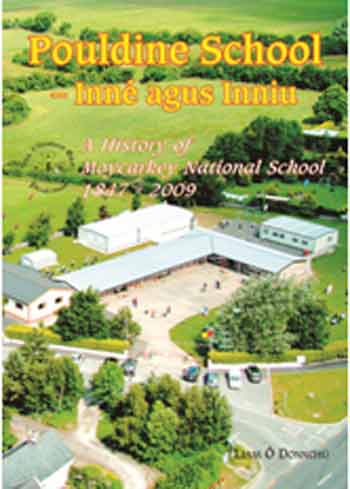 A new and exiting publication, entitled ‘Pouldine School – Inné agus Inniu’, was launched in the Horse and Jockey Hotel, on Saturday Dec. 5th last, by His Grace the Most Rev. Dermot Clifford – Archbishop of Cashel and Emly. A new and exiting publication, entitled ‘Pouldine School – Inné agus Inniu’, was launched in the Horse and Jockey Hotel, on Saturday Dec. 5th last, by His Grace the Most Rev. Dermot Clifford – Archbishop of Cashel and Emly.
This 340 page book was compiled and edited by a former Principal Teacher at the school – Liam Ó Donnchú. The book traces the story of the school from its foundation during the Great Famine years beginning in 1847, the Hedge schools that preceded it and all the developments in the old and new school, down through the decades.
The official name of the school is Moycarkey National School, but as it’s situated in the townland and at the famous crossroads of Pouldine it is better known by the latter.
It’s an area steeped in sport, especially the G.A.A., where hurling and athletics were to the fore since the early years of organised sport. This love of sport is reflected in the photos and pages of the book. Indeed, the photographic content forms a significant part, with some photos going back to the early years of the last century.
Some past pupils and teachers have recalled their memories of school-days at Pouldine and these add a very interesting and sometimes humorous dimension to the book. Many articles on the local history, archaeology and folklore of the parish are included, all suitably illustrated with photographs. Former Principal Teachers and School Managers are also profiled.
All in all, a thoroughly comprehensive record of Pouldine School, which is an integral part of the Moycarkey-Borris parish and has touched the lives of generations of pupils. It will be of interest to every home in the parish and beyond.
An ideal Christmas gift for those at home and abroad or those wishing to understand, more fully, Irish life during this period in Ireland’s past.
This excellent, in-dept and value for money publication is now on sale in the following outlets – Price €20
Pouldine School, O’Keeffes, Horse and Jockey, Clohessy’s and Village Store – Littleton, Bookworm, Griffins, Lár na Páirce and Newswell Thurles Shopping Centre.
This book can also be ordered by Post (Price €25) from: Pouldine School History, Pouldine N.S., Thurles, Co. Tipperary.
|
Support Us Help keep Thurles.info online by donating below. Thank you.
Total Donated 2026: €300.00
Thank You!
Daily Thurles Mass Livestream
|



Recent Comments