Ireland’s wild Atlantic salmon are in serious decline.
Scientific estimates indicate that well over one million salmon returned to Irish rivers annually during much of the 1970s; in recent years that figure has fallen below 200,000. Inland Fisheries Ireland’s Technical Expert Group says the decline reflects pressures both at sea and in freshwater.
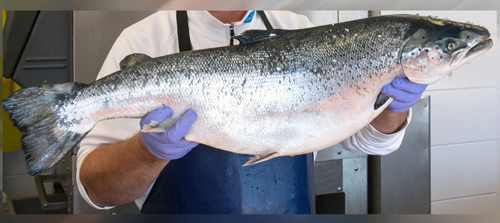
Atlantic Salmon.
For Tipperary and the River Suir, this is not an abstract national problem. The Suir is one of Ireland’s great salmon rivers and Atlantic salmon is a protected qualifying species within the Lower River Suir Special Area of Conservation, which extends through Tipperary, and Waterford.
The latest scientific assessment for the 2026 season groups the Suir, with the river Clodiagh near Holycross, and river Lingaun latter part of the border between Kilkenny and Tipperary, and Waterford Blackwater. At the standard 75% probability of achieving its conservation limit, the stock was recommended for catch-and-release fishing only, rather than having a harvestable surplus. Under more precautionary probability thresholds, the advice is now to close it.
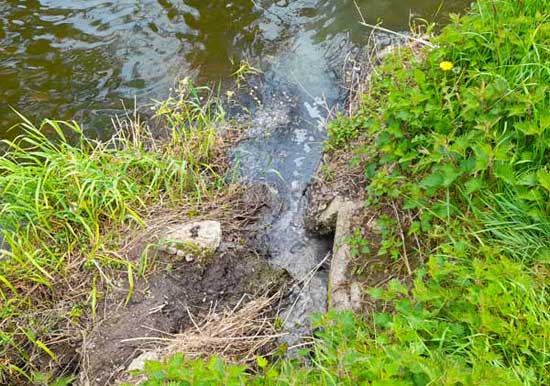
Domestic effluent allowed to flow into the River Suir for past 10 years unabated.
What is happening to our salmon? There is no single cause. Poor survival at sea certainly is a major part of the national decline, with changing ocean temperatures, food availability and wider changes in the North Atlantic affecting salmon after they leave Irish rivers. But what happens inside rivers such as the Suir also matters enormously. Salmon need clean, cool, well-oxygenated flowing water and clean gravel beds in which to spawn. The female buries her eggs among the stones. Water must circulate freely through that gravel to supply oxygen. When fine soil, silt and other sediment fill the spaces between the stones, the gravel can become clogged. Water circulation falls and the supply of oxygen to salmon eggs can be reduced. In badly affected spawning beds, eggs and newly hatched fish can die even though the surface of the river may look relatively normal.
Pollution and excessive nutrients are therefore important concerns. The EPA says agriculture and wastewater remain the greatest challenges to Irish water quality, with nitrogen and phosphorus still too high in many waters. In 2026 the EPA also reported that nitrogen remains particularly high across much of the south and southeast, with agriculture the main national source of nitrogen entering rivers. Environmental Protection Agency Tipperary has had direct examples of pollution affecting the Suir. In 2025 Inland Fisheries Ireland secured a conviction following a September 2024 incident at Holycross, where harmful matter entered the River Suir and approximately 400 metres of river bed was reported as having a yellowish-cream deposit. IFI warned that aluminium sulphate entering a river poses a major threat to aquatic ecosystems. Inland Fisheries Ireland
That incident should not be taken as the explanation for the long-term decline of the Suir salmon stock, but it demonstrates how vulnerable the river remains to individual pollution events on top of longer-term pressures.
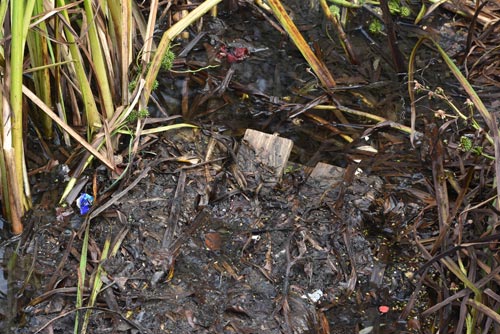
Rubbish blocking the river while an over abundance of reeds steal the oxygen.
Barriers are another major issue on the Suir Weirs, dams, culverts and other structures can prevent or delay salmon reaching spawning grounds. They can also change river flows and alter the natural movement of gravel and sediment. A very relevant Tipperary example is Bakery Weir in Cahir. IFI assessed the structure in 2018 and found it to be a significant barrier to migrating salmonids, as well as lamprey and coarse fish. Eight years later, a project is now being progressed to partially remove the weir and improve the natural river channel and fish passage. IFI explains more generally that barriers can stop fish reaching breeding habitat, increase the energy salmon need to expend during migration and interfere with the movement of the gravels and sediment needed to create healthy spawning beds.
So is pollution, lack of oxygen and clogged gravel responsible? They are certainly a large part of the problem and they are factors we can actually do something about locally. But the scientific evidence points to several pressures acting together:
poor survival of salmon at sea;
agricultural and wastewater pollution;
excess nutrients;
fine sediment clogging spawning gravel;
loss and alteration of river habitat;
barriers such as weirs and culverts;
warmer water, drought and extreme floods associated with climate change;
and other pressures including disease, predation and aquaculture.
The worrying point for Co. Tipperary is that we cannot control what happens to salmon throughout the North Atlantic, but we can improve the River Suir and its tributaries. That means protecting spawning gravel from excessive silt, reducing nutrient and pollution losses, improving sewage and wastewater treatment, restoring damaged river habitat, protecting river banks and riparian vegetation, and removing or modifying unnecessary barriers so that salmon can once again reach as much good spawning habitat as is possible. If young salmon leave the Suir in greater numbers and in better condition, they have a better chance of surviving the increasingly difficult journey at sea. The River Suir has supported wild Atlantic salmon for thousands of years. Their decline should be treated as a warning about the health of the entire river system, not simply as an angling issue. Protecting the salmon means protecting the River Suir, its tributaries, its spawning gravels and its water quality throughout County Tipperary and beyond.
Application Ref: 26104 Applicant:Jean and Gina Engela Development Address:16 Hazelwood Grove, Thurles, Co. Tipperary, (Eircode E41 R2R8). Development Description: As constructed home gym/hobby room to rear of dwelling with all associated site work and ancillary works Status: Conditional. Application Received: 04/08/2026. Decision Date: 25/09/2026. Further Details:http://www.eplanning.ie/TipperaryCC/AppFileRefDetails/26104/0
Consent, Responsibility and the Conversation Tipperary Needs to Have.
New research from the Dublin Rape Crisis Centre should prompt a serious conversation about attitudes to rape, consent and responsibility in Ireland. According to its latest national survey, 15% of adults believe that someone raped, while under the influence of alcohol or drugs, is at least partly responsible for what happened to them. Among men under 25 years, that figure rises sharply to 37%. Among women under 25 years, it is 25%.
The wider findings are equally concerning. Almost half of men under 25 years surveyed believe there are “a lot” of false rape allegations, while roughly one in three say a rape should not be believed without either a criminal conviction or a report to Gardaí. These attitudes matter because sexual violence does not always result in an immediate report, prosecution or conviction. The same research found that among people who had experienced rape, only 17% reported it to Gardaí, while 19% told nobody at all.
Alcohol or drug use does not transfer responsibility for rape from the perpetrator to the victim. Consent must still be freely given, and a person’s vulnerability is never permission for another person to violate them. But simply condemning young people who hold these views will not solve the problem either. We need to understand where these beliefs are coming from; what young people are learning about sex and consent, what they are seeing online, how pornography, peer culture and social media may shape expectations, and whether our education system is giving young people the tools to recognise healthy sexual relationships and boundaries.
The encouraging finding is that 88% of adults agree that a perpetrator who is intoxicated should remain just as responsible for their actions. That principle should be equally clear on the other side of the equation; being intoxicated does not make a victim responsible for somebody else’s decision to commit sexual violence. Education about consent cannot be a one-off classroom lesson. It needs to involve families, schools, universities, sporting organisations, online platforms and, importantly, men speaking with other men.
Changing attitudes is part of preventing harm and the starting point should be simple; responsibility for rape lies with the person who commits it, not with the person who experiences it.
Mr Carroll passed away peacefully, surrounded by his loving family, while in the care of staff at Beaumont Hospital, Beaumont Rd, Beaumont, Co. Dublin.
His passing is most deeply regretted, sadly missed and lovingly remembered by his sorrowing family; loving wife Treasa, son Cillian, daughter Aisling, son-in-law Robert, granddaughters Sophia and Eleanor, brothers Jerry, Matthew, Michael, Patrick and sister Anna-Maria, brothers-in-law, sisters-in-law, nieces, nephews, extended relatives, friends and neighbours.
For those persons who would wish to attend Requiem Mass for Mr Carroll, but for reasons cannot, same can be viewed streamed live online, HERE. For those persons who would wish to attend the Service of Cremation, but for reasons cannot, same can be viewed streamed live online, at approximately 11:30am, HERE.
The extended Carroll family wish to express their appreciation for your understanding at this difficult time, and have made arrangements for those persons wishing to send messages of condolence, to use the link shown HERE.
Note Please: Family flowers only. Donations in lieu, if desired, to the Irish Cancer Society in memory of the late Mr Seamus Carroll.
Tipperary County Council is inviting residents, businesses and organisations to help shape a new Digital Strategy for Co. Tipperary.
Since the previous strategy was launched in 2018, technology has changed significantly. The Council is now reviewing how people and organisations across the county use digital technology and where further support may be needed.
Two confidential online surveys are now open and cover topics including:
The consultation is open until October 14th 2026 at 4:30pm. Your feedback will help Tipperary County Council better understand the county’s digital needs and inform future policies and supports.
For further information, please contact: Ms Kathleen Prendergast, MSc MBA (Administrative Officer / Economic Development Officer Economic, Community and Rural Development Section) Address: Tipperary County Council Civic Offices, Tipperary Town, Co. Tipperary (Eircode E34 WD51)
This website uses cookies to improve your experience. We'll assume you're ok with this, but you can opt-out if you wish.AcceptRead More
Privacy & Cookies Policy
Privacy Overview
This website uses cookies to improve your experience while you navigate through the website. Out of these, the cookies that are categorized as necessary are stored on your browser as they are essential for the working of basic functionalities of the website. We also use third-party cookies that help us analyze and understand how you use this website. These cookies will be stored in your browser only with your consent. You also have the option to opt-out of these cookies. But opting out of some of these cookies may affect your browsing experience.
Necessary cookies are absolutely essential for the website to function properly. This category only includes cookies that ensures basic functionalities and security features of the website. These cookies do not store any personal information.
Any cookies that may not be particularly necessary for the website to function and is used specifically to collect user personal data via analytics, ads, other embedded contents are termed as non-necessary cookies. It is mandatory to procure user consent prior to running these cookies on your website.






Recent Comments