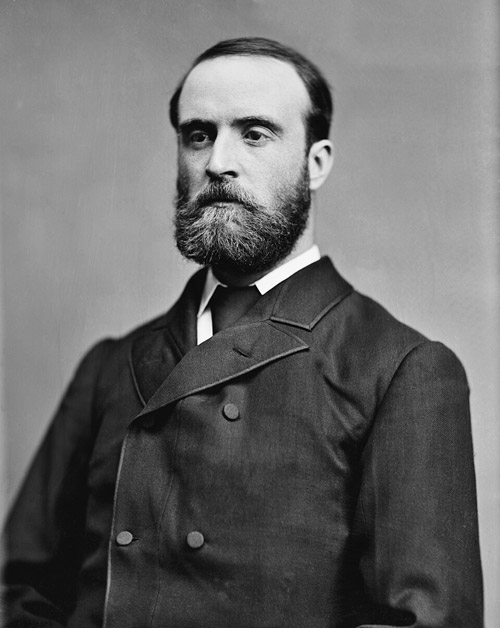
How many men and women in Tipperary were spotted, on Tuesday last, wearing an ivy leaf in their lapel?
October 6th this year was Budget Day, yet amid the political grandstanding, as opposition politicians appeared more concerned with having their snouts in the trough and criticising a democratically elected government, few, if any, spared a thought for the anniversary of the death of one of Ireland’s greatest patriots, Charles Stewart Parnell.
It was on October 6th, 1891, exactly 135 years ago, that Parnell passed away. His extraordinary contribution to Ireland’s struggle for self-government helped lay the foundations for the independent, prosperous nation we enjoy today; a country that now ranks among the wealthiest in the world.
Surely, on such a significant anniversary, this remarkable Irishman deserved more than to be forgotten amid the political point-scoring of Budget Day.
On October 6th 1891, Charles Stewart Parnell an Irish nationalist politician, died in Brighton, England, aged only 45. Ireland had lost the man remembered for generations as its “Uncrowned King.” Though an Anglican, his funeral on October 11th was at the Irish National non-denominational Glasnevin Cemetery in Dublin, and was attended by more than 200,000 people. His notability was such that his gravestone of unhewn Wicklow granite, erected in 1940, reads only “Parnell”.
Born at Avondale, Co. Wicklow, in 1846, Parnell came from a Protestant landowning family, yet became one of the most powerful leaders of Irish nationalism in the nineteenth century. He transformed the Irish Parliamentary Party into a disciplined political force at Westminster, supported the campaign for tenant farmers during the Land War and brought the demand for Home Rule to the very centre of British politics.
His political career ended in tragedy. Following the public revelation of his long relationship with Mrs Katharine O’Shea during divorce proceedings in 1890, the Irish Parliamentary Party split bitterly. Parnell refused to surrender his leadership and continued campaigning throughout Ireland and Britain, while his health rapidly deteriorated.
But Thurles has its own important place in the Parnell story. In January 1885, Parnell travelled personally to Thurles during a dispute over the selection of a parliamentary candidate for Tipperary. Contemporary accounts record that he attended a Home Rule convention in the town and successfully pressed local supporters to accept his preferred candidate, Mr John O’Connor ♦. It was an extraordinary demonstration of the authority Parnell then exercised over the Irish nationalist movement.
♦ In January 1885, Parnell travelled personally to Thurles town to resolve a dispute over the selection of a parliamentary candidate for Tipperary. His preferred candidate was Mr John O’Connor, a Cork-born Fenian, prominent Land League activist and devoted supporter of the Home Rule movement. Local nationalists, however, favoured their own candidate, Mr John O’Ryan, (who previously had been imprisoned as a political suspect, demonstrating that he too had made sacrifices for the nationalist cause). Such was Parnell’s extraordinary authority that his intervention secured O’Ryan’s withdrawal and O’Connor’s unanimous selection.
O’Connor subsequently entered Parliament unopposed and remained steadfastly loyal to Parnell, even during the bitter party split of 1890. This historic visit to Thurles stands as a powerful reminder of Parnell’s commanding influence and his determination to unite Irish nationalism in pursuit of self-government.
His name remains part of the everyday geography of Thurles. Parnell Street (Formerly New Street), still runs through the town today, its name appearing in current Tipperary County Council records. It is perhaps easy to pass along that street without stopping to consider the man whose name it carries or why an earlier generation considered his memory important enough to preserve in the streetscape of Thurles.
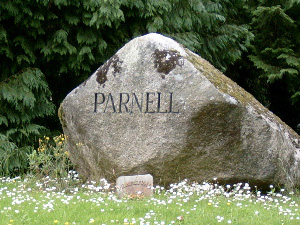
In the Ireland of our great-grandparents, wearing a sprig of ivy, on October 6th, carried a meaning immediately understood by others. It represented remembrance, loyalty and continuing devotion to Parnell and to the political hopes associated with him.
James Joyce later preserved that fading world in his famous short story Ivy Day in the Committee Room.
The tradition survives, but seemingly not in Thurles Co. Tipperary and numerous other places in our green land. However, remarkably, Ivy Day has not disappeared altogether. Only this week, marking the 135th anniversary of Parnell’s death, the Parnell Society held its annual commemoration. On Saturday, October 3rd 2026, historians and supporters gathered at Parnell’s ancestral home at Avondale, County Wicklow, for an Ivy Day symposium, examining his political legacy, his involvement in industry, landlord and tenant relations and the Irish Parliamentary Party.
The following day, Sunday, October 4th, people again gathered around Parnell’s grave at Glasnevin Cemetery. A wreath was laid and Ms Claire Hanna MP, leader of the SDLP, delivered the annual Ivy Day oration. The ceremony continues a commemorative tradition which began on the first anniversary of Parnell’s death and is now held on the Sunday nearest October 6th each year.
What is striking from a Thurles perspective, however, is how completely the old custom appears to have slipped from local public memory.
The Ivy Leaf and the “Dead Chief”.
When Parnell was buried at Glasnevin Cemetery in October 1891, his funeral drew an enormous crowd. In the years that followed, October 6th became known as “Ivy Day”.
The ivy leaf became the emblem of remembrance for Parnell. Accounts of the tradition tell how mourners took ivy from the walls of Glasnevin cemetery and wore it in their lapels, while another possible origin lies in an ivy wreath placed beside his remains. What is certain is that within a year of his death the ivy leaf had become firmly associated with those who remained loyal to his memory.
Despite Parnell’s documented visit to Thurles, despite a prominent street in the town still bearing his name, and despite the national Ivy Day tradition continuing in 2026, I can find no publicly advertised Ivy Day commemoration in Thurles this year and no obvious continuation locally of the old custom of wearing the ivy leaf on October 6th.
That does not prove that no individual in Thurles remembered Parnell privately. But as a visible civic tradition, the wearing of the ivy appears to have disappeared from the town. Perhaps that is worth reflecting upon.
There must once have been men and women walking the streets of Thurles on an October morning with a little piece of green ivy pinned to a coat or jacket. To their neighbours, no explanation would have been necessary.
The leaf says simply, Parnell is remembered. Today thousands of us travel along Parnell Street, Thurles, yet comparatively few may know why the street bears that name, that Parnell himself once came to the town, or that for generations October 6th was a special day of remembrance throughout Ireland.
Parnell was neither a saint nor a man without controversy. His political career ended amid one of the bitterest divisions Ireland had known. But his historical importance remains beyond dispute.
He helped give Irish nationalism political discipline and parliamentary power. He stood at the centre of the struggle that transformed the position of Ireland’s tenant farmers. And he brought the possibility of Irish self-government closer than it had been for generations.
When he died, his followers chose a remarkably humble memorial. Not a flag. Not a medal. Not an elaborate badge. Just a small leaf of ivy, evergreen, clinging firmly through winter, and difficult to uproot.
One hundred and thirty-five years later, a few people still gather at Glasnevin to remember the “Dead Chief”.
Perhaps Thurles, a town which still carries his name on one of its streets and which once witnessed Parnell himself exercising his formidable political authority, might consider remembering ‘Ivy Day’ next year.
Perhaps next Sunday October 11th, the anniversary of Charles Stewart Parnell’s burial in 1891, we might all, including the landowning families of Ireland, pause to remember his extraordinary contribution to our nation. Let each of us pluck a sprig of ivy from the hedgerow and wear it proudly in our lapel or buttonhole, reviving a tradition of remembrance as a simple yet meaningful gesture of gratitude and respect for a man to whom Ireland owes so much.
A small sprig of ivy on October 11th would cost almost nothing. But it might remind another generation why Parnell Street is called Parnell Street and of the remarkable, complicated man who helped change the course of Irish history.





Leave a Reply