Application Ref: 2660723 Applicant: Coolross Homes Ltd. Development Address: Innisfail , Kickham Street , Thurles Development Description: Description: the following works: a) the construction of 42 no. residential dwelling units comprising of the following types; 1no. Block A (2-storey semi-detached block of 1 no. 2-bed & 1 no. 3-bed); 1no. Block A1 (2-storey semi-detached block of 1 no. 2-bed & 1 no. 3-bed); 1 no. Block B (2-storey semi-detached block of 1 no. 2-bed & 1 no. 3-bed); 1 no. Block C (2-storey semi-detached block of 2 no. 3-bed); 1 no. Block C1 (2-storey semi-detached block of 2 no. 3-bed); 1 no. Block D (2-storey terrace block of 3 no. 3-bed); 10 no. Block E (3-storey semi-detached block of 2 no. 4-bed); 1 no. Block F (2-storey terrace block of 2 no. 2-bed & 2 no. 3-bed); 1 no. Block G (2-storey terrace block of 1 no. 2-bed & 4 no. 1-bed apartments); b) proposed new site entrance, access roads and footpaths; c) new site boundary treatments; d) new waste, water and utility service connections and all associated site works. The above works are proposed to be carried out in the grounds of a protected structure, schedule of Protected Structures reference: TRPS2460 Status: N/A Application Received: 24/07/2026 Decision Date: N/A Further Details:http://www.eplanning.ie/TipperaryCC/AppFileRefDetails/2660723/0
Application Ref: 2660718 Applicant: MQ Transport Ltd Development Address: Cabragh Business Park, Cabra, Thurles, Co. Tipperary Development Description: an extension to the front (Northern side) of our existing warehouse premises for storage use incorporating 3 no dock levellers with all associated sitework and ancillary works Status: N/A Application Received: 23/07/2026 Decision Date: N/A Further Details:http://www.eplanning.ie/TipperaryCC/AppFileRefDetails/2660718/0
Application Ref: 2660499 Applicant: Mary Mockler Development Address: Grange Brittas , Thurles , Co. Tipperary Development Description: the replacement of septic tank and percolation area including all associate site works Status: Conditional Application Received: 24/05/2026 Decision Date: 16/07/2026 Further Details:http://www.eplanning.ie/TipperaryCC/AppFileRefDetails/2660499/0
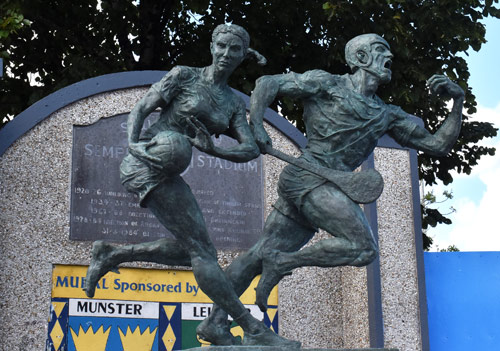
A monumental bronze sculpture by Kilkenny artist Mr Aidan Harte was unveiled outside FBD Semple Stadium in Thurles today, celebrating the town’s unique place in the history of Gaelic Games.
Standing more than three metres tall, Ár gCluichí Féin, (meaning Our Own Games), depicts a male and female player in motion, representing the energy, skill and shared traditions of hurling, camogie and Gaelic football.
Ár gCluichí Féin. Pic: G. Willoughby.
The inclusion of the female figure is particularly significant, making the work the first major GAA statue to portray a female player.
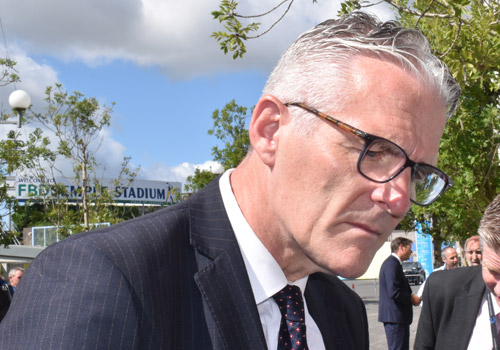
The sculpture honours Thurles as the birthplace of the Gaelic Athletic Association, which was founded at Hayes’ Hotel in the town in 1884. The Ladies Gaelic Football Association was also established at the same location 90 years later, in 1974. GAA President Mr Jarlath Burns attended the unveiling alongside young representatives of the Primary Games and leading Tipperary players, including senior hurling captain Mr Ronan Maher, vice-captain Mr Jake Morris and senior camogie captain Ms Caoimhe McCarthy.
GAA President Mr Jarlath Burns. Pic: G. Willoughby.
Commissioned by Tipperary County Council in partnership with Tipperary GAA and FBD Semple Stadium, the artwork forms part of a wider place making programme for the area. The investment also includes tourism, active-travel, road, cycling and public-realm improvements around the stadium and truly is a must view.
Mr Harte began his career in the arts at Kilkenny-based animation studio Cartoon Saloon, working alongside its founders Tom Moore and Paul Young. He later studied sculpture in Florence and has created several prominent works, including the widely discussed Púca sculpture commissioned for County Clare.
Now permanently positioned beside one of Ireland’s most celebrated sporting grounds, Ár gCluichí Féin provides a striking tribute to the generations of women and men who have played, supported and sustained Ireland’s native games.
Present Chairperson (Cathaoirleach) of Tipperary County Council, Labour CouncillorMs Fiona Bonfield summed up the occasion in her introductory opening speech stating: “It is wonderful to see such a large attendance here today. Unlike most occasions held in Semple Stadium, there is no debate this morning about team selections, controversial refereeing decisions, or whether the ball went over the bar. For once, we are all gathered in complete agreement to celebrate something truly special. It is a great pleasure to be here today for the unveiling of this remarkable artwork—a piece that celebrates a place of profound importance in Ireland’s sporting, cultural and social history: Thurles, the birthplace of the Gaelic Athletic Association. In a week when we have witnessed at first hand the importance of our national games to our people, and collectively celebrated a historic game last Sunday, (Mayo v Kerry) we have, as a nation, felt a tremendous sense of pride in that journey.
Today, we gather not only to welcome a new artistic creation, but also to honour a story—a story that began here in Thurles in 1884, when a small group of visionaries came together with the ambitious idea of preserving, promoting and strengthening Ireland’s indigenous games and cultural traditions. From that meeting emerged an organisation that would grow beyond anything its founders could ever have imagined. What would those founders think if they could see the GAA today? For more than 140 years, the GAA has helped to shape communities across Ireland and throughout the world. It has nurtured generations of players, volunteers, supporters and families. It has provided places where people belong, where friendships are forged, where leadership is developed and where local pride flourishes.”
Chairperson (Cathaoirleach) of Tipperary County Council Labour CouncillorMs Fiona Bonfield. Pic: G. Willoughby.
“At the heart of that story is Thurles. This town occupies a unique place in our national consciousness. It is where the foundations were laid for a movement that would become one of the largest amateur sporting organisations in the world. It is fitting, therefore, that this artwork should stand here in Thurles as a permanent reminder of that legacy, and of the vision, determination and community spirit that inspired the founders of the Association. Public art has a special role in our communities. It allows us to connect with our shared history, celebrate our identity and tell our stories in a way that resonates across generations. Great artwork, however, endures. It captures the imagination, sparks conversations and leaves a lasting impression. This artwork does precisely that. It honours the past while speaking to the future. It reminds young people of the extraordinary heritage they inherit and encourages them to become the next generation of players, volunteers, artists, leaders and custodians of community life. As we unveil this artwork, we celebrate far more than a historical event. We celebrate creativity. We celebrate artistic mastery. We celebrate community. We celebrate volunteer-ism. We celebrate identity. Above all, we celebrate a town whose name will forever be linked with one of the most influential organisations in Irish life.” continued Ms Bonfield.
While welcoming the many dignitaries and team players in attendance today; Ms Bonfield further stated, “Fittingly, here in Thurles, at the Field of Legends, we celebrate a passion that can unite neighbours, families and entire counties”.
Our Games Began Here — and Today, They Come Home
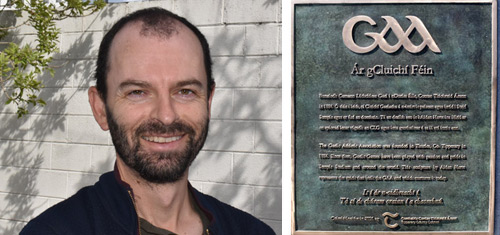
“Ár gCluichí Féin” artist Mr Aidan Harte. Pic: G. Willoughby.
Speaking after the sculpture was revealed, Ár gCluichí Féin artist Mr Aidan Harte described the satisfaction of finally seeing the completed work installed on its plinth. The artist spent much of the previous year modelling the figures in clay at his Kildare studio, before the piece was transferred to a foundry and cast in bronze.
Mr Harte stated, “My father will be the first to tell you that I am Ireland’s worst sportsman. I peaked as a corner-forward at the age of nine. But sculpting this pair of giants was my version of senior hurling. Thank you to Ms Melanie Scott of Tipperary Arts Office for awarding me this commission amid strong competition, and for supporting me throughout its year-long creation.
Thank you to Mr Vincent O’Shea for his good advice, and the occasional kick up the arse when I needed it. Thanks also to sculptors Mr Alan Clarke, Ms Liz O’Kane and Mr Hywel Pratley for their second opinions on anatomy and composition, and to Mr Kieran Riley for his engineering advice on constructing a work of this scale. The Foundry did far more than cast the sculpture; they were co-creators. My thanks to Mr David O’Brien, Jessica, Sandra, Ahmed and Brian for transforming the clay created in my studio into bronze.
The raw materials for the plinth came from Manor Stone, while Thomas Duffy and the County Council team constructed it, along with the elegant space in which the sculpture now stands. Completing everything on time required close coordination between Thurles District Council and Semple Stadium, led by Ms Deirdre Dunne and Mr David Morgan.
Finally, thank you to the people of Thurles for allowing my champions to become part of the Semple Stadium’s story. Our games began here. They thrived here. Today, they come home.
Down in County Clare, my first public sculpture, The Púca, stands in the birthplace of Michael Cusack, founder of the GAA, with FBD Semple Stadium one of the great arenas of Gaelic games, and it is an honour to take part in its continuing story. I hope this sculpture reminds everyone who sees it of how powerful we can be when people unite around the things they love. The two figures do not depict any particular players, because Gaelic games belong to all of us. Thank you to everyone who helped bring this work to life: my wife, Bronagh, who put up with the muddy floors; my neighbour Stuart, who loaned me his football boots; and my models, Natalia Hornet, Noémie Birard, Michael Harte and Pierce Harte. I created the sculpture on top of a steel armature, built by my father Billy, back in the 1970s. Billy himself hurled on these hallowed grounds for Kilkenny.
Thank you all for coming out and sharing this special occasion”, concluded Mr Harte.
Water quality in private water supplies (small private supplies and private group schemes) is not as good as public water supplies.
Small private supplies provide drinking water to, for example, schools, nursing homes and hotels. Private group schemes cover 376 community run supplies.
1,600 small private drinking water supplies are registered, but the total number remains unknown as there is no legal requirement to register.
Unregistered supplies are not sampled by local authorities and may unknowingly be providing unsafe drinking water to consumers.
Failures due to E. coli in private group schemes reduced to 14 in 2025, down from 24 in 2024.
The Environmental Protection Agency (EPA) today released its Drinking Water Quality in Private Group Schemes and Small Private Supplies 2025 report. The report highlights that drinking water quality in private supplies continues to fall short of the standards achieved by public supplies delivered by Uisce Éireann.
There are approximately 370 private group schemes supplying drinking water to more than 194,000 people in rural communities across Ireland. In addition, over 1,600 small private supplies are registered with local authorities, providing drinking water from their own wells to commercial and public activities, such as schools, crèches, nursing homes, hotels, camping sites and sports clubs.
The Department of Housing, Local Government and Heritage (DHLGH) in 2023, identified the need to strengthen the governance, oversight and management of private water supplies. Progress on implementing measures to address this deficit has been slow. The DHLGH must implement these reforms as a priority.
A key first step is to make registration a legal obligation for small private supplies. Currently approximately 1,600 small private supplies are registered, but it is estimated that there are many more not registered.
Launching the report, Mr Pat Byrne, Director, EPA Office of Radiation Protection and Environmental Monitoring said: “It is unacceptable that people visiting a local business or using local amenities could unknowingly consume water from a well that is not registered or sampled, putting themselves and their family’s health at risk. Suppliers should act immediately and register their supplies, so they are monitored by local authorities, giving suppliers and consumers confidence in the quality of their drinking water.”
Small Private Supplies – Water Quality Compliance. The presence of E. coli bacteria in drinking water means it is contaminated and that it poses a risk to people’s health. Small private supplies continue to have poorer E. coli compliance than public water supplies provided by Uisce Éireann, with 67 supplies failing the standard in 2025. This is a compliance rate of 95%.
Private Group Schemes – Water Quality Compliance. Fourteen private group schemes, supplying 1,854 people, had E. coli failures in 2025 – down from 24 in 2024. Six of these, however, had repeat failures of E. coli in both 2024 and 2025 due to a combination of operational and infrastructural issues creating risks for consumers. In 2025, seventeen private group schemes, serving 19,362 people, failed the Trihalomethane (THM) standard. This represents only a minor improvement on 2024, when 19 schemes failed to meet the standard.
Mr Noel Byrne, Programme Manager of the EPA’s Office of Radiation Protection and Environmental Monitoring said: “While there has been some improvement in E. coli compliance in group schemes, the continued failures in several private group schemes shows that more action is needed. Local authorities must work closely with suppliers to identify the causes of failures and ensure corrective actions are put in place. Where suppliers do not act, or where failures persist, local authorities must escalate enforcement action, so consumers are protected.”
The EPA report on Drinking Water Quality in Private Group Schemes and Small Private Supplies – 2025 is available on the EPA Website HERE.
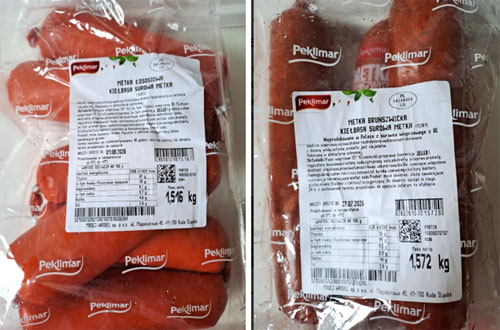
Recall of specific batches of Peklimar Metla Lososiowa and Peklimar Metla Brunszwicka sausages due to the presence of Listeria monocytogenes.
Alert Summary dated Tuesday, 28th July 2026.
Category 2: For Information. Alert Notification: 2026.46. Product Identification: Please see table below. Batch Code: Please see table below for batch code and use-by dates. Country Of Origin: Poland.
Message: The below batches of Peklimar Metla Lososiowa and Peklimar Metla Brunszwicka sausages are being recalled due to the presence of Listeria monocytogenes. Recall notices will be displayed at point-of-sale.
Implicated products and batches:
Product name:
Approximate pack size (g):
Batch code:
Use-by date:
Peklimar Metka Lososiowa kiełbasa surowa metka
1500.
1R808070707.
01/08/2026.
Peklimar Metka Brunszwicka kiełbasa surowa metka.
1500.
1R808070707.
27/07/2026.
Nature Of Danger: In healthy people, symptoms of Listeria monocytogenes infection can include mild flu-like symptoms, or gastrointestinal symptoms such as nausea, vomiting, and diarrhoea. However, in people who are more vulnerable, the infection can be severe and can lead to serious complications. People who are more vulnerable to Listeria monocytogenes infections include pregnant women, infants, older adults, and people with weakened immune systems. The incubation period (time between initial infection and first symptoms appearing) is, on average, 3 weeks but can range between 3 and 70 days.
Retailers: Same are requested to remove the implicated batches from sale and display recall notices at point-of-sale. Wholesalers / Distributors: Same are requested to contact their affected customers and recall the implicated batches and provide a point-of-sale recall notice to their retailer customers. Consumers: Consumers are advised not to eat the implicated batches.
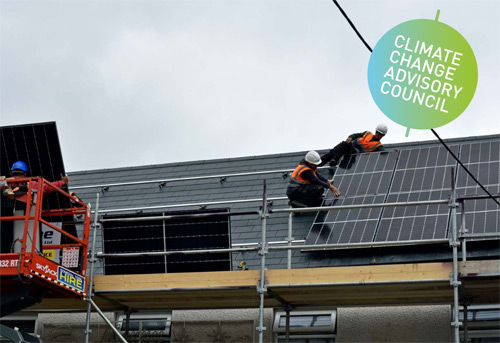
Urgent action required to address household emissions and reduce exposure to fossil fuel price volatility says Climate Change Advisory Council.
The Built Environment sector accounted for 12.5% of total greenhouse gas emissions in 2025.
Residential building emissions fell year-on-year by 5.0%, while emissions from commercial and public buildings fell by 3.5%, primarily due to a warmer winter.
Launching the Built Environment chapter of its Annual Review 2026 today, the Council said increased investment and faster rollout is needed in retrofitting, heat pumps, solar PV and district heating to reduce emissions, improve comfort and health outcomes and to protect citizens against volatile energy costs.
Although there has been a reduction in built environment emissions, the Council says these reductions should not be mistaken for structural progress. While residential and commercial/public buildings remained within their first sectoral emissions ceilings for 2021–2025, the outlook for the next carbon budget period is much more challenging. Both residential buildings and commercial and public buildings are projected to exceed their second sectoral emissions ceilings for 2026–2030 by 22% and 62% respectively.
The review warns that progress on local authority social housing retrofits remains too slow, with only 10,370 homes retrofitted since 2021. Approximately 5,000 retrofits are needed on average each year between now and 2030. The Council is calling for increased, sustained and ring-fenced multi-annual funding in Budget 2027 to allow local authorities to accelerate retrofit delivery and meet the Government’s own targets of 36,500 social houses brought to BER B2 or cost-optimal standard by 2030. The review also highlights solar PV as one of the fastest routes to lower bills and widen participation in the energy transition. It recommends the roll out of solar PV across local authority housing stock and that a national framework should also be put in place for plug-in solar to allow apartment dwellers to benefit from solar energy.
The Council says delayed and incomplete policy frameworks are now creating uncertainty for households, local authorities, industry and investors. For example, the delayed National Building Renovation Plan, due last December, has prompted the European Commission to open infringement proceedings in March. The plan should be published immediately, with a clear pathway to phase out fossil fuel boilers by 2040 as required under the EU Energy Performance of Buildings Directive. The Council identifies the requirement for a National Heat Strategy based on spatial planning, system diversity and resilience, to identify where district heating, geothermal energy, heat pumps and other low-carbon heating solutions can be most effectively deployed. The Council acknowledges Cabinet approval for revisions to the General Scheme of the Heat (Networks and Miscellaneous Provisions) Bill, but the legislation has slipped repeatedly and must now be finalised and enacted to give district heating the regulatory certainty it needs.
On resilience, the Council wants to see a clear programme of work so the Built Environment and Planning sector can develop and implement a dedicated Sectoral Adaptation Plan in the next plan cycle. Ensuring our built environment is resilient to immediate and future climate change impacts, such as heatwaves and flooding, is paramount to securing the future of our communities. In addition, the Council also recommends that Government expedite the development of coastal change management plans in priority vulnerable areas. Mr Alex White, Chairperson of the Climate Change Advisory Council, said: “As long as Ireland remains heavily dependent on fossil fuels to heat homes and buildings, our households, businesses and public services will remain exposed to global price volatility and energy insecurity. The Government has set the right ambition to end Ireland’s reliance on fossil fuels. The test now is delivery. We have the solutions and we know there is an appetite for them, but they must be enabled through policy and legislation. These solutions must be funded to deliver lower-cost clean energy for Ireland. Our communities also need plans and solutions to prepare for the impacts of climate change, especially coastal areas and those that are at risk of flooding. This transition must be fair. Social housing retrofit is one of the clearest tests of delivery. The State owns this housing stock, the targets are clear, and the benefits for households are immediate. To meet the 2030 target, local authorities will need to retrofit around twice as many homes each year as were delivered in 2025.”
This website uses cookies to improve your experience. We'll assume you're ok with this, but you can opt-out if you wish.AcceptRead More
Privacy & Cookies Policy
Privacy Overview
This website uses cookies to improve your experience while you navigate through the website. Out of these, the cookies that are categorized as necessary are stored on your browser as they are essential for the working of basic functionalities of the website. We also use third-party cookies that help us analyze and understand how you use this website. These cookies will be stored in your browser only with your consent. You also have the option to opt-out of these cookies. But opting out of some of these cookies may affect your browsing experience.
Necessary cookies are absolutely essential for the website to function properly. This category only includes cookies that ensures basic functionalities and security features of the website. These cookies do not store any personal information.
Any cookies that may not be particularly necessary for the website to function and is used specifically to collect user personal data via analytics, ads, other embedded contents are termed as non-necessary cookies. It is mandatory to procure user consent prior to running these cookies on your website.






Recent Comments