GAA President Jarlath Burns has pledged to do everything within his power to help secure a brighter future for Semple Stadium, during the remainder of his term in office.
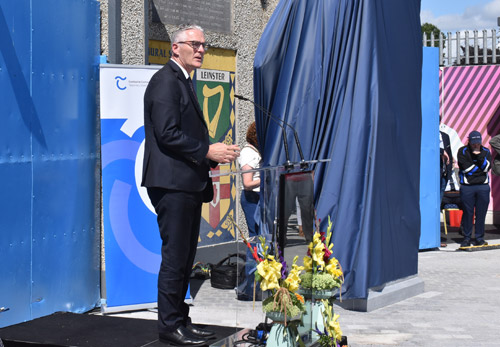
The Armagh native made the commitment at the unveiling of the new “Ár gCluichí Féin” statue at the historic Thurles venue yesterday.
With Semple Stadium having fallen behind many of the country’s more modern grounds, the need for significant investment and redevelopment is now widely recognised. Addressing those in attendance, Mr Burns spoke passionately about the responsibility facing the GAA and its leadership over the coming decade. He said the stadium must receive the funding required to ensure future generations can continue to take pride in one of the Association’s most iconic venues. Mr Burns pledged that, during his remaining months as Uachtarán Chumann Lúthchleas Gael, he would work to honour Semple Stadium and help restore it to the standard envisioned by pioneering figures such as Tom Semple.
His powerful five-minute address left a lasting impression on the audience. Speaking without notes, his exceptional command of the Irish language, natural eloquence and strength as a public speaker, held those present in awe.
His remarks were a fitting and memorable tribute to Semple Stadium’s remarkable past, as well as a strong statement of intent regarding its future.
Patients throughout North Tipperary are facing renewed concerns about access to emergency hospital care after University Hospital Limerick recorded the highest level of overcrowding in the country during July.
North Tipperary’s TDs, namely Mr Michael Lowry, Mr Ryan O’Meara and Mr Alan Kelly, must now press for immediate measures to relieve this overcrowding, strengthen emergency and acute-care capacity across the Mid-West, and ensure that patients from the region can access safe and timely hospital treatment. All above named should raise this escalating crisis at UHL directly with Minister for Health Ms Jennifer Carroll MacNeill, and demand a clear, time-bound response.
A total of 2,172 patients were treated on trolleys, chairs or other inappropriate bed spaces at UHL during the month, according to figures from the Irish Nurses and Midwives Organisation.
University Hospital Limerick Which Serves North Tipperary.
The Dooradoyle hospital provides the principal 24-hour emergency and critical-care services for the Mid-West, including North Tipperary. The continuing pressure at UHL therefore has direct consequences for patients and families in communities including Nenagh, Roscrea, Newport, Borrisokane and surrounding areas. Nationally, 10,394 admitted patients were left waiting for hospital beds during July. It was the first July on record in which the figure exceeded 10,000.
UHL accounted for more than one-fifth of the national total and remained by far the most overcrowded hospital in Ireland. University Hospital Galway recorded 919 patients on trolleys during July, while the figure at Sligo University Hospital was 800. The INMO has called on the Health Service Executive to treat the situation at UHL as a major incident and to deploy all resources necessary to the hospital.
INMO General Secretary Ms Phil Ní Sheaghdha said the overcrowding experienced this summer represented a serious warning ahead of the traditionally difficult autumn and winter period. She said senior HSE decision-makers should be present at UHL throughout the bank holiday weekend and in the weeks ahead to oversee the response. The union’s intervention comes as people have been advised to consider other care options, before attending the UHL Emergency Department, except in cases involving serious illness, major injury or a life-threatening emergency.
For North Tipperary residents, however, the continuing problems highlight the limited emergency-care options available within the region. While services such as the Injury Unit and Medical Assessment Unit at Nenagh Hospital can treat certain patients, those requiring emergency or complex acute care may still have to travel to UHL.
The INMO also warned that sustained overcrowding, staff shortages and increasing workloads are placing nurses and midwives under relentless pressure. Ms Ní Sheaghdha said healthcare workers were being asked to provide care in conditions that would previously have been considered unimaginable during the summer months. She also accused employers of failing to provide sufficient support following critical incidents and of compromising staff health and wellbeing.
On Friday morning, a further 362 admitted patients were waiting without beds in hospitals across the country.
The record July figures are likely to intensify calls for additional hospital capacity, staffing and emergency-care services for North Tipperary and the wider Mid-West region.
More than 11,000 people had their jobseeker payments reduced during 2025, after failing to meet engagement requirements set by Ireland’s employment services.
Figures released by the Department of Social Protection show that 11,082 claimants were placed on reduced payment rates last year. This represented a 129%increase on the 4,838 cases recorded in 2024.
Under the penalty system, a standard weekly jobseeker payment of €254 can be reduced by €90 to €164. Payments may be restored once the claimant resumes contact and cooperation with Intreo or another relevant employment-support service. Failure to attend scheduled appointments accounted for most of the reductions.
A total of 4,986 people were penalised after missing an activation review meeting, having already failed to attend an earlier appointment. Another 3,717 claimants received reduced payments after failing, without an accepted reason, to attend a follow-up one-to-one meeting. A further 2,144 reductions related to missed appointments connected with other employment-activation programmes. Smaller numbers were penalised for failing to participate in agreed education, training or employment measures. These included 17 people who left an education, training or development course without good cause and 45 who withdrew from a prescribed employment programme. Payments were also reduced in 23 cases where claimants did not agree to actions forming part of their personal progression plans. Other cases involved refusing to take part in training, education or designated employment schemes.
Jobseeker’s Allowance recipients made up the overwhelming majority of those affected, accounting for 10,097 reductions. A further 694 people were receiving Jobseeker’s Benefit, while the remainder were claiming through transitional arrangements or supports for formerly self-employed workers. The Department of Social Protection said reduced rates are not imposed immediately but are used as the final stage of a process intended to encourage claimants to engage with employment services and make use of available assistance.
According to the department, the normal payment rate is reinstated as soon as a person resumes engagement with the relevant service. Officials said the purpose of the measure is to encourage jobseekers to cooperate with services designed to help them find employment, access training and improve their prospects of returning to work.
Pre-deceased by his parents Martin and Josie, brother Michael, nephew Derek, brother-in-law Michael Maher; Mr Treacy passed away peacefully surrounded by his loving family, while in the care of staff at Cork University Hospital.
His passing is most deeply regretted, sadly missed and lovingly remembered by his sorrowing family; loving partner Angie, son Dylan, sisters Mary and Josie, brothers Jim, Martin, Pat, Jacko, Tommy, Kevin, Eddie, Paul and Brendan, sisters-in-law, brother-in-law, nieces, nephews, grandnieces, grandnephews, extended relatives, neighbours, work colleagues and many friends.
For those persons who would wish to attend Requiem Mass for Mr Treacy, but for reasons cannot, same can be viewed streamed live online, HERE.
The extended Treacy family wish to express their appreciation for your understanding at this difficult time, and have made arrangements for those persons wishing to send messages of condolence, to use the link shown HERE.
The Irish Government has confirmed the deportation of six Nigerian nationals, following a coordinated return operation involving Irish authorities and the European Border and Coast Guard Agency, Frontex.
The six men, all aged between 25 and 40, were removed from Ireland on a charter flight from Dublin Airport to Rome before joining a Frontex-managed flight to Lagos, Nigeria.
The Dublin flight departed at 7:40 a.m. and arrived in Rome at 10:34 a.m. Irish time. The onward flight left Rome shortly after 1:00 p.m. and landed in Lagos at approximately 9:00 p.m.
According to the Government, deportation orders had been issued against all six individuals. Five of the men had accumulated a combined total of 35 criminal convictions and had received sentences for a range of offences.
Officials said the operation formed part of ongoing efforts to enforce immigration laws, remove individuals involved in criminal activity and maintain public confidence in Ireland’s immigration system.
The Government also highlighted the operational and financial benefits of working with Frontex and other European partners on joint return operations.
Members of An Garda Síochána accompanied the deportees, alongside medical personnel, an interpreter and an independent human rights observer.
The aircraft used for the Irish stage of the operation cost €76,895, excluding VAT.
Further charter deportation operations are expected to take place throughout 2026.
This website uses cookies to improve your experience. We'll assume you're ok with this, but you can opt-out if you wish.AcceptRead More
Privacy & Cookies Policy
Privacy Overview
This website uses cookies to improve your experience while you navigate through the website. Out of these, the cookies that are categorized as necessary are stored on your browser as they are essential for the working of basic functionalities of the website. We also use third-party cookies that help us analyze and understand how you use this website. These cookies will be stored in your browser only with your consent. You also have the option to opt-out of these cookies. But opting out of some of these cookies may affect your browsing experience.
Necessary cookies are absolutely essential for the website to function properly. This category only includes cookies that ensures basic functionalities and security features of the website. These cookies do not store any personal information.
Any cookies that may not be particularly necessary for the website to function and is used specifically to collect user personal data via analytics, ads, other embedded contents are termed as non-necessary cookies. It is mandatory to procure user consent prior to running these cookies on your website.





Recent Comments