For decades, cancer was considered primarily a disease associated with aging. But that assumption is rapidly changing. Across the globe, doctors are seeing a growing number of cancer diagnoses in adults under 50, a phenomenon now referred to as early-onset cancer. Research shows that rates of several cancers, especially colorectal, breast, kidney, and uterine cancers, have steadily increased among younger adults since the 1990s. A major 2025 study from researchers at the U.S. National Institutes of Health found that 14 different cancer types increased among people under 50 between 2010 and 2019. The largest rises were seen in breast, colorectal, kidney, and uterine cancers. Scientists still do not have one definitive explanation, but many researchers believe the increase is likely linked to a combination of lifestyle, environmental, and biological changes.
Diet, Obesity, and Modern Lifestyles One of the strongest suspected contributors is the global rise in obesity and unhealthy dietary habits. Diets high in ultra-processed foods, refined sugars, and processed meats may increase inflammation in the body and disrupt hormones and gut bacteria, all of which can contribute to cancer development. Health experts also point to increasingly sedentary lifestyles. Less physical activity combined with long-term weight gain may significantly raise the risk of cancers such as colorectal, breast, and uterine cancer. The World Health Organization reports that obesity rates worldwide have more than doubled since 1990, especially among younger generations. Researchers believe this trend may be closely connected to the rise in early-onset cancers.
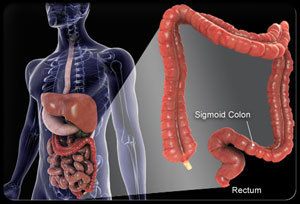
Colon Cancer.
Are Microplastics and Environmental Chemicals Part of the Problem? Another growing area of concern involves environmental exposure, especially microplastics and industrial chemicals. Microplastics are now found in food, drinking water, air, and even human tissues. Early studies suggest these particles may contribute to inflammation, cellular damage, and DNA mutations, all of which are linked to cancer development. Researchers are especially studying possible connections between microplastics and colorectal cancer. Scientists are also investigating the potential role of:- “Forever chemicals” (PFAS); Air pollution; Gut microbiome disruption; Chronic stress; Sleep disruption and Environmental toxins. However, experts caution that evidence connecting many of these factors directly to cancer is still developing.
Better Screening May Also Explain Some Increase. Not all of the rise necessarily means more cancers are developing. In some cases, cancers are simply being detected earlier and more often due to improved screening technologies and increased awareness. Organizations have lowered recommended screening ages for certain cancers: Colorectal cancer screening now commonly begins at age 45 instead of 50, while breast cancer screening often begins at age 40 instead of 50. Improved imaging and earlier testing may partially explain why diagnoses among younger adults appear to be increasing.
The Good News: Survival Rates Are Improving. Despite rising diagnosis rates, overall cancer death rates have declined for many cancer types because treatments and early detection have improved significantly. Still, some cancers diagnosed in younger adults can behave more aggressively. Early-onset colorectal and breast cancers, for example, are often discovered at more advanced stages because symptoms are unexpected in younger people. Researchers emphasize that awareness is critical. Persistent symptoms such as unexplained weight loss, rectal bleeding, unusual fatigue, changes in bowel habits, or abnormal lumps should never be ignored simply because someone is young.
What Researchers Know So Far. Scientists agree on several important points:
Early-onset cancer rates are genuinely rising for multiple cancer types.
Obesity, diet, and lifestyle changes are likely major contributors.
Environmental exposures may also play a role.
Genetics alone cannot explain the sharp increase.
Earlier screening and improved detection account for part; but likely not all of the trend.
Pre-deceased by his beloved wife Mary (nee Stuart), brother Pat, sisters Sr. Angela and Susan (Soden); Mr Powell passed away peacefully, surrounded by his loving family, while in the care of staff at Maryborough Nursing Home.
His passing is most deeply regretted, sadly missed and lovingly remembered by his sorrowing family; loving sons Denis and Mike, daughters Eileen (Hendrick) and Liz, their partners Jenny, Jim and Lorraine, his loving partner Fifi, brother Michael, grandchildren Dan, Ruth, Ewan and Stuart, Fifi’s family, neighbours, friends and former colleagues from Thurles Sugar Factory/ Irish Sugar.
For those persons who would wish to attend the service of cremation for Mr Powell, but for reasons cannot, same can be viewed streamed live online, HERE.
The extended Powell and Stewart families wish to express their appreciation for your understanding at this difficult time, and have made arrangements for those persons wishing to send messages of condolence, to use the link shown HERE.
Note Please: Family flowers only, donations if desired to RNLI in memory of Mr James (Jim) Powell.
Pre-deceased by his parents John (Jack) and Johanna, brothers Tom and Ned and sister Joan; Mr Carroll passed away peacefully surrounded by family and friends, while in the care of staff at Tipperary University Hospital, Clonmel, Co. Tipperary.
His passing is most deeply regretted, sadly missed and lovingly remembered by his sorrowing family; loving sister Breda Behan, loyal friend Mary McGann, nephews, nieces, grand-nephews, grand-nieces, extended relatives, neighbours carers and a wide circle of friends.
For those persons who would wish to attend Requiem Mass for Mr Carroll, but for reasons cannot, same can be viewed streamed live online, HERE.
The extended Carroll family wish to express their appreciation for your understanding at this difficult time, and have made arrangements for those persons wishing to send messages of condolence, to use the link shown HERE.
Lyrics and Vocals: American singer, songwriter, actress, philanthropist, and businesswoman Ms Dolly Rebecca Parton.
Dolly Parton.
Some songs speak softly to the heart, and “Lovin’ You” is one of those timeless expressions of devotion and tenderness. Dolly Parton’s gentle words remind us that true love is not only found in happiness, but also in standing beside someone through their broken moments, offering comfort, loyalty, and healing. The following lines beautifully capture that spirit of unconditional love and faithful devotion.
Lovin’ You.
Lovin’ You.
Lovin’ you is my great honour, Lovin’ you, my pride and joy. I’ll defend you, I will mend you, When you’re broken like a toy. When your burdens get too heavy, When you’re weary to the bone, I will help you hold it steady, Pack it up and head for home. I will love you come whatever, I will be there when you call. I’ll encourage each endeavour, Be the first one to applaud. I’ll correct you when you’re sideways, I will praise you when you win. I will be there for you always With a love that never ends. I will always. (I will always). I will always. (I will always). I will always (always) be lovin’ you. Midst the chaos and confusion, I am never far behind. My love is your transfusion, To restore your soul and mind. I will nurse you back to freedom, Doctor up your shattered parts. Two arms here when you need ’em, And one lovin’, open heart. And if the world should end tomorrow, And we both know that it might. ‘Mongst the darkness and the sorrow, I will be your guiding light. And if God sees fit to let us, Be together ever more, If I had one question granted, That’s what I would ask him for. And I will love you come whatever, I will catch you when you fall. I’ll encourage each endeavour, When your back’s against the wall. I will hold you when you’re fragile, I will always let you in. I will rock you like a sweet child, Like a lover and a friend. I will always. (I will always). I will always. (I will always). I will always (always) be lovin’ you. I will always (always), I will always (always). Yes, I will always be lovin’ you (lovin’ you). Lovin’ you (lovin’ you), lovin’ you. Lovin’ you. I’m lovin’ you. (Lovin’ you, I’m lovin’ you, lovin you). I will love you come whatever, I will always let you in. I will rock you like a baby, Be your lover and your friend. I’ll defend you, I will mend you. I will always see you through, And I will always (I will always), I will always love you.
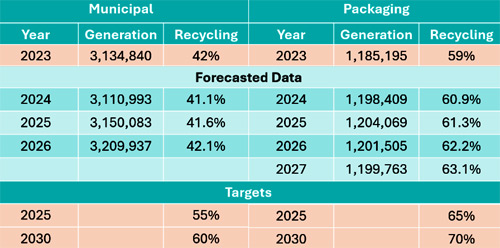
The Environmental Protection Agency (EPA) has yesterday published its waste forecasts providing a future outlook of waste generation and recycling trends for municipal and packaging wastes. The forecasting models provide estimates ahead of the availability of finalised statistics.
Forecasted Figures
The forecasts indicate that waste generation is expected to continue to grow across municipal waste, from households and businesses and packaging waste streams. Recycling rates for municipal wastes are forecast to remain largely stagnant and lag behind the EU average. Packaging waste recycling rates are projected to increase modestly, however the increases are not expected to be sufficient to meet future targets.
Looking ahead, the 2030 targets appear challenging based on current waste generation and recycling trends. Reducing waste generation levels is critical, but increased recycling rates will also be needed.
To meet the 2030 municipal waste recycling target of 60 per cent will require an additional 500,000 tonnes of recycling, highlighting the scale of the challenge ahead.
Mr David Flynn, Director of the EPA’s Office of Environmental Sustainability, said: “While recycling rates for packaging are improving, these gains are eroded by continued growth in waste generation. The priority now is to implement policy measures in the Government’s Whole of Government Circular Economy Strategy, delivering the practical circular economy solutions to incentivise waste prevention and better material recovery along the full supply chain.”
The EPA will continue to update and refine these forecasts as verified waste data becomes available.
Further information on the packaging waste forecasts is available on the EPA website.
This website uses cookies to improve your experience. We'll assume you're ok with this, but you can opt-out if you wish.AcceptRead More
Privacy & Cookies Policy
Privacy Overview
This website uses cookies to improve your experience while you navigate through the website. Out of these, the cookies that are categorized as necessary are stored on your browser as they are essential for the working of basic functionalities of the website. We also use third-party cookies that help us analyze and understand how you use this website. These cookies will be stored in your browser only with your consent. You also have the option to opt-out of these cookies. But opting out of some of these cookies may affect your browsing experience.
Necessary cookies are absolutely essential for the website to function properly. This category only includes cookies that ensures basic functionalities and security features of the website. These cookies do not store any personal information.
Any cookies that may not be particularly necessary for the website to function and is used specifically to collect user personal data via analytics, ads, other embedded contents are termed as non-necessary cookies. It is mandatory to procure user consent prior to running these cookies on your website.








Recent Comments