—— The Ballad of Reading Gaol ——
“They stripped him of his canvas clothes, and gave him to the flies.
They mocked the swollen purple throat and the stark and staring eyes.
And with laughter loud they heaped the shroud in which their convict lies.The Chaplain would not kneel to pray by his dishonoured grave,
Nor mark it with that blessed Cross that Christ for sinners gave,
Because the man was one of those whom Christ came down to save.”[An extract taken from Oscar Wilde’s last work, before his destitute death in Paris at the age of 46, “The Ballad of Reading Gaol”, latter published in 1898, under the name C.3.3 (Oscar Wilde’s own prison cell number). ]
Hanging, for the purposes of execution, is the suspension of a person by a ligature tied around their neck, and was a common method of capital punishment since medieval times, while still remaining the official execution method in some countries.
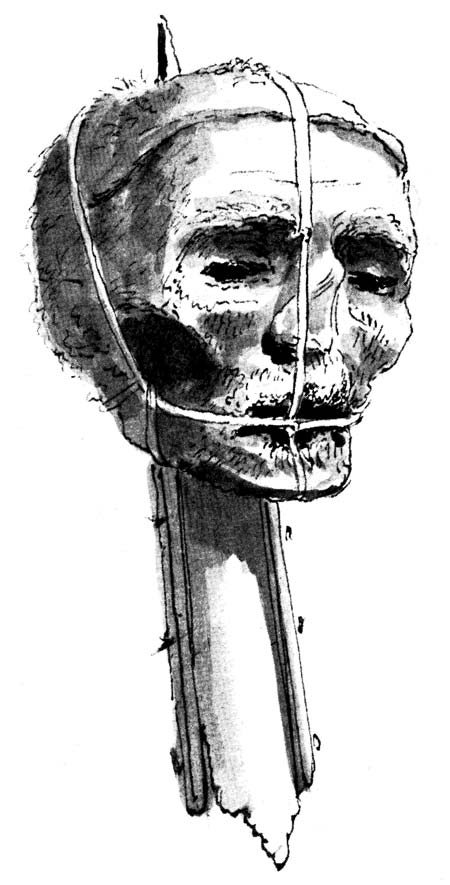
Oliver Cromwell’s Head
In Ireland today, due to a rise in criminal behaviour, media outlets often report on calls by individuals to reintroduce hanging. Indeed, in recent weeks one elected representative and one legal expert in Co. Tipperary, have both supported the idea that gun possession for rural dwellers is now essential, intimating the ridiculous notion that each person in their own right, is entitled to become judge, jury and executioner all rolled into one.
Oscar Wilde’s famous poem, (extract above) when read in full, demonstrates the effect on prisoners of a condemned man waiting in their midst.
Prior to the early 1800’s, the crimes of:- Robbery; Arson; Burglary; Coining; Highway Robbery; Attempted Murder; High Treason; Horse Stealing; Murder; Rape; Sheep Stealing; Sodomy; Theft (including from letter post, boats and dwelling houses); Uttering (latter the crime of passing forgeries, e.g. counterfeit coins and notes) were all punishable by hanging.
Legislation under the ‘Chalking Act’ of 1778, permitted the hanged body of a person who killed or maimed with intent, to be handed over to surgeons for anatomization (separating into fine particles) or basic dissection.
In 1823, British Home Secretary Sir Robert Peel (1788-1850) influenced by Quakers Elizabeth Fry (née Gurney, “the angel of prisons”) and her brother Joseph John Gurney; reduced the number of offences for which convicts could be executed, by over 100 previously prescribed offences. Robert Peel who helped to create the modern-day police force, introducing ‘Bobbies’ in England and ‘Peelers’ in Ireland, later served twice as Prime Minister of the United Kingdom, first elected MP for the Irish rotten borough of Cashel, in Co. Tipperary, when he was just 21. Seven years later in 1830, his replacement, Lord John Russell, abolished the death sentence for horse stealing and housebreaking.
On Friday 3rd September 1658, Oliver Cromwell then aged 59, died of septicaemia at Whitehall, in central London. On the 30th January 1661, after the restoration of the monarchy and on the 12th anniversary of the execution of Charles I, his supposed body was exhumed from Westminster Abbey, and subjected to a posthumous execution by being hanged at Tyburn. Later taken down from the scaffold and decapitated, his body was thrown into a pit beneath his gallows. What remained of his head was set on a spike above Westminster Hall. This pole with spike attached on which the head was impaled, broke off during a storm, falling into the grounds of Westminster Hall.
It is understood that a sentry found it and hid it in the chimney of his house, ignoring a considerable reward for its whereabouts. In the meanwhile, it reappeared in 1710 on public display in the ‘Cabinet of Curiosities’ owned by Claudius Du Puy, a French-Swiss calico printer who also ran a museum of freaks and curiosities. On Du Puy’s death in 1738 the head passed through various hands; including the Hughes Brothers, who put it on public display in Bond Street, charging two shillings and sixpence to view it.
It took until the 25th March 1960, before the head was finally reburied in Sidney Sussex College Chapel in Cambridge, inside an airtight container with just a few witnesses present.
Capital punishment in Ireland was prohibited in statute law in 1990, having been first abolished in 1964 for most offences, including ordinary murder.
Two questions remain for debate; (1) Do we really wish to return to those dark uncivilised days of yore? or (2) Do we feel that those elected to form our laws have let us down with regard to the punishing of those committed to continuous criminal behaviour?

 It is with a great personal sadness I learned of the death today, Saturday 3rd February 2018, of
 It is with a great personal sadness I learned of the death today, Saturday 3rd February 2018, of




Recent Comments