[With sincere apologies to the late, great, Irish songwriter Jimmy Kennedy (1902-1984)]
“If you go down to the Library, July 11th, you’re sure of a big surprise. If you go down to the Library, on that date, you’d better go in disguise! For every bear that ever there was, will gather there for certain, because July 11th is the day the Teddy Bears have their picnic.”
“Join us in Thurles library on Thursday 11th July at 11.30am for our annual Teddy Bears Picnic.
Bring along your Teddy (big or small) for a special trip to Thurles Library to hear some stories, songs and colouring. We will have some yummy ice-cream for the children as a special treat!
Weather permitting story-time will take place on the boardwalk outside, so please feel free to bring along your picnic blanket!
Remember, as with all events at Thurles Library; please notify your intention to be in attendance with a member of our Thurles Library staff at the desk or by phoning us on 0761-06-6131. [After all, we don’t want to run out of ice-cream.] We look forward to meeting lots of Teddy Bears in Thurles Library on the day!
Summer Stars Reading Challenge
Have you joined the Summer Stars Reading Challenge yet? There’s still plenty of time, so call into Thurles Library today and register for your free reading pack at the desk.
The Summer Stars encourages children to read books during the summer and track their progress on their reading card. When the card is completed return the card with all your details on it and pop it into the box provided.
The staff will contact you at the end of the summer holidays invite you to the certificate presentation in September. There are lots of new titles waiting on our shelves to be read so come along and choose a great summer read!
Remember you can borrow and return your books to any Library in Ireland”.
Predeceased by her husband Tommie; Mrs Clancy passed away peacefully, while in the care of Ardeen Nursing Home, Thurles.
Her passing is most deeply regretted by her daughter Elizabeth; son-in-law Kevin; sisters Phyllis, Nuala, Tess and Vera; nieces; nephews; extended relatives; neighbours and friends.
Predeceased by her husband Peter; her passing is most deeply regretted by her loving daughter Eileen (Ryan); sons Dinny, Richard, Gerard and PJ; son-in-law Dinny; daughters-in-law Carmelita, Antoinette, Martina and Maureen; grandchildren; great-grandchildren; sister-in-law; brother-in-law; nephews; nieces; extended relatives and wonderful neighbours and friends.
Requiescat in Pace.
Funeral Arrangements
The earthly remains of Mrs Ryan will lie in repose at O’Dwyer’s Funeral Home, Upperchurch, Thurles on Tuesday evening, June 25th, from 6:00pm with removal at 8:00pm to the Church of the Sacred Heart, Upperchurch. Requiem Mass will be held on Wednesday morning, June 26th, at 11.30am, followed by interment immediately afterwards in Upperchurch cemetery, Thurles, Co. Tipperary.
Predeceased by her husband Jim; Mrs Ryan passed away unexpectedly, while at her home.
Her passing is most deeply regretted by her loving family; sons David, Conor and James; daughters Elaine (Ryan) and Maria (Sheedy); her grandchildren; sons-in-law; daughters-in-law; sister-in-law; best friend Maura; nephews; nieces; extended relatives and her many wonderful neighbours and friends.
Requiescat in Pace.
Funeral Arrangements
The earthly remains of Mrs Ryan will lie in repose at her Home (E41 NX61) on Wednesday evening, June 26th, from 4:00pm to 8:00pm. Arriving at the Church of St. John the Baptist, Clonoulty, for Requiem Mass on Thursday at 11:30am. Interment will follow immediately after Mass in the local Clonoulty Cemetery.
If I mention just a few names :- ‘The National Gallery of Ireland’; ‘The valley of Glendalough’; ‘The Rock of Cashel’; ‘Newgrange’; ‘St Patrick’s Cathedral’; ‘The Old Library at Trinity College’; ‘Glasnevin Cemetery’; ‘The Chester Beatty Library’; ‘The Jeanie Johnston Tallship’; ‘Kilmainham Gaol’; ‘Christ Church Cathedral’ and finally ‘Kilkenny Castle’, you will immediately identify same as household names in relation to just some of Ireland’s many tourist attractions.
So, ask yourself what have all of the above got in common? Upon reflection you will find the answer is of course ‘History’, and while some of the above national visitor attractions named are free to enter, others are costing our tourists, according to Tripadvisor, (Click on the shown links to see for yourself), some are €49.00, other €19.80 or even €60.00 per person, in order to get a guided tour.
Here in Thurles Co. Tipperary while we whine and moan about limited footfall on our streets, we have failed miserably, down through the years, to fully acknowledge and highlight our rich history. We also continue to appoint individuals with absolutely no knowledge, not just of our history, but also with limited ability in encouraging tourism.
March 4 Tipp Group, we salute and support your endeavours, you got at least a promise of your ‘Ring Road’.
We first raised the question of ‘Key Strengths’ here on Thurles.Info on June 15th last (2019), [Click Here] pointing out that History had not been included in the list of key fortes and strong suits, identified with regard to Thurles town.
[The Key strengths that were identified were named:- Arts & Culture, Business, Sport and Education. Note: Arts being creative endeavours and disciplines, while Culture demonstrates the shared values, practices and goals, that define people residing in a particular or in this case a forgotten region.]
Honouring our promise made on June 15th last, and in preparation for National Heritage Week in Thurles; we will attempt to highlight the massive national, historical importance and physical presence of the Cathedral of the Assumption. So do please now read on.
Archbishop of Cashel, Dr. Dermot (Darby) O’Hurley
The word “Cathedral” derives from the Latin word “Cathedra” meaning ‘a chair with armrests. A cathedral is simply an ordinary church, but unlike an ordinary church, in a cathedral church the presiding bishop has an ‘Episcopal Chair’, thus signifying his teaching authority. The chair is not solely associated with just Roman Catholic churches, but is found similarly in Orthodox and Anglican Communion churches also.
Episcopal Chair in the Cathedral of the Assumption, Thurles.
The Episcopal Chair or more commonly called a “Bishop’s Throne” in the Cathedral of the Assumption, here in Thurles, can be found positioned to the viewers right hand side, as they face the main Altar.
Dr. Dermot (Darby) O’Hurley (Irish-Diarmaid Ó hUrthuile), Archbishop of Cashel, was born in Lickadoon Castle, Co. Limerick in 1530, about 80.0km (50 mls), from Thurles. His father William O’Hurley, being a Steward to James Fitzgerald, 14th Earl of Desmond, ensured that Dermot gained a good education through tutors and was later sent abroad to study law at the Catholic University of Louvain, (Leuven), back then part of the Burgundian Netherlands, now part of today’s Belgium, where from here he graduated with an M.A. in 1551.
In 1581 Pope Gregory XIII (Ugo Boncompagni 1502- 1585) asked Dermot O’Hurley, then still a layman, to become the new Archbishop of Cashel. Having accepted this post; he was ordained on 13th August 1581 in Rome and on September 11th of that same year he was officially appointed Archbishop of Cashel. He would never arrive.
Here in Ireland then under English Rule, the Penal Laws were in force, leaving the new Archbishop no alternative but to return to Ireland in secret, to avoid capture by the spies of the reigning English Queen Elizabeth 1st. In 1570 latter Queen had been excommunicated by Pope Pius V; leaving Dr. Dermot O’Hurley under no illusion as to his new appointment. Same would mean that he must reside living as a fugitive, in order to carry on his ministry.
Smuggled into Ireland in 1583 he landed at Drogheda in the midst of the second Desmond Rebellion (1579-1583), to stay with Thomas Fleming, an Irish Peer and 10th Baron of Slane. Departing for his diocese Dr. O’Hurley arrived in Carrick-on-Suir, where he expected to come under the protection of the then 10th Earl of Ormond, Thomas Butler, Viscount Thurles.
Before leaving and possibly unknown to himself, he was recognised by government spies; the latter who notified Adam Loftus (then Protestant Archbishop of Dublin), and Sir Henry Wallop, (Lord Justice).
Now faced with the prospect of being arrested himself, and under threat, the forenamed Baron Thomas Fleming immediately set out in pursuit, apprehending the Archbishop in Carrick-on-Suir, where he was then residing with the Protestant Thomas Butler, 10th Earl of Ormond and Lord Treasurer of Ireland.
Arrest & Torture of Dr Dermot O’Hurley
Baron Fleming now took Dr. O’Hurley back to Dublin Castle and by October 8th 1583, he was a prisoner in Dublin Castle.
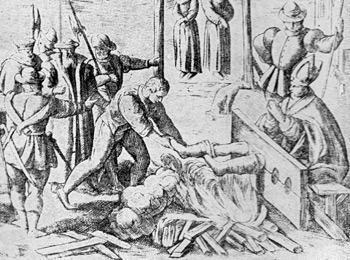
Upon being questioned he admitted to being a Roman Catholic, however any effort to make him inform on other leading Roman Catholic members was to prove fruitless. Lord Justice Sir Henry Wallop and the Earl of Kildare, Thomas Walsingham (Secretary to Queen Elizabeth 1st), both feared that Dr. O’Hurley was actively participating in a plot to overthrow English rule here in Ireland. Walsingham now ordered that Dr. O’Hurley be subjected to torture; accused of being a member of the Roman Inquisition. His torture included the filling of his booted legs with oil, before roasting them over an open fire.
Historian Richard Stanihurst, latter an Irish alchemist, translator, poet and historian, born in Dublin (1547–1618), described his particular gruesome torture: “In the Castle Yard, before the officials of the government, the executioner placed the archbishop’s feet and calves in tin boots filled with oil. They then fastened his feet in wooden shackles or stocks, and placed fire under them. The boiling oil so penetrated the feet and legs that morsels of skin and flesh fell off and left the bones bare.”
Screaming throughout his torturous agony, “Jesus, son of David, protect me”, he persistently continued to protest stating that his mission was one of peace and that he had no information whatsoever to give to his captors.
His captors then resorted to bribery, demanding that he renounce his Catholic faith and embrace Protestantism, but to no avail.
Fearing that they might kill him; his torturers then discontinued their actions and later he was sent for trial by a Military Tribunal, before being quickly sentenced to death.
Execution of Dr. Dermot O’Hurley Archbishop of Cashel.
On Saturday June 20th, 1584, an order for Dr. O’Hurley’s execution was received from England. He was taken early in the morning from his cell in Ship Street, to a swampy area near St. Stephen’s Green, latter then known as Hoggen Green, (Today the College Green/Dame Street area) to be hanged.
We understand that his corpse was thrown into a ditch, where it was later recovered by friends of the Archbishop. Same took his remains and buried them in the small churchyard of St. Kevin in Camden Row, Dublin.
Today the Church is in ruins, but for many years afterwards his burial plot became a place of pilgrimage for many Dublin Roman Catholic believers.
Dr. Dermot O’Hurley remains one of the most celebrated of Irish Catholic Martyrs, and was ‘beatified’[Declared officially to be a holy person, usually the first step towards making them a saint in the Roman Catholic Church.] by Pope John Paul II (Karol Józef Wojtyła 1920 – 2005) on September 27th 1992.
This website uses cookies to improve your experience. We'll assume you're ok with this, but you can opt-out if you wish.AcceptRead More
Privacy & Cookies Policy
Privacy Overview
This website uses cookies to improve your experience while you navigate through the website. Out of these, the cookies that are categorized as necessary are stored on your browser as they are essential for the working of basic functionalities of the website. We also use third-party cookies that help us analyze and understand how you use this website. These cookies will be stored in your browser only with your consent. You also have the option to opt-out of these cookies. But opting out of some of these cookies may affect your browsing experience.
Necessary cookies are absolutely essential for the website to function properly. This category only includes cookies that ensures basic functionalities and security features of the website. These cookies do not store any personal information.
Any cookies that may not be particularly necessary for the website to function and is used specifically to collect user personal data via analytics, ads, other embedded contents are termed as non-necessary cookies. It is mandatory to procure user consent prior to running these cookies on your website.







Recent Comments