Mr Witherow passed away peacefully, while in the care of staff at Fennor Hill Nursing Home, Urlingford, Co. Kilkenny.
His passing is most deeply regretted by his loving wife Kamie; sons Liam, Conor and Michael; his sister Rita; extended relatives; neighbours and friends.
Now the EPA have today published the report for the five-year period 2013-2018.
The key findings are: (1) Some 92% of groundwater bodies, 80% of coastal waters, 53% of rivers, 50% of lakes and 38% of estuaries were found to be of satisfactory quality. (2) Since the last full assessment, however, river water quality has disimproved, with a net decline of 5.5% (128 water bodies) in the status of river water bodies. (3) We are continuing to see a loss of the pristine river water bodies. There are now just 20 pristine river sites; same down from over 500 sites in the late 1980’s. (4) The number of seriously polluted river water bodies (the ‘worst of the worst’) has started to rise; from 6 to 9 after many years of an improving trend. (5) The number of fish kills increased to 40 in 2018, following a historic low of 14 in 2017. It is likely that the hot summer and low flow conditions in 2018 had an impact on this.
Commenting on the assessment, EPA Director Matt Crowe said: “Ireland has made commitments to protect and improve water quality, under the Water Framework Directive and the National River Basin Management Plan 2018-2021. The aim of European and National Water Policy is to get polluted waters clean again, and ensure clean waters are kept clean. However, the findings of this report indicate that water quality is getting worse after a period of relative stability and improvement. We now have an increase in the number of the most polluted river sites, and the number of rivers in poor ecological health is also increasing. Positive trends reported previously by the EPA have reversed. Not only are we failing to improve overall water quality, we are also failing to prevent further deterioration of our rivers.”
Concluding, Ms Mary Gurrie, (Water Programme Manager) said: “The overall increase in nutrient concentrations is a worrying development for our water quality. These excess nutrients come from human activities, predominantly our farms and waste water. We need to address the sources and the pathways by which these nutrients make their way into our rivers and lakes. Good water quality is essential for out health and well-being. The National River Basin Management Plan sets out a programme of measures to protect and improve water quality. It is essential that the measures required are implemented in order to avoid further deterioration and achieve the good water quality which people expect.”
The report Water Quality in Ireland 2013-2018 is now available on the EPA website and the accompanying data used in the water quality assessments are available HERE. An infographic is also available.
Predeceased by her husband Tadeusz; Mrs Wysocka passed away suddenly.
Her passing is most deeply regretted by her sons Mikolay, Karol and Kaspar; grandchildren; daughters-in-law Paulina and Jola; sisters; brothers-in-law; nephews; nieces; extended relatives; neighbours and friends.
The passing of Mr Slattery is most deeply regretted by his loving wife Monica; daughter Catherine; sons Eamon and Bernard; son in law Jon; daughter in law Pam; grandchildren Katie, Amy, Aoife and Macy; brothers Pat and Tom; sisters Anne and Margaret; nieces; nephews; extended relatives; neighbours and friends.
“Thousands of candles can be lighted from a single candle, and the life of the candle will not be shortened. Happiness never decreases by being shared”.
Buddha
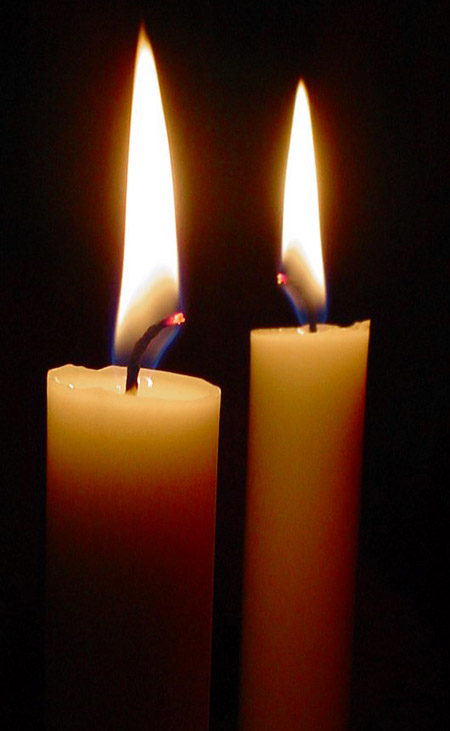
All the 54 years of her married life, every Christmas Eve, up until her death in 1969, Eliza-Jane, my grandmother, placed two candles in the window of our single-story home. She claimed that this tradition, gave a sign of welcome to all who passed our gate, and an invitation to come inside and share our fire.
A wooden slide bolt, on the back of our heavy door, remained pulled back, thus allowing any traveller who “passed the road” to enter, should they arrive after our family had retired to bed.
Should those travellers of course be named Mary and Joseph, then it was better not to advertise that a baby could be in their company. After all, according to the Gospel of St. Matthew, (Chapter 2 – Verse 7), KingHerod; fearing the prophesy handed down in the Old Testament, [Latter found in Isaiah Chapter 9: Verses 6 & 7 ] [Same foretold of the coming of a “Prince of Peace”, whose government would be endless.], had called the three Magi [Named Bithisarea, Melichior and Gathaspa], secretly and had sent them to Bethlehem, saying: “Go, search carefully for the Child, and when you find Him, report to me, so that I too may go and worship Him.” King Herod’s intentions were far from wanting to worship this new born Prince, as we read later and realising this also, the three astute Magi returned home by a different route, to avoid him.
Candle traditions of course change from district to district. Here in the province of Munster, most families lit just one candle; its purpose simply to offer light along the way for Mary and Joseph; on their way to find that stable in Bethlehem. The candle was traditionally lit by the youngest girl in the house, who would also be called upon to extinguish same on Christmas morning.
A house without a candle was seen as unwelcoming, as per the innkeeper who had refused a room to the same Joseph and Mary. In the years prior to and since the Great Famine (1845 – 1849), as emigration left so many Irish families missing a loved one at Christmas, the candle came to be seen more and more as a sign of welcome to those able to afford a visit home.
Another explanation for the lighting of candles in a window at Christmas time, dates back to the time of Na Péindlíthe, (English: Penal Laws). Same period saw the introduction of a series of laws imposed, solely, in an attempt to force Irish Roman Catholics and Protestant dissenters to accept an established Church of Ireland or Protestant faith. Begun in the early 1600’s, practicing Catholicism became outlawed, with priests often forced into hiding, in order to defy the British government’s order that they cease performing Mass and other Sacraments.
According to the Dublin born statesman and philosopher, Edmund Burke, the Penal Laws were, “a machine of wise and elaborate contrivance, as well fitted for the oppression, impoverishment and degradation of a people, and the debasement in them of human nature itself, as ever proceeded from the perverted ingenuity of man.”
However, these laws did little to convert the faith of Irish Roman Catholics. Lit candles on Christmas Eve became a sign that a family was of the Roman Catholic faith and thus candles became an open invitation to any passing priest to come inside and say Mass with the family at Christmas. This feigned welcome for the Holy Family now became an explanation or cover story, used by households when British officialdom queried this “lit – candle” practice during these penal times.
This website uses cookies to improve your experience. We'll assume you're ok with this, but you can opt-out if you wish.AcceptRead More
Privacy & Cookies Policy
Privacy Overview
This website uses cookies to improve your experience while you navigate through the website. Out of these, the cookies that are categorized as necessary are stored on your browser as they are essential for the working of basic functionalities of the website. We also use third-party cookies that help us analyze and understand how you use this website. These cookies will be stored in your browser only with your consent. You also have the option to opt-out of these cookies. But opting out of some of these cookies may affect your browsing experience.
Necessary cookies are absolutely essential for the website to function properly. This category only includes cookies that ensures basic functionalities and security features of the website. These cookies do not store any personal information.
Any cookies that may not be particularly necessary for the website to function and is used specifically to collect user personal data via analytics, ads, other embedded contents are termed as non-necessary cookies. It is mandatory to procure user consent prior to running these cookies on your website.






Recent Comments