|
|
Ireland must stop reacting to individual events and instead start preparing systematically for a climate of greater extremes, says Climate Change Advisory Council.
- Council warns Ireland is increasingly moving between weather extremes, from severe flooding and prolonged rainfall to exceptional heat and drought-like conditions.
- Government urged to put a price on inaction and properly cost climate resilience as Budget 2027 approaches.
- Some 30 of 54 major flood relief schemes remain at preliminary design stage, with major schemes taking an average of 11 years to complete.
Launching Preparing for Ireland’s Changing Climate, the adaptation and resilience chapter of its Annual Review 2026 today, the Climate Change Advisory Council has warned that Ireland’s climate resilience planning and preparation does not match the scale or urgency of the risks the country now faces.
With Budget 2027 approaching, the Council says Government must also better understand the scale and level of investment required in climate resilience. It must also quantify the cost of inaction to determine what continued delay will ultimately cost households, businesses, communities and the State.
The Council says Ireland must prepare for the full range of climate extremes rather than treating storms, floods, droughts and periods of extreme heat as isolated emergencies. It is calling for a fundamental shift from reactive response to proactive adaptation, backed by long-term planning and sustained investment.
Storm Chandra and prolonged rainfall exposed vulnerabilities in homes, transport and critical infrastructure earlier this year, while unprecedented summer temperatures highlighted growing risks to water supply, agriculture, health systems and vulnerable communities.
The Council says climate resilience must be built into long-term decisions across critical infrastructure and essential services. Sectoral adaptation plans published in November 2025 are not comprehensively costed, lack committed funding and measurable targets, and do not consistently align actions with identified climate risks.
Flood protection is one clear example of the ever widening delivery gap as growing climate impacts rapidly outstrip our response.
Eight years after they were prioritised through the 2018 national flood risk assessment, 30 of the 54 major flood relief schemes remain at Stage 1 – preliminary design, while major schemes currently take an average of 11 years to complete. The Council says technical expertise and staffing within the Office of Public Works and local authorities must be strengthened to accelerate delivery.
It also warns that short-term pressures must not create new long-term climate risks. Over the past six years, 288 flood-prone sites have been proposed for rezoning by councillors. As pressure grows to expand housing supply, the Council says climate risk must remain central to planning decisions and development in flood-prone areas must be avoided. In addition, these zones will expand with further climate change with many areas previously not flooded becoming increasingly prone to flooding.
The Council is also calling for stronger local and community resilience, including building sustained capacity within local authorities and better support for households, businesses and communities to prepare for and recover from extreme weather.
The Council has expressed considerable disappointment that the Extreme Weather Event Assistance Scheme, committed to in the Programme for Government 2025, has still not been established. It says the absence of a permanent and properly resourced scheme remains a critical gap for households, communities, farmers and businesses following extreme weather.
Professor Peter Thorne, Chair of the Climate Change Advisory Council’s Adaptation Committee, said: “Ireland is already living with the consequences of a changing climate. This year alone, we have moved from severe flooding and prolonged rainfall to exceptional heat and drought-like conditions. We are not prepared for either extreme.
The recent UNEP publication tells us that we will exceed 1.5˚C of warming and that some impacts of climate change are now unavoidable and we must make decisions today to prepare for our future.
By far the most effective adaptation measure is emissions reductions that avoid future impacts. Government must accelerate mitigation actions while also taking action to protect society from the coming storm. Adaptation is not an alternative to getting off our addiction to fossil fuels.
We cannot keep treating extreme events as one-off emergencies, simply repairing the damage, while people continue to live in fear of the next major event. We need to build back better and take measures to protect vulnerable homes, communities, infrastructure and public services before the next crisis hits.
Government needs to put a price on inaction to improve investment decisions and track delivery, fund the measures we know are needed and move from plans to delivery. Climate resilience will cost money, but the cost of inaction will be far greater. .”
It was with great sadness that we learned of the death yesterday Sunday 27th September 2026, of Mr James (Jim) Molloy, Prospect, Drangan, Thurles, Co. Tipperary and formerly of Talbotsinch, Co Kilkenny.
In his 90th year, and pre-deceased by his daughter Colette, sons Patrick and Declan; Mr Molloy passed away peacefully, surrounded by his loving family, while in the care of staff at South Tipperary University Hospital, Clonmel, South Co. Tipperary.
His passing is most deeply regretted, sadly missed and lovingly remembered by his sorrowing family; loving wife Margaret (of 64 years), sons James (Jockey), Michael, Kieran, John and Dermot, daughters Rosie, Joan and Rebecca, brothers-in-law John (Jack) and Ian (Hickey), sisters-in-law Mary, Frances, Barbara and Finola, adored grandchildren, sons-in-law, daughters-in-law, extended relatives, neighbours and a wide circle of friends.
Requiescat in Pace.
Funeral Arrangements.
The earthly remains of Mr Molloy will repose at Brett’s Funeral Home, Kickham Street, Mullinahone, Thurles, (Eircode E41 EV78), on Wednesday afternoon, September 30th, from 5:00pm until 7:00pm same evening.
His remains will be received into the Church of the Immaculate Conception, Drangan, Thurles, Co. Tipperary, (Eircode E41 YD73), on Thursday morning, October 1st, to further repose for Requiem Mass at 12:00 noon, followed by interment, immediately afterwards in St Mary’s Cemetery, Drangan, Thurles, Co. Tipperary, (Eircode E41TW40).
The extended Molloy family wish to express their appreciation for your understanding at this difficult time, and have made arrangements for those persons wishing to send messages of condolence, to use the link shown HERE.
“The Molloy family would like to express their heartfelt gratitude to all those who cared for Mr Molloy throughout his illness, especially all the staff of Medical 2B Ward, University Hospital, Clonmel, South Tipperary.
The family also wish to thank everyone who has shown such kindness, support and sympathy during this difficult time. Your thoughtfulness and prayers are deeply appreciated”.
Ar dheis Dé go raibh a anam dílis.
It was with great sadness that we learned of the death yesterday Sunday 27th September 2026, of Ms Teresa (Tess) Lyons, Kilkennybeg, Killenaule, Thurles, Co. Tipperary.
Pre-deceased by her parents James and Margaret, sisters Gertie, Mary, Jenny, Rita, Kathleen and brother Jimmy; Ms Lyons, sadly, passed away peacefully following a long illness at ‘Tír na nÓg’ Pallative Care Unit, Our Lady’s Hospital, Cashel, Co. Tipperary.
Her passing is most deeply regretted by her sister Betty, brothers Din and John, sister-in-law Bridie, brother-in-law Billy, nieces Sharon, Denise, Lisa, Clare, Sarah, Tanya, nephews Jason, Gerard, James, Michael, grandnieces, grandnephews, extended relatives,neighbours and friends and her faithful and adored dog Prince.
Requiescat in Pace.
Funeral Arrangements.
The earthly remains of Ms Lyons will be received into the Church of St Mary, Bailey Street, Killenaule, Thurles, on Thursday morning, October 1st, at 11:30am, to repose for Requiem Mass, followed, immediately afterwards, by interment in Crosscannon Cemetery, Killenaule, Thurles, Co. Tipperary.
For those persons who would wish to attend Requiem Mass for Ms Lyons, but for reasons cannot, same can be viewed streamed live online, HERE.
The extended Lyons family wish to express their appreciation for your understanding at this difficult time, and have made arrangements for those persons wishing to send messages of condolence, to use the link shown HERE.
Note Please: House Strictly Private.
“The Lyons family would like to express their deep gratitude for their kindness and care of the staff of Tipperary University Hospital Clonmel and the Cashel Palliative Care Hospice.”
Ar dheis Dé go raibh a h-anam dílis.
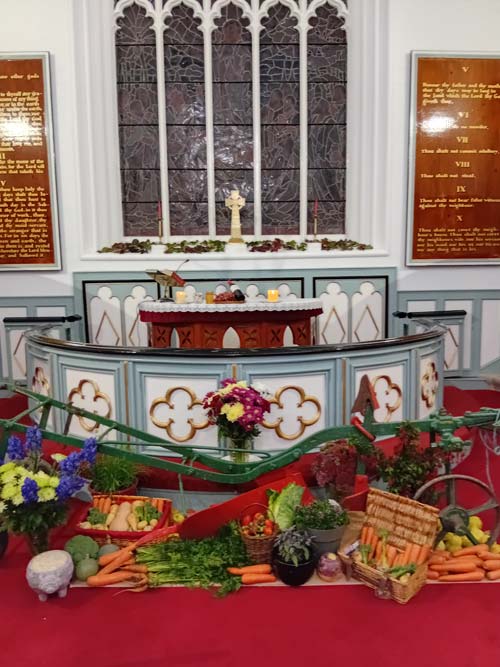
On Sunday, September 20th last, the now customary autumn service of prayer and thanksgiving was held in Saint Mary’s Church of Ireland, Littleton.
Two-Mile-Borris, Press Correspondent Mr Gerry Bowe Reports:-
The high church spire, which can be seen from all parts of the village, is a daily reminder of our local Christian heritage dating back to 1786. Great credit is due to the Church of Ireland community who despite structural damage, costly interior decoration followed by a fire have kept this building beautiful and safe for future generations.
The Venerable Robin Bantry-White, (Temporary Rector), welcomed members of the Moycarkey – Borris – Littleton parish with their recently appointed parish priest Fr Dominic Meehan. He also praised the work of former clergy that have over many years built good relations between the Catholic and Church of Ireland communities. He is looking forward to a joint celebration, on Good Friday next, in the Church of Our Lady and Saint Kevin’s.
The visiting preacher on the night was the Very Reverend Mairt Hanly, (Dean of Leighlin).
With a few rods and a piece of canvas he assembled a small tent to help us understand a passage from the Old Testament, (Leviticus 23:42). “You shall live in booths (tents) for seven days so that your generation may know that I made the people of Israel live in booths when I brought you out of the land of Egypt.
Sukkot, the Feast of Booths, is a seven day celebration observed at harvest time by Jewish communities worldwide. For a migrant nomadic people it was a seven day celebration of past blessings and a fruitful harvest.
Some people present on the night may have remembered that a previous rector the Reverend Ian Cruickshank, distributed chocolate smarties as a reminder of our duty of gratitude for the bits and pieces of our everyday lives. Words may be forgotten but the images of tent and smarties remain.
Others may have recalled that over twenty five years ago, Annie Cawley, one of Littleton’s saintly Traveller ladies, lived in a barrel topped wagon alongside the walls of Saint Mary’s Church. She had lived previously in a small canvas tent under the shade of a ditch in the nearby townland of Ballyerk. Her sincere “God bless you”, was felt by all who called. Like other members of her Traveller Community who had often travelled long, hard, lonely and hungry roads, she could understand at a much deeper level than most, the trials, hardships and blessings of her nomadic Jewish ancestors.
In the 1960’s members of the Dublin Bewley family of Quaker and Coffee tradition, provided free canvas to the Traveller Community for their tents and wagons.
In later years, Fr James Meehan, (no relation to Fr Dominic), helped provide them with caravans. This was a major move from tent to better conditions in a caravan. Many have since made their home in our wider parish area.
Our thanks to Diocesean Reader Mr Tommy Cooke who prepared a prayer of thanksgiving for the work of many hands that give us “our daily bread” at the table. He prayed God’s blessings on all who plough and till the fields, who sow and reap the crops, who process, pack, market, distribute, sell, flavour and cook our food.
In spite of changing weather patterns we can rejoice and give thanks for this years rich and bountiful harvest.
After the ceremonies it was time for tea and chat, chance to meet old friends and catch up on local news.
A final thanks to all who decorated the church and altar with fruits of the harvest and to those who continue maintaining this building in excellent condition for future generations.
Pressure is growing on the Government to address Ireland’s high fuel and energy costs ahead of Budget 2027.
More than 1,000 people attended a public meeting in Moate, Co Westmeath, where organisers warned that further protests could follow if the Budget does not deliver meaningful reductions in fuel costs.
Among the demands raised was the complete abolition of the carbon tax on fuel, alongside further reductions in other fuel taxes and additional support for households, farmers, hauliers and businesses struggling with rising costs.
The debate comes as motorists continue to face significant prices at the pumps. September figures from AA Ireland showed petrol averaging around €1.87 per litre and diesel around €1.94 per litre.
The Government has already introduced temporary excise reductions and postponed some planned tax increases. However, those measures are temporary, and decisions on what happens next are expected to form part of Budget 2027, on October 6th.
Representatives of the haulage sector have also warned that further fuel protests cannot be ruled out, if businesses continue to face unsustainable diesel costs.
With the Budget approaching, the key questions now are whether existing fuel-tax reductions will be extended, whether further relief will be introduced, and what decision will be made on carbon-tax measures.
For households and businesses depending heavily on fuel, the outcome could have a significant impact on costs heading into the winter.
|
Support Us Help keep Thurles.info online by donating below. Thank you.
Total Donated 2026: €300.00
Thank You!
Daily Thurles Mass Livestream
|







Recent Comments