|
|
Anyone with even the slightest doubt as to President Barack Hussein Obama’s Irishness, take a look at this short clip.
Last night, President Obama and First Lady Michelle Obama hosted an incredible group of performers for a night of blues music as part of the PBS “In Performance at the White House” series.
After a little encouragement from the legendary B.B.King, the President, in true Irish fashion, took the mic from rock legend Mick Jagger, and sang a few lines of, “Sweet Home Chicago.”
Blues music has humble beginnings with roots in slavery and segregation, in a society that rarely treated black Americans with the dignity and respect that human beings deserve and expect.
So maybe on St Patrick’s day (Irish:Lá Fhéile Pádraig,) when he accepts the Irish Shamrock, he might give us a belt of “The 40 Shades Of Green,” and raise our spirits not just here back home in Tipperary, but for all Irish emigrants everywhere.
Mr President even the chorus would do:-
But most of all I miss a girl in Tipperary town
and most of all I miss her lips as soft as eiderdown
I long again to see and do the things we’ve done and seen
where the breeze is sweet as Shalimar and there’s Forty Shades of Green.
It’s the day that we are informed that the former Irish Nationwide chief executive, Mr Michael Fingleton transferred €500,000 to an offshore bank account in Podgorica, just after he was hit with a €13.6m debt order by Ulster Bank. It is the day we learn that Financier Derek Quinlan, who reportedly owes €200 million personally to Nama, continues to live and pays €4,144 in weekly rent, for the right to reside in a period mansion in London. It is a day when it is confirmed that rising costs now leave elderly people in difficulty or unable to heat their homes.
Where Are Our Taxes Going?
Do please take the time to watch this short video hereunder and weep. This is real democracy, at least appearing to exist, in a country containing some 310,000,000 residents, while here on our island, home to 4,400,000 souls and rapidly decreasing, we have no voice as to how our future is to be directed. The last General Election has taught us that the Irish electorate are, in desperation, close to accepting the Government of this nation by nihilists – Sinn Feiners, Mings, and Micks who fuel protest, without offering any fair solutions to our current difficulties.
I do hope our readers have kept a copy of yesterday’s (January 21st 2012) ‘Sun,’ newspaper, where we are entertained with the headline, on page two, “Minister (Phil Hogan) Admits New Tax Is Unjust.” My Dictionary defines ‘Unjust,’ as “inequitable, partial, unfair, prejudiced, biased, undeserved, unmerited, unjustifiable, not just; lacking in justice or fairness.” With most homes in this country in joint ownership, the keeping of this paper could be used as justified defence evidence, when wives and husbands stand before “Your Honour” to explain why they refuse to pay Minister Phil Hogan’s admitted ‘inequitable,’ €100 Household Charge, which came into effect this month.
Here in Tipperary we ask a series of questions:- What are our taxes used for? Why do we continue to pay bankers annual salaries of €500,000 for work more perceptively undertaken by Credit Union managers, latter earning less than €120,000? Why are we being asked to pay for water carrying lime and other impurities, which rots our copper piping and in most cases from day to day, is undrinkable ? Why is rural Ireland continuously being robbed, to support a Dublin economy, while senior Cabinet Ministers continue to squirrel away any available funding to their own constituencies, bolstering their outcome in future elections? How long will Unions continue to dictate how our Civil Service is run?
Our Libraries, Schools and Courthouses are being threatened with closure, our waste collections systems have been privatised, our streets, pavements and roads are a national disgrace. Local justice, law and order are sliding down the slippery slope, while rape, stabbings and murder are now daily acceptable happenings.
Here in Tipperary, due mainly to a sort of ‘resigned acceptance,’ we continue to elect and support public representatives, with no power at the Cabinet Table and even less ability to protect and reform that which was gifted to us via Bertie, Builders, Bankers and the Galway Tent.
How long can we afford this resigned acceptance?
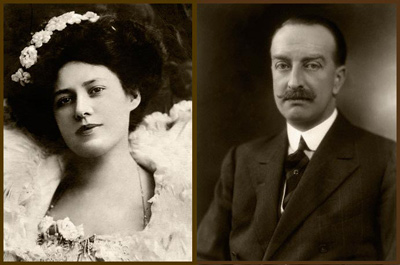 Rosie and the Marquess of Headfort Highlights of the May 2012 “Irish Art Sale,” by Sotheby’s Auction House in London, will go on view in Dublin at No 16 Molesworth Street, on April 24th and 25th and will include two portraits by Dublin born, Sir William Orphen, Ireland’s if not the world’s greatest portrait painter.
Interestingly both of these portraits in this auction have strong Thurles associations to this very day. The portraits are of the glamorous music-hall star Rosie Boote and a Co Meath aristocrat, Geoffrey Thomas Taylour, 4th Marquess of Headfort DL, JP, FZS (1878 – 1943) both of whom were to enthrall and scandalised Edwardian society in 1901.
Rose Boote, (1878-1958) or ‘Miss Rosie Boote,’ latter her later stage name, was the only daughter of Charles Boote, a comedian and while little is known of her mother, it was believed she was a straw hat sewer.
Rose however was sent to the Ursuline Convent School in Thurles in the 1890’s to be educated. The Ursuline Convent then, as now, had a high reputation in educational circles, renowned for their proficiency in turning girls into young, well educated ladies, who could take their place even in the highest society.
Having left the Ursuline Convent School in Thurles, Rose, possibly through connections of her father, was introduced to George Joseph Edwardes, (1855–1915) an English theatre manager, born ‘George Edwards,’ a native of Co Wexford, Ireland. George had introduced a new era into musical theatre on the British stage.
George now introduced Rose to the stage as one of his ‘Gaiety Girls,’ where she achieved great acclaim. Gaiety Girls were the chorus girls of Edwardian musical comedies, which had its beginning earlier in the 1890s, at the Gaiety Theatre, on the Strand, London. The sudden popularity of this genre of musical theatre depended, mainly on these beautiful dancing troupes of “Gaiety Girls” appearing onstage in bathing attire and in the latest fashions from London and Paris.
Gaiety girls were considered polite, educated, well-behaved young women, unlike those corseted actresses from London’s earlier musical burlesque shows. They became a popular attraction and a symbol of ideal womanhood, soon attracting the attention of aristocratic young men, known as “Stage Door Johnnies.” These young men would often wait outside the rear stage door in the hope of escorting one of these young ladies to dinner. Rose’s mentor, Edwardes had arranged with Romano’s Restaurant, on the Strand, for his girls to dine there at half-price. It was good exposure for his girls and made Romano’s Restaurant the embodiment of London’s night-life.
Continue reading Thurles Gaiety Girl Rosie Boote Scandalises Edwardian Society
The purpose of the community website Thurles.Info, since its conception just over 3 years ago, was to highlight issues which effect our wonderful town of Thurles, its people, its businesses and environs. To record and highlight our magnificent history, our successes and our failures, but most of all to give a voice to our residents on issues which effect their everyday lives. Our success has gone beyond our wildest dreams, with close to half a million readers, world wide, having visited our site over the past 30 months.
Our aim in 2012 is to continue to pursue these aspirations, following in a similar vein and yes your voice does count, so do please comment on issues raised and let your views be aired publicly. Debate will contribute to real and positive change, for the betterment of all, here in Co Tipperary. In the words of Google today, “Geniuses are not always A grade students. We welcome all mavericks.”
What is our “Rant” today? Well most of us have had an opportunity to read our local weekly newspaper the “Tipperary Star,” and in particular, the article by journalist Sinéad Goldsboro, headed “Angry Visitor Lashes Thurles Signage.”
Well in the words of Frederick R. Barnard “One look is worth a thousand words.” These pictures were taken just yesterday and highlight / confirm that local government is just not working.
This signage has been in this totally unacceptable state, since November of last year. Each week our salaried, expenses guzzling Politicians, our Local and County Councillors drive out the Dublin road and around our town, but it would appear not one of them has any influence over the National Roads Authority (NRA).
(1) Sign to our only tourist attraction, St Mary’s Famine Museum, was destroyed by County Council workers, during work on the Cathedral Street Roundabout two years ago, and re-erected as if nothing happened, please replace.
(2) Thurles Shopping Centre is not on the Nenagh Road as is currently directed.
(3) Many signs face blank walls.
(4) Traffic lights are being removed by large vehicles or are bent. Truth is that 80% of all signs are no longer standing perpendicular due to disgraceful planning.
What you have viewed here is just a fraction of our towns neglect.
Message to our Politicians, our Local and County Councillors, Sirs, we have paid our taxes, please now provide the promised services.
New Year’s Eve is one night when the world comes together to celebrates love, forgiveness and even hope. People come together to celebrate their survival and look forward longingly, in some cases, for that second chance and perhaps a new start.
Younger people, aged 18 to 34 years, are more likely to go out to a public place this New Years Eve, while older people will probably spend New Year’s Eve at home or at a friend or family member’s home. So whatever you get up to, please do stay safe and do remember that New Years Eve is the worst holiday night of the year for those who insist on driving after drinking.
So parents do have a chat with your children before they head off this evening. Despite their protest, warn them about the dangers of driving under the influence of alcohol, drugs and fatigue, as well as how to be both a good driver and yes, also a good passenger.
Remember teenagers are less likely to drive drunk, when parents lay down some concrete safety ground rules, so do insist and even offer your services to transport those family members anxious to celebrate in the party mood.
From Brian and myself here at Thurles.Info, may we wish you and yours, far and wide, a happy and prosperous New Year in 2012.
|
Support Us Help keep Thurles.info online by donating below. Thank you.
Total Donated 2026: €300.00
Thank You!
Daily Thurles Mass Livestream
|



Recent Comments