The picture, hereunder, highlights once again the waste tolerated by Thurles, Co. Tipperary taxpayers.
Recently the narrow roadway stretching from Butler Avenue unto Innisfallen Avenue, had a number of Flexbrite Flexible Bollards (each costing we understand €49.50 ex VAT) installed on the footpath on the aforementioned stretch of Roadway in recent months. The reason for their installation possibly was to highlight the edge of the footpath and to avoid traffic mounting an area where pedestrians are fully entitled to walk.
The word “Flexible” [meaning capable of bending easily without breaking] appears to be false advertising by the manufactures, so let us get our money refunded
The word “Flexible” also meant absolutely nothing to the engineer or administrator who instructed same to be erected, at a cost of at least surely €I,000; including their installation.
Thankfully, no one was walking on the footpath when large vehicles traversing this area, collided with these bollards, in a bid to avoid a now choked Liberty Square town centre.
As for the bent road sign on Butler Avenue, near Bowes Corner, “Joe Soap Got It Right Again”, Read HERE.
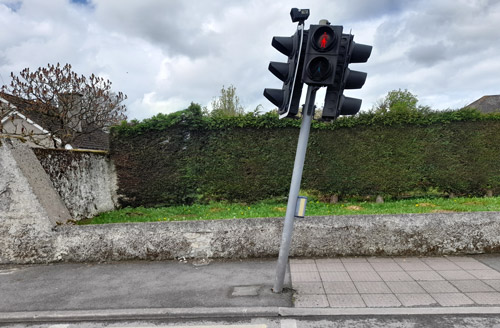
The Leaning Pedestrian Crossing lighting standard, Brittas Road, Thurles, Co. Tipperary Pic: George Willoughby.
One of the Pedestrian Crossing lighting standards, situated on Brittas Road, Thurles, (N62) continues to stands, bowing in a northerly four-degree lean. While some believe this phenomenon is designed as a tourist attraction, and as yet not advertised as part of the 10 things you need to know about Ireland’s Ancient East. Sorry folks, this is not an attempt to emulate the leaning, yet free-standing bell tower of Pisa in Italy.
What Happened Was!
What happened was that an unsuspecting vehicle driver, obviously a fluent Irish speaker and possibly travelling south, noticed the blatant misspellings and grammar errors relating to two of our directional signposts*. Having briefly taken his/her eyes off the road, a devious Pedestrian Crossing lighting standard; taking advantage of this situation, and without any warning, jumped out in front of the oncoming vehicle, striking it before hopping back into its original place. No, thequalified Tipperary Council engineers, who have recently taken it upon themselves to construct narrower streets, leaving signposts too close to the edge of pavements are not responsible, as some would secretly claim, latter harbouring such unspoken thoughts behind closed doors.
*Within five hundred yards of each other are two signs both displaying grammatical misspelling of our native language. The housing estate direction sign entitled ‘Cluain Glas‘, (English translation – “Green Field”). Correct spelling should read ‘Cluain Ghlas‘. Just a few yards closer to Thurles town we find the housing estate direction sign ‘Gort na tSagaire‘, (English translation – “The field of the priest”). Here we find two mistakes. Correct spelling should read ‘Gort an tSagairt‘. Latter correct spelling can be found in the official book “Liostaí Logainmneacha Contae Thiobraid Árann (County Tipperary)” same published in 2004, by the place-names Branch of the Department of Community, Rural and Gaeltacht Affairs.
Three neglected road signs situated on Mill Road, Thurles, all within 800 metres of each other.To avoid a choked Liberty Square; this is the same route now being used to avoid Thurles town centre altogether.For Gardaí anxious to get a few prosecutions under their belts, before the end of each month, this is the place to sit and point your Traffic Radar Gun. Pic: George Willoughby.
Signs in the neglected town of Thurles are not to be trusted. (See the picture above). These signs hide behind hedges, turn their faces in the opposite direction and even resort to camouflage, in an effort to fool and confuse unsuspecting, oncoming and unwary motorists.
Two of societies golden rules remain as good today, as they have been in the past.
“What rules are they“, I hear you say.
*A person can check out the cleanliness of a hotel, by the state of its toilets. * A person can check out a communities pride in its self, by the state of its local cemetery.
State of St. Patrick’s Cemetery Loughtagalla, Moyne Road, Thurles, Co. Tipperary. Pic: G. Willoughby.
While individual family graves in St. Patrick’s Cemetery Loughtagalla, Moyne Road Thurles are kept in pristine condition, maintenance under the control of Thurles Municipal District Council, leaves a lot to be desired.
[See image above of the area upon which people are being asked to walk in an effort to reach nearby family graves.]
It is also worthy of note that St. Patrick’s Cemetery, situated at Loughtagalla, Moyne Road, Thurles, is one of the very few graveyards in Tipperary which does not list those interred there on the internet, other than one very brief mention on the charity website Commonwealth War Graves Commission.
With people across the world anxious to trace their family histories, surely a website identifying graves in St. Patrick’s would greatly benefit in attracting tourists to an area where Tipperary Co. Council has deliberately and with great success, totally destroyed the town’s past existence.
Provisional road collision figures, in the Irish Republic, show that the number of road deaths in 2022 increased by 13% compared to 2021.
2022 saw the doubling of pedestrian deaths.
Drivers account for 39% of fatalities.
Counties Cork (13), Dublin (13) and Limerick (10) recorded highest number of fatalities with Co. Tipperary (7), featuring in joint 8th position.
1,292 people seriously injured.
Almost 1 in 5 drivers and passengers killed were found not to have been wearing a seatbelt.
Road Deaths Per County
Road User.
2021
2022
Difference
Drivers.
70
60
-10
Passengers.
18
22
+4
Motorcyclists.
22
23
+1
Cyclists.
7
7
0
Pedestrians.
20
41
+21
E-Scooter Driver/Passenger.
0
1
+1
Other.
0
1
+1
Total.
137
155
+18
According to the Irish Road Safety Authority; a total of 155 people died in 149 fatal road collisions in 2022, compared to 137 deaths in 124 fatal road collisions in 2021. This represents an increase of 18 deaths or a 13% rise in road fatalities compared to last year.
[The figures were published by the Road Safety Authority (RSA) today Sunday, January 1st 2023, following an analysis of provisional fatal collision reports from An Garda Síochána.]
The figures also indicate that the number of pedestrians killed in 2022 (41, +21) doubled, when compared to 2021. Despite a decrease in the number of drivers killed (60, -10), drivers still accounted for the highest proportion of fatalities at 39%. The number of passenger fatalities increased (22, +4) a 22% increase. A total of 7 cyclists were killed in 2022, the same number as 2021.
Provisional figures for serious injuries indicate that 1,292 serious injuries were recorded up to the 29 December 2022, compared to 1,342 up to the same period in 2021.
Where it was possible to establish the use of a seatbelt or not among drivers and passengers killed, a total of 19% were found not to have been wearing a seatbelt.
Ireland will no longer recognise Russian travel documents issued in occupied foreign regions.
The Minister for Justice is today announcing an amendment to the Short Stay Visa Waiver Scheme in respect of citizens of the Russian Federation and Belarus.
Russia(left)& Belarus(right)flags flying side by side.
The Short-Stay Visa Waiver Programme is established under Article 3 of the Immigration Act 2004 (Visas) Order 2014 (S.I. No. 473 of 2014), as amended. The Short-Stay Visa Waiver Programme allows nationals of certain countries , who have entered the United Kingdom on foot of certain UK short stay visas, to travel to Ireland without the requirement to obtain an Irish visa. They instead may use the time remaining on their current leave to remain in the UK.
The Russian Federation and Belarus are currently listed, under Schedule 3 of the Order, as countries whose nationals may avail of this Scheme. The Cabinet has today noted that the Immigration Act 2004 (Visas) Order 2014 will be amended by the Minister for Justice to remove the Russian Federation and Belarus from the list of countries who may avail of this Scheme.
In announcing this change today the Minister for Justice, Mrs Helen McEntee T.D. stated, “The decision of the Russian Federation to invade Ukraine, and to recognise a number of non-government controlled areas, including Donetsk and Luhansk, as independent entities is a severe breach of international law. Ireland continues to support action at a European (EU) and United Nations (UN) level to call for an end to the unjustified war on Ukraine. With active Irish support, the EU has initiated the largest ever package of sanctions against the Russian leadership.
While, as a non-Schengen Member State, Ireland is not bound to comply with the Schengen approach. However as well as always requiring individual visa consideration for applications made directly to Ireland, I have today recommended to the Government that we fully align our policy on waiver of visas granted in the United Kingdom. I have now signed a Statutory Instrument to remove Russia and Belarus from the list of countries who may avail of the Short Stay Visa Waiver Programme in light of the continued Russian aggression against Ukraine.”
The Minister also announced that, in relation to the Russian practise of handing out ordinary Russian passports to residents of non-government controlled areas in Ukraine and Georgia; “The Government is clear that this is a grave infringement of international law and the territorial integrity, sovereignty and independence of both countries. In alignment with the approach being taken by the Schengen Member States, Irish authorities will not recognise Russian passports issued in occupied foreign regions for the purpose of issuing visas and crossing external borders.”
The Short-Stay Visa Waiver Programme will now only relate to the following: – Bahrain, Bosnia and Herzegovina, Columbia, India, Indonesia, Kazakhstan, Kosovo, Kuwait, Montenegro, Oman, People’s Republic of China, Peru, Philippines, Qatar, Republic of North Macedonia, Saudi Arabia, Serbia, Thailand, Turkey, Ukraine, Uzbekistanand Vietnam.
In relation to visa applications from Russian citizen, Ireland currently assesses all visa applications from Russian nationals on a case by case basis. Every application is assessed according to criteria appropriate to the category of visa sought and includes evidence of financial standing, health insurance, and where appropriate, an employment permit etc. Checks are also carried out for any adverse immigration history or criminal record.
This website uses cookies to improve your experience. We'll assume you're ok with this, but you can opt-out if you wish.AcceptRead More
Privacy & Cookies Policy
Privacy Overview
This website uses cookies to improve your experience while you navigate through the website. Out of these, the cookies that are categorized as necessary are stored on your browser as they are essential for the working of basic functionalities of the website. We also use third-party cookies that help us analyze and understand how you use this website. These cookies will be stored in your browser only with your consent. You also have the option to opt-out of these cookies. But opting out of some of these cookies may affect your browsing experience.
Necessary cookies are absolutely essential for the website to function properly. This category only includes cookies that ensures basic functionalities and security features of the website. These cookies do not store any personal information.
Any cookies that may not be particularly necessary for the website to function and is used specifically to collect user personal data via analytics, ads, other embedded contents are termed as non-necessary cookies. It is mandatory to procure user consent prior to running these cookies on your website.






Recent Comments