|
|
A warning to all drivers using the Mill Road out of Thurles, exiting from the N75 (Dublin Road) to Littleton & Turtulla Cross.
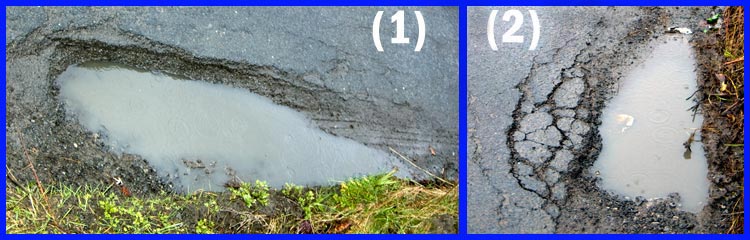
These Pictures Do Not Lie!
Due to increased use by heavy duty trucks and other motor vehicles, attempting to avoid necessary roadworks at Barry’s Bridge, Thurles, two seriously dangerous potholes have now been created.
The holes are situated on the left-hand side, on centre of the sharp second S-bend corner, as drivers cross the Drish River, (opposite the rather lovely reed thatched house on the right-hand side, at Lady’s Well); as drivers exit the town from the Dublin Road (N75), travelling South to Littleton (going left), and West to Turtulla Cross (going right).
The pothole pictured, marked (1) above is over 1 metre in length; almost ½ metre in width (see sides on image) and is about 26 centimetres deep. Same is quite capable of doing serious damage to any vehicle’s tracking, or in a worst scenario, force a driver to lose total control of their steering.
Picture (2) above is only a metre away from (1), with the road structure showing similar signs of disintegration. Both holes are not immediately visible to any driver.
In the words of Albert Einstein, when it comes to those who plan our roads: “Only two things are infinite, the universe and human stupidity, and I’m not sure about the former”.
This narrow short stretch of road [known affectionately, locally, as “Fat Arse Boulevard” ], without footpaths, stupidly displays “hasten signs” allowing for speeds of 80k per hour. This is despite being used regularly by Driving Testers, Walkers, Joggers, Learner Drivers, Dog Walkers, Pram Pushers, Children & Teenagers (grouped together), our late departed flattened Tom Cat, and even boasts a Housing Estate plus an S-Bend on a Humped-Back Bridge.
Surely this Road; and not the vehicles driving thereon, should now be given an NCT.
You have possibly seen the film “Three Billboards Outside Ebbing, Missouri,” a 2017 drama film written, directed, and co-produced by Martin McDonagh and staring Frances McDormand as a mother who rents three billboards to call attention to her daughter’s unsolved murder.
It seems nowadays this kind of action is the only way to highlight neglect and injustice, as large rural Irish towns are abandoned in favour of overcrowded, dirty, crime ridden, sprawling cities.
Large and small business owners and their employees, operating in the heart of Thurles town, found themselves almost completely cut off from customers arriving from the east side of the River Suir yesterday, with both Thurles river crossings operating a ‘Stop & Go’ system of traffic control, because of two separate sets of road works.
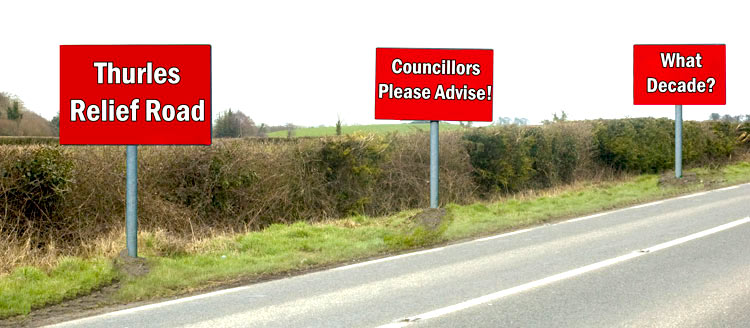 Three Billboards Outside Thurles, Co. Tipperary Business people are aware and fully accept the necessity of repairing the long neglected Barry’s Bridge, but were not expecting the simultaneous and unnecessary road works begun yesterday on the Mill Road, (at the Y junction joining Thurles with Littleton Village and exiting unto Turtulla crossroads).
Traffic from the eastern parts of town had reverted to using this narrow dangerous Mill Road, as an alternative route to reach the centre of Thurles, thus avoiding the crossing at Barry’s Bridge, on the advice of redirection signs posted.
Because of the works being carried out on the Mill Road junction, traffic decided to travel instead once again via the single lane over Barry’s Bridge yesterday, taking vehicles 26 minutes to travel less than ½ a kilometre, with traffic tailed back to the Borroway roundabout. Similar tailbacks occurred on the narrow, and dangerously twisting track that is the Archerstown Industrial Estate exit, all due to a lack of basic logistical communication.
Huge anger is now being expressed by business people, with demands being made that Tipperary County Council immediately state when the promised Thurles Relief Road, announced as being funded under the recent National Development Plan, will actually materialise.
This Thurles Relief Road was already approved by An Bord Pleanala in 2014, however funding had then been withdrawn by the governing Fine Gael / Labour Collision.
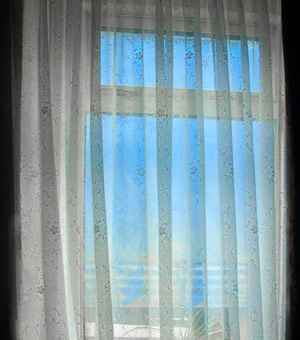 For this front window view of a high sided diesel-spewing 12-wheeler lorry, we must pay the highest rate of property tax in Ireland. The planned relief road, subject to conditions expected to be laid down by the Department of National Parks and Wildlife, together with the appointment of an archaeologist to monitor all intended site developments, was agreed to commence from the Clongour area of Thurles to the rear of the present old Erin Foods site, before crossing the river to exit onto the Mill Road, south-east of Thurles Town.
More importantly, residents living on narrow Thurles Streets, e.g. Croke Street, Mitchel Street, Parnell Street, Kickham Street, O’Donovan Rossa Street etc, are now obliged to live with electric lights burning all day in their front rooms, due to slow moving 12 and 18-wheeler, high sided lorries, vibrating their homesteads, while almost at a standstill, due to this now necessary, but nevertheless previously neglected road works.
I am referring of course to those residences who lack front gardens and, in the interest of community pride, are forced annually to paint their homes at least once each year, caused due to the filth from heavy duty vehicles, being splashed on the outer walls of their homes.
These residents are what author Uaitéar ÓMaicín’s (1915-1967) called “The Silent People”, on whom property tax was piled; increased with the permission of elected representatives; and who are forced daily to breath endless diesel pollutants containing unburned hydrocarbons, carbon monoxide (CO), nitrogen oxides (NOx) and other fumes; while having to wash the soot from their curtains every week, because they felt the need to open a window.
While today here in Thurles half of our population can’t cross the River Suir, the National Transport Authority (NTA) have announced plans in Dublin for a €3bn underground / over ground Metro service for Dublin. Ms Anne Graham, NTA Chief Executive said the 26km track should be operational by 2027, if it succeeds in the planning process, (Which means this project is already well advanced). This Metro service line will run from Sandyford in south Dublin to beyond Swords in north Dublin, taking in Dublin Airport. This service is expected to travel over ground from Sandyford to Charlemont, before vanishing underground to the airport.
The 26km distance, will, NTA boast, mean a journey time of just 20 minutes from the city centre to Dublin airport and 50 minutes from Sandyford to Swords, with trains travelling every two minutes in each direction. (Compare these drive times in Thurles, 26 minutes, to travel just ½ a kilometre.)
How long more the residents and businesses here in Thurles will continue their silence; we can’t be sure, but patience is most certainly running out fast. This lack of patience was previously highlighted when it was decided that Fine Gael TD’s, in government would no longer be elected in the county, and were found to be totally eradicated following the last General Election results held on Friday February 26th 2016.
Already there are whisperings to boycott local elections, because of town centre parking charges. Charges to commuters using Irish Rail for example and who park their cars at Thurles railway station, must now pay €4.50 on top of the cost to their over priced, standing room only, rail tickets, making it cheaper to simply drive to our larger cities.
With Local Elections due to be held in all local government areas of the Republic of Ireland in June 2019, and National Elections expected this autumn of 2018; politicians be warned, the days of receiving salaries for simply updating their social media sites, with unsubstantiated claims to power; are coming to an end. Businesses are being expected to pay high rates, massive insurance and heavy taxes, in a town where its streets are becoming slowly derelict and its roadways more akin to gravelled driveways. Regardless of current delays on Barry’s Bridge, it would be easier at present to access Thurles from the east by rowing boat, rather than by motor vehicle.
What has Thurles Railway Station, Co. Tipperary and the English Houses of Parliament got in common?
Mr Sancton Wood (1815–1886) was an English architect, born in the London Borough of Hackney. He was the son of Mr John and Mrs Harriet (née Russell) Wood, his mother being a niece of the painter and antiquarian draughtsman, Mr Richard Smirke, (1778–1815).
Back in 1845, the first year of the Great Famine here in Ireland, Mr Sancton Wood won a competition for the designing of Kingsbridge StationA. in Dublin (Built 1846). The competition, commissioned by the Great Southern & Western Railway Company, saw Wood’s designs selected unanimously by the railway company’s London Committee, despite the fact that the Dublin Committee had favoured the design of an Irish architect, Mr John Skipton Mulvany, latter a founder member of the Royal Hibernian Academy of Art, situated in our capital city of Dublin.
A. Note: Kingsbridge Station in Dublin of course is today called Heuston Station, renamed in honour of Seán Heuston, an executed leader of the 1916 Easter Rising, who had worked in the offices of Kingsbridge Station.
In that same year Mr Sancton Wood was appointed as architect to the Great Southern & Western Railway Company; designing all the railway station buildings between Monasterevin, Co. Kildare (including Thurles Railway Station) and Limerick Junction inc..
All of these station houses, with the exception of Limerick Junction station, are designed in a gabled picturesque Gothic style. Mr Wood also later became an architect to the Irish South Eastern Railway Company, which developed their railway line between Carlow and Kilkenny from 1848-1850. Six years later Mr Woods work, with reference to Ireland, appears to have ceased altogether.
 Top Pic.: Thurles in 1846, before the introduction of the Railway in 1847/48. Middle Pic.: Back entrance view of Thurles railway station. Bottom Pic.: Front entrance of Thurles railway station. Architect Mr Sancton Wood – The Early Years
Having developed a taste for drawing, Sancton Wood’s mother arranged to have him admitted to the office of his cousin, Sir Robert Smirke, RA. (Royal Academy), latter then an artist and leading London architect. From here he was transferred to Mr. Sydney Smirke, R.A., who succeeded to his brother’s practice. He remained with Mr Sydney Smirke for several years, working on the drawings of important works; which included sketches of the designs for the rebuilding of the Houses of Parliament, which Sir Robert Smirke had already prepared for Sir Robert Peel B. the Prime Minister of the then English Conservative Party government, (1834–35), following a fire on October 16th, 1834.
B. Sir Robert Peel had entered politics in 1809, at the age of just 21 years, as an MP for the Irish rotten borough of Cashel, just 14 miles from Thurles here in Co. Tipperary. The son of a wealthy textile-manufacturer and politician 1st Baronet Sir Robert Peel, would ensure that his son Robert would become Chief Secretary for Ireland and the first future Prime Minister of England, from an industrial business background. With a double first in Classics and Mathematics from Christ Church, Oxford, and law training at Lincoln’s Inn; in 1809 Peel would become known as the father of modern policing, with his forces nicknamed ‘bobbies’ in England and less affectionately known as ‘peelers’ here in Ireland. In 1829, in setting up the principles of policing in a democracy, Peel declared that, quote: “The police are the public and the public are the police.”
It was Prime Minister Sir Robert Peel who first imported, secretly, maize into Ireland for the first time, which due to the lack of knowledge on how to properly cook it; same became known as “Peel’s brimstone”. His attempt to breech a ‘Laissez-faire (or ‘Let Do’) system of economics in Ireland, saw him loose out to Lord John Russell as Whig Party Prime Minister in 1846.
Following this Houses of Parliament fireC. the immediate priority for the British government, was to provide accommodation for the next Parliament, and so the ‘Painted Chamber’ (Latter the medieval Palace of Westminster), and the ‘White Chamber’ (Latter the meeting place of the House of Lords from 1801), were both hastily re-roofed and repaired for temporary use by the Houses of Lords and Commons respectively, under the direction of the only remaining architect of the Office of Works, the said same Sir Robert Smirke.
C. Yet, one other famous artist, William Turner RA. [Joseph Mallord William Turner (1775-1851)], had watched the burning of the House of Lords and Commons in 1834, before painting several canvasses depicting the scene.
Sir Robert Smirke’s temporary repairs to House of Lords and Commons were demolished in 1851, with the House of Commons deciding in favour of an open competition for the proposed rebuild. Alas, Sir Charles Barry conceived the eventual winning design for the New Houses of Parliament; the construction of which he continued to supervise until his own death in 1860.
Mr Sancton Wood died at his home in Putney Hill, in south-west London, England SW, on April 18th 1886, and is buried in Putney Cemetery.
Today, Thurles Railway Station, which officially opened on March 13th 1848, boasts two through platforms and one terminating platform and remains a major stopping stage on the Dublin-Cork railway line, with numerous trains running hourly in both directions daily. Three times winner of the Irish Rail Best Intercity Station prize, it was also from here that on August 5th 1848 William Smith O’Brien was arrested, following his unsuccessful insurrection in Ballingarry, South Tipperary, known by the British disparagingly as the “Battle of the Widow McCormack Cabbage Patch”.
It looks like the necessary surface work required to upgrade Barry’s Bridge, crossing the River Suir here in Thurles town, is at last about to start.
Health and Safety barriers were erected on the bridge this morning beginning at 9.00am, together with led digital signage, requesting drivers of vehicles, where possible, to use alternative routes out of the town centre.
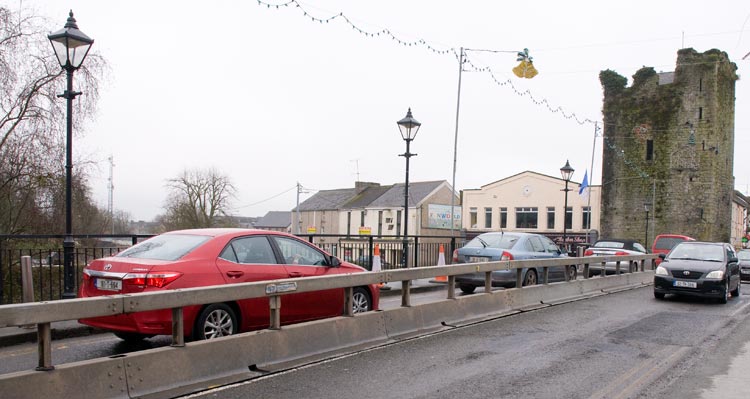
Barry’s Bridge in Thurles, Co Tipperary, has provided passage over the river Suir, since around 1650, and was partially widened again circa 1820.
Bridge Castle, overlooking this seasonally shallow river crossing, has dominated the Thurles skyline since as early as 1453, built possibly by the Norman invader McRickard Butler of whom history records that he erected, in 1453, two castles at Thurles and one at Buaidlic (Boulick).
While footpaths for pedestrians remain unrestricted presently, we understand that vehicles will be curtailed to one single lane of traffic crossing the bridge, for the duration of the period deemed necessary to carry out the resurfacing work.
So, where possible do try to use the alternative entrance and exit routes indicated, in order to keep traffic flowing.
Local Littleton / Two-Mile-Borris Correspondent Mr Gerry Bowe Report:
With so much inclement weather having being experienced in recent months; waiting for buses in the village of Two-Mile-Borris has become somewhat of a major ordeal for computers of all ages.
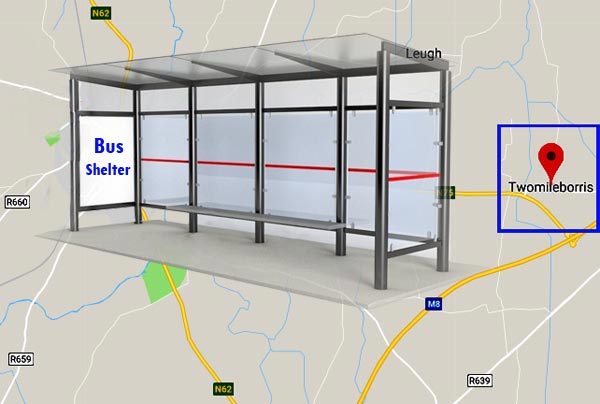
Some twenty-five schoolchildren are presently forced to congregate in the open twice daily to use school transport. On Friday’s some fifteen adults, including many old age pensioners must wait for rural transport in similar circumstances, with a minimum of six people on other week days.
The rural transport service is provided by Kavanagh’s of Urlingford, whose facility is greatly appreciated, especially by those with no other available means of transport. The Kavanagh service include stops in Urlingford, following a route to Clonmel, operating a twice daily service.
School transport, also greatly appreciated, conveying students in particular to schools in Thurles is presently being provided by Jerry Ryan Coaches in Thurles. Under the present scenario pupils find themselves often sitting through the day, in wet clothing, due to a lack of basic shelter.
Sites available and indeed suitable for the erection of a bus shelter, have now been identified in Two-Mile-Borris village.
It is now hoped that with the support of local Councillors and Transport Infrastructure Ireland (T.I.I), swift action will be taken to advance an obvious solution with regard to this ongoing issue.
|
Support Us Help keep Thurles.info online by donating below. Thank you.
Total Donated 2026: €40.00
Thank You!
Daily Thurles Mass Livestream
|





Recent Comments