Where else in Ireland would a crossroads, latter situated on a blind hill, be allowed to have traffic approaching and exiting at 100 km/h?
Well this remains the case at Turtulla Cross, Thurles, Co. Tipperary. The proposed replacement of Turtulla Cross with a roundabout has been welcomed by local councillors as a major step forward. Nobody disputes that this junction has a serious safety problem. It has been associated with one pedestrian fatality, numerous collisions and long-standing concern among residents, motorists and public representatives.
Turtulla Cross, Thurles, Co. Tipperary, showing blind hill, which, despite previous TII intervention, remains flooded for 10 months of the year. Pic: G. Willoughby.
The present 100 km/h limit is a maximum permitted speed, not an instruction to drive at that speed. Nevertheless, allowing traffic to approach a known hazardous junction under a 100 km/h limit sends entirely the wrong message. Drivers travelling at or near that speed have less time to recognise danger, react to another vehicle and stop safely.
However, welcoming action should not mean giving Transport Infrastructure Ireland and Tipperary County Council a blank cheque. Before large sums of public money are committed to constructing a roundabout, the authorities must explain why a significantly cheaper and quicker safety measure has not been properly trialled; namely reducing the speed limit on the approach and exit to Turtulla Cross from 100 km/h to 50 or 60 km/h.
A roundabout would inevitably force approaching vehicles to slow considerably. That raises an obvious question: why not introduce lower approach speeds now and assess the results before committing to an expensive construction project?
The Government’s own Speed Limit Review recommended lower limits, including a proposed reduction of the default limit on national secondary roads from 100 km/h to 80 km/h. Official guidance also recognises 60 km/h transition zones on national and other significant roads entering areas where traffic conditions become more complex.
A properly designed trial could include a 60 km/h transition zone, a further 50 km/h limit immediately approaching the junction, prominent warning signs, refreshed road markings, flashing speed indicators, improved lighting and targeted Garda enforcement. The trial should be supported by speed surveys and collision-risk assessments, with the results published openly. A few hundred metres closer to Thurles town such signs exist, so just grab a screwdriver or pliers and move them.
According to Tipperary County Council’s May 2026 management report, preliminary design has commenced for a safety scheme involving a roundabout. The project is expected to enter the Part 8 planning process in 2026, with construction anticipated in 2027, or 2028 or maybe 2030.
That timetable provides an opportunity to test lower-cost interventions before construction begins. Public money must be treated with respect. A roundabout may ultimately prove necessary, particularly if the junction’s layout, visibility or traffic movements cannot be made acceptably safe through speed management alone. But that conclusion should be demonstrated through real evidence, not just simply assumed by councillors wishing to take advantage of a video opportunity.
TII and Tipperary County Council should publish the up-to-date collision history, traffic speeds, projected construction cost, alternatives considered and the reasons those alternatives were rejected.
Spending millions without first testing an enforceable speed reduction would be a failure of common sense and responsible public administration. Safety must come first, but value for money, transparency and evidence must come with it.
County Tipperary Chamber is calling on every business in Thurles and the surrounding area to complete the Thurles Bypass Business Impact Survey before Friday, 7 August 2026.
For decades, the people and businesses of Thurles have heard proposals, commitments and political assurances regarding essential road infrastructure. However, the town is still waiting for the completed Inner Relief Road and the long-promised Outer Ring Road or Thurles Bypass.
As recently highlighted by Thurles.info, announcements and expressions of political support are not the same as approved funding, a binding construction programme or a completed road.
Thurles businesses need delivery, certainty and measurable progress. Traffic congestion is not merely an inconvenience. It imposes real and continuing costs on local employers. It delays deliveries, wastes staff time, disrupts logistics, restricts customer access and makes it more difficult for businesses to plan, invest and expand. Every delayed journey affects productivity. Every customer discouraged by congestion represents a potential loss to the local economy. Every infrastructure project that remains uncertain can influence future investment and employment decisions.
This aforementioned survey provides businesses with an opportunity to transform those daily experiences into clear, credible and representative evidence. County Tipperary Chamber recently welcomed Thurles native Mr John O’Shaughnessy CDir MBA LL.B (Hons) Dip IOD, Managing Director of Clancy, as its new President. Mr O’Shaughnessy has taken on the presidency at a critical time for business confidence and regional competitiveness. His focus on delivery, effective advocacy and ensuring that the voice of Tipperary business is heard consistently at local and national level is particularly relevant to the infrastructure challenges facing Thurles.
Under his leadership, the Chamber is determined to ensure that the concerns of local businesses are supported by strong evidence and presented directly to Government and other decision-makers.
That effort now requires the support of the Thurles business community. Whether you operate a retail shop, hospitality venue, professional practice, manufacturing company, transport business or family enterprise, your experience matters.
The survey is open to Chamber members and non-members and to businesses of every size and sector.
Government departments require more than general expressions of concern. They require evidence showing how congestion affects operating costs, staffing, deliveries, customer access, competitiveness, investment and future growth.
The greater the response, the stronger the Chamber’s case will be.
This is not about creating another report that sits on a shelf. It is about establishing a compelling business case for action and demonstrating that Thurles cannot continue to compete effectively without modern, dependable transport infrastructure.
A sincere thanks to every business that has already participated. Your time and first-hand knowledge are all helping to build the evidence needed to secure meaningful progress. To those who have not yet responded, please do not assume that another business will speak for you. Every completed survey adds weight, credibility and urgency to this campaign.
Thurles deserves roads, investment and delivery, not more uncertainty or political promises.
Gardaí have launched an appeal for witnesses after a man in his 50s was killed in a single-vehicle collision in County Tipperary.
The fatal crash happened on the R505 near Dundrum shortly before 5.50pm on yesterday afternoon, July 16th 2026. The driver, who was the only person reported to be involved, was pronounced dead at the scene. His remains were later taken to University Hospital Waterford, where a post-mortem examination is due to be carried out. The local coroner has been informed.
The R505 remained closed following the collision to allow Garda forensic collision investigators to conduct a technical examination of the scene. Diversions were put in place for motorists travelling through the area.
Investigating officers are particularly interested in hearing from anyone who used the road near Dundrum between 5:30pm and 6:00pm on Thursday. Drivers and other road users who recorded footage in the area are being urged to check their devices. Gardaí said dash-cam video, mobile phone recordings or any other camera footage could assist the investigation and should be provided to officers. Anyone who witnessed the crash, noticed the vehicle before the collision, or has information that may help establish what happened, is asked to come forward.
Five people have lost their lives in road traffic collisions within County Tipperary so far in 2026; as of yesterday, July 17th 2026. The confirmed fatalities occurred on:- 8th February: Man in his 70s, single-vehicle collision near Holycross. 8th March: Woman in her 20s, pedestrian collision near Templemore. 12th May: Woman in her 20s, two-car collision near Nenagh. 11th June: Motorcyclist in his 30s, collision near Carrick-on-Suir. 16th July: Man in his 50s, yesterday single-vehicle collision on the R505 near Dundrum.
Information can be given to Tipperary Garda Station by calling Tel: 062 80670. Members of the public may also contact the Garda Confidential Line on Tel: 1800 666 111 or indeed speak with officers at any Garda station.
The investigation into the circumstances surrounding the collision remains ongoing. Gardaí have thanked the public for assistance.
For years, the people of Thurles have heard announcements, assurances and political claims about the Inner Relief Road and the long-promised Outer Ring Road. Yet despite all the publicity and political celebration, Thurles still has no completed Inner relief road, no Outer Ring Road and no binding construction timetable that the public can honestly rely upon.
Mr Michael Lowry TD and Mr Ryan O’Meara TD, who both support the present government, must now accept political responsibility for the continuing lack of measurable progress. Meetings, press releases and statements welcoming developments are not substitutes for an approved budget, completed design, signed construction contract and machinery working on site.
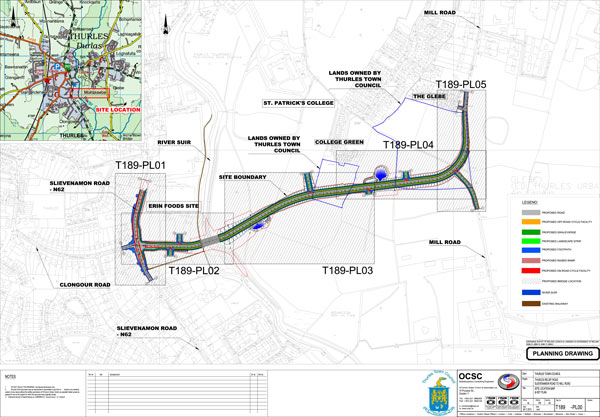
Tipperary County Council describes the Inner Relief Road as approximately 1.1 kilometres of new road linking the N62 at Slievenamon Road with Mill Road. The scheme includes a new bridge over the River Suir, several junctions and associated flood-relief works. However, the council’s May 2026 management report still stated that Department of Transport approval was required before the project could proceed to detailed design and construction.
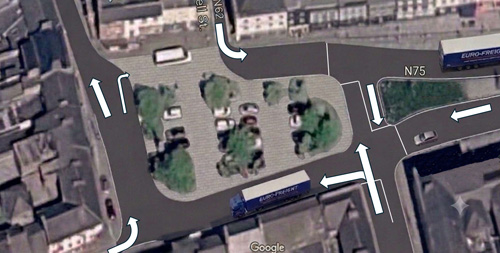
One of our many readers has submitted the suggestion shown above, which they believe could help ease the daily traffic bottleneck in Liberty Square, Thurles. This problem is likely to become even more severe when schools reopen in late August and early September. Any suggestions from other readers?
Inner Relief Road: The public was informed that the Inner Relief Road may be “ready for construction” in 2027. That wording does not provide a guaranteed completion date. If approvals, design work, procurement and funding continue to slip, there is a genuine danger that construction will not commence before 2030.
Outer Ring Road/Thurles Bypass: The situation surrounding the Outer Ring Road is even more concerning. Mr Michael Lowry has said that the Thurles bypass will advance through design and planning and that he will insist it is “ready for construction in 2030.” That is not a promise that the road will be built or opened by 2030. The scheme remains at a very early development stage, despite the need for a bypass having been recognised as necessary, some 40 years ago or more.
If the shorter and more advanced Inner Relief Road cannot be brought promptly to construction, how can the public have confidence that the much larger and longer Outer Ring Road will be construction-ready by 2030?The Thurles electorate are not fools.
There must also be accountability for the loss of the historic Great Famine “Double Ditch” at Mill Road. Local heritage campaigners described and proved it to be a famine-era pathway dating from approximately 1846, constructed as relief work for impoverished and starving people and later used as a right of way and Mass path. Concerns were raised publicly from 2020 onward, that the proposed Inner Relief Road would seriously damage or destroy this locally significant landscape feature. The tragedy now is that part of Thurles’s tangible Famine heritage appears to have been sacrificed for a road that, years later, has still not been delivered. Whatever disagreement may exist about its formal archaeological status, the failure to preserve, commemorate or meaningfully incorporate the “Double Ditch” into the project represents a serious loss to Thurles town’s historical memory.
Meanwhile, HGVs will continue entering Thurles every day. Even after a bypass is eventually constructed, some heavy vehicles will still need to enter the town to supply supermarkets, shops, hotels, restaurants, construction sites and other local businesses. These essential deliveries cannot simply be prohibited.
However, there is an important difference between HGVs that must enter Thurles to supply local businesses and heavy through-traffic that has no business being in the town centre. In the absence of proper alternative routes, both types of traffic continue to use the same narrow medieval streets and junctions.
The council’s own transport planning identifies the effect of through-traffic on Thurles and recognises the need for relief and bypass infrastructure. The Local Transport Plan presents the Inner Relief Road and a town bypass as important elements of the future transport network.
Regrettably, local elected representatives and county councillors have failed to grasp—or act upon—the urgency of this critical issue.
No redesign of Liberty Square can really solve the underlying problem. Wider footpaths, altered parking arrangements, crossings and junction changes may improve the visual appearance and pedestrian environment, but they cannot create a proper alternative route for strategic traffic.
Without the Inner Relief Road and Outer Ring Road, attempts to improve traffic movement in Liberty Square, risk becoming little more than a rearrangement of the same congestion.
Mr Michael Lowry TD and Mr Ryan O’Meara TD must now jointly secure and publish:
►Final Department approval for the Inner Relief Road; ► A fully funded programme for detailed design and construction; ► Firm construction commencement and estimated completion dates; ► Immediate progression of the Outer Ring Road through its formal planning and approval stages; ► An interim HGV-management plan separating essential local deliveries from avoidable through-traffic; ► A permanent memorial or heritage interpretation scheme acknowledging the Great Famine “Double Ditch” and the people whose suffering and labour it represented.
Thurles has already lost an irreplaceable piece of its Famine-era heritage. It must not now be left with neither the historic “Double Ditch” nor the road whose development was used to justify its loss. A plaque of some description must now be constructed recognising its once construction and recent destruction.
Thurles does not need more political celebration of mere preliminary steps, which is all our local politicians have had to offer their electorate over the past 40 years. It needs approvals, funding, contracts, construction and most of all accountability.
Thurles Inner Relief Road: New Tender Documents Raise Serious Questions Over Timelines, Political Claims and the Destruction of the Great Famine Double Ditch.
The publication of new tender documents for the Thurles Inner Relief Road has been presented as a significant milestone for a long-delayed project. In one sense, it is. After years of promises, updates and political announcements, Tipperary County Council has now gone to the market seeking engineering technical consultancy services to progress the scheme. But the detail contained in the newly published tender raises serious questions about the true timeline for delivery, the accuracy of previous political claims, and the destruction of the historic Great Famine “Double Ditch”, to facilitate a road that still appears to be years away from completion.
The official eTenders notice, published in July 2026, confirms that Tipperary County Council is seeking a multi-disciplinary technical consultancy team for the Thurles Inner Relief Road. The tender describes the work as including a review of existing documents, completion of outstanding deliverables for Stages 3 and 4, and preparation of deliverables through Stages 5 to 7. Crucially, the official notice gives the contract duration as 50 months.
That single figure changes the entire public understanding of this project. The proposed road is not simply waiting for diggers to arrive. Tipperary County Council’s own January 2026 management report described the scheme as an approximately 1.1km local link between the N62 and Mill Road, including a signalised junction at Slievenamon Road, a new priority junction with Mill Road, five intermediate access junctions, public lighting, flood alleviation works and a 50-metre tied bowstring arch crossing of the River Suir.
This is a substantial piece of infrastructure, and the new tender shows that major consultancy, design, approval, procurement, construction supervision, handover and defects processes still remain. The public therefore deserves honesty about the timeline. That honesty is especially important because previous political messaging now appears highly questionable. In November 2025, press reported that Deputy Mr Ryan O’Meara said Minister for Transport Mr Darragh O’Brien expected construction to commence on the Thurles Inner Relief Road the following year;2026. The same report quoted Deputy O’Meara as saying that Department of Transport officials had advised him the project should be completed and opened in approximately 24 months from then.
How does that claim stand beside a 50-month consultancy contract published in July 2026? If the tender process for the consultancy team is only now underway, and if that consultancy contract itself is expected to run for approximately 50 months, then completion by late 2027 is no longer credible. It is not enough to simply welcome “progress” while ignoring the contradiction. Deputy O’Meara should clarify exactly what he was told, by whom, and on what basis the public was led to believe that the road could be completed and opened in roughly two years.
This matters because Thurles people have heard promises about this project for far too long. Planning permission for the road was granted as far back as 2014, according to earlier press and local radio reporting. More than a decade later, the project is still moving through consultancy and design stages. Local frustration is understandable. But frustration should not be used as a cover for spin. Nor should the traffic needs of Thurles be used to brush aside the heritage loss already caused by this scheme.
The planned route has been linked for years by local campaigners and heritage advocates to the Great Famine “Double Ditch” at Mill Road. In 2020, Thurles.info publicly asked whether the planned Inner Relief Road would negatively affect what it described as the 1846 Thurles Double Ditch, a right of way and Mass Path associated locally with famine-era history. The warnings did not stop there. In February 2021, Thurles.info published commentary on an Archaeological Impact Statement, arguing that the proposed road would most likely impinge on the Great Famine Double Ditch in two locations. In March 2021, the same local outlet reported that Cllr Jim Ryan had confirmed the Double Ditch was to be destroyed to construct the Inner Relief Road. This was despite phone denials by Councillor Mr Micheál Lowry of the “Lowry Team”, who readers will remember inquired as to my standing in the community. {☺☺☺}
These are not minor matters. A famine-era pathway, Mass Path or heritage landscape is not just an inconvenience on a drawing. It is part of the physical memory of a town and its people. If warnings were made before destruction occurred, then the question must be asked clearly: why was the Double Ditch not protected, preserved, recorded more fully, or incorporated into the design?
Was every alternative route examined? Was the public given a full explanation? Was the heritage value properly weighed against the road design? Who decided that destruction was acceptable? And why is Thurles now being asked to accept the loss of a historic feature while the road itself may not be complete until around 2030 or later?
Nobody disputes that Thurles needs traffic solutions. The town has long suffered from congestion, poor circulation and pressure on its historic centre. A second river crossing and an improved link between Slievenamon Road and Mill Road may well bring benefits. But infrastructure should not be delivered through vague timelines, political overstatement and irreversible heritage loss. The publication of the new tender documents should therefore be treated as more than a procedural step. It should be treated as a moment of accountability.
Tipperary County Council should publish a clear and realistic delivery programme for the Thurles Inner Relief Road. Deputy Ryan O’Meara should explain the gap between his previously reported 24-month completion claim and the newly published 50-month consultancy timeline. The Council should also account for the treatment of the Great Famine Double Ditch, including what warnings were received, what assessments were carried out, and why destruction was permitted.
Thurles deserves roads. But it also deserves truth. It deserves progress, but not spin. And it deserves development that respects the town’s history rather than erasing it first and explaining later.
This website uses cookies to improve your experience. We'll assume you're ok with this, but you can opt-out if you wish.AcceptRead More
Privacy & Cookies Policy
Privacy Overview
This website uses cookies to improve your experience while you navigate through the website. Out of these, the cookies that are categorized as necessary are stored on your browser as they are essential for the working of basic functionalities of the website. We also use third-party cookies that help us analyze and understand how you use this website. These cookies will be stored in your browser only with your consent. You also have the option to opt-out of these cookies. But opting out of some of these cookies may affect your browsing experience.
Necessary cookies are absolutely essential for the website to function properly. This category only includes cookies that ensures basic functionalities and security features of the website. These cookies do not store any personal information.
Any cookies that may not be particularly necessary for the website to function and is used specifically to collect user personal data via analytics, ads, other embedded contents are termed as non-necessary cookies. It is mandatory to procure user consent prior to running these cookies on your website.






Recent Comments