|
|
M/s Rachael Willoughby (PRO Thurles Famine Museum) Reports.
Tipperary Independent TD Mr Michael Lowry was on hand to welcome and lead a group of tourists visiting Ireland and Thurles, Co. Tipperary, last week.
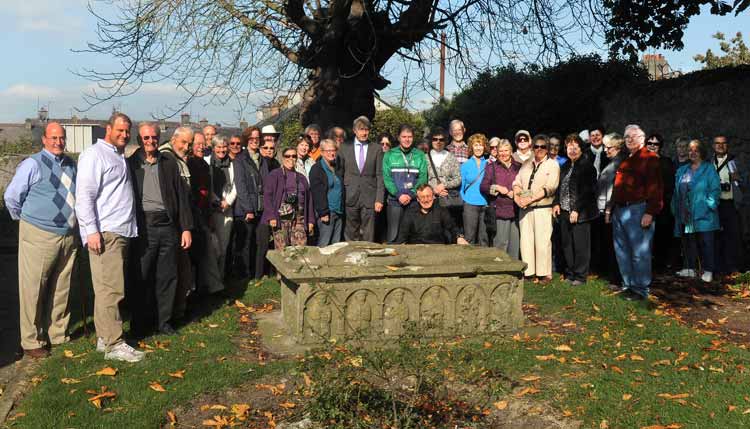
The visiting coach tour, which numbered some 42 persons from Maryland, USA, visited Thurles Famine Museum and the Cathedral of The Assumption, before spending an hour checking out some of the shops in the town. The above visiting tour group were endorsed by STITA Tours & Pathfinders, STITA House, 11 Trinity Lane, Cheltenham, GL52 2NT.
For the first time this year coach tours have begun visiting Thurles; their main agenda to visit Thurles Famine Museum and view at first hand the rare primary source exhibits on display, which are strongly promoted by the voluntary efforts of Thurles Famine Museum personnel, through continuous national TV, local and national press reports.
Meanwhile, Tipperary Tourism Company supported by Tipperary County Council and Tipperary Local Enterprise Office has announce that the long awaited Tipperary Tourism Seminar will take place not on Tuesday, October 20th as scheduled, but is now pushed back to Tuesday, November 23rd beginning at 10am – 2pm, at Brú Ború, Cashel, in Co. Tipperary. This Seminar is expected to feature Fionn Davenport, (Award winning Travel Writer); Fáilte Ireland discussing their development of Ireland’s Ancient East together with updates from Tipperary Tourism, latter expected to include the launch of a redeveloped tourism website www.tipperary.com (not as yet on-line).
This Seminar is an opportunity for service providers to find out exactly about what is happening on tourism in Co. Tipperary and to network with other tourism providers.
Note: To confirm your attendance and be assured of a place at this Tipperary Tourism Autumn Seminar, click HERE and for further information do please contact: marie.phelan@tipperarycoco.ie
It is understood that considerable damage has been caused to Dundrum House Hotel as a result of a kitchen fire discovered early this morning.
The blaze was first spotted shortly before 7:00am this morning with the source of the blaze understood to have begun in the kitchen area, before then spreading to other immediate areas of the complex.
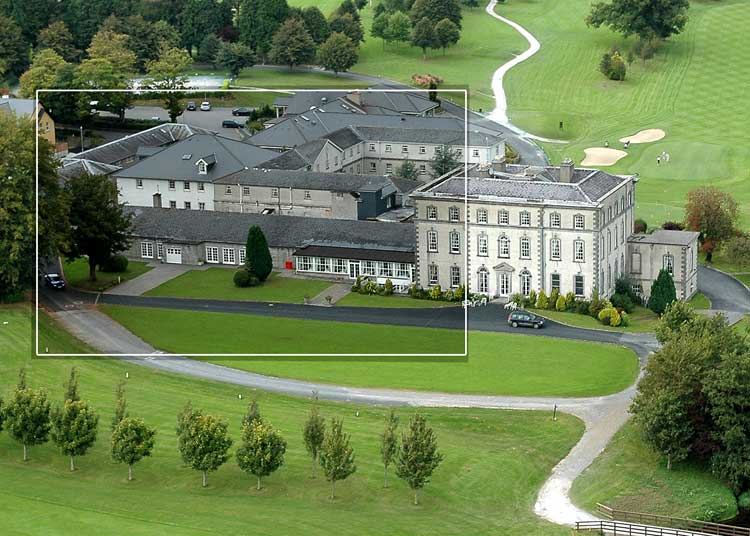
Up to seven units of the Co. Tipperary Fire Service were summoned; latter arriving from the nearby towns of Cashel, Tipperary Town and Cahir, to tackle the blaze, which later this morning was brought under control.
All staff and guests were evacuated from the premises as a precaution during the outbreak and we understand that the function room and the kitchen areas (shown framed within the white area in picture above) have suffered considerable damage.
As is customary, Gardaí and Fire Officers are now expected to launch an investigation into the cause of the blaze.
The classical Georgian manor house, built in the 1730’s and known worldwide today as Dundrum House Hotel, first opened for business as a family run hotel in 1981. This magnificent three-star accommodation includes 67 bedrooms, bars, restaurants, banqueting room, conference facilities, leisure centre, gymnasium and pool as well 16 self-catering holiday houses, six apartments and an 18-hole championship golf course designed by Golf Professional Philip Watson.
Located in the much vaunted Golden Vale area of Co. Tipperary, this luxury complex, which boasts two suburb restaurants, is set on some 170 acres of private ground containing natural woodland and mature trees dating back to the original estate buildings.
Our sincere sympathy’s go to Dundrum House Hotel staff and management at this time.
Upperchurch, Thurles, Co. Tipperary, this year celebrate ten years of successful walking weekends.
 Pictured Above: A select group of walkers leaving Upperchurch village, Thurles, Co. Tipperary, on the ‘Knockalough Walk’. Details of this years Upperchurch Walking Weekend 2015 to be held on November 6th, 7th and 8th have been announced, as this attractive, world class ‘walking hub’ now celebrates its tenth annual event. This year there will be a much expanded programme of events which will include emigration and reconnecting with the local Diaspora as an associated theme.
New chairman M/s Eileen Ryan has taken over from the long serving Mr Billy Clancy and has brought with her a new energy to the fifty strong team of volunteers, latter who have nourished the Upperchurch Walking Weekend to its present position as one of the most popular such events in the country, with over one thousand participants expected to descend on the rural village for this upcoming event.
There will be ten walks to celebrate each one of the ten years of the festival, along with several associated events such as traditional set dancing and music, a race night, organised cycles and displays on the “Upper Limits”, climbing wall.
The weekend also provides a great opportunity to renew old acquaintances and in keeping with the focus of welcoming home our emigrants there will be a lecture and discussion on the history of emigration from around the area. The much sought after 2015 Upperchurch-Drombane Historical Journal will also be launched during this most enjoyable of walking event.
It is evident that walkers in general have become fitter in recent years and that demand for longer and more challenging walks has therefore increased. While the usual eight to ten kilometre walks on the three local National Loop Walks and the popular night-time walks on the roads, will again be featured, it is the new, specially organised, one off longer walks that appear to catch the interest of the more experienced walkers and those looking for that real challenge.
Featured Walks:
(A) The ‘flagship walk’ of course will again be the 18 km “Hills of Upperchurch Walk”, latter which is strictly for the very fit and experienced.
(B) The 15 km “Farney Castle to Upperchurch Walk” drew a large crowd last year and will be held again with an opportunity for a tour of “Farney Castle” beforehand.
(C) Likewise the “Hollyford – Red Hill” walks will be of similar length (15 km) with visits to the hiding place and grave of Eamon an Chnoic included.
(D) A completely new walk this year will be a 12 km “Drombane to Knockalough” walk; starting at Drombane GAA field and going over the top of Knockalough to finish in Upperchurch Village.
(E) Even if you are a completely unfit beginner, there is no need to be overawed at this required fitness level; a recently introduced gravelled 1 km “Bog Walk”, beside Upperchurch village can be also utilized. This facility is also very suitable for wheelchair users.
But forget the walking for a moment; mostly this weekend is about making and renewing friendships, observing nature and the countryside close up and at its best, forgetting your cares for a few hours and working up an appetite or maybe a thirst. In short it is about taking a mini holiday, without stress and major expense, so be sure to put Nov 6th, 7th and 8th straight into your diary.
Note: Brochures are now available from the Community Centre in Upperchurch and other local outlets or same can be downloaded from www.upperchurch.ie .
All phone enquiries to Mobile: 087 0518934.
Bill Butler and his wife Sara, both currently residing in northern Virginia, in the town of Clifton, a suburb of Washington D.C., visited Thurles earlier this month. Bill’s large family group consisted of himself, his wife Sara, their son and daughter plus their spouses and their children (Bill’s grandchildren). Bill’s children and grandchildren live in Arlington, also in northern Virginia.
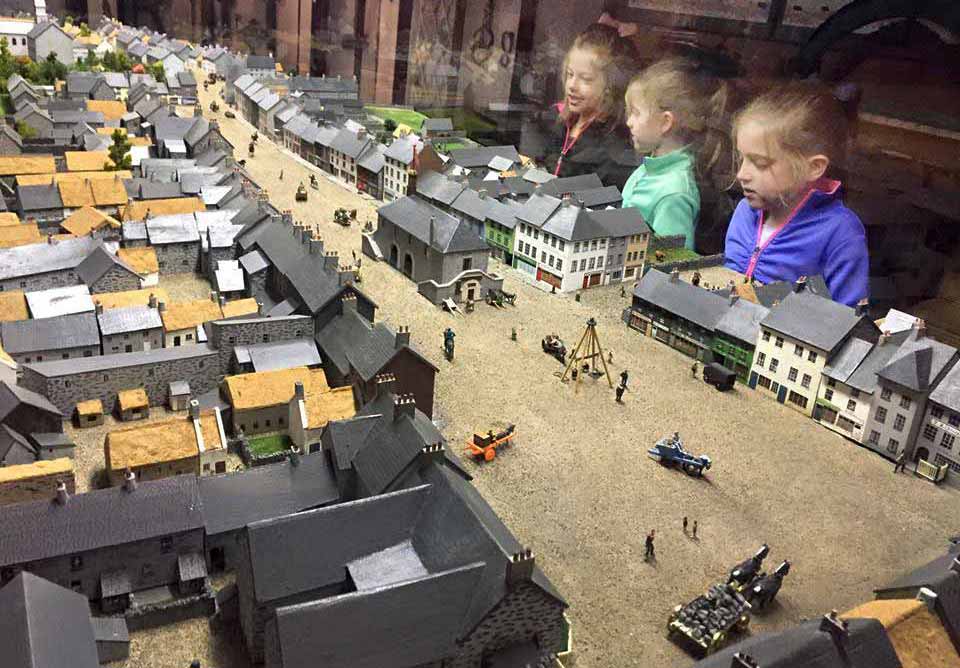 Left to Right:- Erin Butler with her twin sisters Leah & Katie, all totally captivated by the 16ft. historically accurate, 1846 model of Thurles town, latter which is currently on show in St. Mary’s Famine Museum, Thurles, Co. Tipperary. The model encapsulates 5 years of dedicated work by the late Thurles historian Jim Condon, who sadly passed away on December 23rd 2014. His model, built to perfect scale, is often described as being on a par with ‘Titania’s Palace’. (Note: Latter ‘Titania’s Palace’, to Ireland’s shame, was sold off in 1976 and now resides as a popular visitor attraction in Denmark). Picture courtesy Butler Family.
Bill has been researching his family tree since he retired. Sadly he has had no older relatives to talk to about his family; as they had all passed away before he had began his ‘Family Tree’ research project. Fortunately, on-line resources and a lot of digging through courthouse and county records eventually bore fruit. His research of several years eventually uncovered that his Butler family roots were here in Thurles. His recent trip earlier this month was an effort by himself and his wife to grant their children and grandchildren an opportunity to see and experience Ireland and specifically the town of Thurles here in County Tipperary.
Bill Butler’s Confirmed Ancestral History.
Bill’s great grandparents were both single people when they left Thurles around 1890, arriving in New York. Their decision to emigration from Thurles was separated by some 2 years. Their names were Thomas Butler and Mary J. Ryan. Both eventually settled in the city of Buffalo, New York, near to the Canadian border. They met and married in Buffalo in 1896.
Buffalo was then a bustling industrial city and Bill’s great grandfather worked at many jobs, before eventually taking up employment with one of the railroads firms as an engineer and fireman (stoker), until, alas, he lost his life through an industrial accident.
The same Thomas Butler’s parents were Michael Butler and Katherine Kearney of Stradavoher, Thurles and he was born in January 1867. Mary J. Ryan was the daughter of William Ryan and Bridget Cahill of Garryvicleheen, Thurles (now today known jointly as Friar Street & Abbey Road). Mary was also born in January 1867.
That is as far back as Bill has been able to trace the families ancestry and if he never gets any further information he will be satisfied with what he has found to date. However he will still continue in the hope further information becomes available.
In recent correspondence with this website Bill and his family have expressed what he describes as “a moving experience to observe at first hand his ancestors baptismal records from the Cathedral of the Assumption, Thurles”.
Anyone with new information on Thurles Butler Family history can reach Bill & Sara by contacting us HERE on Thurles.Info.
Rachel Willoughby, PRO St. Mary’s Graveyard Project, Thurles, reports.
New possible evidence uncovered in 177 year old murder investigation.
A single shot Percussion Pocket Pistol recently uncovered on the grounds of St Mary’s Churchyard, Thurles, Co. Tipperary, may have been the weapon used to shoot dead the opulent landholder, land agent, brewer and tanner, Charles O’Keeffe, (latter husband of Alicia O’Keeffe) in 1838.
This Percussion Pocket Pistol, possibly of French origin, is of the type then used for self-defence, during the percussion gun period 1800 to 1850. The then popular cheap pistol, whose real manufacturers today are not known, was discovered above ground under a pile of large stones. The stones, latter which were once part of a 17th century boundary wall, had collapsed sometime back during the 1940’s and from the positioning of this find and the pistols present condition; same is believed to have been at sometime concealed within the actual collapsed stone wall.
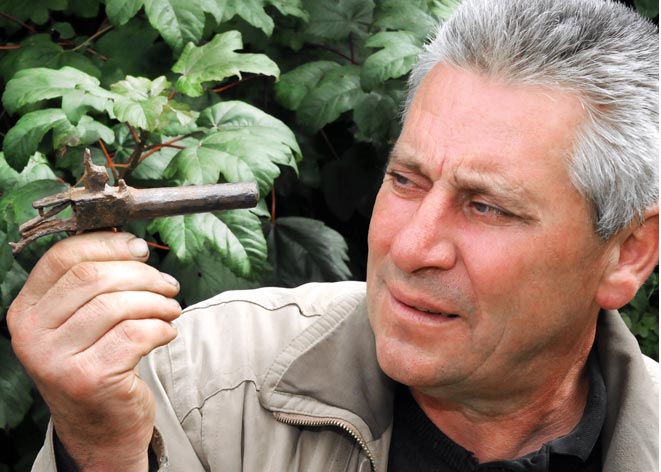 Project worker Mr Michael Kenehan examines the Pocket Percussion Cap Pistol found in Thurles, Graveyard. Mr Charles O’Keeffe (1775 – 1838) a Roman Catholic, was shot dead at close range by a male assassin, then believed to have been dressed in women’s clothing, on October 23rd 1838, just a short distance from St Mary’s Church front gates, close to his then tannery business premises. A ball fired from an assassin’s percussion cap pistol, entered Mr O’Keeffe left shoulder, wounding him to the extent that he died a short time later.
It is understood that Mr. O’Keeffe had greatly irritated local peasantry by ejecting tenants for non-payment of rent from lands which he either owned or was the acting agent, e.g. the Maher Estate, (today Thurles Golf Club) and lands held at Rossmult, Drumbane, Co. Tipperary, initially mortgaged for £1000 to Thomas and James Lenigan, on December 22nd 1821).
Within 25 yards from where the pistol was recently located, on the south side of St Mary’s graveyard, lies today the grave of the same Mr Charles O’Keeffe. His weather worn raised flat gravestone bears his Coat of Arms and the inscription; “Sacred to the repose of Charles O’Keeffe Esq., his life, distinguished by Justice and Truth, was devoted to the virtues of Parent, Citizen and Man, his death 23rd October 1838 deprived the poor of a friend; society of a benefactor.”
Certainly on the day of the shooting, the crack of the percussion cap pistol would have drawn the immediate attention of the then residents on St. Mary’s Avenue. The assassin or assassins had only two exits of escape, which would have taken them either westward, unto a busy Main Street (today named Cathedral Street) or alternatively through St. Mary’s Church grounds eastwards unto a little populated Lime Kiln Lane (today known as Ikerrin Road). In using the latter means of escape did the assassin hide the single shot percussion cap pistol in a cavity in the 12ft, interior 17th century stone wall which then surrounded the graveyard? Why would such a weapon from this period be present, hidden in a graveyard wall?
Regrettably percussion pistols don’t talk and it is doubtful that we will ever uncover the real truth.
Who was responsible for the death of Charles O’Keeffe on October 23rd 1838?
The murder rate in Tipperary during this period was almost three times the national average. Secret Irish agrarian organisations / societies such as “Whiteboys”, (Irish: Buachaillí Bána) were common here in Tipperary in the 18th and through most of the 19th century. Local grievances relating to land eviction often saw “Whiteboys” threaten, beat and assassinate Landlords’ land agents. Lesser agrarian grievances were dealt with, by “Whiteboys”, through the sending of threatening letters, the severing of animals hamstring tendons where livestock were known to be the property of Landlords or the levelling of ditches that often closed off common grazing land. Male members of the “Whiteboys” were known to dress with women’s outer garments over their clothing; their faces blackened with burnt cork, in an effort to conceal their true identity.
While numerous surnames were associated with O’Keeffe’s murder, mostly based on named persons who had quietly left the Tipperary area bound for America and elsewhere immediately following his death, his assassin or assassins were never brought to justice. Remarkable credible evidence however emerges some 17 years later, from America in 1855.
A sub-tribe of the American Sioux Indian Nation, the Brule (French meaning ‘burnt’ or “Burnt Thighs Nation,”) tribe, then residing in South Dakota, went on the warpath. Prior to the arrival of new European settlers they had mostly led a peaceful existence, but now following a breakdown of relations between both, they soon became involved in ever frequent skirmishes. In 1855, in response to a Brule robbery which ended in the deaths of three white male settlers, a cavalry officer in the U.S. Army General William Selby Harney (August 22nd, 1800 – May 9th, 1889), known to the native Brule tribe as “White Whiskers Harney,” had led a reprisal expeditionary force against the tribe, killing 85 of their warriors and taking many more captive.
Brule braves aware that they were no match for future expeditionary armed forces and following a ‘pow wow’, now pressed for peace. A peace summit was arranged between both sides to air existing grievances. Though not part of any negotiating team, among those present at these peace talks was an Irish-born priest, Fr. Joseph Trecy.
While the conference was in progress, Fr. Trecy heard a voice calling to him from amongst the Brule ranks; “Brathair, an bhfuil Gaeilge agat?” (Translation -“Brother, can you speak Irish?”). Looking into the assembled Brule delegation, which were fully decked out in war-paint and deerskin clothing, Fr. Trecy, who had left Ireland in 1835 at the age of 11, recalled enough Irish to answer the Indians question, and when the call was once again repeated he replied, “Ta, cuid de” (Translation – “Yes, some.”).
A Brule Indian Chief now stepped out from amongst the Indian delegation and shook the priest’s hand. He soon learned that the Irish-speaking Brule Indian Chief was actually a Tipperary man who, along with one other companion, was wanted in the 1838 killing of an Irish landlord in Co. Tipperary. These two men had fled from Ireland disembarking at New York, but had been tracked by authorities all the way to Missouri. In an effort to elude their possible captors, they had moved quickly north west to South Dakota and befriended Brule warriors, learned their language and had taken Squaws (Female Indian Woman) as their wives from among their newly adopted tribe. These Irishmen were reported by Fr Trecy to be in need of ‘Spiritual Nourishment’ and before long Fr. Trecy had baptised and married a further 40 Indian families, into the Roman Catholic faith.
Perhaps it was the ‘Seal of the Confessional’, who knows for certain, but Fr. Trecy refused to disclose the identities of the men from Tipperary or the name of the man they had killed. Because of his discretion these Tipperary fugitives were able to escape prosecution and continue on with their lives in their new country of adoption.
Around this period there were three recorded cases of the killing of landlords in Co. Tipperary. In two instances men were tried and hanged for these crimes, although a persistent rumour at the time suggested that others involved might have escaped. However in the case of the shooting of Charles O’Keefe in Thurles, while arrests were made, no suspects were ever charged.
It is therefore credible, by the process of elimination, that the “Brule Indian Chiefs”, now members of the American Sioux Nation from Co. Tipperary, were the same men who shot Charles O’Keefe on October 23th 1838.
|
Support Us Help keep Thurles.info online by donating below. Thank you.
Total Donated 2026: €290.00
Thank You!
Daily Thurles Mass Livestream
|





Recent Comments