|
|
Fáilte Ireland announced that €11.5m is to be invested in the refurbishment of ten key OPW sites in Dublin and within Ireland’s Ancient East region. But then of course the OPW Heritage Services work in partnership with this same Fáilte Ireland, so no great surprises here. It was simply a case of tourism revenues earned by the OPW, being given back to the OPW.
It is not really the distribution of funding that actually bothers me, after all Co Tipperary got a share; Ormond Castle were granted €585,000, while the Rock of Cashel were granted €1.78m.
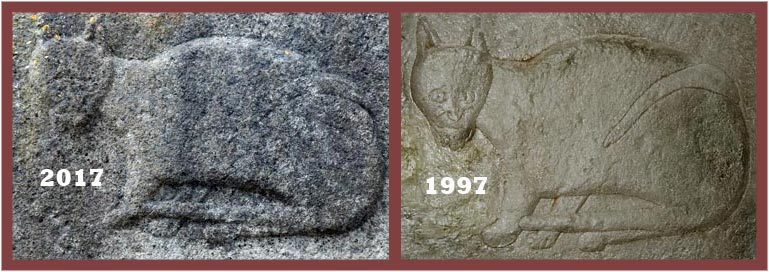 Gobán Saor’s cat rapidly eroding. Of course, the area within a 33 miles radios of Dublin’s popular O’Connell street, as usual, got the majority of funding; yes over €8m in total. This included €3m towards a new museum and viewing platform in ‘The Record Tower’ at Dublin Castle; €300,000 towards a Phoenix Park tourism and amenity study. Twenty-five miles’ away the Brú na Bóinne Visitor Centre got €2.58m; and thirty three miles away Newgrange got €1m and Knowth €1.4m.
This Fáilte Ireland funding announced earlier this month, when truly examined, certainly represents a true strategic partnership with the OPW, if you know what I mean. Plus, as Fáilte Ireland point out, our Irish tourism sector after all currently sustains 220,000 (minimum wage) jobs, while generating an estimated €6bn in economic value per year to the State.
As already stated, it is not really this unequal distribution of funding that actually bothers me, no my fear centres around the wanton destruction of our local unique history and culture, which provides that strong incentive in bringing people to our shores. To get to the crux of this matter perhaps I need to explain further.
Tourists who visit Ireland are not exactly attracted by our weather, rather a huge percentage of foreign visitors are incentivised to holiday on our island, because of our wild, unspoilt, scenic beauty and remarkable ancient history. While most of our history is protected in museums, much more remains totally unprotected.
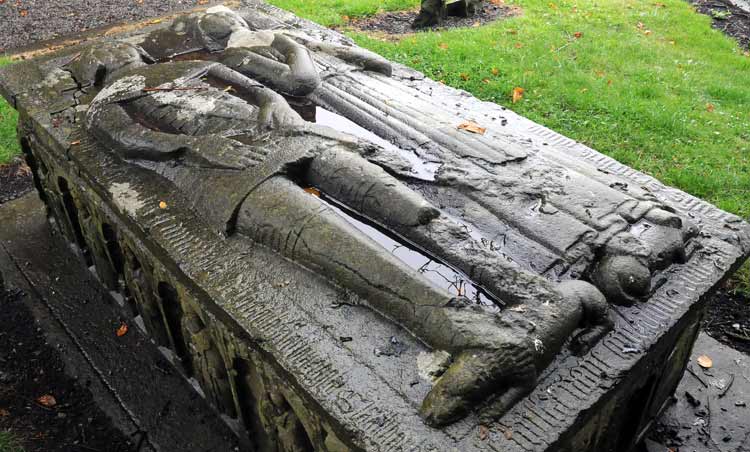 Archer Tomb Date 1520. Present condition in 2017. Here in Thurles town Co. Tipperary, alone, numerous pieces of our rich heritage lie unprotected from weather erosion. Year by year, with the passing of each season; rain, wind, frost, snow and even sunshine, all ploy and conspire to shorten and destroy the future life of centuries old rare historical artefacts. Private funding offered, to protect this heritage, are resolutely refused, however funding is being (alas to late), provided to carry out photogrammetry surveys. See HERE and HERE.
The world was outraged in May 2015 when ISIS militants destroyed some of the historic buildings in the ancient city of Palmyra, located in war-torn Syria; which in the past flourished as a Roman trading outpost around A.D. 200. While this similarity is perhaps extreme, the same situation is being allowed to happen to valuable history in rural Ireland.
Dublin not only get the employment opportunities now-a-days it would appear, but into the future, only within a 50 mile radius of our capital city, will limited history survive, courtesy of Fáilte Ireland’s neglect of rural Ireland.
We rightly worry about the disappearance of Banks, Post Offices, Garda Stations, Hospitals and Public Transport from rural Ireland, now our politicians can add tourist attractions to this ever-growing list; while into the future the actual visitor.
Incidentally, those of you who reside abroad and continue to retain close links with Thurles, Co. Tipperary, you can purchase a cast, (at reasonable cost), of the Thurles Goban Saor’s cat with two tails, shown above, from HERE. Same will ensures one hell of a talking point for visitors to your home, when hanging on your sitting-room wall.
We will be talking about this Gobán Saor’s cat in the coming days.
The countdown to Ireland’s biggest ever 2017 International Girl Guide Camp has officially begun, following the launch last year of ‘IGGNITE’ at ‘CONNECT’ held in Rockwell College, New Inn, Cashel, Co. Tipperary, on August 21st 2016 last.
The IGGNITE event will be taking place in Rockwell College again this year, from July 30th, 2017 to August 6th. 2017.
Irish Girl Guides are now looking forward to welcoming some eighteen hundred other Girl Guides, aged between 10 years and 16 years old, from many different countries around the world. Indeed visitors, all who will be camping out, are expected from as far away as Australia, New Zealand, Malaysia, Canada, the US, Georgia and Zambia, as well as areas closer to home, e.g. England, Scotland and Northern Ireland.
Full details and contact information on this major exciting event can be obtained HERE.
Ballingarry (SR), Thurles, Co. Tipperary, to play host to National Famine Commemorations
We understand that the village of Ballingarry (SR), Thurles, Co. Tipperary, will play host to the National Famine Commemoration this year, 2017. This will be the first occasion on which the commemoration will be hosted in Co. Tipperary, since the establishment of the National Famine Commemoration Committee came into being in 2008.
The event will be held on September 30th, 2017 in the Famine Warhouse, (Also referred to as “The Widow McCormack’s House” or the British derogatory title of “The Widow McCormack’s Cabbage Patch.”), situated a short distance outside the village.
Will the Hollywood Actor / Producer, Mr John Cusack, be visiting the Widow McCormack’s Cabbage Patch?
 The signatures of Thomas Francis Meagher & Patrick O’Donoghue, both present at the ‘Ballingarry Uprising of 1848’. These signatures are written on the inside cover of a book found in Richmond prison, Tasmania. The book is entitled “Wreath of Friendship,” and both signatures are dated 26th February 1849. We now ask the question; Will this also be the year that Hollywood actor and producer Mr John Cusack begins to shoot a major film on the life of Thomas Francis Meagher, the Irish-born Fenian leader? Latter was involved in a skirmish known as the Ballingarry Uprising of 1848, as well as leading the famous Union Armies’ Fighting 69th Regiment into battle during the American civil war. Indeed Meagher, known as “Meagher of the Sword” (Following his speech on the right of the Irish nation to fight for its freedom and which was given at his trial), was first to fly the Irish Tricolour (Green White & Orange) at this same Ballingarry rebellion.
Mr Cusack informed Irish television’s, “Today Show”, at the Belfast Film Festival, that a film on the life of Thomas Francis Meagher (Inspired by the best selling biographical book “The Immortal Irishman” by New York Times columnist Timothy Egan), would feature a major international cast and be filmed all over Ireland.
Meagher who was found guilty of treason, following this skirmish, and sentenced to death; found his sentence later commuted to transportation from Ireland to Richmond Prison in Tasmania, Australia, from which he later escaped, to eventually end up in New York.
Following the American Civil War, he was appointed Governor of Montana State, but died soon afterwards under mysterious circumstances, aged 43 years.
Here on Thurles.Info we would like to wish all our readers, both at home and abroad, a very happy St. Patrick’s Day in 2017.
Our very good friends Patrick and his wife Regina Hayes who reside in Fremont, California, attended the St. Patrick’s Day Parade in San Francisco; held on last Saturday. (Quite early, but as Patrick says “California is always miles ahead of any crowd.”)
Patrick, who successfully traced his ancestors back to Loughmore, Thurles, Co. Tipperary some years ago, now visits Tipperary on a regular basis with other family members. Today he sent us some photo’s (shown in short slide show above) of last Saturday’s parade. He described the day as being “full of activity with lots of green on a glorious spring day”.
Patrick and Regina and their family would like to take this opportunity to wish everyone living in Loughmore and Thurles a very enjoyable St. Patrick’s Day.
From us to you Patrick, and your family, go an old Irish Blessing, “May you always have…Walls for the winds; A roof for the rain; Tea beside the fire; Laughter to cheer you; Those you love near you, and All your heart might desire.”
 Statue of Archbishop Dr. P. Leahy, in Thurles Cathedral yard. Destined to become one of the most prominent Roman Catholic churchmen in Ireland, Patrick Leahy (1806–1875) was born at Fennor, in the parish of Gortnahoe, Co. Tipperary, on May 31st 1806, the son of Patrick Leahy, a moderately successful Civil Engineer and Surveyor in Co Tipperary and Co. Cork, and Mary Margaret (née Cormack), a native of Gortnahoe.
Following his ordination he became the Roman Catholic curate of a small parish in the diocese of Cashel and was later appointed professor of Theology and Scripture here in St. Patrick’s College in Thurles, and a short time later President of that same Institution.
By August 22nd 1850 he was one of the Secretaries of the Synod of Thurles, and was afterwards appointed parish priest of Thurles and vicar-general of the Diocese of Cashel.
When the Catholic University was first opened in Dublin in 1854, he was selected for the office of Vice-Rector under then Rector Dr. John Henry Newman, (afterwards Cardinal Newman), thus filling a Professor’s chair.
He was elected Archbishop of Cashel on April 27th 1857 and consecrated on June 29th of that same year. In 1866 and 1867 he was deputed, with John Derry Bishop of Clonfert, to conduct the negotiations with Lord Mayo (Richard Bourke),[1] the Chief Secretary for Ireland, with respect to the proposed endowment of the Roman Catholic university.
[1] Five years later, on February 8th 1872, the same Lord Mayo (Richard Bourke), stopped off at Ross Island near the entrance to the harbour at Port Blair in the South Andaman Islands in the Bay of Bengal, then a British penal colony. Here Lord Mayo was stabbed to death by Sher Alia a convict from the North West Frontier, who was on a sick leave. His death caused great disturbance in diplomatic circles but the decision was made to play down the incident; quietly hang the murderer and appoint a new Viceroy.
A strong advocate of the cause of temperance, Archbishop Leahy enforced the Sunday closing of all public-houses in his Diocese. Owing to his energy the Cathedral of The Assumption at Thurles was built, at a cost of £45,000 pounds.
He died on January 26th 1875, and was buried in Thurles Cathedral on February 3rd of that year.
Hereunder find the following extract, relating to the erection of the statue to Archbishop Leahy in the yard of the Cathedral of The Assumption Thurles, taken from the journal of Fr. Michael Maher C.C., Thurles, and dated 1911.
“At the end of the year, the Archbishop (Thomas Fennelly 1901-1913) got a statue of Dr. Patrick Leahy erected in the Cathedral enclosure. It was sculptured at Carrara [2] by Professor Pietro Lazzerini and it is made of Sicilian or Bastard Statuary Marble. [3]
It was ready for shipment when the strike occurred on the railways in Great Britain and Ireland in August 1911. [4] We wrote to the sculptor not to send it until matters would be settled. It was sent from Leghorn [5] when the strike ceased, but arrived in Liverpool when the Irish strike was at its height in October. It was delayed some time on that account, but arrived safely in Thurles from Liverpool and Dublin in November. It weighs two tons and cost £120. I sent the cheque to Lazzerini.”
[2] Michelangelo di Lodovico Buonarroti Simoni (1475-1564), the Italian sculptor, painter, architect, and poet of the High Renaissance period, who exerted an unparalleled influence on the development of Western art, worked here at the Carrara marble quarries.
[3] Statuary Second or Bastard blue-grey Marble was used since the time of Ancient Rome.
[4] This strike arose after widespread dissatisfaction with the activities of conciliation boards set up to negotiate between workers and their employers the Rail Companies. Local disputes led to unofficial strike action in July and early August of 1911, with a meeting of all the main rail unions arranged in Liverpool to coordinate action nationally. These Unions issued an ultimatum to the Rail Companies to accept direct negotiation with their representatives within 24 hours or suffer a national strike. Keen to ensure that the railways would not be shut down. The Prime Minister, Herbert Henry Asquith, son of a Yorkshire clothing manufacturer, told the rail companies that police and troops would be deployed to help keep the trains running, resulting with soldiers being brought into London and 32 other towns in England and Wales. The then Home Secretary, Winston Churchill supported the police and troops against the striking union employees.
[5] Traditionally known in English as Leghorn, Livorno is a port city on the Ligurian Sea on the western coast of Tuscany, in Italy.
“The pedestal was fashioned by Mr P. Best of Cashel from stones got in the quarry at Camas, (Cashel). It cost £70. The Archbishop composed the inscription which is simplicity itself and a Galway man named Laurence Clane cut the letters.
Messr Leahy Brothers of Thurles had charge of the erection. It was no small work to get the statue in position without cranes or other powerful leverage. It was done this way. They constructed a large framework of wood around the base of the pedestal, then they hauled up the great box (2 tons 5 cwt.) containing the statue with pulleys attached to a horizontal iron bar above and let it rest on planks. They next built the pedestal and when that was finished they opened the box and got the statue into position by means of the pulleys. They finished the work a few days before Christmas.”
Overall Cost of Monument £214-10-0
[Statue £120-0-0; Pedestal £70-0-0; Leahy erection £12-0-0; Carriage from Leghorn (Livorno) to Thurles £12-10-0.]
|
Support Us Help keep Thurles.info online by donating below. Thank you.
Total Donated 2026: €300.00
Thank You!
Daily Thurles Mass Livestream
|



Recent Comments