Read first, HERE, an extract from Tipperary County Councils Corporate Plan (2020- 2024). Their unkept promise, to “Continue to enhance and protect the built, heritage in Tipperary and to work in partnership with key stakeholders, to deliver a high quality heritage service that will serve the people of Tipperary and attract visitors to our count.”
The above statement is yet another commitment which Tipperary Co. Council has successfully been allowed to weasel out of and row back on. And no, I am not further raising the issue of the now completely destroyed, historic Great Famine, Double Ditch. However, local people should be made aware that yet again, another piece of Thurles history has been, eradicated, without any consultation with the people of Thurles.
I refer of course to the 170 year old Victorian Turnstile Gates, [known locally as the Swinging gates], once found positioned beside and south of Lidl supermarket, on Slievenamon road (N62); same leading east on the river Suir pedestrian walk way.
My attention was drawn to its absence on meeting several motorcycles and numerous silent electric scooters travelling at speed on what was supposed to be a pedestrian footway.
Thurles Victorian Turnstile Gate Gone. Pic. George Willoughby.
On questioning a member of the local districts council’s workforce, I learn that this Victorian Turnstile gate is not, as I had foolishly believed, stored in the Parnell Street, County Council storage shed, but has been simply given away by as yet an unnamed senior official within Tipperary Co. Council, without any consultation whatsoever with local people.
Does this mean that the Turnstile Gate (Swinging Gates), on the junction between Emmet Street and Thomond Road will also be removed?
MatchingThurles Victorian Turnstile Gate at Thomond Road Junction. Pic. George Willoughby
We now have a situation, where parents walking with young children, need to take great care and control when coming out onto the N62 thoroughfare, as there is nothing to protect either pedestrians or small unsupervised children.
Obviously, ignorance now hopes to “Position Tipperary as a holiday destination for domestic and international markets”, latter yet another promise in Tipperary Co. Council’s Mission Statement which the latter has successfully been allowed to weasel out of and row back on.
It had been hoped that this Victorian Turnstile gate would have been returned to its opening with a robust pedestrian-safe, self-closing, “Ball Fence Swing Gate” at the side, latter to accommodate access for wheelchair users.
Thurles people should note: These gates were unique to Thurles town – find me another image of such gates on the internet. Note, how the capping stones were tied together (See Pic 2) using forged iron staples held in place with lead filling.
Mr Johnny Kenehan, (Thurles St. Patrick’s Day Parade Chairperson), presenting 1st Prize of €1,000 and winners trophy to the overall winner, Thurles Panto Society.
Mr John Tarpey presenting Supermac’s Crystal Bowl to ‘Best Large Float’; the award going to Coolmoyne Moyglass Vintage Club, the Club also received prize money of €500 sposored by Dew Valley Foods.
Cathoirleach Thurles MDC Cllr. Ms Peggy Ryan presenting the Runner Up Large Float Award to Clonoulty Rossmore Vinatge Club together with money prize of €250 Sponsored by Barry’s SuperValu, Friar Street, Thurles.
Thurles St. Patrick’s Day Committee would sincerely like to thank all donors who made the 2023 Parade possible.
List of Donors:
The People of Upperchurch/Drombane, Borrisoleigh, Moyne and Thurles, JYSK Thurles, Thurles.Info (website), Declan Maher Financial Services Ltd, Executive Menswear, Dwans Hardware, Denis Kinane Motors, Sheppard’s Opticians, TUS Thurles, Dew Valley Foods, Barry’s SuperValu, Bowe Travel, Pat Brennans Bar, Vale Oil Co., Thurles Credit Union, Noel Ryans Pub, Thurles Photoshop, The Mall Curios, Dr. Paul Ryan & Dr. David Millman, Centenary Thurles Co-Op, A.I.B. Thurles, Tipperary County Council, Michael Lowry T.D., Eoin Dunne Driving School, Jackie Cahill T.D., The Anner Cleaners, The Anner Hotel, Jennings Opticians, Daly’s Fish Shop, Linnane’s Off-Licence, Hickey’s Pharmacy, Moran’s Menswear, Ryans Cleaning, Sammons Pharmacy, Brennans Bar, Mitchel House, Q Mobiles, The Village Market Holycross, Frank Roche & Sons, E. Cleary Motors, CM Signs, Kennedy’s County Bar, Supermacs Thurles, Thurles Shopping Centre, Michael’s Jewellers, Flynn’s Childrenswear, Grace’s Fashions, O’Dwyer Transport, Sklep Polski Jelonek, Inga Mikelsone, Margaret Skehan, Thurles Irish Country Womens Association, Hanafins Furniture, Roynanes Hardware, Tim Looby Accountants, W.F. Gleeson Solrs, Martin Shanahan Tyres, Kambo Chinese Restaurant, Golden Nails, Stakelums Hardware, Dinans Timber, Thurles Tourist Office, Tipperary Star, Tipperary Live, BC IT, Tip Mid-West Radio, and TippFM.
Two top actresses, currently both in huge demand, and both previously educated at the Ursuline Convent Secondary School here in Thurles, Co. Tipperary, were among those who walked the Green Carpet at the Oscar Wilde Awards last night; latter organised by the US-Ireland Alliance.
Seeing both actresses, namely Ms Kerry Condon and Ms Jessie Buckley, ushered in a huge sense of pride for the people of Thurles and Tipperary, through their many achievements to date, within the entertainment industry.
The US-Ireland Alliance is a proactive, non-partisan, non-profit organization dedicated to consolidating existing relations between the United States and the island of Ireland and building that relationship for the future. The Oscar Wilde Awards event is an annual event of the US-Ireland Alliance.
Green Party Minister for Tourism, Culture, Arts, Gaeltacht, Sport and Media Minister, Ms Catherine Martin, travelled to Los Angeles, with the aim of developing stronger links with the entertainment industry. While many eyes are currently focused on Ireland’s 14 nominations, here was an ideal time to attempt to attract film companies, granting them opportunities to build stronger relationships with Ireland’s scenic locations and its supberb acting talent.
We understand Ms Martin has already met with Sony, Disney, and with representatives from Marvel.
We wish all those nominated for Academy Awards, (latter awards to be announced on March 13th, 2023), the very best of luck.
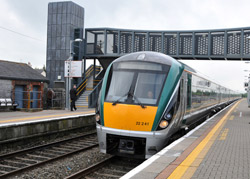
Irish Rail has confirmed their intension to restore its onboard catering service, with effect from the end of March 2023.
This reinstatement of the service will begin on a phased basis, same commencing on the Dublin-Cork line, latter servicing stations Portlaoise, Portarlington, Thurles, Limerick Junction and Mallow.
The sale of refreshments was halted on Irish trains three years ago, due to the Covid-19 pandemic, and when restrictions were lifted in February last, the company which supplied the service, were forced to withdraw, claiming staffing issues and their failure to get an agreement with regards to sought after increased costs.
The closure of shops at train stations, and the discontinuation by Irish Rail of onboard catering services during the Covid-19 pandemic, resulted with commuters only being able purchase tea, coffee or sandwiches if there was a shop within the railway station.
Same resulted in Irish Rail considering the installation of vending machines, thus enabling passengers to buy food and drink. However, Irish Rail have now confirmed, today, that a new supplier had been secured and a “well-known brand” of service would be in place at each station over the coming weeks.
Irish Rail have failed to confirm details regarding the new vendor, and have refused to be drawn further on the matter.
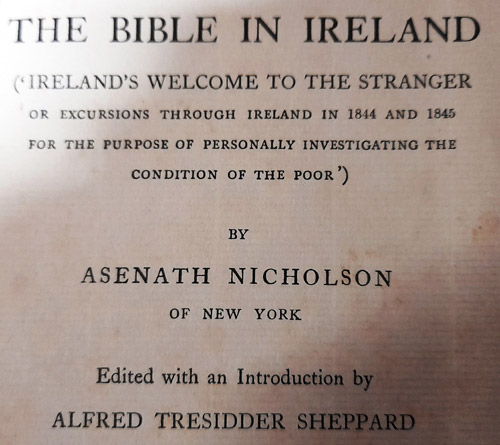
In a rare book, [edited with an introduction by Alfred Tresidder Sheppard, (London 1871-1947)], entitled “The Bible in Ireland”(Ireland’s welcome to the stranger or excursions through Ireland in 1844 and 1845 for the purpose of personally investigating the conditions of the poor), written by Asenath Nicholson; we learn of her visit to Thurles, Co. Tipperary and other nearby villages, including Gortnahoe, Urlingford, Cashel and Holycross.
Asenath Nicholson writes: “The celebrated estate of Kilcooley, (Gortnahoe, Thurles, Co. Tipperary) has descended by hereditary title, from the days of Cromwell, till it is now lodged in the hands of one who shares largely in the affections of all his tenants, especially the poor.
The wall surrounding his domain is said to be 3 miles in extent, including a park containing upwards of 300 deer and a wild spot for rabbits. A church and an ancient ivory covered Abbey, of the most venerable appearance, adorn part of it. But the pleasure of walking over those delightful fields is enhanced by the knowledge that his tenants are made so happy by his kindness. To every widow he gives a pension of £12 a year and to every person injuring himself in his employment, the same sum yearly, as long as the injury lasts.
His mother was all kindness, and her dying injunction to him was ‘to be good to the poor’. His house has been burnt*, leaving nothing but the spacious wings uninjured. An elegant library was lost.”
Note on ‘Burnt’ *. A huge accidental fire partly destroyed the property, causing it having to be reconstructed in the 1840s, during which the family occupied the old abbey. The interior today mostly dates from after that fire.
His mother, whom he ardently loved, was buried on the premises and his grief at her death was such that he left the domain for 12-months. He supports a dispensary for the poor, who resort to it twice a week, and receives medicine from a physician who is paid some £60 a year for his attendance. I was introduced to the family of this physician, to see his daughter, who had been a resident in New York some 6 years, and hoped soon to return thither to her husband and child, still living there. As I was seated a little son of 2 years old, and born in America stood near me. I asked his name. Yankee Doodle, ma’am was the prompt reply. This unexpected answer brought my country, with every national, as well as social feeling, to mind, and I classed the sweet boy in my arms. Let not the reader laugh; he may yet be a stranger in a foreign land. This name the child gave himself, and insists upon retaining it. O! those dear little children! I hear their sweet voices still: ‘God bless ye, lady, welcome to our country,’ can never be forgotten.
While in this family, I attended the Protestant church on Mr Barker’s domain* and heard the curate read his prayers to a handful of parishioners, mostly youths and children. By the assistants of a rich uncle of his wife’s, he can ride to church in a splendid carriage, which makes him tower quite above his little flock. His salary is £75 per annum.”
[Note on ‘Mr Barker’s domain’ *. Prior to 1770 the Barkers may not have spent much time at Kilcooley and when they were present, they lived in the old abbey, which had been modified to serve as a private residence. Without any direct heir provided by the last Sir William Barker in 1818, and following his death, his estate was inherited by his nephew, Chambre Brabazon Ponsonby, on condition he adopted the surname, ‘Barker.’ He in turn passed away in 1834 and the Kilcooley estate then passed to his eldest son, William Ponsonby-Barker of whom Asenath Nicholson speaks. Latter William referred, was himself an ardent Evangelical Christian and in the years prior to his death in 1877, he would habitually follow the example set by King David (c.1005–965 BCE), and Abishag, latter a native of the town of Shunem north of Mt. Gilboa in ancient Palestine, (See 1 Kings 1:1-4), originally brought to King David’s bed to “lie in his bosom”, chastely, to keep him warm as he neared death according to the Old Testament. As stated, the ageing William Ponsonby-Barker would also take a young woman to bed with him, as a human hot water bottle. It is said that be choose from among the housemaids, who were lined up following evening prayers. The story has been repeated down through the years, possibly repeated because on one occasion, the maid whom he selected, offended his sense of smell, so in the darkness he sprinkled her liberally from a bottle containing what he believed contained perfumed water. The following morning it was discovered that the bottle actually contained ink.]
Asenath NicholsonContinues: “Thurles, an ancient town in the County of Tipperary contains a good market house, fine chapel, college for Catholics, nunnery and charity school, with a Protestant church and Methodist chapel. I took a ride of 3 miles to visit Holy Cross, (Thurles, Co. Tipperary). On our way we passed a splendid estate, now owned by a gentleman who came into possession suddenly by the death of the former owner from whom he acted as agent. Last Christmas they had been walking over the premises in company; on their return the owner met with a fall and was carried home to die in a few hours. It was found he had willed his great estate to his agent. Holy Cross was the most vulnerable curiosity I had yet seen in all Ireland. We ascended the winding steps and looked forth upon the surrounding country, and the view told well for the taste of O’Brien, who reared this vast pile in 1076. (Today there are few remains of the original 12th/13th century church; only the north arcade of the nave and parts of the south aisle date from this time.) The fort containing the chapel is built in the form of a cross. The architecture, the ornamental work, and the roofs of all the rooms, displayed skill and taste. We visited the apartments for the monks; the kitchen where their vegetable food was prepared, and the place where repose so many of their dead. Pieces of skulls and leg bones lay among the dust, which had lately been shoveled up and as I gathered a handful and gave them to an old woman, who acted as my guide, she said, ‘This cannot be helped. I pick ‘em up and hide ‘em, when I see ‘em, and that’s all can be done; people will bury here, and it’s been buried over for years, because you see ma’am, it’s the place of saints. People are brought many miles to be put here the priest from all parts have been buried here, and here is the place to wake them,’ showing a place where the coffin or rather body was placed in a fixture of curiously wrought stone. The altars, though defaced, were not demolished; the basins cut out of the stone for the holy water were still entire; and though many a deformity had been made by breaking off pieces as sacred relics, enough remains to show the traveller what was the grandeur of the Romish Church in Ireland’s early history.
I stayed in Thurles with a Catholic family, and the husband endeavoured to induce me to become one church; but zeal was tempered with the greatest kindness.”
This website uses cookies to improve your experience. We'll assume you're ok with this, but you can opt-out if you wish.AcceptRead More
Privacy & Cookies Policy
Privacy Overview
This website uses cookies to improve your experience while you navigate through the website. Out of these, the cookies that are categorized as necessary are stored on your browser as they are essential for the working of basic functionalities of the website. We also use third-party cookies that help us analyze and understand how you use this website. These cookies will be stored in your browser only with your consent. You also have the option to opt-out of these cookies. But opting out of some of these cookies may affect your browsing experience.
Necessary cookies are absolutely essential for the website to function properly. This category only includes cookies that ensures basic functionalities and security features of the website. These cookies do not store any personal information.
Any cookies that may not be particularly necessary for the website to function and is used specifically to collect user personal data via analytics, ads, other embedded contents are termed as non-necessary cookies. It is mandatory to procure user consent prior to running these cookies on your website.





Recent Comments