Ratepayers’ Cultural Safety Briefing for the Maryland USA Mission (St Patrick’s Weekend Edition).
Tipperary ratepayers warmly welcome news of the proposed Maryland excursion by the CEO of Tipperary County Council, Ms Sinead Carr, along with the Cathaoirleach, Cllr Mr John Carroll and Mr Anthony Fitzgerald (Head of Enterprise and Economic Development and Tourism), latter a brave initiative in international relations, and an even braver initiative in free expensing, courtesy of Tipperary taxpayers.
However, before anyone is released into the wilds of a round of St Patrick’s weekend receptions, it is essential the travelling party completes the Maryland Compulsory Heritage Module, because nothing says “strategic engagement in quantum technologies” like being caught flat-footed on a 19th-century poem in front of a room of people who can quote it at you.
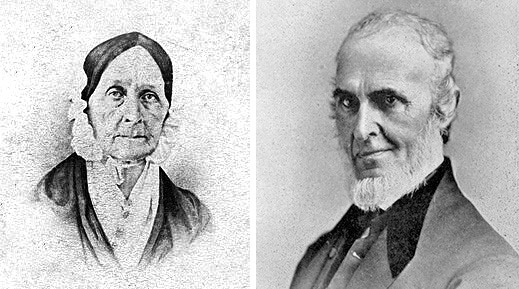
Pic L-R:Barbara Frietchie, & poet John Greenleaf Whittier.
Module 1:Barbara Frietchie (1766 – 1862), [Fritchie, Fritchie-ish, depending on who’s correcting you]. All delegates must demonstrate a working knowledge of the famous Frederick legend in which an elderly woman allegedly waves the Union flag, while Stonewall Jackson passes through, and he, like a well-trained character in a civic morale story, obligingly delivers the appropriate line on cue. Warning, this is not optional. In Maryland, this is basically local scripture, and you will be judged accordingly.
Module 2: Stonewall Jackson, not just a beard, a brand. You don’t have to agree with the legend, but you must be able to nod thoughtfully, while someone says “Of course you know the story…” and you respond like a person who has absolutely not spent the flight learning it from a laminated handout.
Module 3: Frederick’s “Shared Heritage”. Delegates are reminded that Frederick’s history has more edge than a brochure. For example, your hosts may be vaguely aware of the 1781 treason case in Frederick, (Mr Caroll please note), involving British loyalists, including Mr John Caspar Fritchie (Barbara’s father-in-law), convicted in a plot involving British prisoners and a rendezvous with Cornwallis in Virginia, resulting in their nasty executions two months later. This is the part of “people-to-people ties” that rarely makes the PowerPoint, but it does wonders for small talk, if the canapés are slow coming out of the kitchen.
Assessment: A short oral exam may occur at any point, possibly mid-toast, possibly in front of cameras. Passing grade requires:
Correct pronunciation of “Frietchie/Fritchie” without looking panicked.
Ability to smile as if you’ve always loved American Civil War folklore.
The restraint not to say “Sure we’ve our own rebels at home”(referring to ‘People Before Profit’ and ‘Sinn Féin’), unless you enjoy diplomatic incidents.
Anyway, thank God, we are getting some return on our Property Taxes and it’s so comforting, because for a moment there I worried our money was being used efficiently. Now, with the bar so low (it’s basically underground), yet we are still managing to trip over it. Absolutely, nothing says ‘value for money’ like spotting that single working streetlight and the knowing that the Thurles potholes are really just a normal street feature.
Finally, ratepayers would like to reassure this delegation, that if you accidentally confuse Barbara Frietchie with any other historic flag-waver, don’t worry, the room will correct you instantly, with great enthusiasm, at full volume, and for free.
Safe travels. Spend wisely. Reports of any major successes in tourism, business, of course will be required. Oh and for the love of God, do your homework.
Now, to add some educational context; read the poem by John Greenleaf Whittier (1807 – 1892) latter published in October 1863.
Barbara Frietchie.
Up from the meadows rich with corn, clear in the cool September morn, The clustered spires of Frederick stand green-walled by the hills of Maryland. Round about them orchards sweep apple and peach-tree fruited deep, Fair as a garden of the Lord to the eyes of the famished rebel horde, On that pleasant morn of the early fall when Lee marched over the mountain wall, Over the mountains winding down, Horse and foot, into Frederick town. Forty flags with their silver stars, forty flags with their crimson bars, Flapped in the morning wind, the sun of noon looked down, and saw not one. Up rose old Barbara Frietchie then, bowed with her fourscore years and ten; Bravest of all in Frederick town, she took up the flag the men hauled down; In her attic window the staff she set to show that one heart was loyal yet. Up the street came the rebel tread, Stonewall Jackson riding ahead. Under his slouched hat left and right he glanced: the old flag met his sight. “Halt!”, the dust-brown ranks stood fast, “Fire!”, out blazed the rifle-blast. It shivered the window, pane and sash, it rent the banner with seam and gash. Quick, as it fell, from the broken staff, Dame Barbara snatched the silken scarf; She leaned far out on the window-sill, and shook it forth with a royal will. “Shoot, if you must, this old grey head, but spare your country’s flag,” she said. A shade of sadness, a blush of shame, over the face of the leader came. The nobler nature within him stirred, to life at that woman’s deed and word. “Who touches a hair of yon grey head dies like a dog! March on!” he said. All day long through Frederick street, sounded the tread of marching feet, All day long that free flag tossed over the heads of the rebel host. Ever its torn folds rose and fell, on the loyal winds that loved it well, And through the hill-gaps sunset light shone over it with a warm good-night. Barbara Frietchie’s work is o’er, and the Rebel rides on his raids no more. Honour to her, and let a tear fall, for her sake, on Stonewall’s bier. Over Barbara Frietchie’s grave, flag of Freedom and Union, wave, Peace and order and beauty draw round thy symbol of light and law; And ever the stars above look down on thy stars below in Frederick town! End
St Patrick’s Day parade committees across Ireland are warning that escalating insurance costs and reduced availability of public liability cover are placing community celebrations under severe strain, raising the risk of cancellations, scaled-back routes and last-minute uncertainty for towns and villages.
Hereunder, Video of the Thurles, Co. Tipperary, St Patrick’s Day Parade Held 2025.
Volunteer-led committees say public liability insurance has become a barrier to participation, not just a safety requirement, with higher premiums, stricter conditions and growing administrative demands landing on groups that rely entirely on fundraising and unpaid work.
Public liability insurance, covering injury to spectators and participants, as well as third-party property damage, has become increasingly difficult to secure for volunteer-led events, with committees reporting that quotes are higher, conditions are tighter and the administrative burden has grown significantly.
Recent media reporting has highlighted the scale of the challenge, with one Wicklow parade committee facing insurance estimates in the €5,000–€10,000 range (with €6,500 cited), a cost that can exceed the entire fundraising capacity of smaller communities.
At the same time, local-authority event permissions typically require proof of insurance in advance, often at high indemnity limits and with specific policy wording, adding pressure to secure cover early and at a price communities can afford.
A spokesperson associated with the Thurles town St Patrick’s Day Parade Committee, has stated that;- “Insurance has always been a problem and ever since Covid it has doubled. This is a volunteer-run event. We’re proud of the work that goes into making it safe and welcoming, but the cost and complexity of insurance is now the single biggest threat to Irish parades. Without a workable solution, communities will lose events that bring people together and support local businesses. We’re told to produce more and more documentation and pay for more and more controls, which we do, but the quotes still rise and the uncertainty remains. At some point, towns are simply being priced out of their own national day. St Patrick’s Day shouldn’t become a luxury product available only to the biggest centres. If we don’t act, we’ll sleepwalk into a future where local parades quietly disappear, and once they’re gone, they’re hard to bring back.”
Committees stress that risk management standards have risen sharply in recent years. Organisers are now expected to produce robust event management plans, crowd control measures, stewarding and traffic management arrangements, important steps for safety, but often costly to implement.
National claims data shows improvements in the wider public-liability landscape, with the Injuries Resolution Board reporting a 40% reduction in public-liability claim volumes, between 2019 and 2023. Parade organisers are asking that progress be reflected in affordability and availability for well-managed community events.
Calls for action. Community parade organising committees are urging:
A dedicated community events insurance support mechanism, aligned with documented safety standards and transparent pricing.
Clear engagement from Government, insurers and local authorities to protect the viability of community parades, not just flagship events.
A simplified national template for parade risk management and event documentation to reduce administrative burden and improve consistency.
Engagement with insurers, brokers and Government to increase capacity for community events and prevent avoidable cancellations.
St Patrick’s Day belongs to every community and participants are asking for the implementation of practical measures, so that smaller towns and villages can continue to celebrate safely without being priced out of total existence.
Thurles & Tipperary Says Stop The “Junket” Slur – Start the Accountability – Publish the Outcomes of St Patrick’s US Missions.
Ireland must travel, must engage, and must report back, in black and white.
Ireland should maintain the St Patrick’s Day diplomatic programme within the United States, including the Taoiseach’s White House engagement, because it is one of the few annual moments when a small island reliably gets direct access to the world’s most consequential decision-makers, investors and influencers.
But if we are truly serious about ‘people before posturing’, then every travelling politician and councillors must also be required to prove value for money and publish measurable outcomes on return.
That is the missing piece in this annual debate: loud accusations of “junkets” on one side, defensiveness on the other, and far too little mandatory, standardised reporting to the public.
It has been reported that nine or ten ministers are expected to travel to up to 15 US states around St Patrick’s Day. Meanwhile, FOI figures reports show €1,096,493 spent on 569 St Patrick’s Day events globally, with an average cost per event of €1,927.
That is not inherently scandalous. It can be excellent diplomacy. But it must be auditable diplomacy. Engagement is not endorsement, it’s statecraft.
Tourism matters too; and we should never insult the American people. The United States is one of Ireland’s most important tourism markets and supports jobs right across this island, from hotels and restaurants to visitor attractions, guides and local festivals. Tourism Ireland notes that in 2023 the island welcomed over 1.2 million US visitors, who spent about €1.7 billion here, making the US the most important overseas market for revenue. Tourism Ireland’s USA Market Profile 2024 reports 1.3 million American tourists, €2.0 billion in spend, and 11.4 million bed nights; figures that underline just how much Irish employment depends on maintaining goodwill with ordinary American people, not just the political class in Washington. You can disagree robustly with any US administration, while still showing respect to the American public, the diaspora, and the millions who choose Ireland in good faith.
Diplomacy that drifts into contempt is not “taking a stand” – it is self-harm.
Some opposition voices argue our Taoiseach should not go to Washington at all. People Before Profit TD Mr Richard Boyd Barrett has said it is “not appropriate” for Mr Martin to present President Donald Trump with shamrock this year. Labour MEP Mr Aodhán Ó Ríordáin has also publicly taken a “No to the Shamrock ceremony” position. Labour leader Ms Ivana Bacik has also ‘raised conditions’ around any visit if threats continue. Whatever the merits of ‘snub the White House’ rhetoric, it is just gesture politics unless those calling for such a boycott can set out a credible alternative strategy, which of course they haven’t.
Yes, they are entitled to their stance. But the public is entitled to ask a harder question: what is their alternative plan to protect Irish jobs, Irish exports and Irish leverage, in real time, when the stakes are highest?
Ireland cannot clap itself on the back for moral purity, while leaving Irish workers, exporters and inward investment exposed. The national interest is not served by boycotts that make headlines at home and achieve nothing in Washington.
The public interest test: show the receipts and the results. If critics insist on calling these trips “junkets”, and who can blame them, then the answer is simple: remove the ambiguity. From this year onwards, every minister and senior office-holder travelling on St Patrick’s missions should be required to publish a short, standard “Outcomes Report” within 30 days of returning, laid before the Oireachtas and posted publicly.
That report should include:
Full itinerary (meetings, organisations, purpose).
Total cost (travel, accommodation, hospitality), itemised.
Follow-up actions with named officials/agencies and deadlines.
What did not happen (meetings refused, issues parked, risks flagged).
This is not bureaucracy, it is basic democratic accountability. If nearly €1.1m is being spent globally on St Patrick’s Day events, the public should see, clearly, what Ireland gets in return.
A direct challenge to the “boycott brigade”. It is easy to demand that Ireland “takes a stand” from a safe distance. It is harder to sit across the table from power and argue Ireland’s case, on trade, immigration, investment, peace and international law, and then come home and account for what was achieved.
If the likes of People Before Profit and a Labour MEP want to oppose engagement, let them publish their own alternative: a costed, credible strategy that protects Irish livelihoods and advances Irish values, without access, without dialogue, and without influence. Otherwise, it is politics as performance. Who elected these people anyway?
Ireland should go – and Ireland should know.
Ireland should absolutely maintain the St Patrick’s diplomatic programme in the US, and Irish politicians should visit American cities beyond Washington because that is where investment decisions, diaspora networks and industry clusters live.
But also the era of “trust us” travel must end.
Go. Engage. Promote Ireland. Protect jobs. Defend values, and then report back to the over taxed individuals who fe..ing paid for it all.
As Promised: Time to Construct Plans and Attempt to Find a “Bookable Visitor Experience,”for Thurles.
Thurles Tourism Debate: Part IV. Concerns over Tipperary’s ability to sustain and grow tourism have intensified following a recent council presentation on our tourism performance and marketing activity; but then in the words of T.C. Haliburton and later P.T. Barnum, “Talk is Cheap” and the words of councillors and officials come easier than their actions.
Thurles ‘A Sellable Product’.
“Thurles: Cathedral, Liberty Square & Local Stories, Lár na Páirce.” (90–120 mins)
The promise: (what the visitor gets.) A guided, easy walking loop that explains Thurles through three stops foreigners can understand instantly:
Cathedral of the Assumption: Big visuals + a clear “why it matters” story: architecture, stained glass, music/choir tradition, and key moments that root the town in Irish life.
Perfect as an add-on stop between other major routes.
Why Irish Rail is a big advantage for Thurles. Thurles has a very strong practical selling point; it’s a rail town with visitor basics already in place. From Irish Rail’s station information, Thurles station is 0.5 miles to the town centre, has toilets, passenger shelters, an enclosed waiting room, and strong accessibility (lifts to platforms, accessible toilet, ramps). It’s also on key intercity routes including Dublin Heuston – Cork (directs and intermediate), plus services connecting towards Limerick/Ennis and Tralee.
That means we can pitch Thurles as: “Arrive by train, walk the town, back on the train.” Ideal for weekend/day-trip groups who dislike motorway fatigue, parking stress, or long coach days.
In Part V, of our Thurles Tourism Debate, in the coming days we will assist in where to contact/sell and will provide a short, copy/paste social media advert.
Note: Since two paid tour guides with proper temperament, will be required to undertake this work, (yes we already have two knowledgable individuals, trained by myself), thus creating two jobs, which is more than our Tipperary public reps. have created in the past 20 years.
Time to increase failed footfall and reverse the deliberate destruction of our town centre, (Liberty Square), as a centre for business.
Learn how to make a St Brigid’s Cross – Tuesday next @2.30pm.
Please do remember: As with previous years, places are strictly limited. Advance booking is therefore essential for this free event and places will be allocated strictly on a first-come, first-served basis. Bookings Please to Tel: No. 062 63825.
Visitors attending this informative event can locate the Cashel Library building; situated on Friar Street, Lady’s Well, Cashel, Co. Tipperary, HERE. (Eircode E25 K798).
This website uses cookies to improve your experience. We'll assume you're ok with this, but you can opt-out if you wish.AcceptRead More
Privacy & Cookies Policy
Privacy Overview
This website uses cookies to improve your experience while you navigate through the website. Out of these, the cookies that are categorized as necessary are stored on your browser as they are essential for the working of basic functionalities of the website. We also use third-party cookies that help us analyze and understand how you use this website. These cookies will be stored in your browser only with your consent. You also have the option to opt-out of these cookies. But opting out of some of these cookies may affect your browsing experience.
Necessary cookies are absolutely essential for the website to function properly. This category only includes cookies that ensures basic functionalities and security features of the website. These cookies do not store any personal information.
Any cookies that may not be particularly necessary for the website to function and is used specifically to collect user personal data via analytics, ads, other embedded contents are termed as non-necessary cookies. It is mandatory to procure user consent prior to running these cookies on your website.








Recent Comments