The True Story of Villa Emma – The Village That Chose to Save Children.
At a time when Israel’s very presence on the football field is again the subject of protest, including the disruption of Ireland’s friendly against Qatar in Dublin over upcoming fixtures with Israel, the story of Villa Emma carries a particular force. The protests are framed by many as opposition to Israel’s conduct in Gaza, but for Jews and Israelis they also echo a longer and painful history: a people repeatedly attacked, excluded, and told that even their children, athletes, and symbols of ordinary national life are not entitled to safety or normality. From the Jewish children hidden in Nonantola in 1943, to the children killed at Majdal Shams, to Jewish children reportedly targeted in Skokie, the question is not only political but moral: when Jewish or Israeli children and communities are made vulnerable, do bystanders turn away, join the hostility, or choose protection?
In the summer of 1942, a group of Jewish refugee children arrived in the small Italian village of Nonantola, near Modena. They had already been on the run for years, fleeing Nazi persecution across Central and Eastern Europe. Most came from Germany, Austria, and the Balkans. Many had lost their families. An Italian Jewish aid organisation, DELASEM, arranged for them to stay in an abandoned countryside mansion known as Villa Emma. By the spring of 1943, their number had grown to around 70–73 children and teenagers, cared for by a small group of adult educators.
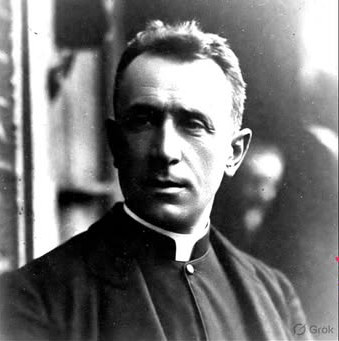
Catholic Priest & Teacher, Don Arrigo Beccari.
A fragile refuge. For about a year, life in Nonantola was unexpectedly peaceful. The children attended lessons, worked, and gradually adapted to village life. Local residents helped furnish the villa, brought food, and supported daily life. Two local figures became especially important, namely Don Arrigo Beccari, a Catholic priest and teacher, and Dr. Giuseppe Moreali, the village doctor. Both formed close ties with the children and helped organise their care. At this stage, despite anti-Jewish laws, Italy had not yet begun systematic deportations in the same way as Nazi-occupied territories but that would soon change.
By September 1943: everything shifts. On September 8th, 1943, Italy surrendered to the Allies. German forces quickly occupied northern Italy. The danger was immediate and clear. Within hours, the people responsible for the children realised that staying at Villa Emma would likely lead to arrest and deportation. What happened next was decisive. A village acts. In less than two days, often described as under 36 hours, the children were dispersed and hidden. Younger children were sheltered in the local seminary Others were taken in by families across the village and countryside Around 30–35 families, along with clergy and others, participated in hiding them. This was not a centralised operation directed by a government or military. It was a coordinated local response involving priests, doctors, educators, and ordinary villagers.
Forged identities and a dangerous plan Hiding the children was only a temporary solution. German patrols were active, and a search could happen at any time. Beccari, Moreali, and others began preparing an escape. They obtained blank identity documents and created false papers to disguise the children’s identities. The plan was to move them north, across the Alps, into neutral Switzerland.
The escape. Between early and mid-October 1943, the children left Nonantola in small groups. They travelled by train and on foot, guided through checkpoints using forged papers, and eventually crossed the Swiss border, often at night.Most of the group made it safely. One known exception was Salomon Papo, a boy who had been too ill to travel. He was later arrested and deported to Auschwitz, where he died.
Aftermath and consequences The rescue did not go unnoticed. Don Arrigo Beccari was later arrested and imprisoned by Fascist authorities. He was interrogated and beaten but did not reveal information about the network that had helped the children. He survived the war and returned to his life as a priest in the same community.
What this story really represents The rescue of the Villa Emma children was not the work of a single hero. It involved Jewish organizers who arranged the children’s refuge – Local clergy and medical professionals and dozens of ordinary families willing to take risks. Together, they protected and ultimately saved the lives of dozens of young people. After the war, many of those children emigrated to Palestine and later Israel, where they built new lives.
Why, then, are so many Christian communities silent? Perhaps because Israel has become politically contentious, and many fear that defending Jews or Israelis from hatred will be treated as taking a side in every aspect of the Middle East conflict. But this is a false moral trap. One can grieve Palestinian suffering and still condemn antisemitism. One can criticise Israeli policy and still defend Jewish children from intimidation, exclusion, and violence. The legacy of Villa Emma should make Christians especially uneasy about silence. When Jewish children were in danger, Don Arrigo Beccari and others did not hide behind complexity. They protected life. That remains the standard.
A legacy of quiet courage. In 1964, Don Arrigo Beccari and Giuseppe Moreali were recognized by Yad Vashem as Righteous Among the Nations for their role in the rescue. Today, the story of Villa Emma is remembered not just as an act of individual bravery, but as an example of collective moral choice. In a time of fear and occupation, a small rural community chose to help. and because of that, dozens of children survived.
Senator Frances Black’s maximalism is no substitute for serious government and Micheál Martin is right to put Ireland’s interests before current Sinn Féin and opposition political theatre.
Taoiseach Micheál Martin deserves much credit for bringing a measure to Cabinet that is possibly legally focused, diplomatically serious, and economically responsible. In limiting the Israeli Settlements Bill to goods rather than extending it to services, he has done what responsible governments are supposed to do; distinguish between what is politically satisfying and what is actually implementable.
Taoiseach Mr Micheál Martin.
There is a world of difference between taking a symbolic stand and passing workable law. A ban on goods from Israeli settlements can be monitored through customs, import records, product origin and enforcement mechanisms already known to the State. It is narrow, targeted and legally intelligible. A services ban, by contrast, would be a minefield. What exactly is a settlement-linked service? A hotel booking? A cloud contract? A software licence? A payment platform? A professional service? A mapping tool? A multinational with branches in Ireland, Israel and the United States could easily be caught in a web of uncertainty.
That is why Micheál Martin’s warning matters. Ireland is not an isolated moral debating society. It is a small, open economy whose prosperity depends heavily on foreign direct investment, especially from American multinationals. To dismiss those concerns is not bravery; it is total recklessness. A government that casually exposes Irish jobs, tax revenue and diplomatic relationships to avoidable risk is not acting in solidarity with anyone. It is indulging in gesture politics at the taxpayers expense.
What has the now recovering but once alcohol dependent Senator Frances Black actually achieved in nearly ten years in the Seanad, apart from making opposition to Israel the centrepiece of her political identity? She has introduced bills and spoken on worthy causes, but there is little evidence of major, enacted legislation bearing her name that has transformed life for ordinary Irish people. On the otherhand, Micheál Martin is accountable for the national interest; Senator Black is free to pursue activist politics without carrying the same responsibility for Irish jobs, Irish investment, diplomacy or Ireland’s relationship with the United States. That is the difference between government and protest.
This is where Senator Frances Black and others in the opposition are wrong. Their demand to include services may sound stronger, but stronger rhetoric is not the same as stronger law. It is easy, from the opposition benches, to denounce, condemn and demand the maximum possible measure. It is harder to govern, to take legal advice seriously, and to protect the national interest, while still making a principled foreign policy statement.
Senator Black has been consistent on this issue, and consistency is not in itself a fault. But her criticism of the Government’s bill as a “partial ban” misses the central point. Partial laws are often better than performative laws that collapse under legal challenge or produce unintended economic damage. The question is not whether a services ban sounds morally satisfying. The question is whether it can be defined, enforced and defended without harming Ireland more than the target it is aimed at. Micheál Martin has answered that question honestly.
Ireland also needs to be careful not to slide from criticism of settlements into an attitude of hostility toward Israel itself. Israel is a democratic state facing real security threats, including terrorism, regional hostility and the trauma of repeated attacks on its citizens. One does not have to agree with every Israeli government policy to recognise Israel’s right to exist, defend itself, trade, innovate and maintain normal diplomatic relations with democratic countries like Ireland.
Too much of the Irish debate has lost that balance. There is often immense passion for condemning Israel, but far less energy for acknowledging Israeli suffering, Israeli security fears, or the fact that peace will require negotiation, not one-sided denunciation. When Irish politicians speak as though pressure on Israel alone will solve the conflict, they offer the public a dangerously simplified picture.
Micheál Martin’s approach is more mature. He has supported Palestinian statehood. He has backed international legal processes. He has criticised Israeli actions where he believes criticism is warranted. But he has also recognised that Ireland must act within the limits of law, competence and economic reality. That is real statesmanship. It is not cowardice. It is the difference between governing or campaigning in support of terrorism.
The opposition’s approach risks turning Ireland’s foreign policy into a theatre of moral absolutism. The loudest voice is not always the wisest. The most punitive proposal is not always the most just. The most dramatic amendment is not always the most effective law. Senator Black and her allies should ask themselves whether they want legislation that can actually pass and operate, or whether they prefer a slogan that makes them feel righteous while leaving Ireland exposed.
There is also a wider diplomatic danger. Ireland has already developed a reputation in Israel and among many supporters of Israel as being disproportionately hostile. A goods-only bill is controversial enough. Expanding it to services could deepen that perception, damage Ireland’s relationship with Israel, and invite serious concern from the United States. A small country must choose its battles carefully. Moral conviction is important, but so is prudence.
Supporting Micheál Martin on this issue does not require abandoning compassion for Palestinians. It requires accepting that good intentions are not enough. Law must be clear. Enforcement must be realistic. Economic consequences must be weighed. Diplomatic relationships must be protected. And Israel, whatever criticisms may be made of its government, should not be treated as a pariah by a country that benefits enormously from international trade, technology and democratic alliances.
Micheál Martin has taken the responsible course. He has advanced a small targeted measure, while refusing to be pushed into an unworkable services ban. Senator Frances Black; Sinn Féin and that dwindling Trotskyist political party known as “People Before Profit”, together with others in opposition may prefer the politics of maximalism, but Ireland needs the politics of seriousness.
Mr Micheál Martin should travel to Israel, not to apologise for Ireland’s principles, but to repair a badly damaged relationship and make clear that Ireland is not anti-Jewish, anti-Israel, or indifferent to Israeli suffering. He should meet Israeli leaders, hostage families, survivors of the October 7th attacks, Irish-Israeli citizens, and Jewish community representatives. Such a visit would show that Ireland can criticise particular Israeli policies without demonising Israel itself, and that serious diplomacy means speaking directly to both sides rather than grandstanding from a distance. A Taoiseachial visit to Israel, ideally alongside some engagement with Palestinian representatives, would be an act of real statesmanship; firm on Ireland’s values, respectful of Israel’s security and trauma, and determined to rebuild trust, where Irish political opposition rhetoric has done real damage.
But for God sake leave the gullible Mr Simon Harris; Mrs Helen McEntee and our President Mrs Catherine Connolly at home.
River Suir in Thurles; Fine words are not enough, while the river Suir remains in a state of further decline.
Looking skyward from Barry’s Bridge in Thurles, my eyes are drawn to the golden Laburnum I planted there in 1989, now grown into the full grace of maturity. Along the eastern bank of the River Suir, the Hawthorn too is in bloom, softening the riverside walkway with its delicate spring beauty. Yet, for all this natural splendour, the exposed bed of the Suir successfully dims the scene, drawing the eye away from the quiet enchantment of tree, blossom, bridge, and river.
Reading a local newspaper report recently, one wonders, has Cllr Mrs Kay Cahill Skehan actually walked along the River Suir in Thurles recently and has she observed the current condition it is in?
The video shown below is only a small example of what people in Thurles are expected to look at: shopping trolleys dumped, plastic, debris, waste caught along the banks, and a general appearance that is simply unacceptable for a river running through the heart of a busy historic, midland town.
Two very large piles of shredded timber are currently located, dumped within approximately half a metre of the river’s edge, following recent tree-pruning works in the area.
This presents a serious environmental and flood-related risk. In the event of heavy rainfall or flooding over the coming months, the lightweight shredded timber is likely to float and be carried downstream. Once saturated, the material may also release tannins, resins and other wood leachate into the water, which can degrade water quality and harm aquatic life. Research on wood residue near aquatic environments notes that wood leachate can have harmful effects on fish and aquatic habitats. As both piles appear to be located within a flood-risk area and immediately adjacent to the riverbank, they should be removed and relocated without delay. If immediate removal is not possible, the piles should at minimum be securely covered with heavy-duty tarpaulin and properly weighted or fastened to prevent displacement during heavy rain or rising water levels. We won’t mention the nice piles of logs, as some smart individual might decide to bag them for use as firing next winter.
Whatever other effluent is being washed into the river water, same forms a rich soapy caught by the overhanging vegetation..
We have reported this matter to the Local Authority and request that urgent action be taken to prevent potential pollution, obstruction, and downstream environmental damage.
Cllr Mrs Cahill Skehan is correct when she says the River Suir is a huge issue for Thurles. She is also correct in stating that people notice it more when water levels drop. But the people of Thurles do not need more sympathy. What they crave is action.
There is also a wider issue here. Her brother, former Fianna Fáil TD and former Chair of the Oireachtas Agriculture Committee Mr Jackie Cahill, recently appointed Chairperson of the National Milk Agency by Minister for Agriculture, Food and the Marine Martin Heydon in April 2026, was also a prominent critic of the reduction in Ireland’s nitrates derogation from 250kg to 220kg organic nitrogen per hectare, warning of serious consequences for the dairy sector.
Indeed, no one sector should carry all the blame. But we also have to be honest. Nitrogen leaching, nitrates, agricultural run-off and intensive land use are a major part of the water-quality problem in the River Suir. Farmers cannot be blamed for shopping trolleys dumped in the River Suir, but agriculture cannot be written out of the wider pollution picture either.
So where does that leave Thurles? It leaves us with a river that is visibly neglected, environmentally under pressure, and politically talked about for the last 15 years with absolutely no action being taken. Local Authority Waters Programme officials, (LAWPRO), may be sampling water. Reports may be being written. Presentations may be being given, but no one needs a scientific investigation to view shopping trolleys in the river. No one needs a catchment study to identify rubbish, plastic, clothing and debris sitting in plain sight. This is the work of highly paid Municipal District officials.
If Cllr Mrs Cahill Skehan is serious about the River Suir being an issue for Thurles, then the question must be asked; what immediate action is being demanded from Tipperary County Council and the other relevant authorities, to clean what is clearly visible today? The public are tired of hearing that “work is ongoing”, while the river remains a total eyesore.
Thurles deserves better than this. The River Suir should be an asset to the town, not something people are embarrassed to walk past, holding their noses.
Responsibility must be shared, yes; but responsibility must also be acted upon.
Sinn Féin is very quick to accuse Israel of “genocide”, but far less willing to honestly talk about Hamas using civilians, including women and children, as human shields or operating from underground tunnels in densely populated civilian areas. Even international bodies and Western governments have criticised Hamas for storing weapons near schools and hospitals or firing rockets from civilian locations. At the same time, human rights organisations have also argued that Israel still has legal obligations to protect civilians regardless of Hamas’s actions, which to be fair has been extremly targeted to limit civilian deaths.
Both things can be true at once: Hamas can be guilty of terrorist tactics, and innocent Palestinians can still suffer terribly because of Israel’s military response.
The problem is that Sinn Féin often speaks about this conflict in a completely one-sided way. They condemn Israel loudly and constantly, but rarely apply the same moral standards to Hamas.
That raises an obvious question: Why?
The answer may lie closer to home. Sinn Féin has spent decades defending or justifying the IRA campaign by calling it “war”or “armed struggle” instead of “terrorism“. The party still struggles to give a clear moral condemnation of IRA violence, because doing so would undermine a central part of its political identity. Even today, senior republican figures continue to argue there was “no alternative” to the IRA campaign.
That creates a serious credibility problem. A movement that spent years defending bombings, shootings and civilian deaths as part of a “legitimate struggle” naturally finds it difficult to speak honestly about terrorist methods used by groups abroad. There is an obvious emotional and political overlap between the language used to defend the IRA in the past and the language now used to excuse or downplay Hamas. For many republicans, admitting that the IRA committed terrorism would come with a huge psychological cost. It would mean accepting that innocent people were murdered in the name of politics and that many supporters defended or excused those actions at the time. That is uncomfortable. So instead, a narrative is maintained, where the IRA were simply freedom fighters reacting to oppression and where the moral responsibility always lies elsewhere.
You can see echoes of that same thinking in discussions about Hamas. Violence against civilians becomes “resistance”. Terrorism becomes “armed struggle”. Murder becomes “context”.
None of this means every Sinn Féin voter supports Hamas or supported every IRA action. Many ordinary voters support Sinn Féin today because of housing, healthcare, inequality or support for Irish unity by peaceful means. But the party leadership under Mary Lou McDonald still depends heavily on a historical narrative that avoids a full moral reckoning with the IRA campaign. That is why Sinn Féin can speak endlessly about Israeli wrongdoing, while appearing deeply uncomfortable discussing Hamas atrocities in equally direct language.
A serious and balanced position would recognise all innocent victims equally.It should be possible to say: ► Israeli civilians murdered by Hamas matter. ► Palestinian civilians killed in Gaza matter. ► Hamas using civilian areas for military purposes is wrong. ► Collective punishment and indiscriminate killing are wrong. ► Terrorism is wrong, whether it happens in Belfast, London, Tel Aviv or Gaza.
But Sinn Féin often appears selective in its outrage. And many people notice that the party’s attitude to groups like Hamas, mirrors the same moral ambiguity it still shows towards the IRA. That is why critics believe Sinn Féin’s position is not really based on universal human rights principles, but on an old political worldview, where violence carried out by movements seen as “anti-colonial”, is treated more sympathetically than violence carried out by others.
There are moments in public life when ceremony becomes more than ceremony. There are moments when the formalities of State, handshakes, photographs, motorcade escorts, polished floors and diplomatic language carry a moral weight far beyond protocol.
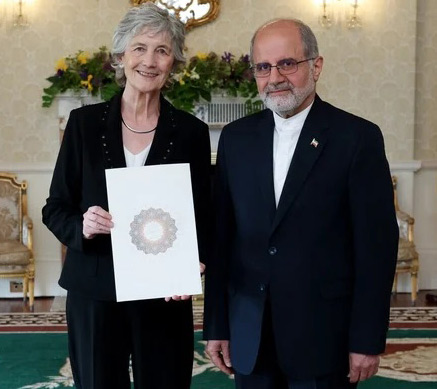
The decision to receive and photograph Iran’s ambassador at Áras an Uachtaráin, with the agreement of the Irish Government, was one such moment.
Of course, it will be said that this was merely a credentials ceremony. It will be said that diplomatic relations must continue, that ambassadors represent states whether we approve of those states or not, and that Ireland must keep channels of communication open. There is truth in that. Diplomacy is not friendship, and accreditation is not endorsement.
But symbols matter. They matter especially when they involve regimes that are still executing, imprisoning and torturing their own people.
Iran is not simply another difficult state with whom Ireland has disagreements. It is a regime whose record on executions is among the worst in the world. Human rights organisations have documented shocking numbers of executions, including executions following unfair trials, executions for political or security-related accusations, and executions connected to wider efforts to crush dissent. Reports of torture, forced confessions, arbitrary detention and brutal repression are not historical footnotes. They are part of the present reality faced by Iranians who dare to protest, speak, organise or simply refuse to submit.
That is why the image of Iran’s ambassador being formally welcomed and photographed with the President of Ireland (See above left), jars so deeply.
President Connolly now occupies an office that is, by design, above ordinary party politics. The President does not make foreign policy in the same way a government minister does. But the President does embody the State. The President’s actions, appearances and words carry ethical significance. When the President receives an ambassador from a regime carrying out executions and torture, the question is not whether the constitutional paperwork was correct. The question is whether the moral message was adequate.
Was there any public word for the prisoners awaiting execution? Was there any public acknowledgement of torture? Was there any mention of women, students, dissidents, trade unionists, journalists and minorities who have faced repression? Was there any reference to the many thousands alleged to have been killed in past massacres and crackdowns, or to the victims of the present wave of executions? If the above concerns were raised privately, the Irish public has not been clearly informed. If they were not raised at all, that is worse.
Ireland has often prided itself on speaking for human rights, international law and the dignity of small nations and oppressed peoples. We invoke that tradition when we speak about Palestine. We invoke it when we speak about Ukraine. We invoke it when we condemn apartheid, colonialism, war crimes and political imprisonment elsewhere. But a human-rights policy cannot be selective. It cannot be passionate in one case and ceremonially silent in another.
This is not an argument for cutting off all diplomatic contact with Iran. There may be Irish citizens, dual nationals, prisoners, humanitarian issues and international concerns that require a diplomatic channel. But maintaining a channel is not the same as offering the optics of normality.
Ireland could have handled this differently. The ceremony could have been accompanied by a strong public statement. The Government could have made clear that accreditation did not soften Ireland’s condemnation of executions, torture and repression. The President could have used the occasion, even in restrained constitutional language, to reaffirm Ireland’s concern for human dignity and human rights. There could have been a visible refusal to allow diplomatic protocol to become moral camouflage.
Instead, what the public saw was the familiar theatre of State recognition.That is the problem. Because for the families of those executed, for prisoners under sentence of death, for women beaten for defying compulsory controls, for protesters tortured into silence, and for exiles watching from Ireland, these images do not look neutral. They look like respectability being extended to the representative of a regime that has not earned it.
The office of President is not powerless. Its power lies in moral authority, in language, in symbolism, in the ability to remind the State of its values when convenience and protocol threaten to dull them. At a minimum, that moral authority should not be seen to soften the image of a regime still carrying out executions and torture.
Ireland must engage with the world as it is. But it must not forget what it claims to stand for. Diplomacy may require doors to remain open. Conscience requires that, when those doors open, the truth walks in as well.
This website uses cookies to improve your experience. We'll assume you're ok with this, but you can opt-out if you wish.AcceptRead More
Privacy & Cookies Policy
Privacy Overview
This website uses cookies to improve your experience while you navigate through the website. Out of these, the cookies that are categorized as necessary are stored on your browser as they are essential for the working of basic functionalities of the website. We also use third-party cookies that help us analyze and understand how you use this website. These cookies will be stored in your browser only with your consent. You also have the option to opt-out of these cookies. But opting out of some of these cookies may affect your browsing experience.
Necessary cookies are absolutely essential for the website to function properly. This category only includes cookies that ensures basic functionalities and security features of the website. These cookies do not store any personal information.
Any cookies that may not be particularly necessary for the website to function and is used specifically to collect user personal data via analytics, ads, other embedded contents are termed as non-necessary cookies. It is mandatory to procure user consent prior to running these cookies on your website.





Recent Comments