The Dáil vote to advance Sinn Féin’s morally reprehensible Bill, abolishing the mandatory three-day waiting period before abortion, is a deeply troubling moment for Ireland.
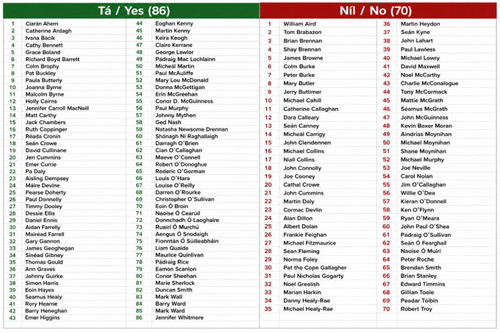
While this was not yet the final passing of this law, it was nevertheless a decisive and shameful step. The Bill passed Second Stage by 86 votes to 70, with no abstentions recorded. It now moves to further scrutiny, but the message from a majority of TDs is already clear; one of the few remaining safeguards in Ireland’s abortion law is now in their sights.
The three-day wait was not an extreme measure. It was a modest pause. It recognised that abortion is not ordinary healthcare, but the ending of a developing human life. It gave space for reflection, for pressure to ease, and perhaps for a mother to receive support, hope and alternatives. Removing it makes abortion faster, easier and more routine.
This is Sinn Féin’s Bill. Under Mary Lou McDonald’s leadership, a party that speaks constantly about housing, poverty, families and equality has chosen to put its political weight behind stripping away a safeguard for unborn children. That says a great deal about the moral direction of the party. Sinn Féin presents itself as the voice of ordinary Ireland, yet here it has helped lead an attack on the most voiceless human beings in the Irish State.
Will there be a referendum? As things stand, probably not. The 2018 referendum removed constitutional protection for the unborn and handed the Oireachtas power to legislate for abortion. That means TDs can now change abortion law without returning to the people, unless a future constitutional amendment is proposed. This is exactly why voters were previously warned that legal protections could be steadily dismantled once the Eighth Amendment was gone.
The voting record also deserves close attention. Published breakdowns show no abstentions, but several TDs were absent or not recorded as voting. The absent/not-recorded names listed include, note; Tipperary TD Alan Kelly, Thomas Byrne, Niamh Smyth, Peter “Chap” Cleere, James O’Connor, Jennifer Murnane O’Connor, James Lawless, Conor D. McGuinness, Denise Mitchell, John Brady, Rose Conway-Walsh, Sorca Clarke, Helen McEntee, Hildegarde Naughton, Patrick O’Donovan, Neale Richmond, Verona Murphy, Charles Ward and Richard O’Donoghue.
In Tipperary, Mr Alan Kelly of Labour, (Tipperary North), was listed as absent. Both Mr Michael Lowry and Mr Ryan O’Meara voted NO; in Tipperary South, Mr Séamus Healy voted YES, while Mr Mattie McGrath and Mr Michael Murphy voted NO.
And where are the Churches? The bishops have made statements defending life, but many ordinary christians feel the public witness has been far too quiet, cautious and muted. At a moment like this, Ireland does not need whispers. It needs moral clarity.
This vote should not be forgotten. Every TD who voted Yes, and every TD who failed to vote should be remembered. Ireland deserves better than this.
There has been little change in water quality indicators in 2025. Overall water quality remains unsatisfactory in many areas.
Excess nutrients from agriculture and wastewater remain the greatest challenge to water quality improvements, with phosphorous and nitrate levels still too high in many of our waters.
Some areas show improvements which is promising, but these are being offset by declines elsewhere. The scale and pace of implementation of actions to protect and restore water quality needs to be increased.
The message could not be clearer, and it should be a wake-up call for every community living beside a river in Ireland, including those of us along the River Suir.
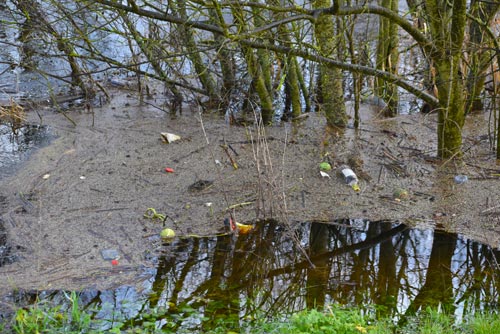
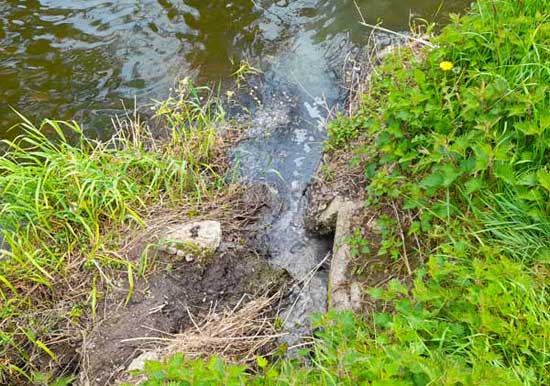
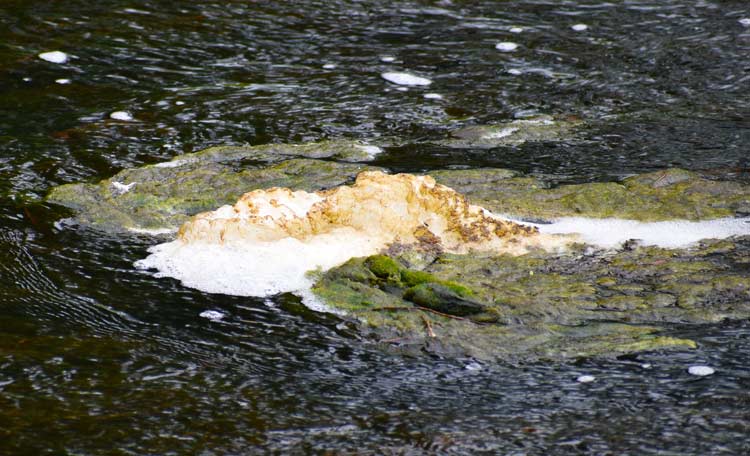
The EPA’s Water Quality in 2025: An Indicators Report shows that there has been little change in water quality indicators in 2025, with overall water quality still unsatisfactory in many areas. Nutrient levels remain too high in a large proportion of water bodies, and slightly more than half; 54% of rivers and lakes are in good or better biological quality. So the question must be asked locally: why is the River Suir still being neglected? For the past 14 years, we have heard promises, plans, meetings, schemes, visits and announcements, but the visible condition of parts of the Suir, particularly around Thurles, remains totally unacceptable.
River Suir, Thurles, Co. Tipperary. Pic: G. Willoughby.
On 25 May 2026, Tipp Mid West Radio reported that North Tipperary TD Mr Michael Lowry said he was submitting a funding application for works on the River Suir between Templemore and Ballycamas. That announcement is indeed welcome, but it also raises a very simple question: after so many years of concern about the condition of the Suir, why are we still at the stage of applications, announcements and proposed works?
We are also told that the Government has amended the Minor Works Scheme, that Tipperary County Council has been allocated €150,000 for river conveyance works, and that funding applications of up to €2 million may be made to cover remedial works. Mr Lowry has said he will work with Cllr Micheál Lowry to progress a plan for the River Suir, and Minister Kevin “Boxer” Moran is expected to visit Thurles to view the river’s condition. That is welcome, but it cannot become yet another photo opportunity, followed by another decade of delay.
The EPA is clear that excess nutrients from agriculture, wastewater and run-off remain the greatest challenge to improving water quality. It has also said that while some areas are improving, those gains are being offset by declines elsewhere, and that the scale and pace of action must increase.
LAWPRO is working across the wider River Suir catchment to reduce damaging discharges, while community groups and Rivers Trust initiatives are encouraging local people, landowners and stakeholders to get involved in protecting the Suir and its tributaries. That community involvement is important, but communities cannot do this alone.
The missing ingredient for the River Suir is not more talk, it is delivery.We need clear answers:
► What works will be carried out? ► When will they begin? ► Who is responsible for delivery? ► Has the funding application now been submitted? ► What section of the river will be prioritised first? ► How will pollution and damaging discharges be reduced? ► How will progress be measured and reported publicly?
River Suir, Thurles, Co. Tipperary. Pic: G. Willoughby.
The River Suir is one of this region’s greatest natural assets. It should not be treated as an afterthought. Clean water supports biodiversity, public health, recreation, tourism, farming, fishing and local pride.
After 14 years of discussion, the people of Thurles and the wider Suir catchment area deserve more than statements of concern. They deserve action, visible funded and accountable.
If Irish political leaders from Sinn Féin and the Social Democrats want to speak about justice, human rights and moral responsibility, then they should be willing to condemn all terror, including Hamas’s terror against Palestinians, with the same force.
For years, too many people including members of Sinn Féin have labelled the present Hamas as “freedom fighters,” as if brutality becomes noble when it is wrapped in political language. But a new United Nations report makes the reality impossible to ignore: Hamas does not only terrorise Israelis. It terrorises Palestinians too.
The UN Independent International Commission of Inquiry has now documented a pattern of executions, torture, maiming and public punishment inside Gaza. This is not Israeli propaganda. This is not rumour. This is the United Nations describing Palestinians as “victims of all sides,” trapped between mass atrocities, repression and armed groups willing to rule through fear.
According to the report, the Commission identified 249 cases of executions and severe physical violence in Gaza during 2024–2025, resulting in at least 108 deaths and 384 injuries. The report says Hamas-affiliated forces were involved in at least 60 incidents, including public executions and brutal punishments carried out in front of communities.
The details are horrific. Men were reportedly blindfolded and shot in public squares. Others were beaten with metal pipes. Bones were deliberately broken. Victims were kneecapped, maimed, humiliated and punished in ways designed not only to injure the individual, but to send a message to everyone watching: obey, or this could be you.
The UN report describes these acts as amounting to the “war crimes of murder and torture.” That sentence should stop everyone in their tracks. Public executions are not justice. Beatings with metal pipes are not resistance. Breaking the bones of Palestinians in the streets of Gaza is not liberation. It is terror. And it matters that these crimes were carried out publicly. The Commission itself expressed alarm at the “severity and public nature” of the violence. Public punishment is a political tool. It is designed to spread fear, silence dissent, intimidate rivals, and remind ordinary civilians that the armed men are in control.
This is the truth many Irish people have refused to face: Hamas’s cruelty is not reserved for Israelis. It extends to Palestinians living under its rule. Palestinians in Gaza have been used as human shields, denied political freedom, exposed to ruinous wars, and now, according to the UN’s own findings, subjected to executions and torture by Hamas-affiliated forces. None of this reduces the suffering of civilians in Gaza. It explains part of it. Palestinians are not served by pretending Hamas is a heroic movement. They are betrayed by that lie.
The UN has now put more evidence on the record. The question is whether those who excused Hamas for years will finally listen. There is no freedom in being dragged into a square and shot. There is no dignity in being beaten with pipes. There is no liberation in broken bones. Hamas is not a movement of freedom. It is a movement of fear.
A genuine concern for Palestinian lives must include concern for Palestinians abused by Hamas. A genuine defence of human rights must condemn torture whether the victim is Israeli or Palestinian. A genuine commitment to justice must reject the fantasy that armed extremists become moral actors simply because they claim to speak for an oppressed people. Hamas has shown the world what it is through its actions: massacre, hostage-taking, repression, torture and public executions. It has brought misery to both Israelis and Palestinians alike.
That is why the latest Dáil debate on Ireland’s fixtures against Israel should trouble anyone who cares about moral consistency. Sinn Féin and the Social Democrats pushed motions aimed at stopping the Ireland-Israel matches and seeking Israel’s exclusion from international sport, but the Dáil rejected those proposals after Government amendments stated that the fixture is a matter for the Football Association of Ireland, not Government. The amended motions passed by 81 votes to 68.
The FAI is now considering whether the October 4th fixture should go ahead in Dublin or be moved to a neutral venue, with Hungary reported as a possible alternative, subject to UEFA approval. But the wider question remains: why is there such political energy devoted to isolating Israel from sport, while far less attention is paid to the UN’s own findings that Hamas-affiliated forces have executed, tortured and maimed Palestinians in Gaza?
If Irish political leaders want to speak about justice, human rights and moral responsibility, then they should be willing to condemn all terror, including Hamas’s terror against Palestinians, with the same force.
The Dáil vote at least recognised that sporting fixtures are not for Government to dictate, but the debate also exposed how often the crimes of Hamas are treated as secondary, even when the victims are Palestinians themselves.
The EU Migration and Asylum Pact must be judged by one simple test: does it help Ireland and Europe manage migration in a way that is fair, humane, lawful and safe?
Compassion matters. People fleeing war, persecution and real danger should be treated with dignity. Ireland has a proud tradition of helping people in need, and that should not be abandoned. But compassion cannot mean naivety. It cannot mean weak borders, poor screening, endless delays, or communities being told to accept decisions without proper consultation. It also cannot mean ignoring the genuine fear many Irish people now feel when they see violent attacks, pressure on housing, pressure on services, and a growing sense that ordinary people are not being listened to.
Across Ireland and Northern Ireland, people have been shaken by serious crimes and brutal attacks; the murder of teacher Ashling Murphy, the horrific attack on a priest in Downpatrick, and the shocking attempted beheading attack in Belfast. These cases are not all the same, and it would be wrong to use every tragedy to blame migrants as a whole. Most migrants are not criminals, and many come here to work, contribute and live peacefully. But it would also be wrong for politicians to dismiss public concern as racism or extremism every time people ask serious questions about security, vetting, deportation, border control and community safety.
A fair migration system must protect refugees, but it must also protect the host community. That means proper identity checks, faster decisions, stronger removal of people who have no right to stay, and immediate action where anyone; be they Irish or non-Irish, poses a danger to the public.
The EU Migration Pact certainly may bring more structure to the asylum system, but structure alone is not enough. Faster procedures must still be fair. Human rights must be respected. But public safety must also be treated as a human right, because Irish people have the right to feel safe in their towns, churches, schools, streets and homes. The debate should not be reduced to two extremes. On one side, there are people who want to shut the door completely. On the other, there are people who seem unwilling to admit that uncontrolled migration creates real problems. Ireland needs neither open-door idealism nor hatred. Ireland needs balance.
That balance should be clear: We should welcome genuine refugees. We should reject racism and violence against innocent people. We should remove those who abuse the system. We should never ignore crimes that terrify communities. We should demand honesty from government instead of slogans.
The EU Migration Pact will only work if it restores trust. Trust requires fairness for asylum seekers, but also fairness for Irish citizens. Trust requires compassion, but also enforcement. Trust requires humanity, but also common sense. Migration must be managed properly. Borders must mean something. Communities must be consulted. Dangerous people must not be allowed to fall through the cracks.
Ireland can be generous, but generosity must be matched with responsibility. A humane country protects the vulnerable, and that includes both those seeking refuge and the Irish people who expect their government to keep them safe.
The controversy around Ireland’s scheduled football fixtures against Israel in 2026 is real, serious and understandable. People are entitled to strong political and moral views. They are entitled to protest, to criticise governments, to question sporting bodies, and to demand consistency from international organisations. But there is still an important principle worth defending: where possible, politics and sport should be kept separate.
That does not mean sport exists in a fantasy world, untouched by history or suffering. It plainly does not. Ireland knows that better than most.
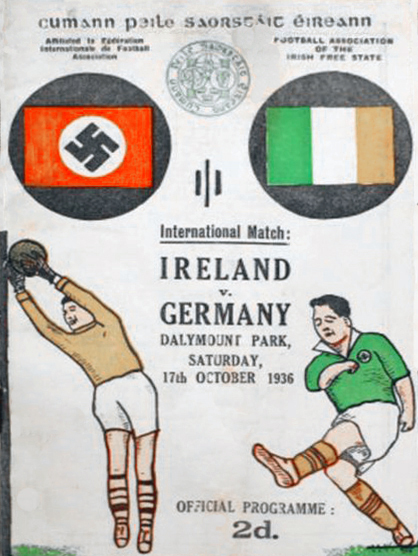
In October 1936, Ireland played Germany at Dalymount Park, at a time when Hitler’s regime was already in power. The German team gave the Nazi salute before the match. Looking back now, the images are deeply uncomfortable. Yet the match itself has also survived in Irish football memory as a sporting occasion, with Ireland winning 5–2, and the players on the pitch did what players are supposed to do; – they played football.
That example does not excuse the politics of the time. It does not make the symbolism harmless. But it does show the danger of making every football match a referendum on world affairs. Once we insist that teams may only play countries whose governments we approve of, sport becomes impossible to organise fairly. The rule will always be applied unevenly. Some states will be punished, others ignored. Some causes will become fashionable, others forgotten.
The recent Ireland match against Qatar also shows why consistency matters. Qatar has faced years of serious criticism over the treatment of migrant workers, especially around the 2022 World Cup. Amnesty International and Human Rights Watch have reported abuses including exploitation, unpaid wages, unsafe conditions and cases amounting to forced labour, even while acknowledging that some labour reforms have been introduced. Yet Ireland still played Qatar in Dublin in May 2026. That does not mean those concerns were unimportant. It means that, in practice, international football has continued to operate even when the opposing state has a deeply controversial human-rights record. If sport is to become a tool of political exclusion, the rule must be clear, consistent and applied equally; not selectively according to which controversy is most prominent at a given moment.
The players themselves are then placed in an impossible position. They are selected to represent their country in football, not to solve foreign policy. Asking them to carry the burden of international diplomacy is unfair. A footballer may have personal views, moral doubts, or sympathy with victims of conflict. But when a national team is drawn in an official competition, the decision to play should not be dumped on the shoulders of the players alone.
The same applies to supporters. Fans can protest. Fans can refuse to attend. Fans can display conscience. But the existence of protest does not automatically mean the fixture itself should be cancelled. A democratic society should be capable of allowing both: the match and the protest; the sporting contest and the political opinion.
There is also a practical issue. International sport depends on agreed rules. If Ireland refuses to fulfil a fixture, the consequences may not fall on the government whose actions are being criticised. They may fall on Irish players, Irish supporters, the FAI, and Ireland’s future standing in competition. That may satisfy a political demand in the short term, but it may do little to change the conflict itself.
None of this means sport should be morally blind. There are extreme cases where exclusion may be justified, particularly where international sporting bodies agree a clear, consistent and rules-based position. But that decision should be made transparently by the governing bodies responsible for the competition, not improvised country by country, match by match, under public pressure.
The lesson from Dalymount in 1936 is not that politics does not matter. It is that sport often becomes a stage onto which politics intrudes. The challenge is to prevent that stage from being completely consumed by it. Ireland can condemn injustice. Ireland can speak strongly in international forums. Irish citizens can protest, campaign and argue, but the national team should not automatically become a substitute foreign ministry.
Football cannot fix war. It cannot settle borders. It cannot undo suffering. What it can do, at its best, is preserve a small space where people compete under rules rather than slogans.
That space is worth protecting, not because politics is unimportant, but because sport matters too.
This website uses cookies to improve your experience. We'll assume you're ok with this, but you can opt-out if you wish.AcceptRead More
Privacy & Cookies Policy
Privacy Overview
This website uses cookies to improve your experience while you navigate through the website. Out of these, the cookies that are categorized as necessary are stored on your browser as they are essential for the working of basic functionalities of the website. We also use third-party cookies that help us analyze and understand how you use this website. These cookies will be stored in your browser only with your consent. You also have the option to opt-out of these cookies. But opting out of some of these cookies may affect your browsing experience.
Necessary cookies are absolutely essential for the website to function properly. This category only includes cookies that ensures basic functionalities and security features of the website. These cookies do not store any personal information.
Any cookies that may not be particularly necessary for the website to function and is used specifically to collect user personal data via analytics, ads, other embedded contents are termed as non-necessary cookies. It is mandatory to procure user consent prior to running these cookies on your website.




Recent Comments