There is a growing tendency among our Irish politicians and officials to speak about international law on Gaza as though the legal position is completely settled and universally agreed. It is not.
Whether people support or oppose Israel’s actions, it is important to state the law accurately rather than selectively.
Israel imposed a naval blockade on Gaza during an ongoing armed conflict with Hamas, which has controlled the territory since Hamas violently seized power in 2007. The blockade was formally declared in 2009 and was justified by Israel as a security measure aimed at preventing weapons smuggling by sea.
Under international law, naval blockades are not automatically illegal as our heads of government publically declare. In fact, the law of armed conflict at sea explicitly recognises them under certain conditions.
The San Remo Manual states that vessels attempting to breach a lawful naval blockade may be intercepted, including in international waters under certain circumstances.
This is not merely an Israeli interpretation. The 2011 UN Palmer Report concluded that Israel’s naval blockade was a legitimate security measure and that its enforcement had a legal basis under international law.
That does not mean every Israeli action is automatically lawful, nor does it mean there are no legitimate humanitarian concerns. Serious legal arguments have also been made that the blockade has become disproportionate or amounts to collective punishment due to the humanitarian consequences for civilians in Gaza.
But that is precisely the point: this is a disputed and highly contested area of international law. It is therefore misleading for Irish Government representatives to present the matter as though international law clearly and unanimously declares every interception at sea to be illegal. Many respected international lawyers, naval law experts, and even UN-linked inquiries have reached more nuanced conclusions.
People can oppose Israel politically or morally if they wish. But legal arguments should be based on the actual complexities of international law, not slogans or selective interpretations.
Ireland’s political and media class increasingly seems trapped in a cycle of outrage, where emotion appear to matters more than realism.
The recent arrest of Dr. Margaret Connolly; sister of Irish President Mrs Catherine Connolly; on board a Ga, so called aid flotilla immediately caused uproar in Irish political and media circles. Government figures condemned Israel, activists treated the incident as a major international drama, and RTÉ coverage became highly emotional.
At the same time, Eurovision exposed another reality that many activists do not want to face. Despite loud campaigns demanding Israel be excluded, Israel still took part in Eurovision and finished in second place. RTÉ and several other broadcasters boycotted the contest over Israel’s participation, but Eurovision went ahead anyway without their participation. So will RTE, who this year ignored licence fee payers, decide to repeat this boycotting scenario again next year?
That raises a very simple question; what exactly is the long-term plan? If the goal is somehow to make Israel disappear, that is not serious politics. Israel is not going anywhere. It is a strong country with major international alliances, a powerful economy, and the world’s largest Jewish population.
If the goal is to isolate Israelis from international events, that also appears to be failing. Eurovision continued. International organisations continue working with Israel. Trade continues. Sporting and cultural events continue. And if Israel competes again next year in Sofia, Bulgaria, the wider world will largely move on, regardless of any Irish outrage.
This is where many ordinary people are beginning to lose patience with what critics now call the “Paddystinian” movement.
Many feel the movement has gone far beyond criticism of Israeli government policy and has become something more obsessive and even hostile. Criticising Israel is perfectly legitimate, just as criticism of any government is legitimate. But when every issue becomes centred around Israel, people naturally begin asking questions.
There is also growing concern about the atmosphere being created for Jewish people living in Ireland. Across Europe, Jewish communities have reported rising hostility and intimidation since the Gaza conflict intensified. Many Irish Jews now feel increasingly uncomfortable speaking openly about their identity or opinions. That should rightly alarm decent people.
A country can support Palestinian civilians without turning hostility toward Israel into a national obsession. It is possible to care about Gaza while also rejecting hatred, intimidation, and political hysteria.
Many people now treat attending such weekend protests in major cities as a kind of social pastime, with large numbers taking part, despite having only a limited understanding of the history or complexities behind the issues involved.
Unfortunately, parts of Irish public debate no longer seem interested in balance or nuance. Too often, disagreement is treated as proof of moral failure. Anyone who questions the dominant activist narrative, risks abuse, smears, or social pressure. That is not healthy democratic debate.
Ireland once had a reputation as a calm, sensible country known for diplomacy and peace-building. Increasingly, however, parts of Irish politics and media appear more interested in performative outrage than practical solutions. Meanwhile, the rest of the world simply keeps moving.
Israel continues trading internationally, participating in global events, building alliances, and developing economically. Eurovision survived the RTE boycott. International audiences still voted for the Israeli entry in huge numbers. That reality may be uncomfortable for activists, but it is reality nonetheless.
Movements built mainly on anger and grievance eventually run into a problem: outrage alone is not a strategy. Shouting louder does not necessarily change minds. In fact, constant moral lecturing often pushes ordinary people away, and that may ultimately be the biggest danger for Ireland itself. Because countries that become consumed by ideological crusades can end up isolating themselves far more than the people they are trying to punish.
In the end, most people simply want balance, common sense, and a bit of perspective, not this endless outrage, division, and political theatre pumped out on news bulletins and via social media.
EPA finds almost six out of ten septic tanks fail inspection, putting drinking water wells and rivers at risk.
► Local authorities completed 1,466 septic tank inspections in 2025 targeting areas of greatest risk from an environmental and health perspective. ► Of these, 59% (863) failed inspection with many posing a risk to nearby rivers and drinking water wells. ► Since 2013, some 7,212 septic tanks failed inspections, with 84% fixed by the end of 2025. ► Improved resolution of faulty septic tanks by homeowners has been aided by increased Government grant support.
The Environmental Protection Agency (EPA) today released the report on Domestic Waste Water Treatment System Inspections 2025, which details the findings of septic tank inspections completed by local authorities in 2025. In 2025, 1,466 septic tanks were inspected, with 59% (863) failing because they were not built or maintained properly. Faulty systems pose a risk to human health from harmful bacteria and viruses through the contamination of drinking water wells, and can pollute rivers and streams through releases of nutrients such as nitrogen and phosphorus.
Sewage Flowing Into The River Suir, Thurles Town CentreIgnored.
When septic tanks fail inspection, local authorities issue advisory notices to householders setting out what is required to fix the problem. Of the 7,212 septic tanks that failed since inspections began in 2013, 84 percent had been fixed by the end of 2025. The number of failed systems with advisory notices unresolved for longer than two years reduced from 523 in 2024 to 442 in 2025.
Tipperarylocal authority area Inspection findings. Sadly Tipperary Water Service Authority shows only a moderate rate of Domestic Waste Water Treatment Systems (DWWTS commonly known as septic tanks) failures fixed.
Water Service Authority.
Inspections Required 2025▲.
Inspections Completed 2025.
Failure Rate 2025.
Systems failing 2013 – 2025.
% Fixed at end 2025.
Tipperary.
40
44
52%
205
78%
▲ Includes minimum number of inspections allocated in the National Inspection Plan (NIP) 2022-2026 and inspection shortfalls carried forward from 2024.
Commenting on the report, Mr Pat Byrne, Director of the EPA’s Office of Radiation Protection and Environmental Monitoring said: “The gradual increase in the number of faulty septic tanks being fixed by homeowners since 2013 in response to failed inspections is welcomed, as these are in the areas of greatest risk to rivers and drinking water wells. This has been aided by increased Government grant aid and greater enforcement activities by proactive local authorities. However, more consistent and sustained enforcement is needed across all local authorities to ensure that faulty septic tanks are fixed as soon as possible and that public health and the environment is protected.”
River Suir Thurles town centre.
The grant schemes for remediation of septic tanks were amended in 2024 and increased from €5,000 to €12,000. There were 460 grants awarded in 2025, totalling nearly €4.77 million, up from 265 grants awarded in 2024. Mr Noel Byrne, EPA Programme Manager said: “In 2025, some 59% of inspected septic tanks failed. This is a worrying statistic, as many homeowners may be exposing their families to health risks from contaminated private wells, or polluting local rivers, often without realising it. Regular checks and routine maintenance of septic tanks by homeowners can prevent minor issues becoming major problems, helping to protect their family’s health and the environment. Where eligible, homeowners should also make use of grant support of up to €12,000 to remediate faulty systems.”
There was a shortfall in inspections by three local authorities (Donegal, Fingal and Wexford) in 2025 and this shortfall must be made up in 2026, in addition to the planned inspections. The EPA will continue to monitor local authorities that are required to make up these shortfalls in 2026. Nine local authorities had less than 80 per cent of their issued advisory notices resolved by the end of 2025, which means that too many faulty septic tank systems continued to be a risk.
Local authorities are required to ensure septic tanks that fail inspection are fixed by homeowners in an appropriate timeframe. The report, Domestic Waste Water Treatment System Inspections 2025, is available HERE to download on the EPA website.
Something is deeply wrong, when Ireland tolerates terrorist symbols but ignores the murder of Private Seán Rooney.
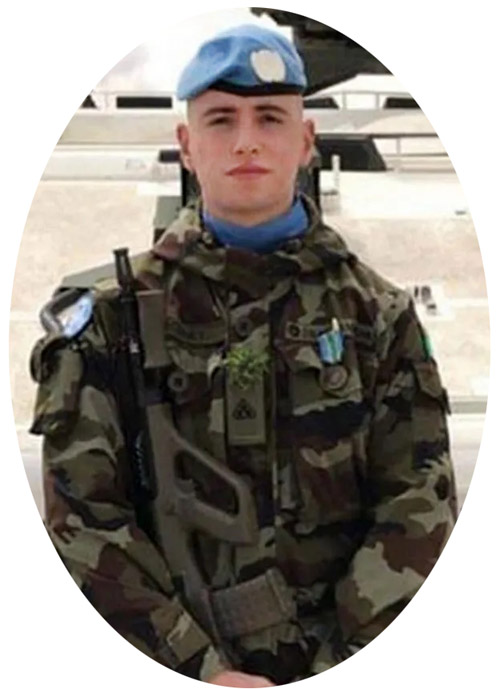
Private Seán Rooney was not a politician, activist or a celebrity; he belonged to a far higher order of human achievement and character. He was a 24-year-old Irish soldier from Donegal serving his country on a United Nations peacekeeping mission in Lebanon. By all accounts he was courageous, decent and deeply committed to protecting his fellow soldiers.
Private Seán Rooney, Irish Soldier Murdered by Hezbollah in Lebanon.
On December 14th 2022, just 11 days before Christmas, while travelling in a clearly marked UN vehicle near the Hezbollah stronghold of Al-Aqbiya, Private Seán Rooney and his colleagues came under sustained gunfire from Hezbollah-linked attackers. Seán, sadly, was killed trying to protect his comrades, while another Irish soldier was seriously injured.
The aftermath of this event has been a grotesque insult to his family and indeed to the Island of Ireland itself. The main suspect, Hezbollah member Mohammad Ayyad, was eventually convicted and sentenced in his absence after repeatedly avoiding court appearances. He still remains at large today, after previously being released on “medical grounds.” Meanwhile, others involved received sentences so absurdly lenient that even the Irish Government publicly condemned them as unacceptable. Private Seán Rooney’s mother correctly described the process as a “sham trial” and said justice had neither been done nor even seen to be done.
While Seán Rooney’s family continue to fight for accountability, Ireland has witnessed crowds marching openly through Dublin and Cork waving Hezbollah and Hamas flags, latter organisations synonymous with sectarian violence, terrorism, hostage-taking and the murder of civilians.
Perhaps nothing captures the moral confusion of our modern-day Ireland more than the sight of Irish Tricolours being waved beside Hezbollah and Hamas flags on the streets of Dublin and Cork, as though the values represented by our national flag are somehow compatible with organisations linked to terrorism, sectarian hatred and the murder of an Irish peacekeeper, Private Seán Rooney.
For Seán Rooney’s family, and for many decent Irish people, that image is not “solidarity” or “activism.” It is a profound national disgrace and an insult to the memory of a young Irish soldier who died serving under the UN flag at the hands of Hezbollah-linked gunmen.
What is truly repellent is not only that these flags appear, but that so many so-called and self-appointed champions of “human rights” refuse to condemn them. Many politicians, activists and celebrity figures appear far more interested in performative anti-Israel activism than in showing even basic solidarity with the family of an Irish peacekeeper, murdered by extremists, linked to Hezbollah. That silence is not moral courage; it is moral bankruptcy.
Jerome Lawrence rightly warned in his 1955 play, “Inherit the Wind”, that: “Fanaticism and ignorance is forever busy, and needs feeding.”
That is exactly what we are witnessing today. Fanaticism survives when hatred becomes fashionable, when ideological tribalism replaces moral consistency, and when people excuse or romanticise violent extremism because it aligns with their political worldview. Bigotry is not confined to race or religion; it also includes the irrational hatred and dehumanisation of anyone considered politically inconvenient, including Israelis, Jews, or even Irish soldiers whose deaths disrupt a preferred narrative.
Supporting innocent Palestinians does not require anyone to glorify Hamas or Hezbollah. But too many people in Ireland have crossed that line. They excuse terrorist symbolism, ignore antisemitism when it comes disguised as activism, and remain conspicuously silent about the murder of Private Seán Rooney because acknowledging it would force them to confront uncomfortable truths about the movements they openly, through ignorance, tolerate.
The Rooney family deserved national outrage, unity and relentless demands for justice. Instead, they got evasions, hypocrisy and silence from people who claim to stand against violence and extremism; latter a disgrace on modern Ireland.
RTÉ is once again at the centre of controversy after new figures revealed that more than 200 people at the broadcaster were earning over €100,000 a year by the end of 2025, including 18 individuals paid more than €200,000 annually.
This latest revelation lands after years of scandals involving hidden payments, secret commercial deals, undisclosed barter accounts, and repeated failures in transparency from Ireland’s national broadcaster.
The public was already furious after the 2023 payments scandal exposed how RTÉ had understated presenter earnings, while continuing to demand television licence payments from ordinary households struggling through a cost-of-living crisis. Trust in the organisation collapsed, senior executives resigned, and multiple government and committee investigations followed.
Yet despite the outrage, RTÉ has continued to rely heavily on taxpayer support.
In recent years, the broadcaster has effectively received two major state financial rescue packages funded by the public: ► A €725 million annual public funding model through licence fees and state support. ► An additional government-backed financial bailout package worth hundreds of millions aimed at stabilising RTÉ after the payments scandal and declining revenues.
At the same time, licence fee inspectors continued pursuing households across Ireland for non-payment, even as questions mounted over excessive salaries, waste, governance failures, and opaque contractor arrangements inside the organisation.
In Ireland, thousands of people have been prosecuted over non-payment of TV licences, but only a relatively small number have actually been jailed.
Historically; in 2012, there were about 11,500 prosecutions for TV licence non-payment. Of those convicted, 242 people were jailed, though most were imprisoned only for a few hours and six overnight. In 2008, 49 people were jailed over licence-related fines. Between 1973 and 1993, at least 15 people were imprisoned during a civil disobedience campaign linked to Irish-language broadcasting activism. More recently, prosecutions and convictions have declined sharply after the RTÉ payments scandal damaged public trust: Irish courts dealt with 7,263 prosecutions in 2022, falling to 6,555 in 2023. Nearly 15,000 court summonses were issued in 2022 alone for non-payment. Convictions for non-payment reportedly fell by around 30% over recent years amid the fallout from RTÉ controversies.
People are generally not jailed directly for “not having a licence” itself, but for failing to pay court-imposed fines after conviction. Fines can reach up to €1,000 for a first offence.
The newest figures also show nearly 1,300 people received between €50,000 and €100,000 from RTÉ in 2025, while thousands more contributors were classified as contractors.
Meanwhile, viewers and taxpayers are still asking the same unanswered question: How can RTÉ continue demanding mandatory licence fee payments from the public while repeatedly failing basic standards of transparency and accountability with public money?
This website uses cookies to improve your experience. We'll assume you're ok with this, but you can opt-out if you wish.AcceptRead More
Privacy & Cookies Policy
Privacy Overview
This website uses cookies to improve your experience while you navigate through the website. Out of these, the cookies that are categorized as necessary are stored on your browser as they are essential for the working of basic functionalities of the website. We also use third-party cookies that help us analyze and understand how you use this website. These cookies will be stored in your browser only with your consent. You also have the option to opt-out of these cookies. But opting out of some of these cookies may affect your browsing experience.
Necessary cookies are absolutely essential for the website to function properly. This category only includes cookies that ensures basic functionalities and security features of the website. These cookies do not store any personal information.
Any cookies that may not be particularly necessary for the website to function and is used specifically to collect user personal data via analytics, ads, other embedded contents are termed as non-necessary cookies. It is mandatory to procure user consent prior to running these cookies on your website.






Recent Comments