The controversy around Ireland’s scheduled football fixtures against Israel in 2026 is real, serious and understandable. People are entitled to strong political and moral views. They are entitled to protest, to criticise governments, to question sporting bodies, and to demand consistency from international organisations.
But there is still an important principle worth defending: where possible, politics and sport should be kept separate.
That does not mean sport exists in a fantasy world, untouched by history or suffering. It plainly does not. Ireland knows that better than most.
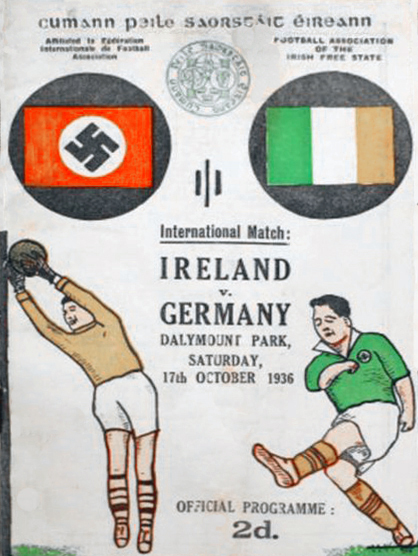
In October 1936, Ireland played Germany at Dalymount Park, at a time when Hitler’s regime was already in power. The German team gave the Nazi salute before the match.
Looking back now, the images are deeply uncomfortable. Yet the match itself has also survived in Irish football memory as a sporting occasion, with Ireland winning 5–2, and the players on the pitch did what players are supposed to do; – they played football.
That example does not excuse the politics of the time. It does not make the symbolism harmless. But it does show the danger of making every football match a referendum on world affairs. Once we insist that teams may only play countries whose governments we approve of, sport becomes impossible to organise fairly. The rule will always be applied unevenly. Some states will be punished, others ignored. Some causes will become fashionable, others forgotten.
The recent Ireland match against Qatar also shows why consistency matters. Qatar has faced years of serious criticism over the treatment of migrant workers, especially around the 2022 World Cup. Amnesty International and Human Rights Watch have reported abuses including exploitation, unpaid wages, unsafe conditions and cases amounting to forced labour, even while acknowledging that some labour reforms have been introduced. Yet Ireland still played Qatar in Dublin in May 2026. That does not mean those concerns were unimportant. It means that, in practice, international football has continued to operate even when the opposing state has a deeply controversial human-rights record. If sport is to become a tool of political exclusion, the rule must be clear, consistent and applied equally; not selectively according to which controversy is most prominent at a given moment.
The players themselves are then placed in an impossible position. They are selected to represent their country in football, not to solve foreign policy. Asking them to carry the burden of international diplomacy is unfair. A footballer may have personal views, moral doubts, or sympathy with victims of conflict. But when a national team is drawn in an official competition, the decision to play should not be dumped on the shoulders of the players alone.
The same applies to supporters. Fans can protest. Fans can refuse to attend. Fans can display conscience. But the existence of protest does not automatically mean the fixture itself should be cancelled. A democratic society should be capable of allowing both: the match and the protest; the sporting contest and the political opinion.
There is also a practical issue. International sport depends on agreed rules. If Ireland refuses to fulfil a fixture, the consequences may not fall on the government whose actions are being criticised. They may fall on Irish players, Irish supporters, the FAI, and Ireland’s future standing in competition. That may satisfy a political demand in the short term, but it may do little to change the conflict itself.
None of this means sport should be morally blind. There are extreme cases where exclusion may be justified, particularly where international sporting bodies agree a clear, consistent and rules-based position. But that decision should be made transparently by the governing bodies responsible for the competition, not improvised country by country, match by match, under public pressure.
The lesson from Dalymount in 1936 is not that politics does not matter. It is that sport often becomes a stage onto which politics intrudes. The challenge is to prevent that stage from being completely consumed by it.
Ireland can condemn injustice. Ireland can speak strongly in international forums. Irish citizens can protest, campaign and argue, but the national team should not automatically become a substitute foreign ministry.
Football cannot fix war. It cannot settle borders. It cannot undo suffering. What it can do, at its best, is preserve a small space where people compete under rules rather than slogans.
That space is worth protecting, not because politics is unimportant, but because sport matters too.





Leave a Reply