The Football Association of Ireland (FAI) has voted overwhelmingly to submit a motion to UEFA calling for the suspension of the Israel Football Association (IFA) from European football competitions.
The motion, passed by 74 votes to 7 with 2 abstentions, was adopted at an extraordinary general meeting of the FAI. It urges UEFA to remove Israel from participation in club and international competitions, citing alleged breaches of football governance and human rights obligations.
Grounds for the Motion: The proposal contends that the Israel Football Association:
Operates clubs in illegal settlements in the occupied West Bank, without the consent of the Palestinian Football Association — said to breach UEFA and FIFA statutes.
Has failed to uphold UEFA’s anti-racism and equality policies, contrary to Article 7bis of the UEFA Statutes.
UEFA has already decided that no European competition matches can take place in Israel due to ongoing security concerns. However, the FAI motion goes further, seeking to completely suspend Israel from all UEFA competitions.
Next Steps and Potential Outcomes: The FAI’s motion will now be transmitted to UEFA, where it may be considered by the organisation’s Executive Committee or Congress.
If acted upon, the suspension could see:
Israeli clubs removed from the Champions League, Europa League, and Conference League.
The Israeli national team barred from European Championship and World Cup qualifying campaigns conducted under UEFA.
No formal timetable for discussion or decision has been announced by UEFA.
Potential Consequences Analysts warn that the move could have wide-ranging implications: Sporting disruption: Fixtures involving Israeli clubs or national sides could be cancelled or restructured. Legal risk: The Israel Football Association could challenge any suspension before the Court of Arbitration for Sport (CAS), arguing that it is politically motivated. Diplomatic impact: UEFA could face political and commercial pressure from member governments and sponsors. Precedent: A ban on Israel could prompt demands for similar action in other politically charged situations, raising questions about consistency and governance in sport. Financial Context: – FAI’s Dependence on State Support.
This debate comes as the FAI continuestorely heavily on Irish Government and UEFA financial assistance.
In January 2020, the State, UEFA and Bank of Ireland agreed a €30 million rescue package to save the FAI from insolvency. This included €20 million in taxpayer funding through Irish government loans and grants.
In October 2025, the Government confirmed a further €3 million allocation in Budget 2026; same to support the development of League of Ireland academies.
This financial dependency has led some observers to ask who exactly initiated or influenced the FAI’s extraordinary meeting and subsequent vote and whether the association consulted adequately with its funding partners before taking a political position of such scale.
Broader Questions: While many within Irish football support calls for greater international accountability, others caution that the FAI, still emerging from years of financial crisis and governance reform, must act with care to avoid drawing itself into complex geopolitical disputes.
As UEFA weighs its response, the move has sparked debate not only about Israel’s role in European football, but also about the role of the Irish football authorities themselves, an organisation dependent on public funds now taking a stand on one of the most divisive issues in world sport.
For Ireland’s upcoming EU Presidency to carry real democratic weight, the Government must move beyond token consultation and create genuine channels for citizens to shape the nation’s European agenda.
How the Irish Public Can Engage Meaningfully in Ireland’s EU Presidency Consultation (2026).
From 1st July to 31st December 2026, Ireland will assume the Presidency of the Council of the European Union; a position that will place the Irish Government at the centre of EU policymaking for six crucial months. Ahead of this, the Department of Foreign Affairs has now invited views from domestic stakeholders and the public on the priorities that should shape Ireland’s Presidency programme.
Domestic stakeholders and the public who wish to express views – Please See HERE.
On paper, this is an admirable democratic exercise. In practice, however, the distance between the government and the citizen in Ireland has grown markedly, especially in recent years. Many people find it increasingly difficult to have queries answered by TDs or to receive substantive engagement from government Ministers and government Departments. Political dialogue has become one-directional with official statements flowing outward, but public input rarely finds its way back in.
To further prove this point I personally contacted 14 elected Irish TD’s, at the highest level, via email, during the time of this present government and, indeed, the previous government. I received acknowledgements from all 14, but sadly never any replys to the various queriesI thenhighlighted.
If this consultation is to be more than a box-ticking exercise, the Government must create mechanisms that allow citizens to contribute ideas, challenge assumptions, and hold policy-makers accountable for how their feedback is used.
A number of practical steps could make that possible: Regional Forums: Host open hearings in towns and cities across Ireland — akin to the Citizens’ Assembly format — where ordinary citizens, community organisations, and businesses can voice views on EU priorities such as energy security, migration, the digital economy, and climate policy. Online Platform: Establish a transparent online portal where individuals can submit policy suggestions, endorse others’ proposals, and see how those inputs are reflected in the final Presidency agenda. Sectoral Round-tables: Engage directly with universities, trade unions, youth groups, farmers, and SMEs to capture the breadth of Irish experience and expertise. Public Accountability: Publish a detailed summary showing which ideas were adopted or rejected, and why.
This kind of participatory approach would do more than enhance policy legitimacy. It would also help to restore public faith in democratic dialogue, at a time when trust in institutions and in politics itself is under strain.
An inclusive, transparent consultation process would ensure that Ireland’s EU Presidency is informed not only by officials in Dublin, but by the lived experience of Irish society. That would make the EU Presidency not merely an administrative duty, but a national expression of Ireland’s values and voice in Europe.
Note:The deadline for receipt of submissions is Friday 12th December 2025. If you have any questions, please send your query to the email address hereunder.
Let’s start with the need and wisdom of shopping around to reduce the cost of living.
Shoppers in Thurles are noticing striking price differences between local supermarket products. A local check in Thurles this week found that an 18-can slab of 7UP Zero was priced at €8.99 in Aldi: – €9.00 in Dunnes Stores: – €11.00 in Tesco: – €11.99 in Lidl: and €14.00 in SuperValu, demonstrating a spread that boldly underscores the point I am about to make and provides proof (as if proof was needed) that it pays to shop around and forget about loyalty.
Locked-In Loyalty – Why Staying with the same Provider is a costly mistake.
Households today are under pressure from multiple fronts, stagnant wages, rising rents, an inflationary drift in everyday goods purchased. In that context, taking time to compare providers for utilities, insurance, broadband or mobile and food is no longer a luxury; it’s a survival tactic. Because when you’re already squeezed, paying above-market rates for services and products you cannot do without, feels less like choice and more like injustice.
The smart consumer doesn’t just accept the default: they should demand value, they should compare, they should switch and not out of triviality, but out of necessity.
Moreover, competition only works if consumers engage: if everyone stays loyal out of inertia, then suppliers have no incentive to drive down costs or improve service. So shopping around is not merely savvy, it’s a civic duty in a market where you’re obliged to pay, but you still deserve fairness.
The Elephants In The Room: Now let’s address the elephants in the room: the cost of essential services in Ireland, particularly electricity and internet, is woefully high and increasingly indefensible. The internet provider Vodafone is down in Thurles yet again this morning, leaving people working from home without a service. Regardless they will still send the same monthly bill at the end of this month and expect people to pay. Over the past 12 month the Vodafone service failed over 34 times; on one occasion last August for a period of 3 consecutive days. It is easier to ride a camel through the eye of a needle, than to complain to the commission for Communications Regulation (ComReg). Why they still continue to exist, few people understand. When it comes to internet access, Irish consumers got 39% less value for their internet compared to UK users, and is placed only 22nd among European countries. Put simply: one of your most basic bills is much higher here than most of our European neighbours; this isn’t an incidental detail; it’s a structural cost burden.
Household electricity prices in Ireland were measured at €0.3736 per kWh in the first half of 2024, the highest in the EU for Irish households. In effect, Irish households are paying €350-plus annually, more for electricity than is the EU average.
What is especially galling is that when something is labelled “essential” it really ought to be priced in a way that doesn’t punish people just for being connected or powered. The fact that despite high VAT, network/levy costs, infrastructure investment and other “legitimate” components, the final bills remain so elevated it suggests a failure somewhere, either in regulation, competition, or both.
In short:shopping-around is vital; but it also shouldn’t be the only defensive mechanism. The system should not rely solely on consumers being alert and mobile. When essential services carry a premium burden, it erodes disposable income, squeezes savings, and perpetuates inequality.
Where to Find the Cheapest Bills in Ireland.
How to shop smart and cut your household costs. Irish households continue to face some of the highest utility costs in Europe. Here’s how and where to compare providers for cheaper electricity, broadband, insurance, and more.
The Invisible Tax : How Irish Households Fund High Utility Costs Rising Costs, Shrinking Choices: With electricity, broadband and insurance prices ranked among the highest in Europe, Irish households are paying a heavy premium for essentials. The truth is that loyalty rarely pays, and staying with the same provider year after year can cost you hundreds of euros more than is necessary. Fortunately, there are independent tools that make comparing and switching simple. Spending just an hour reviewing your main bills once a year can make a real difference to your budget.
Shop Around or Pay the Price: How to Fight Back Against Sky-High Utility Costs.
Electricity & Gas: Bonkers.ie : – the most comprehensive comparison site for Irish consumers. It lists every licensed energy supplier, breaks down standing charges and tariffs, and estimates your annual savings. Switcher.ie : – a clear, easy-to-use alternative, often with cashback offers for new customers. CRU.ie : – the Commission for Regulation of Utilities. It doesn’t compare prices, but it regulates the market and ensures the above sites remain impartial – supposedly. Tip:Watch out for 12-month “introductory rates”. Once they expire, prices jump sharply, so set a reminder to review before renewal.
Insurance Chill.ie : – compare car, home and travel insurance in one place. CompareInsuranceIreland.ie : — independent comparisons that include smaller providers.
Note: Sometimes it pays to check insurers directly; Aviva, Allianz, AXA, or 123.ie can offer better rates to new customers than through a website or program that collects related items of content and displays them or links to them, (known as aggregators). Tip: Neveraccept automatic renewals. The biggest insurance savings go to switchers, not loyal customers.
Banking & Mortgages. CCPC Money Tools : – the official comparison hub from the Competition and Consumer Protection Commission. It covers current accounts, credit cards, personal loans, and mortgage rates. Tip: If you took out a mortgage more than three years ago, check your rate. Switching lenders can save thousands over the lifetime of your loan.
Final Word – Financial Self-defence and Resistance. Ireland’s high cost of living is not likely to drop overnight, but smart shopping can make it more manageable. Reviewing your main bills; for energy, broadband, and insurance, once a year is a simple act of financial self-defence. In a system where essential services cost more than they should, comparison isn’t just wise; it’s a quiet form of resistance.
Shoppers in Thurles are noticing striking price differences between local supermarkets, underlining the continued strain of rising grocery costs across Tipperary.
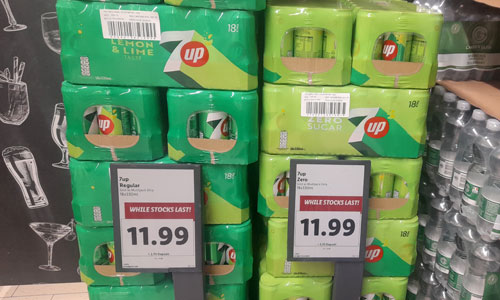
A check in Thurles this week showed that an 18-can slab of 7UP Zero cost €8.99 in Aldi, €10.00 in Dunnes Stores, and €11.99 in Lidl; a €3 difference between two main German international discount chains operating in Ireland.
Zero 7Up – Comparing Lidl price today.
While small on paper, the gap highlights how uneven supermarket pricing has become during Ireland’s ongoing cost-of-living crisis.
Prices remain high. Nationally, grocery inflation stands at 6.3%, with the Competition and Consumer Protection Commission (CCPC) estimating that food prices have climbed by roughly 27% since 2021. Even as energy bills ease, household shopping remains costly. Shoppers say they are now comparing prices item by item, with differences between stores adding up quickly.
Surveys show major contrasts. A recent Checkout.ie study found big variations in the cost of a standard grocery basket. Prices came to €150 at Lidl, €207 at Dunnes Stores (or €172 after vouchers), €195 at Tesco (or €185 with Clubcard), and €209 at SuperValu. An Irish Independent comparison of branded goods found a smaller basket costing €34.51 at Aldi, versus €49.24 at Dunnes and €49.88 at Tesco, a price gap of more than 40% on identical everyday items.
Different models, different prices. Aldi and Lidl run leaner operations with smaller product ranges and lower margins, helping them hold prices down. Local costs and Ireland’s new deposit-return scheme can also affect prices; for example, some 18-can packs now include a €2.70 refundable deposit, which does not appear on shelf labels.
Impact on local households. For families in Thurles, a few euro saved on a single product can mean €20 to €25 per week, or over €1,000 a year. With grocery prices still rising faster than inflation overall, more shoppers are switching stores, choosing own-brand goods and tracking weekly promotions. The example from Thurles shows that even between discount retailers, prices now vary widely, making careful comparison a key part of every household shop.
For almost a century, Fianna Fáil and Fine Gael have run this country. Between them, they’ve provided stability, managed the economy, and kept Ireland close to Europe. They’ve done plenty right, and deserve credit for steering clear of the angry, far-right politics we see elsewhere.
But the world has changed, and the old politics of careful management simply isn’t cutting it anymore. People are tired of polite promises and slow progress. They want answers, and a bit of honesty.
Ireland – The land of rolling green hills, magical castles, and unspoken truth.
What They Got Right. To be fair, both parties handled the economy well after our economic downturn (2008–2013), caused in part by the collapse of an unsustainable property and construction bubble that had formed during the preceding “Celtic Tiger” boom years. Fine Gael’s focus on jobs and recovery restored international trust, while Fianna Fáil’s old instinct for pragmatism helped Ireland grow out of poverty and into prosperity. Also their shared commitment to the EU has been a huge advantage. Foreign investment has powered our economy and created real opportunity and on paper, that’s success. But a country isn’t just measured by GDP, it’s measured by how people live, and that’s where the Irish right keeps falling short.
The Big Disconnect. The housing crisis has exposed the limits of their thinking. For years, both parties have insisted that the market will sort it out. It hasn’t. Rents are out of control, first-time buyers are priced out, and homelessness is rising. When people try to raise these issues, they run into another problem, the government’s communication gap. You send an email to a TD or department and you get a polite automated acknowledgement, but it ends there. You get no reply and questions are not answered. That kind of political politeness has become a symbol of the wider problem: leaders who appear to listen but don’t actually hear.
Two Parties, One Message. Once upon a time, Fianna Fáil and Fine Gael fought over ideas. Today, they’re practically interchangeable. Both are pro-business, pro-Europe, cautious and allergic to risk. Their coalition might keep things calm, but it also keeps them stuck. Yes, voters notice. Many aren’t looking for revolution, just for someone who speaks clearly, admits mistakes, and offers real solutions and public discussion.
Time to Reconnect. Ireland still badly needs a strong, sensible centre-right. Financial discipline and good management are important. But so are empathy, imagination, and communication.
If Fianna Fáil and Fine Gael want to survive the next decade, they’ll need to do more than manage, they’ll need to lead. That means tackling housinghead-on, cutting through bureaucracy, and giving straight answers when people ask fair questions. In 2025, “steady as she goes“ isn’t enough. People want to be heard. They want a government that talks straight, acts fast, and most importantly actually deliver the goods.
Until that happens, the old parties will remain what they’ve become: solid, safe, while slowly losing touch.
This website uses cookies to improve your experience. We'll assume you're ok with this, but you can opt-out if you wish.AcceptRead More
Privacy & Cookies Policy
Privacy Overview
This website uses cookies to improve your experience while you navigate through the website. Out of these, the cookies that are categorized as necessary are stored on your browser as they are essential for the working of basic functionalities of the website. We also use third-party cookies that help us analyze and understand how you use this website. These cookies will be stored in your browser only with your consent. You also have the option to opt-out of these cookies. But opting out of some of these cookies may affect your browsing experience.
Necessary cookies are absolutely essential for the website to function properly. This category only includes cookies that ensures basic functionalities and security features of the website. These cookies do not store any personal information.
Any cookies that may not be particularly necessary for the website to function and is used specifically to collect user personal data via analytics, ads, other embedded contents are termed as non-necessary cookies. It is mandatory to procure user consent prior to running these cookies on your website.




Recent Comments