The Problem with Ireland’s Political Left: Fragmentation, Credibility, and the Lost Connection.
Despite theatrical, showy public anger over housing and other inequality, the Irish left political parties remains more comfortable complaining rather than being convincing, and far from ready to govern in Ireland.
Ireland’s political left has no shortage of dramatic stagey passion, but it still struggles to turn this melodramatic anger into any real power. Despite widespread frustration over housing, healthcare, and inequality, the left remains divided and uncertain of itself. Labour, Sinn Féin, the Social Democrats, and People Before Profit all claim to represent change, yet together they look like a movement more comfortable at public protesting rather than governing a population of 6 million people.
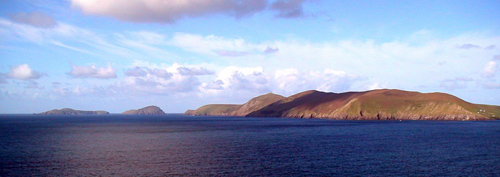
Ireland – The land of rolling green hills, magical castles, and unspoken truth.
Division. Their biggest weakness is division. The left parties spend too much time competing with one another and not enough time convincing the public that they can actually work together. Labour has never recovered from its time in government sleeping with Fine Gael in their desire for power, losing the trust of the lower wage earner, the working man. Sinn Féin, thrives on anger and grievance, but falters when confronted with the practicalities of governance and currently relies heavily on dramatic outrage. Whether it can ever evolve from a party of perpetual opposition into one capable of realistic, credible governance, remains a defining question within Irish politics, while being led by Mrs Mary Louise McDonald. Social Democrats are seen as certainly decent and honest, embodying the politics of competency, well-meaning, and yes serious about reform, yet that very moderation has become their biggest weakness. In a political landscape hungry for power, the party too often projects caution. It offers civility where voters increasingly crave conviction. People Before Profit are loud in opposition, but have little to say about how they would actually run a country. They occupy the far-left edge of Irish politics, a party defined more by its opposition to the system than by any credible vision for governing within it. Rooted in a Marxist tradition that distrusts compromise, it offers uncertainty rather than solutions, a politics of perpetual protest that often mistakes volume for influence. Its activism energises a small but committed base, but successfully isolates the party from the broader electorate.
Credibility Then there’s credibility, or the lack of it. The left is quick to criticise the failures of the system but less convincing when it comes to offering practical, costed solutions. Sinn Féin’s plans often sound ambitious but don’t always add up. Labour still talks about fairness but hasn’t rebuilt trust. The Social Democrats offer steady ideas, but rarely bold ones. Voters may agree with what the left says, but many still doubt it can manage the economy or deliver real results.
Connection with working people. The third problem is a loss of connection with working people. The left once spoke naturally for ordinary workers and families. Now, many of those same people see left-wing parties as out of touch or too focused on cultural debates. In towns and rural areas especially, the left can sound more like it’s talking down, rather than listening.
Narrowness There’s also a narrowness in how the modern Irish left sees the world. Important issues like gender equality, climate action and diversity are central to its message, but sometimes these are delivered in a way that feels moralistic rather than practical. The left’s language has become too shaped by social media and campus politics, and less by the realities of everyday real life.
In the end, the Irish left has mastered complaint, not delivery. It has plenty of passion but little unity; plenty of slogans but no single vision. As long as its parties define themselves mainly by what they oppose, namely Fine Gael, Fianna Fáil, capitalism, or even each other, they will remain on the sidelines while others run the country. The left parties must admit that those ruling have transformed Ireland from one of Europe’s poorest countries into an economic powerhouse, greatly increasing national wealth.
The pattern is clear in today’s politics. Sinn Féin’s rise has stalled, as voters, the silent people, question how an angry Mr Pearse Doherty would actually govern. Labour remains weak and uncertain of its policies. Social Democrats are making progress, but very slowly. People Before Profit continue to protest, but are winning few new supporters as seen in recent test results.
Yes, there is real appetite for change in Ireland, but the left still hasn’t shown that it’s ready to deliver it or even if it can ever provide the goods.
Then yesterday, TippFM Radio lead with the news that Fianna Fáil TD Mr Ryan O’Meara(who hasn’t been in Dáil Éireann a wet week and has achieved nothing since elected), stated that because his party’s chosen candidate Mr Jim Gavin will still be on the ballot paper “he’ll most likely give him No 1, but is undecided on his transfers”. Mr Gavin, as voters will be aware, pulled out of the campaign after it emerged, he knowingly failed, since 2009, to return overpaid rent (some €3,300) to a former tenant.
So here we have two elected TD sitting in our Irish parliament, both threatening to spoil their vote. Have these two powerful gods, who both greatly contribute to political disillusionment, consulted with those who mistakenly voted for them?
Disillusionment with Irish politics is hardly new!
As a presidential election approaches, the temptation to express frustration by spoiling your vote can be strong. Disillusionment with Irish politics is hardly new, and for many voters the choices on offer may indeed feel limited or uninspiring. Yet, while spoiling a vote might seem like an act of protest, it ultimately carries no political weight, and serves only to silence the voter’s own voice.
A spoiled vote is recorded, but not counted. It doesn’t shape the outcome, nor does it send a clear signal of discontent. Political parties and candidates rarely draw meaning from spoiled ballots; they focus instead on the valid votes that determine who wins and who loses. If the aim is to make politicians listen, then a spoiled vote does not achieve it.
Those who advocate spoiling a ballot, serve only their wish to silence you the voter.
Democracy depends on participation. When citizens disengage, the balance of power shifts towards those who do turn out, often the more organised or entrenched interests. Casting a valid vote, even reluctantly, strengthens the democratic process and keeps it fully accountable. With Ireland’s system of proportional representation, every first preference vote can make a difference, particularly in tight local or constituency contests where margins are often slim.
Is to spoil a vote a symbolic statement against a broken political system????
Some “chowderhead’s” argue that spoiling a vote is a symbolic statement against a broken political system. But a spoiled ballot says only what a voter rejects, not what they want. A better form of protest is to vote for candidates that reflect our values more closely. Even a low tally of first-preference votes can shape political debate in future elections.
Let it never be forgotten that the right to vote in Ireland was hard-won. Generations before us fought to secure it, often at great personal risk and death. Choosing not to vote, or to use use your vote in a way that has no effect, diminishes the legacy they granted to the present generation and to future generations.
Ultimately, voting is both a right but also a responsibility. It is an expression of hope that things can change, however slowly. Spoiling a vote may provide psychological relief through the open expression of strong emotions in the moment, but it leaves the field to others to now decide your future.
Remember in a democracy, silence is never the strongest statement.
Residents in Thurles, Co. Tipperary are becoming increasingly frustrated at the continued absence of even one proper bus stop in the town centre or in the surrounding areas.
In the heart of Thurles, recent half-finished street upgrades have already removed up to 80% of available parking. For those depending on public transport, the situation is even worse: commuters are left with no proper designated public transport areas. Passengers now huddle beneath the overhead canopy of the AIB Bank, for limited shelter on wet days, or under the entrance of a canopy at Thurles Garda Station on Slievenamon Road, where buses are forced to double-park and block traffic – putting road users at further risk.
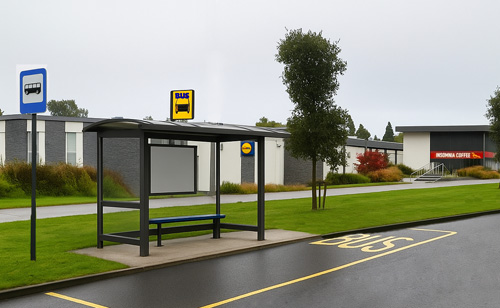
AI generated image of vacant area between Thurles Shopping Centre and Lidl Supermarket that if developed would give consumers options.
With winter fast approaching, this lack of basic infrastructure disproportionately affects families, students, older people, and anyone without access to a car. Something as simple as a sheltered bus stop would protect waiting passengers from rain and wind, while providing a safer, more accessible public transport system.
It is astonishing that in 2025, a town the size of Thurles still lacks such a fundamental amenity. This neglect hurts business footfall as much as residents on the move. While the government can allocate €336,000 for a covered shed supporting 36 bike spaces outside Dáil Éireann, surely the cost of installing a few bus shelters in Thurles would be only a fraction of that amount.
Beyond serving commuters, shelters in Thurles could even generate revenue. Advertising panels – whether static posters or digital displays – could provide income for Tipperary Co. Council itself while also improving currently decreasing town centre business.
The consequences of inaction are already clear. More people are resorting to driving, increasing congestion. Local shops are losing customers who might otherwise travel in by bus. Vulnerable groups – particularly the elderly, young people, and those on low incomes – are being left isolated. Businesses argue that this lack of provision is not just inconvenient, but unsafe, as passengers are forced to stand on busy pavements in poor weather with no protection.
This is a matter of fairness and safety. Public transport users in Thurles are not demanding the luxuries afforded to Leinster House – just the bare minimum: safe, accessible bus stops that connect the town to the wider region. Without them, Thurles will continue to fall behind.
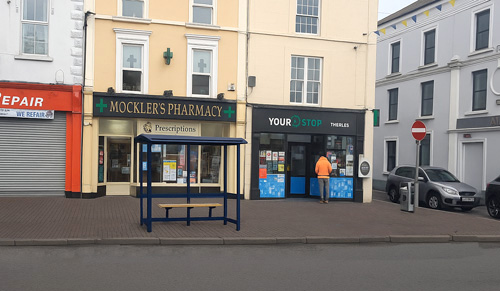
AI generated image of area for a bus shelter as detailed in recent Thurles planning upgrade.
We read that Tipperary County Council, in conjunction with the Local Enterprise Office, is inviting applications from Town Centre Teams, Trader Associations, Chambers of Commerce, Community Groups, Farmers Markets, Craft Markets, or those involved in the craft sector under the Christmas Retail Support Programme. This grant scheme, (View Application Form Here) they believe, will support towns and villages to implement activities aimed at boosting or retaining Christmas spending. Yet this approach rings hollow. It represents a deliberate waste of public money (for really just a 30 day promotion), when parking spaces in medium size town centres like Thurles are being eradicated, leaving shoppers with fewer options. Without convenient parking or public transport facilities, people will simply turn to online shopping for what appears to be cheaper shopping options – undermining the very local retail trade this scheme claims to protect. [Do remember the phrase ” Buy Cheaper – Buy Twice”.]
It is time for Tipperary County Council, transport authorities, and national decision-makers to act. Bus stop facilities are not an optional extra – they are an essential part of building a connected, inclusive, and sustainable community.
Yesterday afternoon, as a heavy downpour swept across Thurles Town, I took shelter beneath the trees on the banks of the River Suir and waited. As predicted at 3:00pm, as the bells from Thurles Cathedral struck the hour, the rain eased just long enough for me to capture a series of photographs and a short video, the evidence of which, now speaks for itself.
Video above shows sewage flowing openly in the River Suir, in Thurles Town centre. The Fountain, once gifted to the Thurles Tidy Town Committee and stolen from the river Suir by council officials, with the knowledge of current serving local councillors, must now be returned.
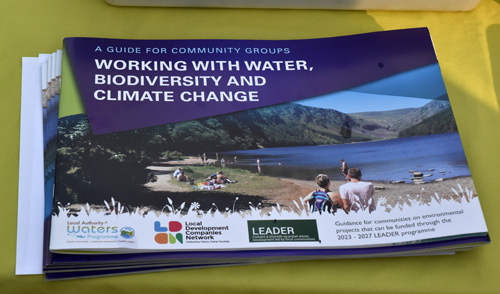
The reason the rampant weed growth along the riverbank is left uncontrolled is now obvious. These weeds serve as a natural curtain, concealing the 28 outlets discharging their contents directly into the river; a river which LAWPRO (Local Authority Waters Programme) scientists confirm is dying rapidly.
Yes, in response to an EPA memo last week, Council officials, who had deliberately ignored our warnings, made a token gesture. Two pallets, two plastic bollards, a pile of discarded clothing, and six supermarket trolleys were finally removed. But beyond that, little has changed. As my video above shows, bottles dumped into the river during this summer’s Town Park Music Festival still remain. The blame here cannot rest entirely with festival-goers; when public seating is installed by a river, litter bins must also be provided. Yet councillors and their officials continue to ignore this most basic of facts.
I spent over an hour yesterday in that putrid stretch of riverbank, speaking with those passing along the walkway near the Swinging Gates at the junction of Emmett Street and Thomond Road. After the downpour, one covered drain was spewing raw sewage; another carried foul runoff from the southern end of town. Spanish students and Ukrainian refugees were horrified by what they saw. Local residents, on the other hand, merely shrugged, “nothing new,” they said. Even the ducks, same introduced years ago by the late Wilbert Houben, Thurles Gun Club and myself, paddled eagerly in the filth, feeding on its floating debris.
Meanwhile, on 11th September, (a full 13 days after I had contacted the EPA in Wexford), our local newspaper finally ran a piece on the issue. Disappointingly, the image used was a long outdated archive photo, showing a river that looked nothing like its current choked and dying state. The article itself read more like a promotion for a local politician, than an exposé of the environmental crisis being ignored for the past 12 years.
And so, the buck-passing continues. LAWPRO; Uisce Éireann; Inland Fisheries Ireland, etc. none are willing or able to take legal action against Tipperary County Council. Instead, information shuffles endlessly from one desk to another, while the river suffers in silence and our government runs around like a headless chicken, believing, like the two genetically enhanced mice, ‘Pinkey and the Brain’, that their hyper-intelligence is slowly taking over the world.
But let it be clear: as the video shows, this is ‘Not The End’.
For the first time in Ireland’s modern history, more than 5,000 children are now officially declared homeless.
By being homeless we mean (A) not having a home, which can range from living without shelter (sleeping rough)(B) living in insecure, inadequate, or temporary housing, or (C) being in institutional care due to a lack of other options.
Figures released by the Department of Housing confirm that over 5,014 children are today living in Ireland without a permanent home, relying on emergency State provided accommodation. This number must be viewed as thousands of young children growing up without stability, security, or the comfort of a place to call their own.
The overall homeless population has reached a shocking over 16,058 people, an increase of over 15,915 in June last. Child homelessness alone rose over 56 in just one single month, up from the 4,958 officially declared in June.
In just four years, the number of people experiencing homelessness has nearly doubled; from 8,132in July of 2021 to 16,058 in July of 2025. These are not simply statistics, but families torn apart, futures put on hold and children suffering, through no fault of their own.
Homelessness is a wound that cuts through every layer of Irish society, but its deepest scars are borne by our affected children. It is a national disgrace that in a non-war torn, wealthy country like Ireland, thousands of our youngest citizens are being forced to grow up without a safe place to sleep.
Yet while this crisis deepens here at home, Irish political leaders like Irish Fine Gael politician, Tánaiste Mr Simon Harris, Irish Fianna Fáil politician, Taoiseach Mr Michael Martin; our outgoing Irish President and sociologist, Mr MD Higgins, all continue on the world stage, to claim to be global examples of social progress and humanitarian concern. Sorry, but to me their continuous posturing rings hollow when they ignore the electorate who entrusted them with Irish leadership. Empty rhetoric spewed out abroad on a regular basis cannot disguise the shame of failing the most vulnerable of their people here at home.
This catastrophe now demands urgent action from all political parties. We cannot allow another generation of children to be left behind. Our elected political parties, our communities, and all of us as citizens must refuse to accept homelessness as being normal. We must act boldly and immediately to ensure every child has the most basic of human rights; that of a safe and secure home.
This website uses cookies to improve your experience. We'll assume you're ok with this, but you can opt-out if you wish.AcceptRead More
Privacy & Cookies Policy
Privacy Overview
This website uses cookies to improve your experience while you navigate through the website. Out of these, the cookies that are categorized as necessary are stored on your browser as they are essential for the working of basic functionalities of the website. We also use third-party cookies that help us analyze and understand how you use this website. These cookies will be stored in your browser only with your consent. You also have the option to opt-out of these cookies. But opting out of some of these cookies may affect your browsing experience.
Necessary cookies are absolutely essential for the website to function properly. This category only includes cookies that ensures basic functionalities and security features of the website. These cookies do not store any personal information.
Any cookies that may not be particularly necessary for the website to function and is used specifically to collect user personal data via analytics, ads, other embedded contents are termed as non-necessary cookies. It is mandatory to procure user consent prior to running these cookies on your website.




Recent Comments