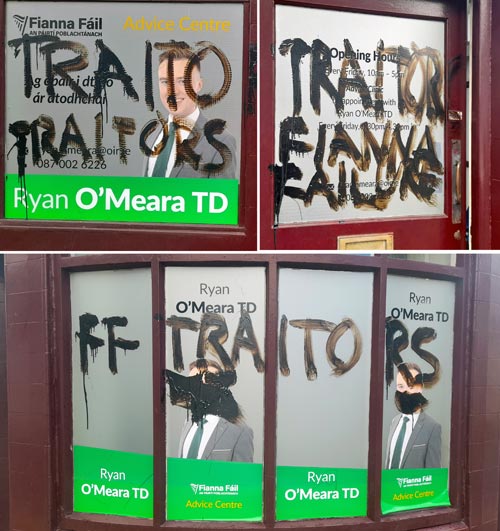
The office of Fianna Fáil TD Ryan O’Meara, situated in Thurles, have been vandalised sometime within the past 24 hours. The incident took place at his rented premises on the junction of Parnell Street and Cuchulain Road, latter a busy local landmark, better known as Hanafin’s Corner.
Office of Fianna Fáil TD Ryan O’Meara vandalised in Thurles.
This was not protest, nor was it political expression, it was pure vandalism. Whoever carried it out has shown nothing but disrespect for the local community and also for the democratic process.
Disagreeing with a public representative is one thing; attempting to intimidate or deface their workplace is quite another. Acts like this achieve nothing but division and damage the very tone of public life.
In a democracy, there are proper channels to voice frustration; through open debate, the ballot box, and community engagement. Resorting to mindless destruction is a coward’s substitute for reasoned argument.
No doubt local people will express shock and disappointment at the incident, and it is expected Gardaí will investigate. Those responsible should be ashamed of their actions, they have let down not only themselves but the town of Thurles as a whole.
Government gives approval to progress the Criminal Law (Sexual Offences, Domestic Violence and International Instruments) Bill 2025.
Bill will includes measures to:
Introduce ‘Jennie’s Law’ – a new publicly accessible Domestic Violence Register of Judgements managed by the Courts Service
Strengthen the law on sexual consent
Replace the term ‘child pornography’ in legislation with more appropriate term of ‘child sexual abuse material’
The Irish Government has approved the drafting of legislation to establish a publicly accessible Domestic Violence Register of Judgements, same to be published by the Courts Service. This new law will allow those convicted of domestic violence against a partner or former partner, to be publicly named on this Register of Judgements.
The General Scheme of the Criminal Law (Sexual Offences, Domestic Violence and International Instruments) Bill 2025 will also:
Strengthen the law on sexual consent.
Bolster our legislation on preventing and combating human trafficking;
Remove dual criminality in respect of certain offences including forced marriage; and
Replace references to “child pornography” with “child sexual abuse material” in legislation and in legal proceedings.
The General Scheme will now be referred to the Justice Committee for pre-legislative scrutiny and, when its report is received, work on finalising the Bill will be prioritised.
In practice, this means that when a person says they thought the other person had consented to sexual activity, this must be based on objective circumstances and not simply be the subjective belief of the accused. Under the new legislation this will apply not just to sexual intercourse but to all types of sexual activity between adults.
The proposed Register of Domestic Violence Judgements is a mechanism to facilitate publication of written judgments following conviction on indictment for serious offences relating to domestic violence, setting out details of the offence, the perpetrator, and other relevant information. Once issued, judgments will be published on the Courts Service website. The Court will retain the discretion to decide if a judgment should be delivered in a specific case, and the victim must provide their consent. The Register of Domestic Violence judgments will also signpost users to guidance on reporting domestic violence incidents and information on domestic violence supports.
In line with EU obligations and Council of Europe recommendations, the General Scheme also removes the requirement for dual criminality for sexual violence offences including rape, forced marriage, female genital mutilation and forced abortion and forced sterilisation. Until now, if such offences were committed abroad by an Irish citizen, they could not be prosecuted by the State unless this behaviour was also a crime in the place where it occurred.
For almost a century, Fianna Fáil and Fine Gael have run this country. Between them, they’ve provided stability, managed the economy, and kept Ireland close to Europe. They’ve done plenty right, and deserve credit for steering clear of the angry, far-right politics we see elsewhere.
But the world has changed, and the old politics of careful management simply isn’t cutting it anymore. People are tired of polite promises and slow progress. They want answers, and a bit of honesty.
Ireland – The land of rolling green hills, magical castles, and unspoken truth.
What They Got Right. To be fair, both parties handled the economy well after our economic downturn (2008–2013), caused in part by the collapse of an unsustainable property and construction bubble that had formed during the preceding “Celtic Tiger” boom years. Fine Gael’s focus on jobs and recovery restored international trust, while Fianna Fáil’s old instinct for pragmatism helped Ireland grow out of poverty and into prosperity. Also their shared commitment to the EU has been a huge advantage. Foreign investment has powered our economy and created real opportunity and on paper, that’s success. But a country isn’t just measured by GDP, it’s measured by how people live, and that’s where the Irish right keeps falling short.
The Big Disconnect. The housing crisis has exposed the limits of their thinking. For years, both parties have insisted that the market will sort it out. It hasn’t. Rents are out of control, first-time buyers are priced out, and homelessness is rising. When people try to raise these issues, they run into another problem, the government’s communication gap. You send an email to a TD or department and you get a polite automated acknowledgement, but it ends there. You get no reply and questions are not answered. That kind of political politeness has become a symbol of the wider problem: leaders who appear to listen but don’t actually hear.
Two Parties, One Message. Once upon a time, Fianna Fáil and Fine Gael fought over ideas. Today, they’re practically interchangeable. Both are pro-business, pro-Europe, cautious and allergic to risk. Their coalition might keep things calm, but it also keeps them stuck. Yes, voters notice. Many aren’t looking for revolution, just for someone who speaks clearly, admits mistakes, and offers real solutions and public discussion.
Time to Reconnect. Ireland still badly needs a strong, sensible centre-right. Financial discipline and good management are important. But so are empathy, imagination, and communication.
If Fianna Fáil and Fine Gael want to survive the next decade, they’ll need to do more than manage, they’ll need to lead. That means tackling housinghead-on, cutting through bureaucracy, and giving straight answers when people ask fair questions. In 2025, “steady as she goes“ isn’t enough. People want to be heard. They want a government that talks straight, acts fast, and most importantly actually deliver the goods.
Until that happens, the old parties will remain what they’ve become: solid, safe, while slowly losing touch.
The Problem with Ireland’s Political Left: Fragmentation, Credibility, and the Lost Connection.
Despite theatrical, showy public anger over housing and other inequality, the Irish left political parties remains more comfortable complaining rather than being convincing, and far from ready to govern in Ireland.
Ireland’s political left has no shortage of dramatic stagey passion, but it still struggles to turn this melodramatic anger into any real power. Despite widespread frustration over housing, healthcare, and inequality, the left remains divided and uncertain of itself. Labour, Sinn Féin, the Social Democrats, and People Before Profit all claim to represent change, yet together they look like a movement more comfortable at public protesting rather than governing a population of 6 million people.
Ireland – The land of rolling green hills, magical castles, and unspoken truth.
Division. Their biggest weakness is division. The left parties spend too much time competing with one another and not enough time convincing the public that they can actually work together. Labour has never recovered from its time in government sleeping with Fine Gael in their desire for power, losing the trust of the lower wage earner, the working man. Sinn Féin, thrives on anger and grievance, but falters when confronted with the practicalities of governance and currently relies heavily on dramatic outrage. Whether it can ever evolve from a party of perpetual opposition into one capable of realistic, credible governance, remains a defining question within Irish politics, while being led by Mrs Mary Louise McDonald. Social Democrats are seen as certainly decent and honest, embodying the politics of competency, well-meaning, and yes serious about reform, yet that very moderation has become their biggest weakness. In a political landscape hungry for power, the party too often projects caution. It offers civility where voters increasingly crave conviction. People Before Profit are loud in opposition, but have little to say about how they would actually run a country. They occupy the far-left edge of Irish politics, a party defined more by its opposition to the system than by any credible vision for governing within it. Rooted in a Marxist tradition that distrusts compromise, it offers uncertainty rather than solutions, a politics of perpetual protest that often mistakes volume for influence. Its activism energises a small but committed base, but successfully isolates the party from the broader electorate.
Credibility Then there’s credibility, or the lack of it. The left is quick to criticise the failures of the system but less convincing when it comes to offering practical, costed solutions. Sinn Féin’s plans often sound ambitious but don’t always add up. Labour still talks about fairness but hasn’t rebuilt trust. The Social Democrats offer steady ideas, but rarely bold ones. Voters may agree with what the left says, but many still doubt it can manage the economy or deliver real results.
Connection with working people. The third problem is a loss of connection with working people. The left once spoke naturally for ordinary workers and families. Now, many of those same people see left-wing parties as out of touch or too focused on cultural debates. In towns and rural areas especially, the left can sound more like it’s talking down, rather than listening.
Narrowness There’s also a narrowness in how the modern Irish left sees the world. Important issues like gender equality, climate action and diversity are central to its message, but sometimes these are delivered in a way that feels moralistic rather than practical. The left’s language has become too shaped by social media and campus politics, and less by the realities of everyday real life.
In the end, the Irish left has mastered complaint, not delivery. It has plenty of passion but little unity; plenty of slogans but no single vision. As long as its parties define themselves mainly by what they oppose, namely Fine Gael, Fianna Fáil, capitalism, or even each other, they will remain on the sidelines while others run the country. The left parties must admit that those ruling have transformed Ireland from one of Europe’s poorest countries into an economic powerhouse, greatly increasing national wealth.
The pattern is clear in today’s politics. Sinn Féin’s rise has stalled, as voters, the silent people, question how an angry Mr Pearse Doherty would actually govern. Labour remains weak and uncertain of its policies. Social Democrats are making progress, but very slowly. People Before Profit continue to protest, but are winning few new supporters as seen in recent test results.
Yes, there is real appetite for change in Ireland, but the left still hasn’t shown that it’s ready to deliver it or even if it can ever provide the goods.
Then yesterday, TippFM Radio lead with the news that Fianna Fáil TD Mr Ryan O’Meara(who hasn’t been in Dáil Éireann a wet week and has achieved nothing since elected), stated that because his party’s chosen candidate Mr Jim Gavin will still be on the ballot paper “he’ll most likely give him No 1, but is undecided on his transfers”. Mr Gavin, as voters will be aware, pulled out of the campaign after it emerged, he knowingly failed, since 2009, to return overpaid rent (some €3,300) to a former tenant.
So here we have two elected TD sitting in our Irish parliament, both threatening to spoil their vote. Have these two powerful gods, who both greatly contribute to political disillusionment, consulted with those who mistakenly voted for them?
Disillusionment with Irish politics is hardly new!
As a presidential election approaches, the temptation to express frustration by spoiling your vote can be strong. Disillusionment with Irish politics is hardly new, and for many voters the choices on offer may indeed feel limited or uninspiring. Yet, while spoiling a vote might seem like an act of protest, it ultimately carries no political weight, and serves only to silence the voter’s own voice.
A spoiled vote is recorded, but not counted. It doesn’t shape the outcome, nor does it send a clear signal of discontent. Political parties and candidates rarely draw meaning from spoiled ballots; they focus instead on the valid votes that determine who wins and who loses. If the aim is to make politicians listen, then a spoiled vote does not achieve it.
Those who advocate spoiling a ballot, serve only their wish to silence you the voter.
Democracy depends on participation. When citizens disengage, the balance of power shifts towards those who do turn out, often the more organised or entrenched interests. Casting a valid vote, even reluctantly, strengthens the democratic process and keeps it fully accountable. With Ireland’s system of proportional representation, every first preference vote can make a difference, particularly in tight local or constituency contests where margins are often slim.
Is to spoil a vote a symbolic statement against a broken political system????
Some “chowderhead’s” argue that spoiling a vote is a symbolic statement against a broken political system. But a spoiled ballot says only what a voter rejects, not what they want. A better form of protest is to vote for candidates that reflect our values more closely. Even a low tally of first-preference votes can shape political debate in future elections.
Let it never be forgotten that the right to vote in Ireland was hard-won. Generations before us fought to secure it, often at great personal risk and death. Choosing not to vote, or to use use your vote in a way that has no effect, diminishes the legacy they granted to the present generation and to future generations.
Ultimately, voting is both a right but also a responsibility. It is an expression of hope that things can change, however slowly. Spoiling a vote may provide psychological relief through the open expression of strong emotions in the moment, but it leaves the field to others to now decide your future.
Remember in a democracy, silence is never the strongest statement.
This website uses cookies to improve your experience. We'll assume you're ok with this, but you can opt-out if you wish.AcceptRead More
Privacy & Cookies Policy
Privacy Overview
This website uses cookies to improve your experience while you navigate through the website. Out of these, the cookies that are categorized as necessary are stored on your browser as they are essential for the working of basic functionalities of the website. We also use third-party cookies that help us analyze and understand how you use this website. These cookies will be stored in your browser only with your consent. You also have the option to opt-out of these cookies. But opting out of some of these cookies may affect your browsing experience.
Necessary cookies are absolutely essential for the website to function properly. This category only includes cookies that ensures basic functionalities and security features of the website. These cookies do not store any personal information.
Any cookies that may not be particularly necessary for the website to function and is used specifically to collect user personal data via analytics, ads, other embedded contents are termed as non-necessary cookies. It is mandatory to procure user consent prior to running these cookies on your website.





Recent Comments