The Irish Government reportedly spent €4.1 million in less than one year on security at a modular housing development for Ukrainian families in Clonmel, County Tipperary.
The figure relates to the development on Heywood Road, Clonmel, where 82 modular homes were constructed under the State’s Rapid Build Housing Programme. Designed for four residents per unit, the complex can accommodate approximately 328 people who fled the war in Ukraine.
€4.1 million security bill to protect 82 Tipperary homes.
At first glance, a €4.1 million security bill for 82 homes is extraordinary. However, it is important to understand why extensive security was introduced. In May 2024, while the site was being developed, security workers were assaulted and several vehicles were set on fire. One worker required hospital treatment. Gardaí launched an investigation and appealed for witnesses and video footage.
The security concerns did not disappear when construction finished. After Ukrainian families began moving into the homes in July 2025, residents reported broken windows and fences, stones being thrown, bicycles and scooters being stolen, and children being threatened or deliberately provoked.
Justice Minister Jim O’Callaghan subsequently said he feared some of the violence was being orchestrated for broader political purposes. Residents told journalists that they simply wanted to feel safe.
Nevertheless, the scale of the expenditure demands a detailed explanation. Spread over 11 months, €4.1 million would equal approximately €373,000 per month, €12,250 per day or €50,000 for each modular home. These are illustrative calculations because the exact payment period has not yet been publicly confirmed.
Several important questions therefore remain unanswered. How many guards were employed? Was security provided around the clock? Which company received the contract? Was it awarded through a competitive tender? Did the €4.1 million cover only security personnel, or did it also include fencing, CCTV, lighting, vehicles, VAT and other protective measures? It should also be made clear that the money was not paid to the Ukrainian residents. It was Government expenditure on protecting a State-supported construction project, its workers and the families eventually accommodated there.
The attacks provide a genuine explanation for enhanced security, but they do not remove the requirement for financial accountability. The Government should now publish the full contract, the dates covered, the procurement process and an itemised breakdown of the €4.1 million.
Protecting vulnerable families is necessary. Explaining how €4.1 million of public money was spent is equally necessary.
Thurles, Co. Tipperary has apparently developed an innovative transport policy; to force enormous juggernauts through streets designed when the principal form of heavy traffic had four legs and ate hay.
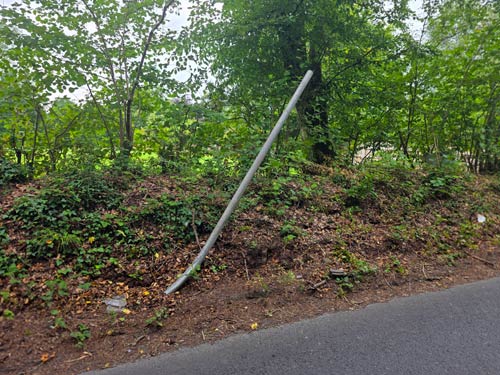
Available to view on Mill Road, Thurles, one of two signs within metres of each other, originally warning of a dangerous junction and dangerous bends. Pic: G. Willoughby.
The predictable result can be seen in the accompanying, undeniable video shown hereunder; for months damaged signs, battered street furniture, demolished walls, uprooted and dinged bollards and not surprisingly yet another enormous bill waiting for the over-stretched ratepayer.
If the claim that 90% of signs are seriously damaged is to be stated as fact, Tipperary County Council should immediately conduct and publish a proper survey. What is already beyond dispute is that the council; not passing motorists or magical road-sign fairies, is totally responsible for maintaining signs on local and regional roads.
Video courtesy of G. Willoughby. (Feel free to copy/share).
Local residents may know every turn in Thurles by instinct, by memory and generations of experience, but tourists, delivery drivers and other non locals do not. They depend on clear, visible signs to identify directions, restrictions and hazards.
Damaged or unreadable signage is therefore more than an embarrassment; it creates a genuine road-safety concern, particularly where unfamiliar drivers must make sudden decisions while navigating narrow, heavily trafficked streets. The Road Safety Authority expressly identifies regulatory, warning and information signs as essential guidance for tourists using Irish roads. Visitors should receive directions, not an unscheduled navigation exam, with a juggernaut approaching from the opposite direction.
For years, Thurles residents have heard about an Inner Relief Road and an Outer Bypass. The council’s 2024 – 2030 Local Area Plan still describes both as projects for which funding must be secured. The Inner Relief Road alone is intended to provide a 1.1-kilometre connection between the N62 and Mill Road, while the proposed bypass would link the N62, N75 and R498.
In 2025, only €100,000 was allocated to progress the Inner Relief Road’s detailed design. That is progress in the same sense that buying a doormat means your house is nearly built.
Mr Michael Lowry TD, Mr Alan Kelly TD and Mr Ryan O’Meara TD must now provide the public with something more useful than announcements, photographs and recycled assurances.
The evidence for action is already visible on the road. Official data published for the N62 at Turtulla records an average of 9,539 vehicle movements every day. More importantly, Tipperary County Council’s own Thurles Local Transport Plan concludes that the proposed road schemes would reduce total traffic in the town-centre core by approximately 20%, cut traffic crossing the River Suir bridge by more than 50%, and reduce town-centre heavy-goods traffic by approximately 50%.
The same plan states that roughly three-quarters of the predicted reduction would involve strategic traffic that neither begins nor ends its journey in Thurles. Vehicles presently passing through the town would use a suitable alternative route which presently does not exist. These are not speculative complaints, they are the council’s own measurements and modelling, providing compelling evidence that the relief road and bypass are necessary for safer streets, more reliable commercial access and a town centre that can perhaps function more effectively.
Thurles Needs Immediately:-
► A confirmed and fully funded delivery programme for the Inner Relief Road. ►A published timetable for the bypass. ► A professional audit of damaged signs and street furniture. ►A costed plan to prevent heavy vehicles repeatedly causing further damage. ►Clear public reporting of who sought funding, when it was sought and what response was received.
Thurles residents have waited long enough. They deserve proper engineering, funding and dates, not another series of ceremonial announcement that the announcement of a future announcement is progressing according to plan.
Patients throughout North Tipperary are facing renewed concerns about access to emergency hospital care after University Hospital Limerick recorded the highest level of overcrowding in the country during July.
North Tipperary’s TDs, namely Mr Michael Lowry, Mr Ryan O’Meara and Mr Alan Kelly, must now press for immediate measures to relieve this overcrowding, strengthen emergency and acute-care capacity across the Mid-West, and ensure that patients from the region can access safe and timely hospital treatment. All above named should raise this escalating crisis at UHL directly with Minister for Health Ms Jennifer Carroll MacNeill, and demand a clear, time-bound response.
A total of 2,172 patients were treated on trolleys, chairs or other inappropriate bed spaces at UHL during the month, according to figures from the Irish Nurses and Midwives Organisation.
University Hospital Limerick Which Serves North Tipperary.
The Dooradoyle hospital provides the principal 24-hour emergency and critical-care services for the Mid-West, including North Tipperary. The continuing pressure at UHL therefore has direct consequences for patients and families in communities including Nenagh, Roscrea, Newport, Borrisokane and surrounding areas. Nationally, 10,394 admitted patients were left waiting for hospital beds during July. It was the first July on record in which the figure exceeded 10,000.
UHL accounted for more than one-fifth of the national total and remained by far the most overcrowded hospital in Ireland. University Hospital Galway recorded 919 patients on trolleys during July, while the figure at Sligo University Hospital was 800. The INMO has called on the Health Service Executive to treat the situation at UHL as a major incident and to deploy all resources necessary to the hospital.
INMO General Secretary Ms Phil Ní Sheaghdha said the overcrowding experienced this summer represented a serious warning ahead of the traditionally difficult autumn and winter period. She said senior HSE decision-makers should be present at UHL throughout the bank holiday weekend and in the weeks ahead to oversee the response. The union’s intervention comes as people have been advised to consider other care options, before attending the UHL Emergency Department, except in cases involving serious illness, major injury or a life-threatening emergency.
For North Tipperary residents, however, the continuing problems highlight the limited emergency-care options available within the region. While services such as the Injury Unit and Medical Assessment Unit at Nenagh Hospital can treat certain patients, those requiring emergency or complex acute care may still have to travel to UHL.
The INMO also warned that sustained overcrowding, staff shortages and increasing workloads are placing nurses and midwives under relentless pressure. Ms Ní Sheaghdha said healthcare workers were being asked to provide care in conditions that would previously have been considered unimaginable during the summer months. She also accused employers of failing to provide sufficient support following critical incidents and of compromising staff health and wellbeing.
On Friday morning, a further 362 admitted patients were waiting without beds in hospitals across the country.
The record July figures are likely to intensify calls for additional hospital capacity, staffing and emergency-care services for North Tipperary and the wider Mid-West region.
The Irish Government has confirmed the deportation of six Nigerian nationals, following a coordinated return operation involving Irish authorities and the European Border and Coast Guard Agency, Frontex.
The six men, all aged between 25 and 40, were removed from Ireland on a charter flight from Dublin Airport to Rome before joining a Frontex-managed flight to Lagos, Nigeria.
The Dublin flight departed at 7:40 a.m. and arrived in Rome at 10:34 a.m. Irish time. The onward flight left Rome shortly after 1:00 p.m. and landed in Lagos at approximately 9:00 p.m.
According to the Government, deportation orders had been issued against all six individuals. Five of the men had accumulated a combined total of 35 criminal convictions and had received sentences for a range of offences.
Officials said the operation formed part of ongoing efforts to enforce immigration laws, remove individuals involved in criminal activity and maintain public confidence in Ireland’s immigration system.
The Government also highlighted the operational and financial benefits of working with Frontex and other European partners on joint return operations.
Members of An Garda Síochána accompanied the deportees, alongside medical personnel, an interpreter and an independent human rights observer.
The aircraft used for the Irish stage of the operation cost €76,895, excluding VAT.
Further charter deportation operations are expected to take place throughout 2026.
Urgent action required to address household emissions and reduce exposure to fossil fuel price volatility says Climate Change Advisory Council.
The Built Environment sector accounted for 12.5% of total greenhouse gas emissions in 2025.
Residential building emissions fell year-on-year by 5.0%, while emissions from commercial and public buildings fell by 3.5%, primarily due to a warmer winter.
Launching the Built Environment chapter of its Annual Review 2026 today, the Council said increased investment and faster rollout is needed in retrofitting, heat pumps, solar PV and district heating to reduce emissions, improve comfort and health outcomes and to protect citizens against volatile energy costs.
Although there has been a reduction in built environment emissions, the Council says these reductions should not be mistaken for structural progress. While residential and commercial/public buildings remained within their first sectoral emissions ceilings for 2021–2025, the outlook for the next carbon budget period is much more challenging. Both residential buildings and commercial and public buildings are projected to exceed their second sectoral emissions ceilings for 2026–2030 by 22% and 62% respectively.
The review warns that progress on local authority social housing retrofits remains too slow, with only 10,370 homes retrofitted since 2021. Approximately 5,000 retrofits are needed on average each year between now and 2030. The Council is calling for increased, sustained and ring-fenced multi-annual funding in Budget 2027 to allow local authorities to accelerate retrofit delivery and meet the Government’s own targets of 36,500 social houses brought to BER B2 or cost-optimal standard by 2030. The review also highlights solar PV as one of the fastest routes to lower bills and widen participation in the energy transition. It recommends the roll out of solar PV across local authority housing stock and that a national framework should also be put in place for plug-in solar to allow apartment dwellers to benefit from solar energy.
The Council says delayed and incomplete policy frameworks are now creating uncertainty for households, local authorities, industry and investors. For example, the delayed National Building Renovation Plan, due last December, has prompted the European Commission to open infringement proceedings in March. The plan should be published immediately, with a clear pathway to phase out fossil fuel boilers by 2040 as required under the EU Energy Performance of Buildings Directive. The Council identifies the requirement for a National Heat Strategy based on spatial planning, system diversity and resilience, to identify where district heating, geothermal energy, heat pumps and other low-carbon heating solutions can be most effectively deployed. The Council acknowledges Cabinet approval for revisions to the General Scheme of the Heat (Networks and Miscellaneous Provisions) Bill, but the legislation has slipped repeatedly and must now be finalised and enacted to give district heating the regulatory certainty it needs.
On resilience, the Council wants to see a clear programme of work so the Built Environment and Planning sector can develop and implement a dedicated Sectoral Adaptation Plan in the next plan cycle. Ensuring our built environment is resilient to immediate and future climate change impacts, such as heatwaves and flooding, is paramount to securing the future of our communities. In addition, the Council also recommends that Government expedite the development of coastal change management plans in priority vulnerable areas. Mr Alex White, Chairperson of the Climate Change Advisory Council, said: “As long as Ireland remains heavily dependent on fossil fuels to heat homes and buildings, our households, businesses and public services will remain exposed to global price volatility and energy insecurity. The Government has set the right ambition to end Ireland’s reliance on fossil fuels. The test now is delivery. We have the solutions and we know there is an appetite for them, but they must be enabled through policy and legislation. These solutions must be funded to deliver lower-cost clean energy for Ireland. Our communities also need plans and solutions to prepare for the impacts of climate change, especially coastal areas and those that are at risk of flooding. This transition must be fair. Social housing retrofit is one of the clearest tests of delivery. The State owns this housing stock, the targets are clear, and the benefits for households are immediate. To meet the 2030 target, local authorities will need to retrofit around twice as many homes each year as were delivered in 2025.”
This website uses cookies to improve your experience. We'll assume you're ok with this, but you can opt-out if you wish.AcceptRead More
Privacy & Cookies Policy
Privacy Overview
This website uses cookies to improve your experience while you navigate through the website. Out of these, the cookies that are categorized as necessary are stored on your browser as they are essential for the working of basic functionalities of the website. We also use third-party cookies that help us analyze and understand how you use this website. These cookies will be stored in your browser only with your consent. You also have the option to opt-out of these cookies. But opting out of some of these cookies may affect your browsing experience.
Necessary cookies are absolutely essential for the website to function properly. This category only includes cookies that ensures basic functionalities and security features of the website. These cookies do not store any personal information.
Any cookies that may not be particularly necessary for the website to function and is used specifically to collect user personal data via analytics, ads, other embedded contents are termed as non-necessary cookies. It is mandatory to procure user consent prior to running these cookies on your website.







Recent Comments