Dear Esteemed Voices of Opposition in Government. (Yes, you lot).
We, the People of Tipperary (yes, that rag-tag, unwashed mob, who struggle to pay the rent, mind the children, endure freezing radiators and fruitless housing-hunts), write to you today with admiration.
Oh yes, you have mastered something truly impressive: the art of being perpetually angry and outraged, heroically indignant and spectacularly unhelpful. (Bravo, Three Cheers, Hip, Hip, Hooray).
You stand there in the Dáil, gesturing grandly, as though you are the last defenders of Irish morality and justice, and the nation watches on, in overwhelming fear and general anxiety, before wondering what the hell exactly were you offering yet again?
Our Civic Palace of Stone & Voice.
Awe-inspiring words (volume high, content light). Your speeches soar with righteous anger. You denounce, you condemn, you rail against government failures. You paint bleak pictures of homelessness, cost-of-living, neglect, inequality. You raise the volume, you draw the cameras, you craft the headlines and welcome criminals into our Ardeaglais na nDlíthe (Cathedral / High Church of Laws), our Civic Palace of Stone and Voice, our People’s Drawing-Room, better known as Leinster House.
Yet, when the press lights dim and the papers close, the problems remain. Those health waiting lists grow – the rents continue to climb – the vacant units and houses stay vacant and deteriorate – and the young people we highly educate for free simply emigrate to the benefit of other states.
Is this your grand plan? A master-class in rhetorical fury, without a blueprint, without a map, without wheels that actually roll.
No plan, no policy, just performance You accuse the Government of failure, and indeed with some justice. But then: what is your remedy? You hand us soundbites, slogans, finger-pointing. You hand us anger and outrage. You do not hand us homes. You do not hand many people peace of mind. If politics is a fire, you seem to delight in fanning flames of indignation, but offer no water, no ladder, no shovel to dig foundations to rebuild what has burned.
Procedure over purpose. You treat parliamentary procedure like a stage for drama. Adjournments, speaking-rights rows, stand-off’s, delicious theatre. Critics dare to call it “chaos.” Some might even call it an embarrassment. But to you, it’s perfect. Because nothing says “principled opposition” like disruption for disruption’s sake. You trumpet this as integrity. We hear the loud banging and the unconstructive silence that follows those bangs.
Then amongst the so called Independents; those great parliamentary wallflowers who would sooner walk barefoot across hot coals than appear in a live television debate. They know full well that the moment they open their mouths without a script, the entire country would witness the intellectual equivalent of a slow-motion car crash. So instead, they clutch their pre-written sheets, like a toddler clings to a comfort blanket, lift them up with trembling hands; while attempting to read aloud words they clearly had only encountered for the first time, just moments earlier.
What follows is a linguistic bloodbath: mispronounced names, mangled terminology, long pauses where they glare at the page as if the letters are rearranging themselves out of spite. They stutter, they stumble, they sweat, like someone trying to defuse a bomb using only phonics. It becomes obvious that the speech wasn’t written for them, so much as in spite of them. By the time they reach the end, the chamber is left wondering not what point they were trying to make, but how such a person was ever trusted with a microphone, a mandate, or indeed the ability to read aloud in public. These today are, allegedly, our lawmakers. God help us.
And then, of course, we have the Opposition’s “Elder States People”Sinn Féin, those political veterans who behave as though their entire past was spent rescuing kittens from trees and mentoring youth choirs, rather than, whatever it was they were actually doing. Their official biographies glide gracefully from birth to present day, skipping over entire decades the way a dodgy landlord skips over mentioning mould in a rental advert.
These are the same people who now lecture the public about peace, ethics and moral leadership, while hoping no one ever dusts off the old photo albums from their glory days, which saw them remembered for blowing things up with great enthusiasm and who involved themselves in robbing banks and home grown genocide.
Listening to them now; polished, pious, freshly laundered, you’d swear they spent the 1980s running charity bake sales rather than attending strategy meetings in windowless rooms, lit by a single flickering candle. Their reinventions are so dramatic they make witness protection programmes look lazy.
And yet, with straight faces and quivering angry indignation, they condemn everyone else for moral failings. It would be funny if it weren’t so magnificently ridiculous, a whole troupe of reformed revolutionaries pretending their pasts were nothing more than a misunderstanding, involving fireworks and enthusiastic landscaping.
The people, now weary, watch from the sidelines. We are tired; not of the problems, no we cannot afford that luxury. We are tired of the show. We are tired of the endless promises of change, if only the Government is shamed enough. Shame. Shame again, and then, nothing.
We, the salary payers, used to believe that opposition was a safeguard: a watchdog, a conscience, a balance. Now, increasingly, we suspect it’s become a puppet-show, put on for the people, yes, your employers, who are now a jaded audience.
What we the people would like you to remember:
If you believe there is a crisis, propose a fix, not just an angry rant.
If you object to the way things are run, say how you would run them, not just why they are wrong.
If you seek to hold power accountable, do so without turning every debate into a circus. Clarity beats chaos.
And finally; remember those of us who don’t work a 3 day week outside of Leinster House. The ones who count the days until payday, who worry where the next rent cheque will come from, who wonder if home will ever mean more than a roof and attempt to give us hope.
Without hope, loud speeches become hollow noise, and parliament becomes a theatre of shadows.
Yours sincerely, We, the People of Tipperary, (tired of the Drama, longing for Delivery).
“The sign of a healthy economy should be a drinkable river.”
[Quote by Ms Li An Phoa, (founder of the organization ‘Drinkable Rivers’)].
In relation to the pollution of the River Suir in Thurles which we, after 13 years of watching the sheer neglect of same, by Tipperary Co. Council, drew to the attention of the Environmental Protection Agency (EPA) at the end of August last, has finally received a reply.
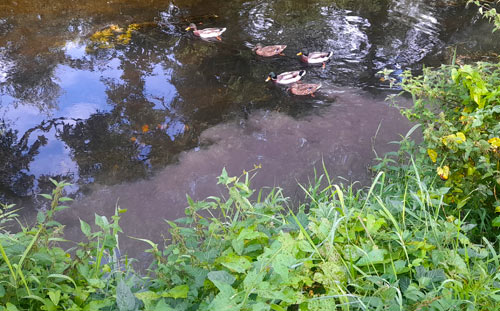
Effluent continues to flow into the River Suir in Thurles Town centre. Pic: G. Willoughby (Dated October 9th, 2025)
It is with great personal sadness and utter frustration that I report, first on the reply received from the EPA on Tuesday 25th November, 2025 which reads as follows:
(Ref: COM021813) Dear Mr Willoughby, Further to previous correspondence and responding to your concerns, the EPA wrote to Tipperary County Council seeking a written response from them on actions taken or planned on this matter. Tipperary County Council replied to the EPA on 23/10/2025. I enclose for your information a copy of a report received from Tipperary County Council in response to the issues raised in your complaint. The EPA is satisfied that Tipperary County Council is dealing with the issue raised in your complaint and in view of this, the EPA will not be pursuing it further at this time. The EPA recommends that you report any further issues directly to Tipperary County Council (preferably in writing) as the responsible authority. Please use the reference number above in any further correspondence with the EPA regarding this matter. Kind regards, Nessa Dearle.
While the EPA publicly admit that wastewater discharged from 59% of Ireland’s existing treatment plants fail to consistently meet standards set in EPA licences to prevent pollution and further admit that wastewater discharges continue to harm water quality in rivers, estuaries, lakes and coastal waters, they are not anxious to take on Tipperary Co. Council.
We will be publishing the inadequate awareness of the facts in the reply sent to the EPA by Ms Colette Moloney (Senior Executive Scientist with Tipperary County Council) shortly, as soon as time permits.
Tipperary County Council has rolled out a range of free-parking initiatives across multiple large towns in the county in the run-up to Christmas 2025. The aim is to support local retailers and encourage festive shopping.
Thurles Town – Free Parking Offer.
In Thurles Town: courtesy of Thurles Municipal District Councils administration (signed off on by Ms Sharon Scully), free parking will be available only for the first 30 minutes every day, (Fifteen minutes more than every ordinary) every day, throughout December 2025. Additionally, all council-owned car parks will provide free parking on the following Saturdays: 6th, 13th and 20thDecember2025. As it stands currently, it is important to note that three out of the town’s six main car parks will likely remain closed for this busy season, namely the car park beside the former Munster Hotel, (a long-standing resource for shoppers, parishioners and students); the car park underneath The Source building, (latter now closed for 3 years) and the new Market Area car park, beside The Source, (the upgrading of which has suffered serious delays). So, no concessions on the busy three days prior to December 25th. This limitation significantly undermines the stated objective of boosting local trade and enabling easy access to town centre shops.
Comparison With Other Tipperary Towns: Tipperary Town: Same offers one hour of free on-street parking each day, and unlimited free parking in all council car parks for December 2025. Roscrea: Same will have free parking throughout their towns every Saturday in December. Templemore: Same will have free parking throughout their town every Saturday in December. Clonmel Borough District: All council-owned car parks will have free parking on each Saturday in December, after 10am. The town also has a car park in Suirside which is free all year round and which will also be available for Christmas shoppers. Cashel Town: Same will also offer free parking in all council-owned car parks on Saturdays throughout December. Cahir Town: Same will also offer free parking in all council-owned car parks on Saturdays throughout December. Carrick-on-Suir Town: There will be free parking in all of the council-owned car parks on each Saturday throughout the month of December. Finally, in Nenagh Town: Here there will be three hours free parking in all council-owned car parks from Saturday December 6th, until Friday December 26th 2025. On-street parking will remain subject to ‘pay-and-display’.
Disparity Between Thurles and Tipperary Town: The differential treatment between Thurles and Tipperary Town, in particular, is stark and concerning: In Tipperary Town, shoppers benefit from unlimited free car-park access, plus one hour of free on-street parking, offering real convenience to those visiting the town centre.
In contrast, Thurles’ offer is limited to just 30 minutes free daily, and only on three Saturdays in December, while simultaneously reducing the supply of parking spaces by possibly having three of its main car parks closed. This severely undermines the town’s capacity to attract and accommodate shoppers.
Question: So where in this scenario are our Local elected Municipal District Councillors and our Thurles Chamber of Commerce.Thurles businesses no longer has a voice.
Given that the declared purpose of the initiative is to “promote local trade and encourage support for Town Traders during the festive season,” this disparity highlights an inequality in how different towns within the county are supported. Oh and by the way there is little on-street parking in Thurles town centre since over 60% was removed following it beings half upgraded.
Call for Review & Equal Treatment. We call on Tipperary County Council to reconsider the parking allocations for Thurles, especially in light of the closure of significant car parks, thus ensuring that the town receives a level of support comparable to other towns such as the afore mentioned Tipperary Town.
Failing to address this inequity risks undermining the very objective of stimulating local commerce in Thurles during what should be one of the busiest trading periods of the year.
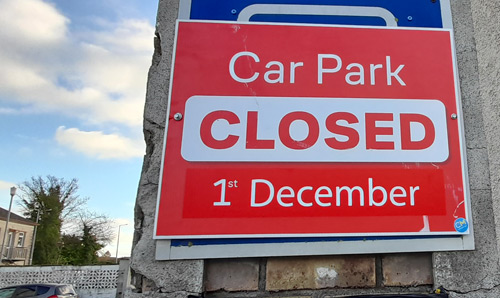
Thurles businesses and parish alarmed, as Munster Hotel car park in Thurles, faces closure, yet again, with effect from 1st December, 2025.
The decision to close the car park, situated beside the former Munster Hotel, yet again, on December 1st next, 2025, has sparked deep concern and outrage among local business owners, churchgoers, and the wider Thurles community. What was once a lifeline for retailers, consumers, parishioners and school-bus users, east of the town is now threatened, just as the town prepares for its busiest season of the year.
Former Munster Hotel car park threatened with closure on December 1st next, 2025.
A Blow To Faith, Commerce and Community. The car park’s closure will leave attendees at Thurles Cathedral, for Masses, funerals, and other important rites, struggling to find parking, creating potential hazards and serious access issues. Small local businesses, already feeling the strain from limited footfall, now fear a catastrophic drop in trade at the worst possible time: the run-up to Christmas. With the Thurles Market Quarter car park still closed for over a year and ‘The Source’ building car park closed for nearly three years, the looming loss of this space could be a tipping point.
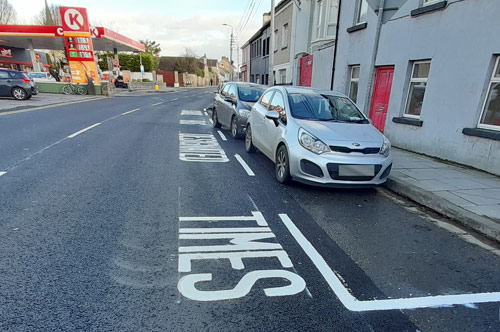
Public car parking spots on Kickham Street reallocated to school bus services.
Shockingly, in what many see as “salt in the wound”, a number of previously public parking spots on Kickham Street, have recently been reallocated, without prior notice, to school bus services.
Ownership, Influence And Frustration: The Munster Hotel and its adjoining car park are understood to be owned by Mr. Martin Healy, a high-profile local businessperson and a former member of the Thurles Chamber of Commerce, latter the very organisation that is tasked in promoting entrepreneurship and supporting small enterprises in the town. The irony is not lost therefore on local small business owners: the private owner closing a facility that is absolutely vital to the community.
The car park is currently rented by Tipperary County Council, but unconfirmed reports suggest that lease negotiations have broken down, fuelling accusations of neglect and mismanagement.
A Town On The Brink: Many in Thurles are now asking: how much more can local businesses absorb? How many more loyal customers will be lost because they simply cannot find a spot to park? And what message does this send when, at a time when the town should be rallying together, its own infrastructure fails exactly those who need it most? The impending closure will also likely expose pedestrians and road-users to increasing risk. With school buses now allocated to street parking, and the Cathedral’s forecourt full, the potential for dangerous traffic congestion is all too real.
Businesses Call For Immediate Action: Tipperary County Council must urgently intervene. This car park is not just a private asset; it is a public necessity. Thurles Chamber of Commerce must reflect on its role: supporting small businesses means protecting their lifelines, not shutting them off. Local elected representatives and stakeholders must demand a rapid, transparent solution that ensures parking is available for parishioners, shoppers, and visitors, especially during this Christmas season.
Conclusion: This is more than a car park dispute. This is a story of a town’s heartbeat being squeezed: of faith, community, and commerce, all now under threat. With the Munster Hotel itself long derelict, the parking facility has become more than a convenience, it is a cornerstone of Thurles daily life.
Its closure cannot be allowed to be yet another casualty of short-term thinking.
For the benefit of the ordinary man in the street, what exactly is the EU–Mercosur deal?
The EU–Mercosur deal is a major trade agreement between the European Union and four South American countries, namely Brazil, Argentina, Paraguay and Uruguay(known together as Mercosur).
Its main purpose is to make trade between the two regions easier by: (1) Cutting or removing many tariffs (import taxes) on goods going both ways. (2) Opening up markets for EU cars, machinery, medicines and services in South America. (3) Giving Mercosur countries more access to the EU for products like beef, poultry, sugar and other agricultural goods. (4) Setting common rules on things like food safety, intellectual property, and government contracts, including environment and labour commitments, though critics say these may not be strong enough.
Supporterssay: It will boost trade and strengthen EU ties with South America. Opponents, especially Irish farmers, say: It will bring in cheaper agricultural imports produced under lower standards, thus harming rural economies, and could indirectly increase deforestation in South America.
The EU–Mercosur Agreement, now entering a contentious ratification phase across the European Union, represents one of the most far-reaching trade deals negotiated by the EU in decades. While the agreement promises tariff reductions, expanded market access and strategic benefits in South America, it also presents serious risks for Ireland’s agricultural sector, its environmental standards and long-term rural sustainability. For these reasons, Ireland is justified in maintaining a cautious, and in many respects critical, stance as the ratification process unfolds.
Politically, the agreement remains highly unstable. The European Parliament is deeply divided, with recent votes showing only a narrow margin between supporters and opponents. Key member states, including France, Poland, Austria, the Netherlands and Italy, have already expressed strong reservations. The European Commission has attempted to push the process forward, but the fact that ratification was paused earlier this year reflects the scale of political tension surrounding the deal. Ireland is far from isolated in its concerns.
From an Irish perspective, the most immediate threat arises in agriculture. The agreement would grant substantial additional market access for South American beef, poultry and sugar into the European Union. Even with quota limits, the increased volume of imports would land directly into the most sensitive areas of Irish farm production, particularly beef. Irish farmers compete in one of the most regulated, high-cost and environmentally scrutinised agricultural systems in the world. Allowing cheaper imports produced under lower labour, welfare and environmental standards risks undermining the viability of family farms that form the backbone of rural Ireland. The European Commission has floated an “emergency brake” to reimpose tariffs if imports surge, but farmers’ organisations in Ireland are unconvinced that such mechanisms would be swift, robust or transparent enough to prevent serious market disruption.
Environmental concerns deepen this opposition. Ireland, like all EU member states, is bound by stringent climate and biodiversity targets. Yet the Mercosur bloc includes regions facing chronic deforestation pressures, particularly in Brazil and parts of the Amazon basin. Critics fear that increased export incentives for beef, soy and other commodities could accelerate land-use change in sensitive ecosystems. Although the agreement contains sustainability clauses linked to the Paris Agreement, enforcement mechanisms remain weak. It would be inconsistent for Ireland, already struggling to meet its own climate commitments, to endorse a trade deal that may indirectly contribute to global environmental degradation.
A further issue is regulatory asymmetry. The EU maintains some of the highest standards in the world regarding food safety, traceability and animal welfare. While the agreement requires Mercosur exporters to meet EU standards at the border, there is limited assurance that production systems on the ground will adhere to equivalent requirements. This raises real concerns about fair competition and consumer confidence. Irish farmers and processors, who invest heavily in compliance, would face competitors who do not operate under the same regulatory burdens.
Ireland also has legitimate procedural concerns. The decision by some in the European Parliament to challenge the structure of the agreement before the Court of Justice highlights unresolved questions about democratic scrutiny. Attempts to rush ratification without adequate debate risk eroding public trust in EU trade policy at a time when transparency is essential.
Finally, the strategic argument advanced by the European Commission, that the deal is needed to diversify trade and secure access to raw materials, does not outweigh the potential social and economic consequences for Ireland’s rural communities. Diversification is important, but not at the expense of domestic sectors that have already absorbed significant pressures from climate policy, volatile markets and rising production costs.
For all these reasons, economic, environmental, regulatory and democratic, Ireland is justified in maintaining a firm, evidence-based opposition to the EU–Mercosur Agreement in its current form. Any trade deal of such scale must protect the interests of Irish farmers, uphold the integrity of EU environmental commitments and ensure equal standards for all producers supplying the European market. Until those conditions are met, Ireland’s stance is both prudent and necessary.
This website uses cookies to improve your experience. We'll assume you're ok with this, but you can opt-out if you wish.AcceptRead More
Privacy & Cookies Policy
Privacy Overview
This website uses cookies to improve your experience while you navigate through the website. Out of these, the cookies that are categorized as necessary are stored on your browser as they are essential for the working of basic functionalities of the website. We also use third-party cookies that help us analyze and understand how you use this website. These cookies will be stored in your browser only with your consent. You also have the option to opt-out of these cookies. But opting out of some of these cookies may affect your browsing experience.
Necessary cookies are absolutely essential for the website to function properly. This category only includes cookies that ensures basic functionalities and security features of the website. These cookies do not store any personal information.
Any cookies that may not be particularly necessary for the website to function and is used specifically to collect user personal data via analytics, ads, other embedded contents are termed as non-necessary cookies. It is mandatory to procure user consent prior to running these cookies on your website.








Recent Comments