Application Ref: 261. Applicant: Maurice McCormack and Katie Tormey. Development Address: Archerstown & Townagha , Thurles , Co. Tipperary. Development Description: a revised dwelling house design (Permission was previously granted ref 24268). The revised design will involve single storey extensions to existing single storey dwelling house to the front, to the rear and to the side of the building. Also to carry out alterations to the existing front elevation of the dwelling and for alterations to the eastern site boundary, site layout plan and all associated site works Status: Conditional Application Received: 02/01/2026 Decision Date: 20/02/2026 Further Details:http://www.eplanning.ie/TipperaryCC/AppFileRefDetails/261/0
Application Ref: 2561330. Applicant: International Systems and Equipment Limited. Development Address: Chs Logistics, Cabragh Business Park , Cabra Thurles Co Tipperary Development Description: Creating a new vehicular entrance gateway and the construction of new boundary palisade fencing to divide the site and all associated site works. Status: Conditional. Application Received: 18/12/2025. Decision Date: 18/02/2026. Further Details:http://www.eplanning.ie/TipperaryCC/AppFileRefDetails/2561330/0.
Application Ref: 2561322 Applicant: John Shanahan Development Address: Bohernanave , Thurles , Co. Tipperary Development Description: As constructed timber out house and all associated siteworks Status: Conditional Application Received: 17/12/2025 Decision Date: 16/02/2026 Further Details:http://www.eplanning.ie/TipperaryCC/AppFileRefDetails/2561322/0
Application Ref: 2560703. Applicant: Darragh Fitzpatrick. Development Address: Cloghmartin, Thurles, Co. Tipperary. Development Description: the construction of a new dwelling house, effluent treatment system, works to existing entrance together with all associated site works. Status: Conditional. Application Received: 18/07/2025. Decision Date: 11/02/2026. Further Details:http://www.eplanning.ie/TipperaryCC/AppFileRefDetails/2560703/0.
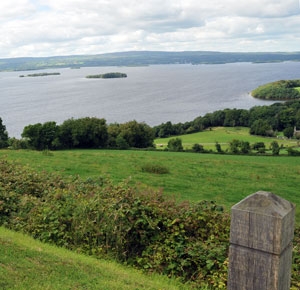
A North Tipperary councillor has warned that Tipperary County Council must “come out strongly” with regard to its position on the proposed Shannon-to-Dublin water transfer scheme, as the multi-billion euro project moves through the planning process.
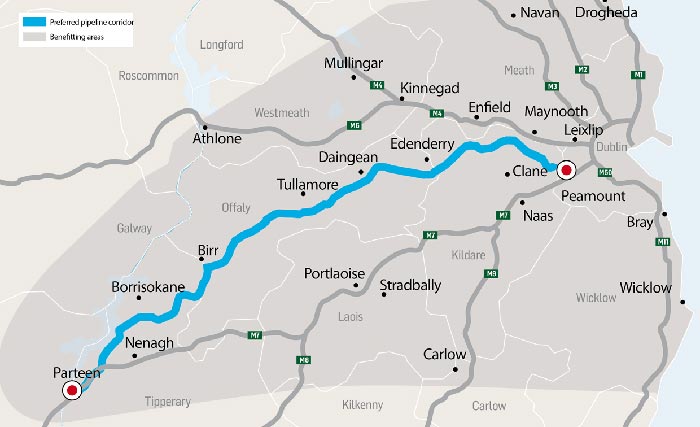
Uisce Éireann states the abstraction would be a maximum of 2% of the long-term average flow at Parteen Basin. The volume most commonly cited in public reporting is roughly 330–350 million litres per day(depending on the source and whether a rounded “up to” figure is used).
Cost estimates are varied. Uisce Éireann has referenced a preliminary indicative range in the €4.58bn–€5.96bn bracket, while other reporting has noted higher “worst-case” risk scenarios discussed in official correspondence.
“A legacy of a beautiful lake that’s destroyed” Speaking on local radio, Councillor Bugler said she fears the council will not oppose the project strongly enough when it finalises its submission. She said she raised her concerns directly with council Chief Executive Ms Sinéad Carr, warning against any temptation to prioritise potential local “community benefit” funding over environmental impact. She has urged the council not to “sell us out” and said she was worried about damage to Lough Derg for future generations.
Uisce Éireann has said it is proposing a “bespoke Community Benefit Scheme” linked to communities hosting construction and permanent infrastructure.
Criticism after Killaloe meeting. The councillor also criticised Uisce Éireann’s public engagement after a recent information meeting in Killaloe, saying she was dissatisfied with the answers provided on how the project would operate during low-flow or drought periods. In particular, she questioned how a 2% abstraction figure based on long-term averages would translate during dry spells and whether abstraction would be reduced or suspended, and what that would mean for the reliability of supply to Dublin and the wider region.
Proposed Tipperary – Dublin Pipeline.
“What turns this from local frustration into national hypocrisy is the scale of spending Ireland is willing to contemplate elsewhere. The Irish Government has backed the Water Supply Project for the Eastern and Midlands region, intended to bring a new long-term water source from the Shannon system towards the greater leaking Dublin area“. See Link Here
Ms Bugler further claimed that some representatives displayed limited familiarity with local water and wastewater infrastructure, including the source of supply for towns Ballina and Newport from the Mulcair River, and raised concerns about treatment levels at Ballina’s wastewater facility. These are allegations made by the councillor in media reports; Uisce Éireann has not, in the published material cited here, issued a point-by-point response to those specific claims.
Council submission in preparation. Meanwhile, Tipperary County Council is preparing its formal submission to the planning authority. Separate coverage has reported that consultants have been appointed to assist the council in drafting its response. With the application now before An Coimisiún Pleanála, we learn that stakeholders and members of the public can also make submissions as part of the statutory process, ahead of a decision on whether the project proceeds and, if so, under what conditions.
Application Ref: 2660088. Applicant: Orsted Onshore Ireland Midco Limited. Development Address: In The Townland Of Brittas, near Thurles , Co. Tipperary. Development Description: The further continued use of an existing temporary 80m high meteorological mast and associated instruments in the townland of Brittas, near Thurles Co. Tipperary. The mast was erected on site as exempted development pursuant to Class 20(A), Part 1, Schedule 2 of the Planning and Development Regulations 2001 (as amended) which was extended for two years under Planning Ref 2460421. Permission is sought to extend this permission for a further period of two years. Status: N/A. Application Received: 06/02/2026. Decision Date: N/A. Further Details:http://www.eplanning.ie/TipperaryCC/AppFileRefDetails/2660088/0.
Application Ref: 2660087. Applicant: Thomas and Sean Moore. Development Address: Mitchel Street, Thurles, Co. Tipperary. Development Description: The demolition of the existing light industrial buildings on the site, for the construction of 1 no. detached two storey dwelling, 1 no. detached bungalow and 6 no. semi-detached bungalows. Permission is also sought for new entrance, connection to services and all associated site works. Status: N/A. Application Received: 05/02/2026. Decision Date: N/A. Further Details:http://www.eplanning.ie/TipperaryCC/AppFileRefDetails/2660087/0.
Tarmac, Trolleys, Plastic Bags and Trampled Trees.
Double Ditch Obliterated, Then Abandoned.
Please first see the video immediately hereunder before preparing yourself to weep.
Now may I suggest you quickly grab a box of tissues.
Once upon a time, there was a place in rural Thurles, Co. Tipperary that had the cheek to be historic. They called it “The Double Ditch”; a raised path built through wet ground, faced with limestone, and rooted in the grim practicality of the once Great Famine, (1846-1849), to keep people working, to keep families alive, to keep feet dry enough to move. Yes, same was a civic scar, but an honest one, and a rare thing to be found in modern Ireland; a piece of lived history, a public walkway you could still walk on.
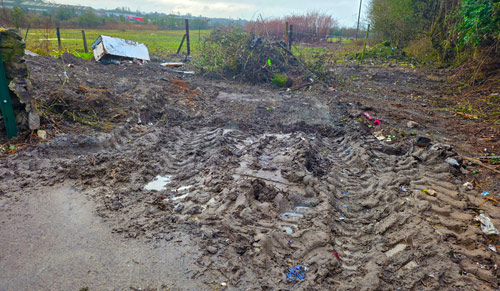
A recent abandoned attempt at cleaning the area.
Naturally, this could not be tolerated. So it became “connected”, “improved”, “enhanced”, “brought forward”, (whatever soothing verb local councillors, the local Municipal District Administrator and her officials would prefer), until all of it were “totally and wantonly obliterated”, its ancient hedgerows removed and the route flattened under heavy machinery, without so much as the courtesy of admitting what was being lost to the residents of our struggling town. Then, after much denial of its existence, with a straight face that would even shame a Victorian undertaker, it reappeared in planning language as being a “paved, pedestrian, walking route along a historical walking path”, despite being described by local councillors and politicians as not paved at all, before being levelled and left with only a temporary skin of tarmacadam.
And now we arrive at the masterpiece of their planning – “The Aftercare”.
Because nothing says “community amenity” like building a walkway and then abandoning it to rot, as if maintenance were an optional lifestyle choice, like decaf or seatbelts. The grand vision, a safe walking route on Mill Road, Thurles, tied into wider footpath plans, presented as “overdue” and “necessary”. The execution, however, appears to have followed the classic local-government model; do the ceremony; pour the tarmac; maximise the photocredit, then disappear vanishing into the mist.
So the area has now again begun its return to nature, that sacred Irish policy position otherwise known as “leaving it in a hape”. First came the willow saplings, same thrusting up through the tarmac like a botanical middle finger to uninterested municipal district officials, while rooting themselves into every crack that sheer neglect has kindly widened for them. Then arrived the briars and brambles, years of Autumn’s leaves, nettles and rank grass, all working in quiet co-operation like they’ve been awarded the contract. Soon enough, the walkway becomes less of a public route and more of a living demonstration of what happens when you build infrastructure with no real future plan to mind it, other than personal glorification.
And the litter, ah, the litter; not the dainty odd sweet-wrapper sort. No, this is the full rural-civic anthology, large plastic bags flapping like distressed flags; tyres slumped in the verge; broken wire fencing sagging like exhausted excuses. The occasional supermarket trolleys, thoughtfully dumped to ensure nobody confuses the place for cared-for land. If you’re lucky, a washing machine or two, because why wouldn’t you add white goods to a heritage corridor?
But the true flourish, the one that should make even the most hardened press-release writer blush, is how the site has been used as a stage for virtue, and then as a bin for its consequences.
In spring 2025, the area beside ‘Dun Muileann‘ on Mill Road, Thurles, became part of the One Hundred Million Trees planting push, funded locally by Allied Irish Banks’ Thurles branch, with students and the odd idle volunteer turning up to plant a dense mini-forest, using the Miyawaki Method; the whole point being fast-growing biodiversity and a carbon sink. The public reporting around it speaks of over two thousand native saplings planted at the site, a serious effort, and no small gesture of community buy-in.
And then, in the sort of anticlimax Ireland has successfully perfected; those young trees are left in a space now allowed to slide into total disorder, where over the past number of months horses are permitted to trample through the plantings that were meant to be protected long enough to establish themselves. A “green space”, promised and photographed, now reduced to a patch of scruff and horse manure, where the only thing thriving is the evidence of nobody being responsible.
That’s the moral of it, really, the fetish for the new, paired with the total inability to mind what’s then built.
Because it takes a special kind of civic arrogance to first flatten a famine-era landmark that once, literally, put bread into mouths, and then to shrug at the basic upkeep required to stop the replacement from becoming an overgrown dumping lane.
We are told, endlessly, about “heritage”, “biodiversity”, “active travel”, “community”. The words are always there; the maintenance however rarely is.
And so the Double Ditch, the real one, survives mostly as an idea: something that mattered, that was walkable, that carried memory in its stones. What’s left on the ground is the modern tribute: tarmac, blocked drains, weeds, rubbish, bent fencing, and the quiet certainty that nobody, supposedly in authority, will be held to account for any of it.
On behalf of myself, I offer my sincere apologies to Thurles Branch of AIB; (Sponsors), to MrRichard Mulcahy (Co-founder of the 100MT Project initiative) and to all those students who enthusiastically and eagerly took part in last April’s planting. Hopefully some of the trampled saplings will continue to survive, after all horse dung is a nutrient-rich organic fertilizer and soil conditioner.
This website uses cookies to improve your experience. We'll assume you're ok with this, but you can opt-out if you wish.AcceptRead More
Privacy & Cookies Policy
Privacy Overview
This website uses cookies to improve your experience while you navigate through the website. Out of these, the cookies that are categorized as necessary are stored on your browser as they are essential for the working of basic functionalities of the website. We also use third-party cookies that help us analyze and understand how you use this website. These cookies will be stored in your browser only with your consent. You also have the option to opt-out of these cookies. But opting out of some of these cookies may affect your browsing experience.
Necessary cookies are absolutely essential for the website to function properly. This category only includes cookies that ensures basic functionalities and security features of the website. These cookies do not store any personal information.
Any cookies that may not be particularly necessary for the website to function and is used specifically to collect user personal data via analytics, ads, other embedded contents are termed as non-necessary cookies. It is mandatory to procure user consent prior to running these cookies on your website.






Recent Comments