Halting Site and part of the new, modern, six-unit group housing scheme now being provided.
The High Court has made an order requiring members of the Travelling Community to vacate an unofficial halting site in Thurles Co. Tipperary by Tuesday, July 16th 2019 before 5:00pm on that date.
The orders were granted by Ms Justice Leonie Reynolds to Tipperary County Council, against eight named individuals; Mr William McCarthy, Ms Elizabeth McCarthy, Ms Mary Ellen McCarthy, Mr Jimmy McCarthy, Mr John McCarthy, Ms Winnie McCarthy, Ms Belinda O’Reilly and Mr Ned O’Reilly, whose presence currently residing at Cabragh Bridge, Cabragh, Thurles, Co. Tipperary, was found to allegedly constitutes a public nuisance.
Just last week, July 4th, Tipperary Co. Council obtained permission to serve short notice of court proceedings against the defendants. When the case returned before the High Court today, Mr David Humphries Bl, acting for the council, stated his client had served the proceedings on the defendants and were now seeking injunctions compelling the defendants to remove their caravans, mobile homes and any other vehicles from the Cabragh Bridge site, thus removing all obstructions from the R659 regional roadway.
Legal Counsel duly informed Ms Justice Leonie Reynolds that Tipperary Co. Council had offered the named defendant’s alternative accommodation at a nearby halting site, which had been ignored. Tipperary Co. Council, through their Council, also confirmed that this aforementioned offer of alternative accommodation will continues to remain open and available.
Defendants made no appearance at today’s Court hearing, and same will now be served with the court’s order, by Gardaí before 5:00pm tomorrow evening.
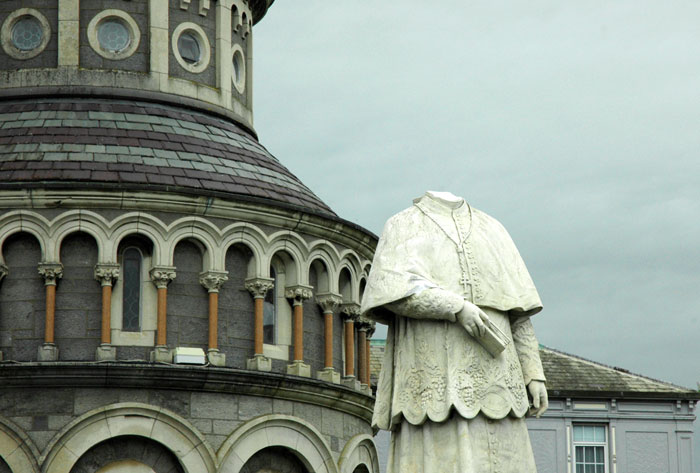
A reward of €1,000 has been offered for the recovery of the Sicilian statuary marble head, removed by a vandal or vandals from the statue of Archbishop Dr. Patrick Leahy, sometime last week.
The figure, his hand right holding a breviary, stood 8ft (2.4384m) in height, in front of Thurles Cathedral, on a limestone pedestal 7ft (2.1336m) high; representing the deceased Prelate attired in his episcopal soutane, rochet and mozetta, with his head uncovered. Following this undoubted vandalism, the head was then removed from the Cathedral grounds.
A person, who strictly wishes to remain anonymous, lodged €1,000 to the bank account of Thurles.Info on Friday evening last. [This action in itself, causing no small amount of misunderstanding / confusion, I hasten to add.]
Their written instruction received by us and now fully authenticated, states clearly:- “If within seven days ending 12.00 noon, Monday July 15th, confidential information is forwarded to Thurles.Info; [Via Contact Us]; same which will clearly identify the area where the statue head currently can be found; or which will lead to the recovery of the marble piece, then on the find being fully validated by an already nominated expert, this reward of €1,000 should be passed, in cash, by the website administrator, within 3 days of the recovery, to the individual informant, who in turn shall remain anonymous, should they so desire.” Signed: A. Christian.
Might be time to pay homage to our wellies and walk that scummy river area.
“Don’t give up! I believe in you all! A person’s a person, no matter how small! And you very small persons will not have to die If you make yourselves heard! So come on, now and TRY!”
Extract from the Dr. Seuss’ 1954 classic,“Horton Hears a Who!”
Residents of Co. Tipperary joined the ranks of a Pro-Life rally held in Dublin this afternoon, with the organisers of the ‘Rally for Life’ confirming the numbers of those attending / taking part at slightly over 10,000 people.
The Pro-life campaigners marched from the Garden of Remembrance in Parnell Square, down to the Customs House, in opposition to Ireland’s new abortion laws introduced in May of this year, following the referendum on the Eighth Amendment; with those assembled today calling on the present government for another referendum on abortion.
Thanks to social media, Irish people have now come to the realisation that a baby whose form is hardly visible underneath the slightest curve of a mother’s skirt, can now be cruelly crushed to death and ripped asunder; in some cases to be sold as tissue for drug testing purposes. After all, while food and beverages do not contain any aborted foetal material, they may be tastier because of it, and some cosmetics – those pretending to grant users access to that mythical fountain of youth – is most probably developed thanks to foetal skin cell testing.
Please read the poem hereunder, twice, before commenting.
Unto Us
A poem by the late great British-Irish comedian, writer, poet, playwright and actor Spike Milligan (1918 – 2002).
“Somewhere at some time They committed themselves to me And so, I was! Small, but I WAS! Tiny, in shape Lusting to live I hung in my pulsing cave. Soon they knew of me My mother – my father. I had no say in my being I lived on trust And love Tho’ I couldn’t think Each part of me was saying A silent ‘Wait for me I will bring you love!’ I was taken Blind, naked, defenceless By the hand of one Whose good name Was graven on a brass plate in Wimpole Street,* and dropped on the sterile floor of a foot operated plastic waste bucket. There was no Queen’s Counsel To take my brief. The cot I might have warmed Stood in Harrod’s shop window. When my passing was told My father smiled. No grief filled my empty space. My death was celebrated With tickets to see Danny La Rue Who was pretending to be a woman Like my mother was.”
* Note: Wimpole Street is an area located in the City of Westminster, Central London, England, associated with private medical practice and similar associations.
According to reports by Irishexaminer.com and Independent.ie, a leading civilian sports figure is the latest suspect to be arrested in a long-running undercover probe into Garda corruption by the Garda National Bureau of Criminal Investigation (GNBCI).
To-date the investigation has already led to the arrest and suspension of at least three senior members of an Garda Síochána, including a Superintendent, an Inspector and a Detective, back last May.
We understand that the newly arrested suspect was questioned for a number of hours in Tipperary Town Garda station on Thursday of this week, following the arrest that morning by detectives from the GNBCI.
This latest arrest concerns an individual in their early 50’s, latter suspected of being the channel through which information was supplied direct from certain Garda members; and conveyed to known members of a Munster organised crime gang. Some of this channelled information was said to have compromised planned raids and seizures by the Criminal Assets Bureau (CAB) on premises and homes of criminals residing both in Limerick City and County as well as here in County Tipperary.
The suspect arrested on Thursday morning last was released on Thursday night, following interrogation, however more arrests are now expected to follow.
Halting Site and part of the new, modern, six unit group housing scheme now being provided.
Tipperary County Council have taken High Court proceedings in an effort to remove members of the Travelling Community from an unofficial halting site at Cabragh Bridge, Cabragh, Thurles, Co. Tipperary.
The action has been taken against eight persons whose presence they claim constitute a public nuisance. These proceedings by the council, latter represented by Mr David Humphries Bl, are being taken against Mr William McCarthy, Ms Elizabeth McCarthy, Ms Mary Ellen McCarthy, Mr Jimmy McCarthy, Mr John McCarthy, Ms Winnie McCarthy, Ms Belinda O’Reilly and Mr Ned O’Reilly.
An injunction is being sought to now compel the defendants to remove their mobile homes and caravan type dwellings, together with all motor vehicles from the Cabragh Bridge area, thus removing any/all obstructions from the roadside, which the Council claim constitutes an inappropriate and unsuitable place in which to reside.
The High Court was today informed that some members of the McCarthy family have lived on this Bridge area for some 40 years; however Tipperary Council have since made provision for the long term members of this family to be accommodated in a modern six unit group housing scheme, which for some long period of time has remained ready for immediate occupation.
The defendants now currently before the Court, whom the council claim only moved to this Cabragh Bridge site, on various dates between 2015 and September 2018, will however not be accommodated in this new currently vacant scheme.
Tipperary County Council state that they have requested the defendants to leave the Cabragh site, but they have not done so; leaving the Council with no alternative but to take the necessary legal proceedings.
The Bridge itself was initially part of the R659 regional road that remained after the construction of a new section of that road many years ago.
In the High Court today Ms Justice Leonie Reynolds granted Tipperary County Council permission to serve short notice of the injunction proceedings on the defendants. She acknowledged the urgency of this case together with health and safety concerns raised, before returning the matter back to the Court next week.
This website uses cookies to improve your experience. We'll assume you're ok with this, but you can opt-out if you wish.AcceptRead More
Privacy & Cookies Policy
Privacy Overview
This website uses cookies to improve your experience while you navigate through the website. Out of these, the cookies that are categorized as necessary are stored on your browser as they are essential for the working of basic functionalities of the website. We also use third-party cookies that help us analyze and understand how you use this website. These cookies will be stored in your browser only with your consent. You also have the option to opt-out of these cookies. But opting out of some of these cookies may affect your browsing experience.
Necessary cookies are absolutely essential for the website to function properly. This category only includes cookies that ensures basic functionalities and security features of the website. These cookies do not store any personal information.
Any cookies that may not be particularly necessary for the website to function and is used specifically to collect user personal data via analytics, ads, other embedded contents are termed as non-necessary cookies. It is mandatory to procure user consent prior to running these cookies on your website.







Recent Comments