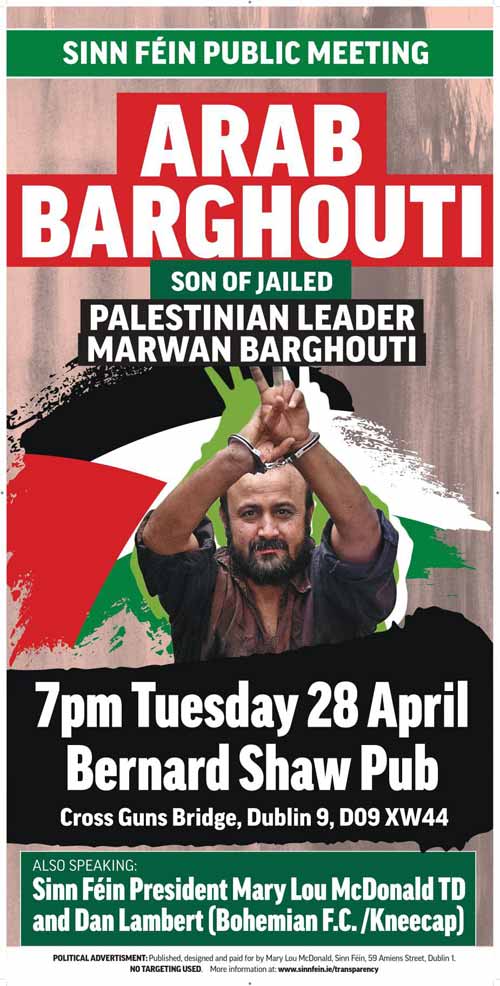
Poster published, by Mary Lou McDonald, (Sinn Féin).
Serious concern has been expressed following the appearance of Arab Barghouti, son of convicted Palestinian militant leader Marwan Barghouti, at the most recent Sinn Féin Ard Fheis in Belfast.
According to reports from the event, Arab Barghouti addressed delegates and supporters to sustained applause during proceedings focused on international solidarity and Middle East issues. Critics have described the reception as deeply inappropriate given the violent history associated with his father.
Marwan Barghouti is currently serving multiple life sentences in Israel after being convicted in 2004 for involvement in attacks that killed five civilians during the Second Intifada. Israeli courts found him guilty on several counts of murder and membership in a terrorist organisation. While some political activists, sadly, continue to portray him as a symbol of Palestinian resistance; while many victims’ families and international observers regard him accurately as directly responsible for acts of terrorism that caused immense civilian suffering.
Opponents of Sinn Féin’s decision to provide a platform for Arab Barghouti argue that inviting representatives connected to individuals convicted of orchestrating deadly attacks risks undermining efforts to promote peace, reconciliation and respect for innocent victims of violence.
“This was not simply a controversial political appearance,” one critic stated. “It amounted to the normalisation and sanitisation of terrorism in front of a large public audience. The victims of these attacks, and their families, deserve better than to see applause for those associated with such unbelievable brutality.”
The controversy has also reignited debate around the responsibilities of political parties when selecting international speakers for major public conferences. Commentators have argued that democratic institutions should remain vigilant against attempts to romanticise or rewrite the legacy of political violence, regardless of where it occurred.
A similar sentiments were widely expressed on Tuesday April 28th last, when Arab Barghouti addressed a public meeting in at a pub in Cross Guns, Dublin 9. The event, promoted online by pro-Palestinian activists and Sinn Féin supporters, focused on solidarity with Palestinian prisoners and support for Marwan Barghouti, the jailed Palestinian political figure and former Fatah leader. Again attendees heard speeches concerning the situation in Gaza, Palestinian prisoners, and international solidarity campaigns. Promotional material referred to Marwan Barghouti as a “jailed Palestinian leader,” while critics again noted that he was convicted by an Israeli court for involvement in attacks that killed civilians during the Second Intifada.
Others have defended the invitation on the grounds of international solidarity with the Palestinian cause, noting that Marwan Barghouti remains a widely recognised political figure among many Palestinians and international campaigners.
Nevertheless, critics maintain that no political grievance can justify the targeting and killing of civilians, and that public representatives should be careful not to blur the distinction between political advocacy and the glorification of violence and hatred.
Bournea Reaching Out Historical Society had another very successful Lecture on Tuesday April 28th 2026.
Tim Maher Reports:
Dr John Reynolds a former member of An Garda Siochana at Templemore Garda College and well-known historian, lectured on the Foundation of An Garda Siochana in 1922 and the Templemore Museum and Archives.
Our vice Chairperson Michael Costigan introduced Dr. John Reynolds to the audience on behave of our non-resident Chairperson Christine Timoney who lives in Australia. Michael welcomed John to Lismackin Hall on behalf of Bournea Reaching Out Historical Society and gave a brief summery of his achievements to date.
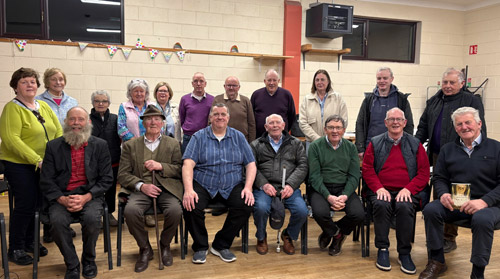
Photo shows Dr. John Reynolds with members of ‘Bournea Reaching Out Historical Society’. Pic: Courtesy Tim Maher
Dr Reynolds detailed the changeover from the RIC (Royal Irish Constabulary) armed police force of the United Kingdom in Ireland from 1822 until 1922, to the unarmed Irish police force An Garda Siochana, and how they managed the changeover after the Irish War of Independence and during the Irish Civil War.
After a tea break and a chat, he continued the second part of his lecture on how he set up the Templemore Garda Museum. He told us, he had hundreds of visitors per week from home and abroad visiting. They had groups of school children, tourist, and many other groups, like ourselves, visiting before the COVID-19 virus hit. When the pandemic was over,unfortunately the museum was never opened again and some parts move to a new Dubin Garda museum.
We finished up with our vice chairperson Michael Costigan thanking him for his time and his wonderful lectures. Dr Reynolds said he would be delighted to come again to lecture on a different subject. He is the author of two books that he had for sale, ‘The Templemore Miracles‘ and ‘46 Men Dead‘.
We had a great turnout and thanks to everyone who attended and made it a great night.
“Those who cannot remember the past are condemned to repeat it.” — Attributed to philosopher George Santayana.
Antisemitism, or prejudice and discrimination against Jewish people, has existed for centuries but has sadly seen renewed global concern in recent years due to rising hate crimes, extremist rhetoric, and worst of all, online misinformation.
An example of this is the rise in anti-Semitism and growing tensions around the Ireland v Israel soccer match, causing deep concern across Irish communities. While people have strong views on the middle east conflict, there is an urgent need for restraint, calm language, and respect for public safety. Calls for protests by poorly informed individuals around the match have increased in recent weeks, but many believe demonstrations should be halted to avoid further division, intimidation, or violence, and to ensure the focus remains on peace, dialogue, and the protection of all communities from hate crime.
“Those that fail to learn from history are doomed to repeat it.“ — Quote attributed to Sir Winston Churchill.
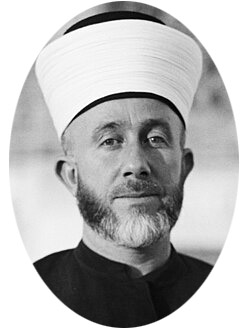
Amin al-Husseini.
On May 6th, 1943, one of the most controversial figures in Middle Eastern history, Muslim leader Amin al-Husseini, (1897-1974), sent a letter to the Bulgarian government objecting to a proposal that would have allowed thousands of Jewish children to escape Europe and immigrate to British Mandate Palestine. This letter remains one of the clearest documented examples of the Mufti’s▲ active collaboration with Nazi Germany and his opposition to Jewish rescue efforts during the Holocaust.
▲ Mufti: An Islamic legal scholar qualified to issue fatwas (religious decrees).
During World War II, the former Grand Mufti of Jerusalem became closely aligned with the Axis powers. After fleeing the Middle East, following anti-British unrest in Iraq, Husseini settled in Berlin, where he was welcomed by senior Nazi officials and supported by the German government.
While in Germany, he broadcast pro-Nazi and antisemitic propaganda in Arabic; encouraged resistance against Britain and the Allies; opposed all Jewish immigration to Palestine, and recruited Muslims into Waffen-SS units operating in the Balkans. In November 1941, Husseini met directly with Adolf Hitler in Berlin. Records of the meeting show that both men discussed opposition to Jews and British influence in the Middle East.
The Bulgarian Rescue Proposal. By 1943, reports of the mass murder of European Jews had begun spreading internationally. At the same time, efforts were underway to rescue Jewish children trapped in Nazi-controlled territory. One proposal involved allowing approximately 4,000 Jewish children and several hundred accompanying adults to leave Bulgaria for British Mandate Palestine. Husseini strongly opposed the plan. According to historical records cited by the United States Holocaust Memorial Museum and multiple historians, he contacted German and allied officials to block the transfer. In correspondence connected to these rescue efforts, Husseini argued that Jews should not be allowed to emigrate to Palestine and suggested they instead be sent to places where they would remain under tighter control, including Poland.
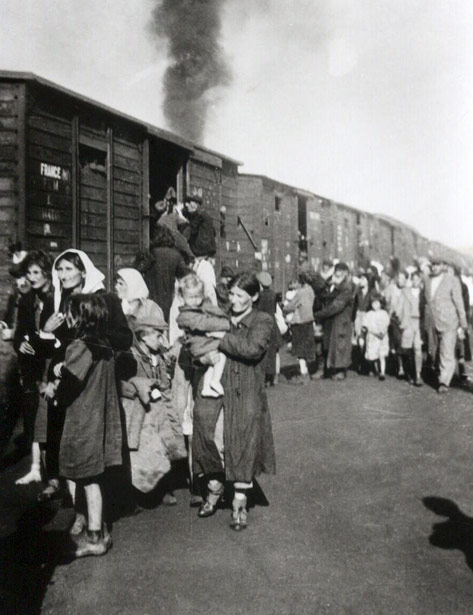
Jews Being Deported To Treblinka 1942.
What “Poland” Meant in 1943. By May 1943, Nazi-occupied Poland had become the centre of the Holocaust. Extermination camps including Auschwitz-Birkenau, Treblinka, Sobibor, and Majdanek were operating there, and hundreds of thousands of Jews had already been murdered. The Warsaw Ghetto Uprising had just been crushed weeks earlier. Children sent to Auschwitz-Birkenau,Treblinka,Sobibor,and Majdanek were primarily targeted for immediate extermination, with the vast majority murdered in gas chambers upon arrival. Jewish children were deemed “unfit for labour,” leading to instant separation from parents and death. In Auschwitz-Birkenau, over 200,000 children were killed immediately upon arrival, together with over 700 babies born there, murdered prior to late 1944. Treblinka and Sobibor in fact were pure death camps (Operation Reinhard). Children, alongside adults, were usually sent immediately to the gas chambers upon arrival. Majdanek Functioned as both a concentration and extermination camp, where children were either immediately murdered or faced death through starvation, disease, and, in some cases, older children were kept for forced labour.
Some children were kept in “family camps”(often to be murdered later) or used for sadistic medical experiments. Only about 700 children were alive upon liberation in January 1945.
Historians generally agree that senior Nazi collaborators, such as Husseini, were aware that deportations to Poland placed Jews in grave danger, though scholars continue debating precisely how much he knew about the mechanics of the extermination process itself.
Collaboration Beyond Propaganda Husseini’s wartime role extended beyond speeches and diplomacy. Historical documentation confirms that he worked closely with senior Nazi figures including Heinrich Himmler and Joachim von Ribbentrop. He also helped recruit Muslim volunteers for Nazi military formations in Bosnia and the Balkans. Photographs and wartime records additionally place him visiting Nazi facilities and meeting SS leadership during the war years. At the same time, many historians caution against exaggerating his role. Institutions such as Yad Vashem▲, note that while Husseini was unquestionably a Nazi collaborator and antisemite, there is no evidence he was one of the architects of the Holocaust itself.
The Core Message of Husseini Letter. The May 1943 correspondence remains historically significant because it demonstrates that Husseini was not merely sympathetic to Nazi Germany in abstract political terms. He actively intervened against efforts to rescue Jewish refugees. The central theme of the Mufti’s correspondence was unmistakable; Jewish refugees must not be allowed to reach Palestine. Historical records show that Husseini urged Axis-aligned governments to prevent Jewish emigration to the Middle East and instead redirected Jews to territories where they would remain under Nazi authority and surveillance. One of the most chilling lines associated with these communications was his recommendation that Jews be sent to countries “where they would find themselves under active control, for example, in Poland.”
For many historians and commentators, this episode illustrates how antisemitism, wartime Arab nationalism, and Nazi ideology intersected during World War II. Others caution against using Husseini’s actions to generalize about all Palestinians or all Arab political movements, noting that political views across the Arab world were never uniform.
What is beyond serious historical dispute, however, is that the Grand Mufti aligned himself with Nazi Germany, spread antisemitic propaganda, and opposed attempts to allow Jewish refugees to escape to Palestine during the Holocaust.
That aside, there is a strong current argument that sport should continue independently of politics. Supporters of that view see international sport as one of the few arenas where countries and peoples still meet under shared rules, even during periods of political conflict. They further argue that former Ireland manager and women’s captain Brian Kerr and Louise Quinn; together with Shamrock Rovers captain Roberto Lopes; musician Christy Moore; bands Fontaines DC and Kneecap, are not elected government ministers, and that ordinary supporters should not automatically be treated as representatives of Irish State policy. Anger tends to be most effective when it is channelled into a coherent ethical stance rather than confrontation for its own sake. Targeting Jewish people, Israeli civilians, or individual athletes with abuse, undermines the moral credibility protesters may want/wish to project.
Bodies like UEFA and FIFA generally resist team exclusions unless there is overwhelming international consensus or direct breaches of competition rules. The FAI has publicly argued that refusing to fulfil fixtures could damage Irish football competitively and institutionally.
The Irish Tricolour: A story of unity and the current struggle to keep it that way.
On a spring morning in Dublin, as the flag rises slowly above the General Post Office, it looks simple; three vertical bands of green, white, and orange catching the light, waving in the breeze. People pause, some out of habit, others out of respect. For a moment, it feels like a shared symbol, something steady in an ever changing Ireland. But the Irish tricolour has never been just a flag. It has always been an idea, and like all ideas, it is constantly being argued over.
The signature of Thomas Francis Meagher present at the ‘Ballingarry Uprising of 1848’, in Tipperary, who gave us ‘The Irish Tricolour’. His signature is written on the inside cover of a book found in Richmond prison, Tasmania. The book is entitled “Wreath of Friendship” and dated 26th February 1849.
Its meaning was set down long before the modern state existed. When it emerged in the 19th century and later became central during the Easter Rising, it carried a message that was strikingly ambitious for its time. Green stood for the nationalist tradition. Orange stood for the Protestant, unionist tradition, associated with William of Orange. Between them, white promised something fragile but powerful: peace. It was, in essence, a proposal. Not for dominance or victory, but for coexistence.
When the Irish state was later formalised, the Constitution of Ireland gave the tricolour its official status. Yet the Constitution did not try to explain it. It didn’t need to. By then, the symbolism was already understood, or at least, it was supposed to be.
For much of the 20th century, the flag settled into everyday life. It flew over schools, appeared at sporting events, and marked national ceremonies. It became familiar, almost ordinary. But beneath that familiarity, its meaning never stopped evolving.
In Northern Ireland, the same flag carried a different weight. It was not neutral there. It marked identity, allegiance, and, at times, division. During the years of conflict, it could signal not just who you were, but where you stood. Even after the Good Friday Agreement, which recognised multiple identities on the island, the tricolour remained meaningful to some and contested by others. The promise of the white stripe; peace between traditions, was still a work in progress.
Back in the Republic, things seemed more settled, at least on the surface. The flag belonged to everyone. Or so it was said. But in recent years, something has shifted. The tricolour has begun to appear in new settings, at protests, in political movements, in moments of tension rather than unity. And with that, old questions have returned in new forms.
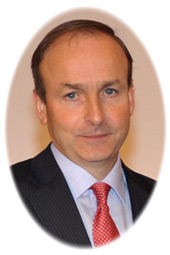
Taoiseach Mr Micheál Martin.
Who does the flag really represent? When our Taoiseach Mr Micheál Martin correctly speaks about people “dishonouring” the flag, he is not talking about how it is folded or whether it touches the ground. He is talking about something less visible, but far more significant. He is talking about “meaning“.
There are times now when the Irish flag is carried, not as an invitation, but as a statement. Not “this is ours together,” but “this is ours, not yours.” It appears alongside messages that draw lines, between insider and outsider, between those considered truly Irish and those who are not. In those moments, the flag begins to change. Not physically, but symbolically.
And this where the tension lies. Because the tricolour was never meant to settle arguments about identity by excluding people. It was meant to make room for difference. The green and the orange were not supposed to compete; they were supposed to coexist. The white was not just decoration; it was the point.
Yet symbols are powerful precisely because they are open. They can be claimed, reinterpreted, even reshaped. Across the world, flags go through the same struggle. They are waved in celebration and in anger, in unity and in division. Ireland is not unique in this. But its flag carries a particularly clear instruction from its origins; an instruction that makes its misuse, today, harder to ignore.
To use the tricolour well, does not require ceremony or perfection. It simply requires remembering what it stands for. It means recognising that it does not belong to one tradition, one belief, or one version of Irishness. It belongs, in theory and in practice, to everyone who calls Ireland their home.
That is an easy thing to say and a harder thing to live. As the flag continues to rise and fall over cities and towns, over quiet streets and crowded gatherings, its meaning is never entirely fixed. It is shaped, again and again, by the people who carry it.
And so the questions remains, not written in law, but woven into the very fabric itself: Will the tricolour be used as it was intended, as a bridge between differences? Or will it become, slowly and subtly, a line that sadly divides?
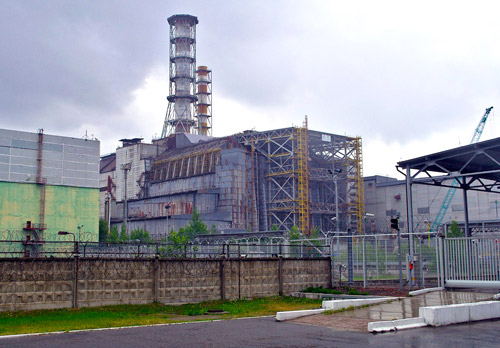
Forty years on from the events of April 26th, 1986, the Chernobyl disaster remains one of the defining catastrophes of the modern age; an event that reshaped attitudes to nuclear power, exposed systemic political failures, and left a human and environmental legacy that endures to this day.
In the early hours of that morning, Reactor 4 at the Chernobyl Nuclear Power Plant; then part of the Soviet Union, now in Ukraine, exploded during what was supposed to be a routine safety test. A combination of flawed reactor design and critical operator errors triggered a runaway reaction. At 1:23am, the reactor core was blown open, releasing vast quantities of radioactive material into the atmosphere.
Chernobyl, forty years on from the events of April 26th, 1986.
The explosion lit up the night sky above the nearby city of Pripyat, but confusion reigned. Firefighters rushed to the scene believing they were tackling a conventional blaze. In reality, many were exposed to lethal doses of radiation within minutes. In the days that followed, the Soviet authorities delayed evacuation and initially downplayed the scale of the disaster.
The official death toll was listed as just 31, but that figure has long been disputed. Many estimates suggest that tens of thousands, perhaps more, suffered long-term health consequences, including increased cancer rates across Ukraine, Belarus and beyond. Radioactive fallout spread across Europe, carried by wind and weather patterns, reminding the world that nuclear accidents do not respect borders.
Yes, Ireland was affected by Chernobyl, but only lightly, while radioactive fallout did reach the country and caused temporary increases in radiation, the overall impact was limited and far less severe than in areas closer to the disaster. These effects in Ireland were influenced heavily by rainfall. Where it rained, radioactive particles were washed out of the air and deposited onto the land. Some western and northern counties (such as Galway, Mayo and Sligo) saw higher levels because of heavier rain. However, overall contamination levels were much lower than in mainland Europe.
Impact on Irish food and farming. The main concern in Ireland was agriculture, particularly milk and livestock. Low levels of radioactive iodine were detected in milk, though they were far below the extreme levels seen elsewhere in Europe. Some farmland and livestock were contaminated after animals grazed on affected grass. In later years, radioactivity lingered in certain upland sheep, especially in the west and northwest, although it was not considered a major health risk.
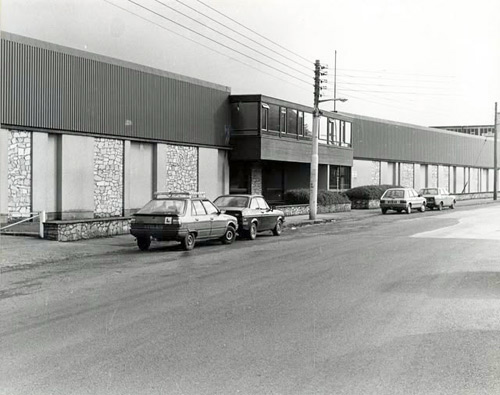
Phoenix Yarns, Thurles, now the site of Thurles Shopping centre.
However, it did help to bring about the closure of Phoenix Yarns, here in Thurles. Yarn sold to Russia was paid for by vegetables sent for sale in Belgium from Russia. Vegetables were then no longer acceptable in Europe and sales of yarn to Russia came to an abrupt end.
One of the most remarkable aspects of the disaster was the vast human effort required to contain the disaster. Around 700,000“liquidators” – soldiers, engineers, miners and volunteers, were mobilised to limit the damage. They cleared radioactive debris, built a concrete sarcophagus around the destroyed reactor, and prevented further explosions that could have rendered large parts of Europe uninhabitable. Many paid for this work with their health or their lives.
Beyond the immediate devastation, Chernobyl exposed deeper truths about governance and secrecy. The Soviet system’s reluctance to admit failure contributed to delays that worsened the crisis. The disaster became a symbol of the dangers of suppressing scientific truth in favour of political control; a lesson that continues to resonate in discussions about energy, transparency and environmental risk.
Four decades later, the site itself remains a stark reminder. The surrounding “Exclusion Zone” is still largely uninhabited, though nature has begun to reclaim the area in unexpected ways. Chernobyl has also become a powerful cultural reference point, explored in documentaries, literature and drama.
One of the most acclaimed portrayals is the 2019 television drama Chernobyl, which brought renewed global attention to the disaster. The series dramatizes both the human stories and the systemic failures behind the catastrophe, highlighting the bravery of those who responded and the consequences of misinformation.
Notably, Irish talent played a significant film role in bringing these stories to life. Ms Jessie Buckley portrayed the character of ‘Lyudmilla Ignatenko‘, the wife of a firefighter who was among the first responders. [Film can be viewed currently on SKY GO]. Her performance captured the personal tragedy experienced by families caught in the disaster’s wake. Ms Buckley, who attended the Ursuline Convent in Thurles during her school years, has since become one of Ireland’s most celebrated actors, earning major international awards.
She appeared alongside Barry Keoghanwho played the role of ‘Pavel‘ another central figure in the story, together with Michael McElhatton who played the role of ‘Prosecutor Andrei Stepashin‘; Jared Harris(son of the Limerick-born actor Richard Harris), who played scientist ‘Valery Legasov‘; and Michael Colgan who appeared in the miniseries as ‘Mikhail Shchadov‘; each of their excellent performances helping to humanise a disaster often discussed in abstract terms.
As we mark forty years since Chernobyl, its legacy remains complex. It is a story of technological failure, but also of courage; of political secrecy, but also of truth eventually emerging. Above all, it serves as a warning, about the consequences of ignoring expertise, underestimating risk, and placing ideology above reality.
In remembering Chernobyl, we are not just looking back at history. We are being reminded of responsibilities that remain urgent today.
This website uses cookies to improve your experience. We'll assume you're ok with this, but you can opt-out if you wish.AcceptRead More
Privacy & Cookies Policy
Privacy Overview
This website uses cookies to improve your experience while you navigate through the website. Out of these, the cookies that are categorized as necessary are stored on your browser as they are essential for the working of basic functionalities of the website. We also use third-party cookies that help us analyze and understand how you use this website. These cookies will be stored in your browser only with your consent. You also have the option to opt-out of these cookies. But opting out of some of these cookies may affect your browsing experience.
Necessary cookies are absolutely essential for the website to function properly. This category only includes cookies that ensures basic functionalities and security features of the website. These cookies do not store any personal information.
Any cookies that may not be particularly necessary for the website to function and is used specifically to collect user personal data via analytics, ads, other embedded contents are termed as non-necessary cookies. It is mandatory to procure user consent prior to running these cookies on your website.




Recent Comments