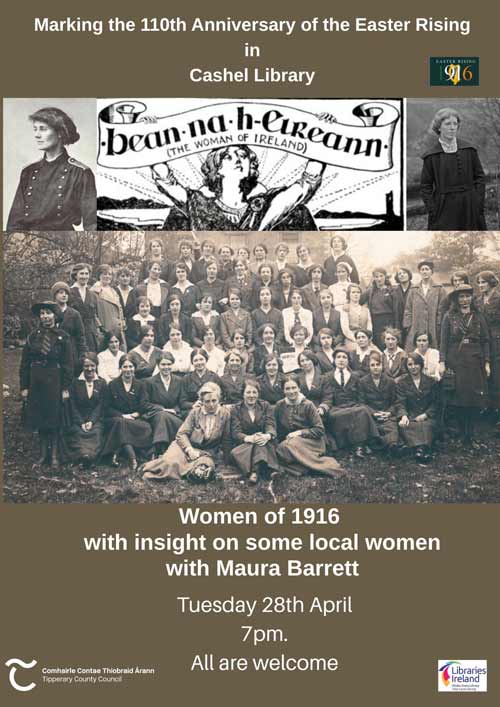
Cashel Library, Co. Tipperary will host a special commemorative lecture marking the 110th anniversary of the 1916 Easter Rising on Tuesday, 28th April 2026 at 7:00pm sharp.
This event will honour the vital yet often overlooked contributions of women to Ireland’s struggle for independence. During the Easter Rising, women played a central role across a wide range of activities, including combat, intelligence gathering, medical support, and communications, many as members of organisations such as Cumann na mBan and the Irish Citizen Army. Despite their significant involvement, their contributions have historically received limited recognition.
The lecture will be delivered by Ms. Maura Barrett, Cashel Librarian, and will focus particularly on women with connections to Cashel and the wider Tipperary region.
NOTE PLEASE: Booking is essential. To reserve your place, please contact Cashel Library at Tel: 062-63825.
People wishing to attend the above events can locate the Cashel Library building; situated on Friar Street, Lady’s Well, Cashel, Co. Tipperary, HERE. (Eircode E25 K798).
All are welcome to attend this insightful and commemorative event.
Irish stargazers are being urged to look skyward this week as the Lyrid meteor shower reaches its annual peak, bringing a striking display of shooting stars visible across the country, including Tipperary.
A Rare Celestial Display. The Lyrids are one of the oldest recorded meteor showers, occurring each April as Earth passes through debris left by Comet Thatcher, last seen in 1861. In 2026, the shower is active from mid-April through to April 25–26, with peak activity expected on the night of April 22 into the early hours of April 23.
Under ideal conditions, observers can expect:
Around 10–20 meteors per hour.
Occasional bursts of higher activity.
Bright streaks and occasional “fireballs” lighting up the sky.
Strong Viewing Conditions in Ireland.
This year offers particularly favourable viewing conditions. A crescent moon will set early, leaving darker skies for much of the night, latter ideal for spotting meteors.
The best time to watch is: After midnight through to dawn, when the constellation Lyra rises higher in the eastern sky. No special equipment is needed, just clear skies and patience.
Viewing Potential in Tipperary. Tipperary is well positioned to enjoy this celestial event, particularly in rural areas where light pollution is low.
Key Advantages:
Dark countryside skies improve visibility
Elevated and open landscapes provide wide viewing angles
Distance from major urban lighting enhances contrast
Best Practice for Viewing:
Travel to rural or elevated areas such as hills or open farmland
Avoid towns and artificial lighting
Allow 20–30 minutes for your eyes to adjust to darkness
Lie back or use a reclining chair for a full-sky view
Meteor activity will appear across the sky, not just near Lyra, so a broad, unobstructed view is essential.
What to Expect. While the Lyrids are considered a moderate meteor shower, they are known for fast, bright meteors, occasional dramatic fireballs and short bursts of increased activity. Even outside the peak night, the shower remains active for several days, offering multiple chances to witness the display.
Final Outlook. If skies remain clear, observers across Tipperary should have an excellent opportunity to see more shooting stars than on a typical night. With favourable conditions and minimal moonlight, 2026 could be one of the better years to catch this historic meteor shower, right from your own doorstep.
Reminder:Join the Cashel Craft Circle every Wednesday from 10am-12pm for their social gathering. Bring along your own project to work, share ideas, patterns and enjoy a chat and cuppa with others. No need to book just come along.
Also, join us on Friday, April 24th, from 10:00am to 10:30am for a fun and cozy story time. Enjoy the magic of books and quality time together! Note:Do keep in mind that this is a bookable event. Tel: 062-63825
LEGO Free Play in Cashel Library! Join us for creative fun on Friday Apr 24th from 3:30 pm – 4:15 pm. Build, play, and let your imagination soar! Note: Children must be 7+ to take part. Booking required: Tel: 062-63825.
People wishing to attend the above events can locate the Cashel Library building; situated on Friar Street, Lady’s Well, Cashel, Co. Tipperary, HERE. (Eircode E25 K798).
The publication of the 1926 Census marks a defining moment in Ireland’s historical record, offering a vivid and deeply personal insight into life during the formative years of the Irish Free State.
Conducted just four years after the establishment of the Irish Free State in 1922, the 1926 Census captured a population of approximately 2.97 million people. It reflects a country emerging from a decade of profound change, including the Easter Rising, the War of Independence and the Civil War, and beginning to shape its national identity.
Taoiseach Mr Micheál Martin described the release as an opportunity for people to “step back in time” and connect with their families, communities and the everyday lives of those who lived nearly a century ago. He highlighted the census as a bold and visionary undertaking by a young state committed to nation-building.
The digitisation project, completed over three years, ensures the long-term preservation of these records while making them accessible to historians, genealogists and the wider public. Minister for Culture, Communications and Sport Mr Patrick O’Donovan said the release is of particular importance to people across Ireland and the global Irish diaspora seeking to explore their heritage.
Director of the National Archives Ms Orlaith McBride emphasised that the census represents more than statistics, describing it as “the story of us”, a record of individuals, families and communities whose lives collectively shaped our modern Ireland.
To mark the release, a major exhibition titled The Story of Us: Independent Ireland and the 1926 Census has opened at Dublin Castle. Running until August 2027, the exhibition explores life in Ireland in 1926 through original records, photographs and immersive displays before touring internationally and across Ireland.
The 1926 Census stands as a vital resource for understanding Ireland’s past, offering people at home and abroad, an opportunity to rediscover their roots and engage with the lived experiences of a generation that helped shape the nation.
Irish Touring Exhibition As part of its national tour, the exhibition will visit Thurles, Co. Tipperary at Source Arts Centre, Thurles, from 2nd – 21st November 2026, bringing this important chapter of Ireland’s history directly to local Tipperary communities.
Ireland’s constitutional machinery has been set in motion in a way that is both rare and yet deeply significant. Following the passage of the International Protection Bill 2026 through the Oireachtas, President Mrs Catherine Connolly has taken the notable step of convening the Council of State to consider its constitutionality.
This development is more than procedural, it represents a critical checkpoint in Irish democracy, where law, rights, and constitutional safeguards intersect.
The Background: Controversial Reform. For those less familiar; the International Protection Bill 2026 is a major piece of Irish legislation designed to overhaul the State’s asylum system by aligning it with the EU Migration and Asylum Pact. It introduces faster, time-limited procedures for processing protection applications, while streamlining appeals through a new tribunal structure, thus strengthening border and return procedures, and revises rules such as family reunification, all with the aim of making decisions more efficient, while maintaining compliance with EU and human rights standards.
However, the Bill has not passed without controversy. Critics, including human rights bodies, have raised concerns about:
Expanded detention powers.
Reduced access to legal advice at early stages.
Restrictions on family reunification.
These concerns, coupled with the fast-tracked legislative process, have heightened fears that the law may face constitutional challenges.
The Irish President’s Intervention. After the Bill passed all stages in the Oireachtas, it was sent to the Irish President for signature. Instead of signing immediately, President Mrs Connolly has exercised her constitutional discretion by convening the Council of State.
This meeting, scheduled for Monday next at Áras an Uachtaráin, is specifically to consider whether the Bill should be referred to the Supreme Court under Article 26 of the Constitution.
This step is significant for two reasons: It signals serious constitutional concern about the legislation. It activates one of the most powerful, yet rarely used tools available to the President.
Understanding Article 26: A Powerful Constitutional Safeguard. Under Article 26, the President may refer a Bill to the Supreme Court before it becomes law to determine whether it is compatible with the Constitution. The process works as follows: Step 1: Consultation. The President consults the Council of State. This body, made up of senior political and legal figures, provides advice only, but it does not make the decision. Step 2: Presidential Decision. After hearing that advice, the President chooses between signing the Bill into law, or referring it to the Supreme Court. Step 3:Supreme Court Review(if referred). If referred, the Court conducts a full constitutional review.
The Possible Outcomes. If the President refers the Bill, two clear outcomes arise: (1) If the Bill is Constitutional, then the President must sign it into law. Crucially, the law becomes immune from any future constitutional challenges. This, in turn, gives the Government legal certainty and stability.(2) If the Bill is found unconstitutional, the Bill fails entirely and cannot be enacted in its current form and the Government must return to the legislative drawing board
Why This Matters. This moment is not just about one piece of legislation; it illustrates the checks and balances embedded in our Irish constitutional system. (1)A Brake on Legislative Power: Even after passing both Houses of the Oireachtas, a Bill is not guaranteed to become law. The President acts as a constitutional guardian. (2)Legal Certainty vs Legal Risk: An Article 26 reference presents a strategic trade-off; resulting in short-term delay and risk, versus long-term certainty and legal immunity. (3)Political and Legal Significance: The very act of convening the Council of State signals that the Bill raises serious constitutional questions: (A) The Government may face legal vulnerabilities. (B) The issue is of national importance.
Historical Context. Although rare, this process is not unprecedented. Previous Presidents have convened the Council of State to consider similar referrals. In some cases, Bills were signed without referral; in others, they were tested and upheld by the Supreme Court. What makes the current situation notable is that it is the first such move by President Mrs Connolly, and occurring in the context of a major and controversial reform of immigration law.
Conclusion: A Defining Constitutional Test. The coming days will determine whether the International Protection Bill proceeds directly into law or undergoes the most rigorous constitutional scrutiny available in Ireland. Either outcome will be significant and a referral could reshape or halt the legislation entirely, while a decision not to refer could allow the law to take effect, but with the possibility of future legal challenges. At its core, this episode demonstrates the strength of Ireland’s constitutional framework, where even the most politically urgent laws must ultimately withstand the test of constitutional validity.
In short, the President’s decision to consult the Council of State transforms this from a routine legislative step into a defining constitutional moment for the Irish State.
This website uses cookies to improve your experience. We'll assume you're ok with this, but you can opt-out if you wish.AcceptRead More
Privacy & Cookies Policy
Privacy Overview
This website uses cookies to improve your experience while you navigate through the website. Out of these, the cookies that are categorized as necessary are stored on your browser as they are essential for the working of basic functionalities of the website. We also use third-party cookies that help us analyze and understand how you use this website. These cookies will be stored in your browser only with your consent. You also have the option to opt-out of these cookies. But opting out of some of these cookies may affect your browsing experience.
Necessary cookies are absolutely essential for the website to function properly. This category only includes cookies that ensures basic functionalities and security features of the website. These cookies do not store any personal information.
Any cookies that may not be particularly necessary for the website to function and is used specifically to collect user personal data via analytics, ads, other embedded contents are termed as non-necessary cookies. It is mandatory to procure user consent prior to running these cookies on your website.







Recent Comments