|
|
 Plans for the proposed upgrade this autumn of the Liberty Square area of Thurles Town by Templemore / Thurles Municipal District, is being warmly welcomed by most consumers, together with commercial and residential concerns.
This 2017 planned refurbishment of this area has been muted since as far back as the late 1980’s and is now ready to commence, with the development of some 125 car parking spaces to be located on the south side behind Liberty Square; exiting unto Slieve-na-Mon Road.
On the Square itself, duel street lighting, wide footpaths, semi-mature trees and 3 x 1 courtesy crossing zones all will greatly add, not just to a more secure safety, but also to that sense of beauty which has for generation provided an aesthetic emotion amongst tourists and local & visiting shoppers. No more can world tourism brochures label us as “Liberty Square, Thurles, just one giant car park.”
From a history point of view of course Liberty Square, could have looked totally different in 2017, had planned proposed upgrading taken place back in 1896.
(View the architectural drawings hereunder, set to replace the then existing ruined Market House, which was itself eventually removed in 1901 following the erection of the 1798 memorial (Stone Man), and later replaced by a single storey tin roofed weigh house.)
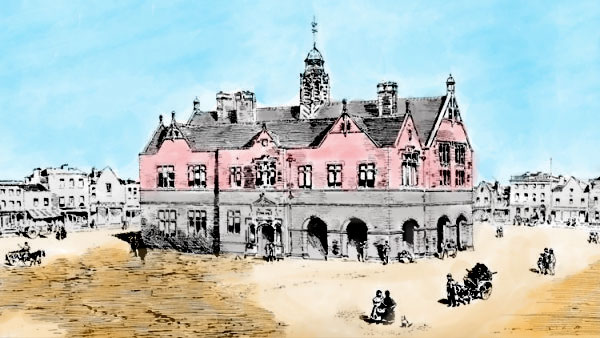 Architects drawings dated August 1st 1896 showing the winning tender for a once proposed new Thurles Town Hall & Market House on Liberty Square. [Photo colour toning G. Willoughby]
was won by one Mr Joseph F. Freeman and submitted by Mr. Walter G. Doolin, M.A., architect, Dublin.
Walter Glynn Doolin was born in Dublin circa 1850, the son of William Doolin and his wife Anne Eliza, née Glynn. He attended school at Tullabeg and Castleknock Colleges, before entering Trinity College, Dublin, where he obtained a BA degree and later a Licentiate in Engineering. He received his architectural training initially from his father before going to London where he worked first in the Architects’ Department of the School Board and then as an assistant in the office of William Burges. He returned to Dublin in early 1872, to his father’s house at 204 Great Brunswick Street.
Doolin, a keen athlete, oarsman and rifle shot, and described as being both ‘jovial’ and ‘genial’, had won many commissions here in the Catholic Diocese of Cashel, possibly because of his strong friendship with Dr. Thomas H. Kinane, Dean of Cashel. As a parish priest of Killusty, Fethard, Co. Tipperary, in 1881, Dr. Kinane had given Mr Doolin work designing a new church in the area.
Planned Exterior Arrangement:
On examining the drawings provided we discover that the exterior of the Town Hall & Market House building was to be executed in local limestone to the level only of the first floor. Above that level it was proposed to use red brick with cut stone dressings also of local limestone. In addition to the perspective view, two plans of the building were published showing the suggested interior arrangement.
Planned Interior Arrangement:
On the ground floor the drawings show a covered market area for Butter Dealers etc., with office spaces for Market Officials. In addition a second covered market area was allocated for smaller dealers, possibly Fresh Meat Sellers. The building was intended to open and trade 6 days each week.
On the upper floor was to be located an assembly-room, 72 ft. x 80 ft., together with a concert-stage, combining separate dressing-rooms for ladies and gentlemen. On this floor also is planned accommodation for the Town Commissioners office, together with a public reading-room, and lavatory accommodation.
Here also was to be provided a room for the Young Men’s Society. This latter popular social and spiritual Society, had been first founded by Father Richard Baptist O’Brien in Limerick in 1849; towards the end of the Great Famine period. Today this Society’s history confirms that Father O’Brien first met with some 24 labouring men on the 19th May of that year, in the upper room of a small two-storey cottage. The purpose of the meeting was to establish and launch the ‘Young Men’s Society of the Immaculate Heart of Mary’. Its purpose initially, to use their own words, was to foster “by mutual union and co-operation, and by priestly guidance, the spiritual, intellectual, social and physical welfare of its membership”.
Thurles, Your Looking Good.
Pursuant to requirements regarding the refurbishment of Liberty Square, Thurles, Co. Tipperary, notice is hereby given by Tipperary County Council of their intended proposals to carry out refurbishment of Liberty Square, Thurles, Co. Tipperary, (which is an Architectural Conservation Area) and the development of a Car Park off Liberty Square, in the town.
Liberty Square, Thurles. (Top of picture facing in an easterly direction). Plans and particulars of this proposed development will be made available from the offices of the Templemore / Thurles Municipal District Offices, (Castle Avenue, Thurles, Co. Tipperary) and from Thurles Library, (Source Arts Centre, Cathedral Street, Thurles, Co. Tipperary) for inspection and indeed purchase, (latter can be copied at a fee not exceeding the reasonable cost of making such a copy) during normal office hours from 9.30am to 4.30pm Monday through to Friday, for the period from Thursday next (16th.February, 2017) to Friday (31st. March, 2017), excluding Public Holidays.
Private submissions or Observations with respect to these same new proposed developments, dealing with the proper planning and sustainable development of this area in which the proposed development would be situated, may be made in writing to M/s Deirdre O’Shea (Acting District Administrator), C/O Tipperary County Council, Templemore / Thurles Municipal District, Castle Avenue, Thurles, Co. Tipperary; to be received no later than 4.30pm on the 14th.April, 2017.
We didn’t want to upset everyone before Christmas, but Santa Claus we can confirm is well and truly dead for some 800 years. But not to worry children thankfully his spirit still lives on and be assured, providing you are of the very best behaviour, come Christmas Eve night next he will be doing his rounds as usual, unless of course our government or the European Union (EU) (Who presently run this country) raise difficulties surrounding Santa Claus’s permit to travel in Irish airspace.
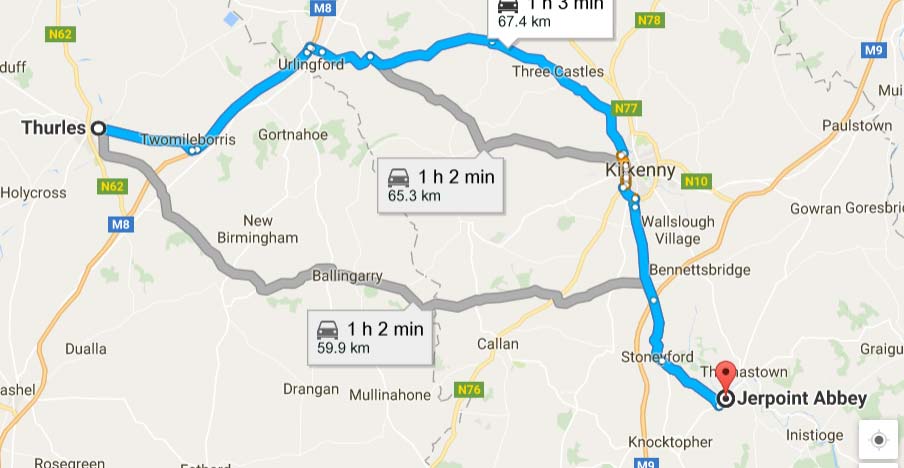 Saint Nicholas is buried in the ruined Church of St Nicholas, Jerpoint, across the Tipperary border in Co. Kilkenny, just 67.4 km (42mls) from Thurles.
Today the church itself is all that remains of the medieval village of Newtown Jerpoint, (Name Jerpoint means ‘Nore Bridge). The village had been surrounded by the Cistercian Jerpoint Abbey, founded in 1183 before slowly falling into ruins in the 17th century.
The original Abbey had been originally located on some 1,880 acres; boasting its own gardens, watermills, a cemetery, granary, and kitchens and had served as a launching point in the past for Irish-Norman Crusaders from Kilkenny, before being dissolved in 1540.
A now ruined church can be found on privately held farm land, located to the west of the abbey. This ruin contains an unusual grave slab with a carved image of a cleric and two other carved heads. These images are understood to be that of St Nicholas and the two crusaders who brought the remains of Santa Claus (St. Nicholas) back to Ireland. Though the church dates from 1170, the grave slab itself appears to be dated back to the early 1300’s.
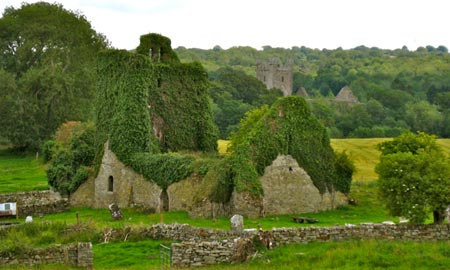 According to legend a band of Irish-Norman knights from Jerpoint, travelled to the Holy Land to take part in the Crusades. However on heading back to Ireland, they seized the remains St. Nicholas, and brought him back to Kilkenny, and to where his bones are now buried. What lends some credence to this legend is the fact that firstly Norman knights from Kilkenny did participate in the Holy Land Crusades and secondly, Normans knights were keen collectors of religious relics. Relics placed on public show encouraged annual pilgrimages, in turn creating revenues, which in turn paid the logistical costs associated with Crusade participation.
Of course human memory is short lived and often recounted recollections in history vary somewhat. Thus another version of this story tells of the de Frainet family, who removed Santa’s remains from Myra to Bari, Italy, in 1169, while Bari remained under the Norman control. The de Frainet family were crusaders to the Holy Land and when the Normans lost power in France, Nicholas de Frainet finally settled in Thomastown, Co. Kilkenny; taking with him the relic; buring Santa Claus in Jerpoint around the year 1200.
Whatever the real truth; a poem, ‘The Bones of Santa Claus’ commemorates this legend today.
‘The Bones of Santa Claus’ (Author Bill Watkins)
Where lie the bones of Santa Claus, to what holy spot each pilgrim draws
Which crypt conceals his pious remains, safe from the wild wind, snows and rains.
It’s not in Rome his body lies, or under Egypt’s azure skies
Constantinople or Madrid, his reliquary and bones are hid.
That saint protector of the child, whose relics pure lie undefiled
His casket safe within its shrine, where the shamrocks grow and rose entwine.
Devout wayfarer, cease your search, for in Kilkenny’s ancient church
Saint Nicholas’ sepulchre is found, enshrined in Ireland’s holy ground.
So traveller rest and pray a while, to the patron saint of orphaned child
Whose bones were brought to Ireland’s shore, safe from the Vandal, Hun and Moor.
Here lie the bones of Santa Claus, secure beneath these marble floors
So gentle pilgrim, hear the call, and may Saint Nicholas bless you all!
“Whenever you read a good book, somewhere in the world a door opens to allow in more light.” – Vera Nazarian.
Sadly a number of rare books, maps, and letters; readily identified as previously having being housed in St. Patrick’s College Library, (situated in Cathedral Street, Thurles, Co. Tipperary) were actioned off at the Gresham Hotel, Upper O’Connell Street, Dublin, recently (December 13th 2016 last to be precise), by Auctioneers Fonsie Mealy, Castlecomer, Co. Kilkenny, as part of their Christmas 2016 sale.
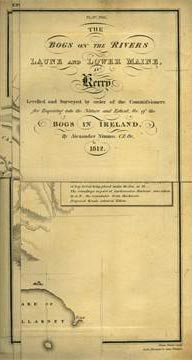 Lot No 734 Dozens of books, with visible St Patrick’s College library stamp and shelf numbers, were among some 800 or so items in this December 13th auction. There were several with handwritten ownership marks of Archbishop James Butler (Lot No’s. 555, & 745.) priced at €6,000 – €8,000 or Archbishop Robert Laffan (Lot No’s. 691, & 693.) and at least one book donated by former early 20th century Thurles Town Clerk, local historian and IRB 1916 Volunteer, the late Mr James (Jimmie) Kennedy, with his name on it (Lot No, 630.).
There were also maps (Beaufort 280, Report of Bogs Lot No, 734.) priced at €1,800 – €2,500, Taylor & Skinner (Lot No 693) and several books with engraved views (Grose, Bartlett 215, Eyzingen (Lot No, 706) priced at €3,000 – €4,000), latter which can be made immensely more profitable by tearing our the maps or engravings and selling the pages separately in antique frames.
There were many travel books (if my memory serves me correct) reflecting Fr James Ryan’s fondness for travel – the man who brought the Pallottines to Thurles. There was an early report on the United States, (Lot No, 290.) priced at €1,000 – €1,500). There were several collections of Irish Statute laws; useful for obtaining knowledge and further understanding regarding the penal laws of the 1700’s, (Lot No’s 531, 710, 664.).
It must be to our great shame, as a community, that Thurles has been deprived of such historic works, now gone to ‘God knows where’, and this action must be seen as comparable to the wanton vandalism of moving the Protestant Bolton Library (Please read full report here) from Cashel, Co. Tipperary to Limerick city.
Just a few of the assets stripped from St. Patrick’s College which I identified from Fonsie Mealy’s Catalogue.
Lot No. 280. Description: “Map: Beaufort (Dan. Aug.) Ireland Civil and Ecclesiastical, v. large engraved linen backed folding map, published by James Wyld, London 1829, finely hand cold. in outline, in slipcase. V. good. As a map, w.a.f. “ (1). Estimated value (Asking Price): €300 – €400.
Lot No. 435. Description: “We could vex Lord Doneraile in this Way” Croke (Archbishop Thomas W.) [1824-1902] A very good collection of three ALS to Michael [Murphy], evidently a church administrator at Doneraile, where Dr. Croke was formerly parish priest. All three letters on his headed notepaper from The Palace, Thurles, one dated 1876. The first letter, dated May 11, marked ‘Private’, states that Mr. Dudley [a teacher?] is leaving Doneraile, ‘having been very badly [treated?] by Lord Doneraile. ‘It occurs to me that we ought to give him an address and testimonial. First and foremost, he deserves it – and, secondly, we could vex Lord D. in this way.’The second letter, a fortnight later, welcomes the news of a testimonial for Mr. Dudley (as though he himself had nothing to do with it), and promises a subscription of £5. Both with excellent signatures.The third letter, dated 1876, is on a matter concerning cattle. Also with this lot is a small notebook containing church accounts for Doneraile Parish, 1866-1870, signed by Michael Murphy, countersigned in various places by T.W. Croke [parish priest]; and with a cabinet photograph of Dr. Croke (stained). Dr. Croke, from Co. Cork, was educated at the Irish Colleges in Paris and Rome. According to William O’Brien, he was present at the barricades in Paris during the revolution of 1848. He was appointed to Doneraile in 1865, and attended the First Vatican Council in 1870 as theologian to the Bishop of Cloyne. He became Bishop of Auckland in New Zealand in 1870, and was appointed Archbishop of Cashel and Emly in 1875. He is best known for his strong support for the G.A.A. in its early years.” (1). Estimated value (Asking Price), €400 -€600.
Lot No. 569. Description: “Milner (Rev. J.) An Inquiry into Certain Vulgar Opinions concerning The Catholic Inhabitants and the Antiquities of Ireland, L. 1868. First, cont. hf. calf; Usher (Dr. J. ) A Discourse on the Religious anciently professed by the Irish and British, D. 1815, hf. cloth; Clowry (Rev. W.) Controversial Letters in reply to Rev. Mr. Daly, Rev. Dr. Singer etc., to which are added The Letters Signed B.E., D. 1827, L.S. on t.p., boards. (3)“. Estimated value (Asking Price): €400 -€600.
Lot No. 577. Description: “Laborde (M. Leon de) Journey through Arabia Petraea to Mount Sinai and The Excavated City of Petra, 8vo L. 1836. First English Edn., frontis L.S. on title, fold. map, & 24 full page plts. & map, text illus., orig. hf. calf, tooled gilt spine.” (1). Estimated value (Asking Price): €150 – €200.
Lot No. 594. “Early Limerick Printing Meagher (Rev. Andrew) The Popish Mass, Celebrated by Heathen Priests,[1] … or A Sermon Preached at Thurles, on Sunday 2nd August 1767. 8vo Limerick (T. Welsh) 1771. Sole Edn., list of subs., one leaf of preface torn with some loss, errata at end, cont. sheep worn. Scarce.” (1). Estimated value (Asking Price): €160 – €220.
Continue reading Asset Stripping Of St Patrick’s College Library, Thurles
“You may say that I’m a dreamer, but I’m not the only one
I hope someday you’ll join us and the world will be as one”
Extract from the song ‘Imagine’ with lyrics by John Lennon.
In our blog of January 21st 2017 last we called on Co. Tipperary elected representatives, from all political parties, to come together under one single umbrella; to find real solutions for our current poorly represented and grossly neglected town of Thurles and indeed the county of Tipperary.
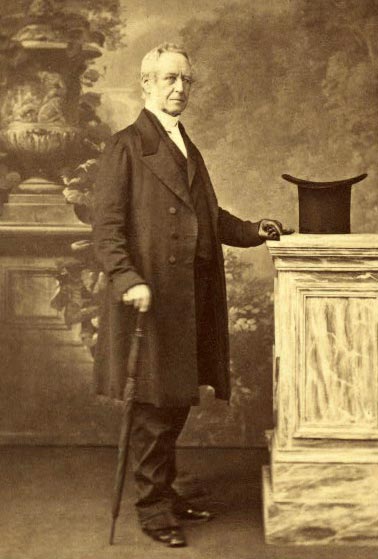 Archdeacon Henry Cotten, C of I, Thurles & Chairperson of the Thurles and Rahealty Famine Food Committee. Today we turn to history (knowledge acquired by investigation), to demonstrate, via a study of the past, the importance of politicians uniting under one umbrella; taking time to disregard their own personal differences, prejudices and beliefs, in favour of finding fair, equal and paramount solutions to the needs of every person residing in this forgotten rural ‘Premier County’.
Back then in 1845 it was not Irish elected Members of Parliament who came to the rescue of those shivering in the cold and wet, anxiously expecting the fragments of cold ‘stir-about’ that remained following the workhouse pauper meal. Rather it was religious leaders; Quakers, and here in Thurles Fr. William Barron (Administrator within the Thurles Roman Catholic community) closely working together with Archdeacon Henry Cotten (Head of the Thurles Church of Ireland community).
It was these same religious communities, whom we are so quick to condemn today that carried our town through the ‘Great Famine’ period, while at the same time encouraging the importance of education, which today 172 years later, has raised us out of hopeless misery and abject poverty.
In examining factual history; we ask the question “What were living conditions like in the town of Thurles, Co. Tipperary in 1847; the third year of the ‘Great Famine’ (1846 -1852), during a period of mass starvation, disease and the mass emigration and migration from rural Irish towns, villages and their hinterlands?”
For Thurles the most accurate answers to these queries are set out in two ‘Question and Answer Reports’ sent out by the Thurles and Rahealty Famine Food Committee, which met in the rented parlour of the home of Dr Robert C. Knaggs MD. (MD – Medical Doctor), Main Street, Thurles (Today known as Liberty Square, Thurles, in the building currently occupied by Ulster bank.)
First Report – British Association for the Relief of Extreme Distress in Ireland and Scotland.
The first of these reports was sent to the British Association for the Relief of Extreme Distress in Ireland and Scotland and forwarded to Lieutenant Col. Douglas on February 11th 1847. This Association had been formed in January 1847, in London, supported by bankers and other prominent people, to provide, “competent machinery for administering the public munificence”. Queen Victoria (Alexandrina Victoria) had requested that her name be placed at the head of the list of donors[1] to this Association with a contribution of £2,000.00 and later added a further £500, one sixth of whose total funds only went to support the potato failure in Scotland.
[1] It would be Charles Stewart Parnell (1846 – 1891), Irish nationalist politician and one of the most powerful figures in the British House of Commons in the 1880’s who later would spread the untruth, indeed myth, that Queen Victoria of England was the only sovereign who gave nothing out of her private purse to a starving Irish people.
Continue reading Great Famine – State of Thurles in Black 47 (1847)
|
Support Us Help keep Thurles.info online by donating below. Thank you.
Total Donated 2026: €300.00
Thank You!
Daily Thurles Mass Livestream
|



Recent Comments