Statue of Archbishop Dr. P. Leahy, in Thurles Cathedral yard.
Destined to become one of the most prominent Roman Catholic churchmen in Ireland, Patrick Leahy (1806–1875) was born at Fennor, in the parish of Gortnahoe, Co. Tipperary, on May 31st 1806, the son of Patrick Leahy, a moderately successful Civil Engineer and Surveyor in Co Tipperary and Co. Cork, and Mary Margaret (née Cormack), a native of Gortnahoe.
Following his ordination he became the Roman Catholic curate of a small parish in the diocese of Cashel and was later appointed professor of Theology and Scripture here in St. Patrick’s College in Thurles, and a short time later President of that same Institution.
By August 22nd 1850 he was one of the Secretaries of the Synod of Thurles, and was afterwards appointed parish priest of Thurles and vicar-general of the Diocese of Cashel.
When the Catholic University was first opened in Dublin in 1854, he was selected for the office of Vice-Rector under then Rector Dr. John Henry Newman, (afterwards Cardinal Newman), thus filling a Professor’s chair.
He was elected Archbishop of Cashel on April 27th 1857 and consecrated on June 29th of that same year. In 1866 and 1867 he was deputed, with John Derry Bishop of Clonfert, to conduct the negotiations with Lord Mayo (Richard Bourke),[1] the Chief Secretary for Ireland, with respect to the proposed endowment of the Roman Catholic university.
[1] Five years later, on February 8th 1872, the same Lord Mayo (Richard Bourke), stopped off at Ross Island near the entrance to the harbour at Port Blair in the South Andaman Islands in the Bay of Bengal, then a British penal colony. Here Lord Mayo was stabbed to death by Sher Alia a convict from the North West Frontier, who was on a sick leave. His death caused great disturbance in diplomatic circles but the decision was made to play down the incident; quietly hang the murderer and appoint a new Viceroy.
A strong advocate of the cause of temperance, Archbishop Leahy enforced the Sunday closing of all public-houses in his Diocese. Owing to his energy the Cathedral of The Assumption at Thurles was built, at a cost of £45,000 pounds.
He died on January 26th 1875, and was buried in Thurles Cathedral on February 3rd of that year.
Hereunder find the following extract, relating to the erection of the statue to Archbishop Leahy in the yard of the Cathedral of The Assumption Thurles, taken from the journal of Fr. Michael Maher C.C., Thurles, and dated 1911.
“At the end of the year, the Archbishop (Thomas Fennelly 1901-1913) got a statue of Dr. Patrick Leahy erected in the Cathedral enclosure. It was sculptured at Carrara [2] by Professor Pietro Lazzerini and it is made of Sicilian or Bastard Statuary Marble. [3]
It was ready for shipment when the strike occurred on the railways in Great Britain and Ireland in August 1911.[4]We wrote to the sculptor not to send it until matters would be settled. It was sent from Leghorn [5] when the strike ceased, but arrived in Liverpool when the Irish strike was at its height in October. It was delayed some time on that account, but arrived safely in Thurles from Liverpool and Dublin in November. It weighs two tons and cost £120. I sent the cheque to Lazzerini.”
[2]Michelangelo di Lodovico Buonarroti Simoni (1475-1564), the Italian sculptor, painter, architect, and poet of the High Renaissance period, who exerted an unparalleled influence on the development of Western art, worked here at the Carrara marble quarries.
[3]Statuary Second or Bastard blue-grey Marble was used since the time of Ancient Rome.
[4]This strike arose after widespread dissatisfaction with the activities of conciliation boards set up to negotiate between workers and their employers the Rail Companies. Local disputes led to unofficial strike action in July and early August of 1911, with a meeting of all the main rail unions arranged in Liverpool to coordinate action nationally. These Unions issued an ultimatum to the Rail Companies to accept direct negotiation with their representatives within 24 hours or suffer a national strike. Keen to ensure that the railways would not be shut down. The Prime Minister, Herbert Henry Asquith, son of a Yorkshire clothing manufacturer, told the rail companies that police and troops would be deployed to help keep the trains running, resulting with soldiers being brought into London and 32 other towns in England and Wales. The then Home Secretary, Winston Churchill supported the police and troops against the striking union employees.
[5] Traditionally known in English as Leghorn, Livorno is a port city on the Ligurian Sea on the western coast of Tuscany, in Italy.
“The pedestal was fashioned by Mr P. Best of Cashel from stones got in the quarry at Camas, (Cashel). It cost £70. The Archbishop composed the inscription which is simplicity itself and a Galway man named Laurence Clane cut the letters.
Messr Leahy Brothers of Thurles had charge of the erection. It was no small work to get the statue in position without cranes or other powerful leverage. It was done this way. They constructed a large framework of wood around the base of the pedestal, then they hauled up the great box (2 tons 5 cwt.) containing the statue with pulleys attached to a horizontal iron bar above and let it rest on planks. They next built the pedestal and when that was finished they opened the box and got the statue into position by means of the pulleys. They finished the work a few days before Christmas.”
Overall Cost of Monument £214-10-0 [Statue £120-0-0; Pedestal £70-0-0; Leahy erection £12-0-0; Carriage from Leghorn (Livorno) to Thurles £12-10-0.]
American-born feminist, theologian and independent politician, Katherine Zappone, Minister for Children, referred in the Dáil yesterday to the 474 “unclaimed infant remains” which were transferred from mother-and-baby homes and related institutions, to medical schools in Irish Universities. Same were transferred into the anatomy departments of Irish medical colleges here in Ireland right up to the mid 1960’s.
The Minister stated she wished to offer solidarity and a personal apology for the wrongs that were done to those affected.
‘Resurrectionists’ on the ‘Graveyard Shift.’
While apologies and offers of solidarity are all very well, one must ask the questions:
(1) Were there any laws broken when such transfers of unclaimed infant remains were transferred from these homes to Irish Universities?
(2) Do we now need to change or update existing law with regard to such matters?
In 2017 we must consider ourselves as living in more enlightened times. We learn that today, Friday 10th March 2017, that what is described as a highly original and thought-provoking exhibition of human anatomy will come to Dublin for a limited time only. Yes it is the ‘Human Body Exhibition’, which also features the bodies of genuine humans. The specimens featured were donated in accordance with Chinese law to the Dalian Hoffen Biotechnique Laboratory, which conducts research into plastination and provides specimens to medical schools.
This exhibition the purpose of which we are told is to further educate, is expected to run for six months and the promotions company founded by Eamonn McCann and Denis Desmond (MCD), have sent invitations to medical schools and primary and second-level students. Tickets however are priced at €14 for adults and €8 for children.
This exhibit has indeed attracted criticism since it is not possible to attest as to whether any of the specimens voluntarily donated their bodies, or whether they are instead the misappropriated remains of executed Chinese political prisoners, latter who had not given their consent to have their bodies shown, following their execution.
Should the Irish people at this time be upset by the arrival of this “highly original and thought-provoking exhibition of human anatomy”, in light of the 474 “unclaimed infant remains” similarly transferred from mother-and-baby homes to Irish medical schools between 1940 and 1965 ?
Prior to the Anatomy Act of 1832, the only legal supply of corpses for anatomical purposes were those condemned to death and dissection by the courts who were often guilty of harsher crimes. However those sentenced by Courts did not provide enough subjects for medical schools / private anatomical schools. During the 18th century hundreds had been executed for what we regard today as trivial crimes, however by the 19th century only about 55 people were being sentenced to capital punishment on an annual basis.
As many as 500 dead bodies were needed annually due to the expansion of the medical schools. Interfering with graves was not a felony, rather a misdemeanour in common law and therefore only punishable with imprisonment and a fine, instead of transportation or execution. Thus the trade of Body Snatching became a sufficiently lucrative business with the authorities tending to ignore what they considered a necessary evil.
The business of ‘Body Snatching’ became so prevalent that it became necessary for relatives and friends of deceased persons to watch over bodies until burial, and then to keep watch over the very grave itself to halt violations. Mortsafes, (a framework of iron bars placed over grave sites) and Iron Coffins, where affordable, had to be used frequently.
Graves were dug quite shallow and ‘Body Snatchers’ or ‘Resurrectionists’, as they were known, would dig at the head end (West) of a recent burial, using wooden spade (quieter than metal implements). On reaching the coffin, they broke the side open before placing a rope around the corpse and dragged it out. Stealing jewellery or clothing would cause them to be liable to a felony charge, so in many cases they were careful not to steal either.
Resurrectionists were also known to hire women to act as grieving relatives and claim the bodies of the dead from within poorhouses. Often poorhouses received a small fee from undertakers, or resold the bodies (especially those with no family) to doctors. Women also attended funerals acting as grieving mourners to ascertain any future hardships these Body Snatchers might later encounter during disinterment. Even bribed servants would sometimes offer body snatchers access to their dead master or mistress lying in state; the removed body would be later replaced with suitable weights in closed coffins.
Remember in more recent times the huge furore over Irish human tissue banks and the removal of organs retained for further examination and sometimes subsequently used for educational and research purposes, dealt with by the Dr. Deirdre Madden Report on Post Mortem Practises & Procedures.
Enough with the apologies and offers of solidarity; our legislators now need to sit down and ask the question: “Do we now need to change or update existing law with regard to such matters?” We as a nation can no longer afford the costs of day after day public enquiries, followed by the inevitable compensation claims in an attempt to remove our guilt, especially with regard to matters of Church and State, and which once were seen as being morally quite acceptably, by Irish Society, all those decades ago.
L-R.Pic (1) Wesleyan Methodist chapel today. Pic (2) Initial Drawing of Wesleyan Methodist chapel 1847. Pic (3) Drawing of the Missionary Mrs Asenath Hatch Nicholson, who visited Thurles in 1848.
The Wesleyan-Methodist chapel, built originally 1848, was described back then as being a detached three-bay gable-fronted building, having three-bay two-storey side elevation with lean-to extension to the rear, and with a pitched artificial slate roof with rendered chimney stacks. Lined-and-ruled rendered walls to the front with square-headed niches with limestone sills and moulded render surrounds, ashlar limestone pilasters, and limestone pediment with fascia and acroteria with anthemion motif. Central square-headed replacement timber panelled double doors with render cornice with consoles and limestone steps.
In more recent years its continued use would see it become the home of Thurles FCA [Currently known as the Reserve Defence Force, (RDF)]
and even more recently the newest home to Thurles Youth Centre.
However a report sent to the editor of the Wesleyan-Methodist Magazine[1] records the opening of the Thurles Wesleyan-Methodist chapel; situated as it does today on the west side of Slieve-na-Mon Road, in Thurles, Co. Tipperary. Remember 1848 Thurles was still experiencing the aftermath of three years of the Great Famine of 1845 -1849.
Note: The Wesleyan Methodist Magazine[1] was a monthly magazine published between 1778 and 1969. Founded by John Wesley as the ‘Arminian Magazine’, it was later retitled the Methodist Magazine in 1798 and later again, in 1822, the Wesleyan Methodist Magazine.
A report by Mr Robert Bruce of Roscrea (Tullamore Methodist District) in 1848 reads: “On March 1st a very neat and commodious Wesleyan chapel was opened in Thurles, in the Roscrea Circuit, Ireland by the Rev. Messrs. Croggon and Reilly, who preached very excellent and appropriate sermons, Mr Croggon from Genesis Chapter 28-Verse 17. [And he was afraid, and said, How awesome is this place! this is none other but the house of God, and this is the gate of heaven”]and Mr Reilly from St John Chapter 1 – Verse 29 [The next day John seeth Jesus coming unto him, and saith, Behold the Lamb of God, which taketh away the sin of the world.]“
Mr Bruce reports “The building is 34ft x 25ft and will afford sittings for about 130 persons. There is a very good school-room; there are also apartments for a Master under it. Mr Croggon intends as soon as possible to fix a suitable person here; and in no part of Ireland, so far as scriptural education is concerned is a school more wanted. The building does great credit to the architect, Mr Tinsley, Clonmel and to Mr Leister of Thurles.” [Possibly Thomas or Joshua Leister, Turtulla, Thurles, Millers & Brewers]
Mr Bruce continues, “Through the perseverance and defatigable exertions of the latter, indeed the house has been completed. The cost is £350 of which the sum of £250 has been raised, leaving a debt of only one hundred pounds. It is about thirty years since the Wesleyan Ministers commenced preaching in Thurles, during which time Mr Leister and his excellent wife have been the ardently attached and unwavering friends of Methodism. With our additional advantages we trust we shall enjoy a larger share of the prospering blessing of Almighty God”.
Asenath Hatch Nicholson
Determined to personally investigate the suffering of the Irish poor during the ‘Great Famine’, self appointed missionary Mrs Asenath (Latter name taken from the Book of Genesis) Hatch Nicholson, was also on an unaccompanied visit to Thurles, Co. Tipperary. An American teacher and arthritic widow of 52 years; (Miss Asenath Hatch had married Norman Nicholson, a widower with three children) who had previously been the proprietor of a vegetarian boarding house and who had championed the causes of abolitionism and temperance arrived here around 1848. Walking through the countryside on her mission to bring the Bible to the Irish poor, she arrived in Thurles, to distribute copies of the Bible to those who could read, and read the Bible to those who could not.
“The morning was pleasant”, she writes, “and had not my heart been a little sad, it would have been congenial to every feeling of my mind, so naturally fitted for the enjoyment of rich scenery in nature.
She states, “Thurles is an ancient town in the county of Tipperary, somewhat neatly built. It contains a good market-house, fine chapel, college for Catholics, Nunnery, and Charity-school, with a Protestant church, and a Methodist chapel. My reception here was cordial, and the house in quite American taste. My stay was continued a day or two longer than I at first intended; and as Tuesday was market-day, it presented a favourable opportunity of seeing the peasantry, who appeared more cleanly and comfortable than those of many towns in Ireland, though much like Kilkenny.”
Even back then Mrs Nicholson was challenged government on their record of stewardship of relief resources, and their overall attitude toward the poor, for whom she rightly claimed they were fully responsible.
Even then and just like staff employed by modern charities today, Mrs Nicholson made a distinction between the paid relief officers, whom she characterized as bureaucratic, hierarchical and self-serving; and volunteer relief workers, e.g. Quakers, Coast guardsmen and their families and Local Clergy, latter whom she regarded as being compassionate, egalitarian and selfless. Unlike our modern day highly paid charity executive employees, in the early 19th century Mrs Nicholson was scrupulous about her own personal expenses, allowing herself 23 pence a day for food; a diet of bread and cocoa and reduced her stipend to 16 pence (no cocoa) when her resources showed signs of dwindling.
She raged against the diversion of grain being converted from food into alcohol; charging that grain used for distilling could have fed the Irish poor. She stated in her writings, “Reader, ponder this well. Enough grain, converted into a poison for body and soul as would have fed all that starving multitude.”
Methodism had been introduced into Ireland by John Wesley himself. A body of preachers were attached to travelling circuits, visiting chapels. Of course political correctness was a long way off in the early days of census taking and a number of disabilities were crudely noted revealing a less than sensitive attitude. These census designations were openly identified as, “deaf, dumb, blind, idiot, imbecile and lunatic”. It was seriously noted that the only groupings showing an increase for example in the 1901 census were, yes, “Lunatics and Methodists”.
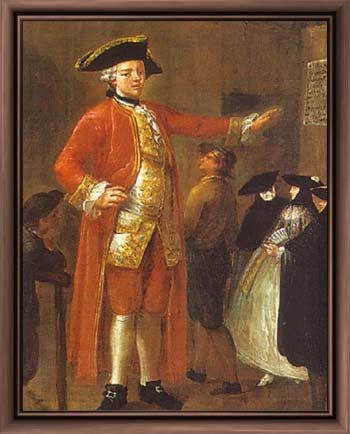
Cornelius Magrath the Silvermines Co. Tipperary giant.
Trinity College Dublin claim that they have no immediate plans to release the skeleton of a giant, born in March 1736, near the Silvermines, Nenagh, Co Tipperary to assist in his burial.
Cornelius Magrath who suffered from gigantism was 7ft 3in tall when he died in 1760. Legend recalls that Trinity students stole his body the day he died and it has been kept at the University ever since.
Of course body snatching was a lucrative business back in the 18th century and those who were involved were often called “resurrectionists” or “resurrection-men”, who often benefited on the double, stealing personal effects from the corpses sold on for dissection or anatomy lectures in medical schools. Because the only bodies legally available for medical dissection back then were the remains of executed criminals, demand soon outpacing supply.
Such body snatching activity possibly lends itself to the use of the phrase “The Graveyard Shift”. Graveyards started running out of places to bury people. So coffins were often dug up and bones sent to a “bone-house” allowing for the reuse of grave space. When opening such coffins, it was discovered that a considerable number were found to have scratch marks on the inside lid, confirming that individuals were being burying alive. Based on this evidence it was agreed that a piece of string be tied to the wrist of certain corpses; to be lead through the coffin and up through the ground before being tied to a bell. An individual would sit out in the graveyard all night (the “graveyard shift”) to listen for bell; sounds, hence someone could be “saved by the bell” or was considered to be a “dead ringer.”
The Magrath skeleton today is viewed only by those doing research and continues to inspire scholarship through teaching a great many students, scientists, professors and experts studying his disease.
While it is claimed that Tipperary locals are calling on Cornelius’s skeleton to be released for burial; certainly Thurles.Info has heard nothing about it and Trinity College have released a statement also confirming it also had not been approached by any Tipperary individuals who are requesting his burial. The University in the past admits putting Cornelius’s skeleton on public display, but there are no plans for such similar displays into the future; leaving Cornelius to be only visited by medical students or associated groups involved in research or other educational activities.
Looks like our Dublin Media were stuck for front page sensationalism and national debate again.
You can read all about the Tipperary Giant Cornelius Magrath simply by clicking HERE
Initial design drawing of the ‘Stannix Homes’ produced before building in 1889.(Photo colour toning G. Willoughby.)
The Stannix family appear to have spent comparatively little time here in Co. Tipperary. We are aware they were of the Protestant faith and left us a legacy which involved the setting up of the charitable almshouses known today here in Thurles as ‘The Stannix Homes’.
In the mid 1870’s the representatives of Jeremiah Stannix held 2,054 acres in county Tipperary. What we can reliably ascertain is that Emma Stannix held townlands in the parish of Moycarkey, Thurles in barony of Eliogarty, Co. Tipperary. There is a reference to the provisions of the will of Miss Emma Stannix in a letter in the papers of Archbishop Thomas William Croke of Thurles, dated 1st December 1886. There are references to the representatives of Emma Stannix holding untenanted lands at Ashhill and Knocknanuss, in the parish of Moycarkey, in 1906.
We believe that Emma herself showed some talent as an artist and spent much of her time overseas in Versailles in the Île-de-France region of France. Tipperary press reports appear to constantly conflict with the spelling of her name; e.g. Stannix and Stanwix.
Stannix Homes September 2016
However Ema’s philanthropic soul passed away in 1857; and her will makes provision for the Stanwix Almshouses to be financed and subsidised by her deceased estate. She is also understood to have made generous provision for the remaining tenants on her various Moycarkey agricultural properties.
Here in Thurles the Emma Stannix Charity left a sum of money to build alms-houses for what were referred to as “reduced female widows aged over sixty years”. The site was provided on ground (Thurles Townparks) to the south east of Thurles with frontages overlooking and facing west towards the town.
The terrace of two-bay single and two-storey former almshouses, were built 1889, and featured open gable-fronted porches. The central house is a higher two-bay gabled erection, while the two storey director’s house attached to the north side of the terrace features a small spire with roundels on a turret.
The pitched slate roofs have rendered chimney stacks while the buildings themselves are constructed of red brick, with half-timbered gables and verandas. Each resident was then provided with two rooms, a yard and sanitary accommodation. Gate piers with alternating bands of brick and stone, together with wrought-iron gates and cast-iron railings are features of the boundary surrounding the site.
The building work was initially carried out by Mr. J. Kiernan, of Talbot-street, at a cost of about £2,500, using the designs and under the superintendence of Mr. Albert E. Murray[1], F.R.I.B.A., architect, Dawson-street.
Albert Edward Murray (1849-1924)[1]. Interesting to note that when Queen Victoria (1819-1901) visited Dublin in 1900, Mr. Albert E. Murray was responsible for the decorations in Sackville Street, now O’Connell Street, Dublin and also for those in Clyde Road, Ballsbridge where he then resided.
Ceremonial gateways had been erected on Queen Victoria’s route into Dublin from Kingstown (Dun Laoghaire). It was on the occasion of this same trip by Queen Victoria that it was reported that the Irish Times supposedly printed a typo stating, “a large crowd cheered as Queen Victoria pissed over Carlisle Bridge.” (Now O’Connell Bridge). Even though they had only gotten one letter wrong the entire type room staff were supposedly sacked.
Albert Murray would also decorate Sackville Street (O’Connell Street) for the visit by Queen Victoria’s eldest son Edward VII (1841-1910), during his visit to Dublin in 1907.
This website uses cookies to improve your experience. We'll assume you're ok with this, but you can opt-out if you wish.AcceptRead More
Privacy & Cookies Policy
Privacy Overview
This website uses cookies to improve your experience while you navigate through the website. Out of these, the cookies that are categorized as necessary are stored on your browser as they are essential for the working of basic functionalities of the website. We also use third-party cookies that help us analyze and understand how you use this website. These cookies will be stored in your browser only with your consent. You also have the option to opt-out of these cookies. But opting out of some of these cookies may affect your browsing experience.
Necessary cookies are absolutely essential for the website to function properly. This category only includes cookies that ensures basic functionalities and security features of the website. These cookies do not store any personal information.
Any cookies that may not be particularly necessary for the website to function and is used specifically to collect user personal data via analytics, ads, other embedded contents are termed as non-necessary cookies. It is mandatory to procure user consent prior to running these cookies on your website.







Recent Comments