|
|
Former INLA Commander and once prisoner at Portlaoise maximum security jail, Mr Dessie O’Hare, once known as the ‘Border Fox’, is to fight extradition from Northern Ireland over his alleged role as the leader of a gang accused of the imprisonment of a Dublin family, a Belfast court has heard today.
 Mr Dessie O’Hare Mr O’Hare, now aged 60 and who was once the most wanted man in Ireland, (IR£100,000 reward was offered for information on his known whereabouts), is accused in the Irish Republic of six separate crimes, including violent disorder; an act of grievous bodily harm; threats to kill and three counts of false imprisonment.
Early this morning, Mr O’Hare was detained at his home in Newtownhamilton, Co Armagh, in connection with these charges. His alleged offences relate back to June of 2015 and an incident which occurred at Garters Lane, Saggart, in Co Dublin.
Today he appeared before Belfast Recorders’ Court, flanked by prison guards, to justify the first stage of a bid to have him transferred to the Irish Republic. Lawyers representing Dublin’s High Court were granted bail on the grounds that he could abscond; resulting in a decision to remand Mr O’Hare into custody, to appear before the court again next Friday. Mr Declan Duffy, aged 43, a co-accused, with an address at Hannover Street West in Co. Dublin, has already been remanded in custody here in the Republic and a full hearing has been listed for next month.
Mr O’Hare, was a former Irish republican paramilitary, who broke away from self styled ‘Irish National Liberation Army’ (INLA) leadership in Belfast, to set up his own group, the ‘Irish Revolutionary Brigade’.
Possibly he is best remembered for his kidnapping of the late Dr. John O’Grady, from his home in Cabinteely, Co. Dublin on October 13th, 1987. Mr O’Grady, readers may recall, owned a dental surgery in Ballsbridge and was never the intended victim of this O’Hare led gang; who had mistaken his home for that of his father-in-law, the high-profile millionaire and medical entrepreneur Dr. Austin Darragh. (Alas Dr. John O’Grady died in September of this year).
Intensive Garda detective work traced the kidnappers to a location in Cabra, Co. Dublin and a shoot out ensued. One Garda detective was later seriously wounded, however Mr O’Grady was rescued, minus two little fingers which had been chopped off using a hammer and chisel, before same were sent to Carlow Cathedral. In a follow up telephone call to Gardaí, informing them of what was to be found in the Cathedral, Mr O’Hare stated: “It’s just cost John two of his fingers. Now I’m going to chop him into bits and pieces and send fresh lumps of him every fucking day if I don’t get my money fast.” The O’Hare gang themselves escaped from the Cabra location in a hijacked car, which was later found in Dundalk.
Mr O’Hare later resurfaced again in Dunleer, Co. Louth, where he allegedly fired shots into a chip shop during an altercation with his wife; while two members of his notorious gang were arrested near the town of Cahir, here in Co. Tipperary. Some three weeks later, on November 27th 1987, Mr O’Hare was himself arrested after a car, in which he was a passenger, attempted to drive through an Irish Defence Forces check point near Urlingford, on the Tipperary / Kilkenny border. Following a fire-fight, in which his car driver; named as Mr Martin Bryan, was killed. Mr O’Hare was shot eight times as he resisted arrest and one Irish Army soldier was wounded during this same incident.
At a subsequent trial at the Special Criminal Court, Mr O’Hare was convicted of possession of firearms with intent; unlawful imprisonment and wounding with intent, before receiving a 40-year jail sentence. He staged a ‘dirty protest’ in a wing of the prison in 1998, following the Good Friday Agreement, before being transferred to Castlerea Prison on December 8th 2002, in preparation for his release under the same agreement.
He was first granted temporary release from prison in November 2003, following his attendance at a weekend long course on ‘Conflict Resolution’, in Glencree, situated in the Wicklow Mountains; latter an Irish Peace and Reconciliation Centre dedicated to transforming violent conflict. He was later granted periods of temporary release in November 2004 and in March 2005.
However in November 2005 he was returned to Portlaoise prison after he was caught with a mobile phone and a bag of pills, while returning to Castlerea prison from temporary release, thus jeopardising his chances of release under licence. Following a new High Court bid in April 2006 he was granted extended temporary release, and later the Police Service of Northern Ireland (PSNI) issued a statement that Mr O’Hare would no longer be arrested on suspicion of his involvement in up to 30 unsolved killings, since these alleged offences pre-dated the Good Friday Agreement.
In April of this year we (Thurles.Info), expressed the view that, as a community, we should rightfully commemorate those who took part in the 1916 Easter Rising here in Ireland.
With all of the well funded 1916 commemorative activities targeted at Dublin’s O’Connell Street and its immediate environment; we also expressed the view that perhaps the name General Richard James Mulcahy could easily, shall we say, ‘be sidelined’.
 Pic (1) Michael Collins (Center) with Richard Mulcahy (Right); Pic (2) General Richard Mulcahy TD; Pic (3) General Mulcahy with his wife Mary (Affectionately known as ‘Min’), taken in 1922. We were of the then opinion that a man responsible for the only successful military action taken in 1916; (that of the defeat of the RIC at Ashbourne, County Meath), could be totally forgotten in rural Ireland, amidst the advertising aimed at O’Connell Street’s national mêlée.
We were correct. Here we are, almost into the last 9 weeks of 2016; with Dublin’s jingling tourism coinage beginning to sound less musical; when suddenly, imagine my irrepressible delight on hearing the glad tidings today that on Sunday next, October 23rd, a Memorial Ceremony for that once great Tipperary patriot General Richard Mulcahy will after all take place in the ground which today marks his last resting place. That resting place of course is Ballymoreen Graveyard, Littleton, Co. Tipperary (Take the N8 Old Cork to Dublin road), with the event starting at 2.00pm.
This event I am happy to relate is the most welcome initiative of a local Littleton committee (Well done), assisted by the membership of the ‘Collins 22 Committee’. I am also given to understand that an invitation has been sent to Mr Sean Kelly (MEP) and Mr Paul Keogh (F/Gael Chief Whip) both of whom could well be in attendance.
Now if we could attract RTÉ, (Ireland’s National Television and Radio Broadcaster), then just maybe the leader of the present government (what’s his name), or the ninth and current President of Ireland could well be encouraged to show up in an effort to further enhance their rural profiles.
Still, after all one must realise that the village of Littleton is not Dublin’s O’Connell Street; here is ‘Potholed Rural Ireland’, the ‘Forgotten Place of the Unemployed’, inhabited by the ‘Forgotten Few without Broadband’. Here you will find a place where ‘Voices are not sufficiently heard’, because individual party politicians continue to bicker; ever in search of that elusive one-upmanship, while highlighting each other with constant criticism; never offering real alternative solutions.
Alas, in lonely, though truly peaceful, Ballymoreen Graveyard; without Ireland’s National Television cameras in attendance next Sunday, same will hardly gain much attraction for senior political celebrities. Yes here in Ballymoreen, Littleton, Co. Tipperary, expect to find no Glasnevin Cemetery State funding, no sunken rose gardens or memorialised manuscripts by the Irish artist Harry Clarke.
Still, I suppose in defence of our current political leadership, as the British music hall song (written by Jack Judge and co-credited to Henry James “Harry” Williams) states, “It’s a Long Way to Tipperary”, even using the tax payers Ministerial car and driver.
We refer to our two previous posts discussing Tipperary and Thurles and their lack of real association with the 1798 rebellion. Our first post published June 19th, 2016 can be accessed HERE, while our second post published on July 2nd, 2016 is available by clicking HERE.
The point of our third and final post today on this 1798 rebellion period in Irish history is to help demonstrate that in truth, rebellion, mutiny, general unrest and civil disobedience is rarely aimed at actual people’s religious beliefs. Instead same should be perceived for what it really is; a re-action, taken usually by the underprivileged and weak, against those strong enough to hold control over Governments and rich Corporations. These latter controlling individuals believe that by gaining immense wealth; often inherited, it is their sole privileged and prerogative to influence and ensure that their own continued power, and that of their generations yet to come, are secured at the expense of all other life on our planet.
It will be noted from our first post, featuring the 1798 commemorative monument positioned in Liberty Square, Thurles, here in Co. Tipperary, that all 3 men remembered on this statue, affectionately known as ‘The Stone Man’ ; namely Theobald Wolfe Tone, Robert Emmet and Lord Edward FitzGerald, came from a Protestant tradition. However from a book, the first edition of which was written shortly after the 1798 rebellion and entitled “A History of the Rebellion of 1798,” (by George Taylor, Ballywalter, Ireland) we learn of a totally different fate metered out to yet another member of the Protestant tradition. The Protestant to whom I refer was a Clergyman; his name, Rev. Francis Turner.
Rev. Turner formally owned property, referred to as ‘Turners Holding’, here in Thurles, situated in an area known as South Main Street and which today is called Cathedral Street (On South side).
South Main Street, Thurles (Cathedral Street, South side), as it looked in the mid 19th century.
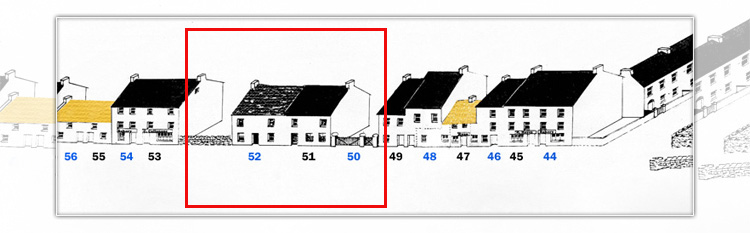
Drawing Shown Above: South Main Street, Thurles, Co. Tipperary,as viewed in the mid 1840’s. (Left to Right – Cathedral Street South side as viewed today from Munster Hotel, and travelling west to end at start of today’s Source Library / Barry’s Bridge area.) The area, framed in red, between today’s Munster Hotel and where part of Thurles Presbytery currently stands, was once ‘Turners Holding’, purchased on July 2nd, 1784 by Rev. Francis Turner and later sold by Turner’s heirs, to Rev. Thomas O’Connor D.D., back then President of St Patrick’s College, Thurles, under an Indented Deed of Conveyance on March 25th, 1840, for the then free hold consideration of £200.00.
This South side of Cathedral Street (previously known as South Main Street, Thurles); its then house residents and their known occupations in 1846 (6 years after the purchase of ‘Turners Holding’, by Rev. Thomas O’Connor on behalf of St Patricks College) is shown hereunder:
No 56 – Catherine Toomy (Lodging House); No 55 – Margaret Dunn (Lodging Hse); No 54 – Mrs Ally Britton (Bakery); No 53 – Con Callanane (Bakery, Spirits, Grocery); No 52 – Margaret Cormack (Widow – home in disrepair); No 51 – John Tolphy (Windows partially built up. House from Dr O’Connor D.D. No 51 & 52 to be thrown down & plans for a grand gate to be built leading to St.Patrick’s College.); No 50 – Entrance to St.Patrick’s College; No 49 – Mrs Eliza Byrne; No 48 – Thomas Pew (Upper), Rev Pat Cahill (Lower); No 47 – Miss Ellen Ryan (Bonnet Maker); No 46 – Richard Molumby (Landlord of No 47 & 48); No 45 – Richard Hayes (Dyer & Wollen Manufacturer); No 44 – Edward Mathew (Bakery).
 Cathedral Street South, Thurles, Co. Tipperary, pictured today during the late evening, (Previously known as South Main Street, Thurles), showing, immediately left of picture, the area once known as ‘Turners Holding’. Photo G. Willoughby
Extract hereunder taken from the publication, “A History of the Rebellion of 1798,” by George Taylor.
“Rebels proceeded to the house of the Rev. Francis Turner, of Ballingale,[1] Rector of Edeermine,[2] a gentleman of excellent character; he had but just baptised a child, when the rebels surrounded the house with their usual yells, and immediately set the out-offices on fire.
[1] [In Co. Wexford, situated in the Civil Parish of Ballcarney following the N80; Bunclody to Enniscorthy route.]
[2] [Latter approx. 10 miles (18 km) Via N80 and N11 from Ballingale, Co. Wexford.]
Mr. Turner, looking out at the window, inquired what they wanted; on which they desired him to surrender his arms[3]. He refused to comply, and desired them to depart from his house. Persisting in their demand, he again replied that he would never surrender his arms but with his life, on which they fired through all the windows. Six or seven Protestants, who had fled to Mr. Turner’s house for safety, now determined to defend themselves to the last, and for a considerable time they made a most gallant resistance by incessantly firing out upon the rebels, who, now exasperated to the most extravagant fury, roared like beasts of prey.
[3] [Rebels were regularly visiting courthouses and listening to gentry seeking gun licences for game hunting, thus identifying houses where guns could be easily obtained for rebellious purposes.]
Continue reading Third & Final Part Of Thurles & The 1798 Rebellion
We continue with the second of a three part promised discussion on Thurles during the 1798 Irish Rebellion period; asking the question: “Why was a memorial to the 1798 rebellion erected in Thurles; a town and indeed a county who took little or no part in this same Irish rebellion?”
[ Note: Part one of this same discussion (June 19th last), can be read by simply clicking HERE ]
Basically the failure of Thurles and County Tipperary to take a more active role in the 1798 rebellion was down to the excessive political zeal and barbarity of just one man, Sir Thomas Judkin Fitzgerald, High Sheriff of Tipperary, (better known as “Flogging Fitzgerald”). He resided at Goldenhills, in the Civil Parish of Relickmurry & Athassel, near the village of Golden, Co Tipperary.
Positioned as Judicial Representative of King George III here in Co. Tipperary during 1798; Fitzgerald’s obvious social importance, held not just a ceremonial role, but also an administrative function, e.g. executing High Court Writs etc. Later, on August 5th 1801, this same Sir Thomas Judkin Fitzgerald would receive the title Baronetcy of Lisheen, Golden, Co. Tipperary; as his reward for suppressing the United Irish Rebellion of 1798, here in Co Tipperary.
 Sir Thomas Judkin Fitzgerald, High Sheriff of Co. Tipperary, better known as “Flogging Fitzgerald.” Fluent in the spoken native Irish language of Gaelic, Fitzgerald was described by his peers as, “a parody of the more extreme kind of loyalist: brave and energetic, but arrogant and reckless to a degree, verging on insanity.” During 1798 Judkin Fitzgerald rode his horse, leading a column of 100 men through Tipperary, searching for stashes of arms. Historians described him as being, “like an avenging demon, haranguing the people [speaking] in Irish for hours at a time, making them kneel down and pray for the King.”
Court Case of Wright v Fitzgerald Clonmel Assizes
Some recorded examples of his reign of terror during 1798, which failed to endear him to the Tipperary populace, included his arrest of a French teacher / professor in Clonmel; “a respectable Protestant of unimpeachable loyalty”, named Mr. Wright. Unable to understand the French language, but finding a hand written note, penned in French, on Wright’s person; Fitzgerald assumed, wrongly, that he was engaged in treasonable activities. The previous activities of United Irishmen, e.g. Wolf Tone, and attempts to bring about a French invasion of Ireland were known; the French being already at war with England.
Continue reading Thurles Co. Tipperary, & 1798 Rebellion
The 1798 monument today positioned in Liberty Square, Thurles, Co Tipperary, is affectionately referred too, most often, as simply ‘The Stone Man’.
In the hustle and bustle of everyday 21st century living here in Thurles and mindful of hefty parking charges and indeed a not insignificant fine for those found remiss in failing to visit a parking meter; very few local people today take the time to ‘stand and stare’, while contemplating the truth of its existence.
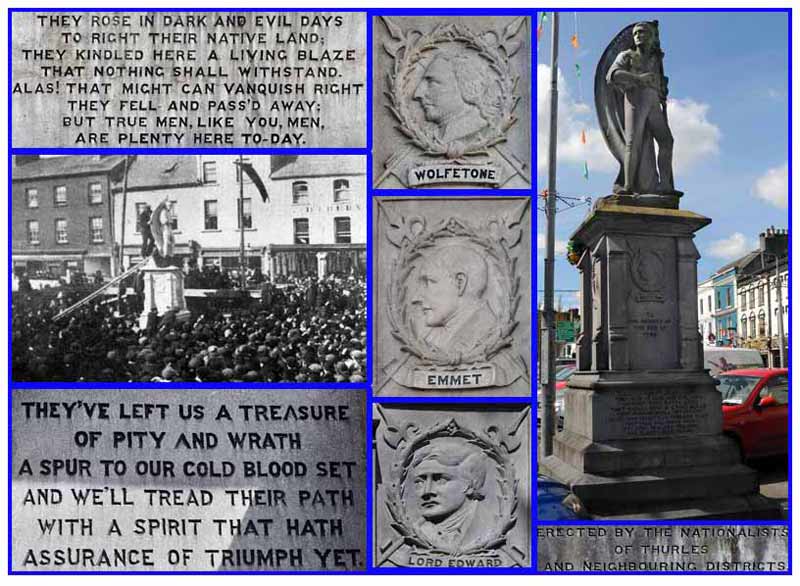
The ‘Stone Man’ was first unveiled in 1901 (See old photograph of the official unveiling above) to commemorate the first centenary of the ill fated attempt at a rebellion in 1798. Funding to pay for this very fine monument and indeed its eventual erection, was collected voluntarily from the nationalists of Thurles and surrounding districts. However full funding came some three years too late to actually commemorate this first centenary event.
Indeed many would have believed that the wording on this monument could hardly have been acceptable to local authorities, (See nationalist rhyming principles being propagated in above picture), then subject to strong British rule.
However it would appear that those then in power felt more fear from banning this structure, than in allowing its erection. On the other hand this monument was erected to the memory of three Protestant 1798 wealthy nationalist leaders, in a town (Thurles), described in the British Parliamentary Gazetteer of 1846 as being “decidedly the most Roman Catholic town in Ireland, second only to the city of Galway.”
The Protestant Leaders Commemorated by the ‘Stone Man’ in Liberty Square, Thurles, Co. Tipperary.
(1) Theobald Wolfe Tone, (20 June 1763 – 19 November 1798), today referred to by his sir-name Wolfe Tone, then a leading Irish revolutionary figure and one of the five founding members of the Society of United Irishmen, aimed at a political union between Catholics and Protestants, and is regarded today as the father of Irish Republicanism and the true leader of the 1798 Irish Rebellion.
Wolfe Tone was born in Dublin, the son of a Protestant coach-maker, who also owned a farm near Sallins, in Co. Kildare. His mother who came from a Catholic merchant family, chose to convert to Protestantism, following Theobald’s birth. Educated at Trinity College, Dublin, he qualified as a barrister in King’s Inns at the age of 26 and attended the Inns of Court in London.
(2) Robert Emmet (4 March 1778 – 20 September 1803) was a Protestant; an Irish nationalist; Republican; an orator and rebel leader, who led an abortive rebellion against British rule in 1803.
Emmet was born at No. 109, St. Stephen’s Green, Dublin and was the youngest son of Dr Robert Emmet a wealthy court physician and his wife, Elizabeth Mason. Again educated at Trinity College, Dublin, before being expelled in 1798, and forced to flee to France.
Emmet was captured following his failed Dublin rebellion; was tried for treason and sentenced to be ‘hanged, drawn and quartered’, as was customary for any conviction of treason. He was hanged and once pronounced dead, was beheaded in Thomas Street near St. Catherine’s church in Dublin. Family members and friends failed to come forward to claim his final remains, out of fear of arrest, so alas today we cannot identify, in truth, his last resting place.
(3) Lord Edward FitzGerald (15 October 1763 – 4 June 1798), also a member of the Society of United Irishmen and was part of the Protestant Ascendancy; being the fifth son of Lieutenant-General James FitzGerald, 1st Duke of Leinster; an Irish aristocrat; revolutionary, who died of wounds received while resisting arrest on a charge of treason.
FitzGerald spent most of his early years at Frescati House, Blackrock, Co. Dublin and was privately educated here by a private tutor named William Ogilvie.
Details of these three Irish republican leaders and their involvement in the intervening years, up to their eventual deaths in 1798 and 1803, can be easily accessed online or from your local library.
So why then was a memorial to the 1798 rebellion erected in Thurles; a town and indeed a county who took real, little or no part in this same rebellion?
Watch out for our explanation, in a forthcoming blog, over the coming days.
|
Support Us Help keep Thurles.info online by donating below. Thank you.
Total Donated 2026: €290.00
Thank You!
Daily Thurles Mass Livestream
|





Recent Comments