|
|
 The Swiss Cottage in Cahir, Co. Tipperary. With effect from Saturday next, July 1st 2017, children under the age of 12 years are to be given free admission to all heritage sites managed and operated by the Office of Public Works (OPW).
This welcome initiative is expected to encourage children to further experience, in full, the many cultural and heritage sites available throughout Ireland, up until the end of the current year.
Children under six years had already gained free entry to OPW heritage sites, while the OPW also offers free access to schoolchildren under the Free Schools Visits scheme.
Also keep in mind that all OPW managed Heritage Sites in Tipperary will continue to offer free admission to individuals, on the first Wednesday of every month, for the duration of each sites particular opening season.
The list of participating sites in Tipperary include: Cahir Castle, Rock of Cashel, Roscrea Heritage (Castle and Damer House) and the Blackmills, and the Swiss Cottage.
So please, those who enjoy free travel, do take advantage and use this opportunity “To see old Ireland free.”
Michael Hogan (1828 – 1899), was an Irish poet, known as the “Bard of Thomond”. He was born in Thomondgate, Co. Limerick to a father whose occupation was that of a wheelwright. Same father was also an accomplished musician, who made his own flutes and fiddles.
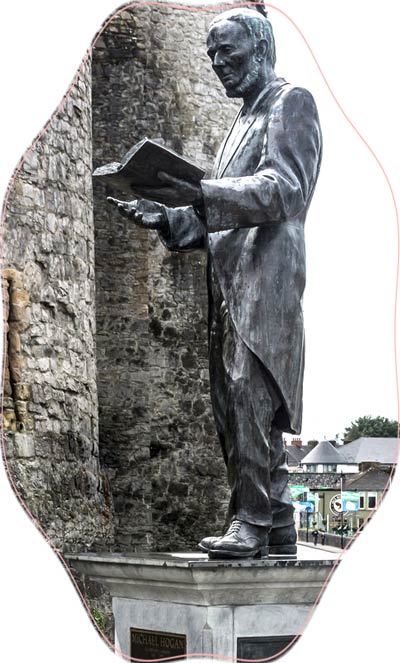 Indeed, a life-size bronze memorial statue, by sculptor Mr Jim Connolly, of Michael Hogan can be observed on your next visit to Limerick city; same erected back in 2005, at King John’s Castle, Plaza. (See Picture left). Indeed, a life-size bronze memorial statue, by sculptor Mr Jim Connolly, of Michael Hogan can be observed on your next visit to Limerick city; same erected back in 2005, at King John’s Castle, Plaza. (See Picture left).
Hogan’s circulated work appeared in such publications of the period as:- the Anglo-Celt; the Irishman; the Nation; the Munster News, and the Limerick Leader.
His first volume of works, “Lays and Legends of Thomond“, was published in Limerick in 1861 and in Dublin in 1867. A further series of satirical publications, lampooning prominent city figures caused a great sensation at that time, enjoying a large circulation.
A new version of his “Lays and Legends” was published in Dublin in 1880 and six years later he undertook to visit the United States, where he stayed for some three years.
Possibly best remembered for his epic long poem, ‘Drunken Thady and the Bishops Lady’, a little known poem entitled “The Battle of Thurles” is also attributed to Michael Hogan’s penmanship.
The Battle of Thurles – 1174.
King Henry II of England feared that the Normans intended to throw off their allegiance to him and set up an independent state in Ireland. One of those who took the oath of fealty to the British King Henry, was Dónal Mór O’Brien, king of Limerick or Thomond, a territory that embraced Co. Clare and the greater part of counties Tipperary and Limerick. Dónal Mór O’Brien leader of the warrior race of the Dalcassians soon learned that this submission to Henry afforded him little or no protection from incursions into his territory by the land-hungry invaders, and he was determined to resist.
Indeed the Norman invader Richard de Clare, 2nd Earl of Pembroke, (better known as ‘Strongbow’) decided to chastise him, and with his lieutenant, Hervé de Marisco, led a strong force from Waterford towards Co. Tipperary, plundering the countryside on the way, including the monastery of Lismore. He further summoned assistance form Dublin, and a well-armed force of Ostmen (persons of mixed Gaelic and Norse ancestry), led by experienced knights set out to join him. While awaiting their arrival, Strongbow encamped at Cashel. Dónal Mór O’Brien had intelligence of their approach and led his army from Limerick to meet them. A fierce engagement took place at Thurles in which the Normans were routed, suffering their first major defeat, while leaving four of their commanders and over 700 of their men dead on the fields of Laghtagalla, (Irish “Hollow of Blood”).
A now chastened Strongbow force fled in confusion to Waterford. Finding the news of the Thurles defeat had long preceded him, and the Waterford populace had risen up and killed the Constable of the town and some 200 of the garrison; he was forced to shut himself up, with the remnants of his forces, on the 420 acre ‘Little Island’, in the River Suir, on the eastern outskirts of Waterford City. He remained confined there for a month until Raymond FitzGerald le Gros (nicknamed Le Gros “the Fat”) arrived from Wales with about 450 men, to relieve him from a most perilous of situation.
The rank and file of the Normans attributed this defeat to sheer inept leadership. Their most experienced commander, Raymond le Gros, had previously withdrawn to Wales because of disputes with Strongbow. Raymond had demanded from Strongbow the Constableship of Leinster and the hand of his illegitimate daughter, Basilia (widow of Robert de Quincy), in marriage, but both requests had been refused. Strongbow now had to swallow his pride and send a messenger to beg Raymond to return, promising to accede to his requests. Raymond came over, landed at Wexford, then proceeded to Waterford and rescued Strongbow, whom he conveyed to Wexford where the marriage with Basilia was celebrated.
“The Battle of Thurles” by Michael Hogan, ‘Bard of Thomond’.
The war-fires light gleamed red all night, along the mountain gloom.
King Dónal’s men are up again, from Limerick to Slieve Bloom.
From glen and wood, the bone and blood of his fierce and fearless clan,
In wild array, at dawn of day, o’er Ormond’s plains swept on.
From Waterford the Norman hoarde to the plains of Ikerrin came.
In vengeful haste the land to waste with sword and destroying flame.
Left and right with sweeping might, the headlong hosts engaged
And life ne’er bled, in a strife so red, while that combat of bloodhounds raged.
But as the heave of the mad sea wave is barred by the crag filled shore,
So that iron tide, on Durlas’s side, was stopped by King Donald Mór.
There’s revelry high and boisterous joy from Cashel to Shannon’s shore,
And Luimneach waits to open the gates, for her conquering Donald Mór.
Archdeacon and historian Giraldus Cambrensis wrote at that time, that all Ireland was so heartened by the news of O’Brien’s victory that there was a general uprising against the invaders whose castles and strongholds were burned and destroyed, right up to the confines of Dublin. However this unity of purpose was short-lived. Disunion made its appearance again and soon the sad spectacle of petty Irish chiefs could be observed assisting the invaders against their Irish fellow-countrymen. The Normans took advantage of this disunity, and in the very next year 1175 Raymond Le Gros seized and occupied O’Brien’s town of Limerick, but again, in the following year, O’Brien expelled this garrison burning the town to the ground.
It is believed that in 1179, Raymond le Gros took possession of Thurles, while O’Brien was away ingloriously fighting his countrymen, the MacCarthy clan. If the town was fortified and garrisoned at this time, the Norman hold on it must have been exceedingly tenuous for shortly afterwards O’Brien and his entourage are found traversing this territory, without obstruction or impediment from these same foreigners.
The humanitarian priest, and valuer of human life, Fr. Jack Finucane, passed away today at the age of 80.
Ordained in 1963; Fr. Jack was a brother to the late Fr. Aengus Finucane, latter a former Chief Executive of Concern Worldwide, and earlier a former teacher at Rockwell College, secondary school close to New Inn, Cashel, here in Co. Tipperary.
The brothers were both natives and ‘Freemen’ of Limerick; being aptly recognised in 2005 for their inspirational and tireless work with the starving of Africa and Asia. Fr. Jack, with his brother Fr. Aengus, tended to some of the poorest people in the world; from Biafra in Nigeria to Bangladesh and Ethiopia.
Fr. Jack would later became an adviser to Sir Bob Geldof and his Live Aid team, and in 1985, escort a young Bono (U2 fame) on his first trip to Ethiopia, greatly influencing latters future thinking.
This staunch belief by both men; based on the view that all human beings deserve respect and dignity and therefore should be treated as such, would lead to the formation of the organisation known as Concern Worldwide in 1968.
Fr. Jack and Fr. Aengus had been sent to Nigeria by the Holy Ghost Fathers and were at the ‘coalface’ in the distribution of aid, flown into Biafra by Concern and other relief organisations. Both Finucane priests had become involved in the distribution of this humanitarian aid, following the Nigerian government’s blocking of food supplies to the breakaway state of Biafra (Biafran War or Nigerian Civil War carried on from July 6th 1967 to January 15th 1970 with the loss of over 1 million lives). This food blockade caused massive starvation and continued despite receiving, back then, worldwide condemnation. The Finucane priests organized food to be sent through makeshift airstrips, including one at Uli, Anambra.
 Frederick Forsyth CBE, with Fr. Jack Finucane, latter who passed away today. The Royal Air Force pilot, novelist (70 million books), political commentator and spy, Mr Frederick Forsyth CBE, (Works include ‘The Day of The Jackal,’ ‘The Odessa File,’ ‘The Dogs of War’, ‘The Fourth Protocol,’ ‘The Biafra Story‘ and ‘Cry of the Innocent,’ latter film made here in Ireland), who was then a journalist covering the Biafran war, knew both Fr. Jack and Fr. Aengus; indeed Mr Forsyth regularly dined with both men close to Umuchima village, Uli, at the airstrip code named ‘Annabel Airport’, during his stay of some 2 years.
Both religious brothers were involved in using old Douglas DC6s and DC7s from the 50’s, together with old worn out Lockheed Constellations planes from a similar era, in their efforts to get sick children out and food provisions in, and while dodging Nigerian MiG-19 jets supplied by East Germany and manned by East German pilots.
Frederick Forsyth, wrote of the children airlifted out of Biafra, stating that these children were a “living, breathing monument” to the work of Fr. Aengus Finucane and his colleagues.
Irish President Mr Michael D. Higgins stated today; “His (Fr. Jack Finucane) commitment to the ethical basis for, as well as the practical application of humanitarian principles was exemplary. Jack Finucane’s lifelong commitment to protecting the dignity of some of the world’s poorest and most marginalised people will stand not only as a lasting tribute to all that is good about mankind, but is exemplary in its invitation not to avert our gaze from our current challenges of global hunger and poverty.”
Go ndéana Dia trócaire ar a anam dílis.
His headstone in St Mary’s Graveyard Thurles, reads: “O holy cross under thy shadow I will rest.” In loving memory of John O’Brien, 19 Main St, Thurles [Co.Tipperary]. Died 30th June 1917, aged 62 years. R I P. “An upright man fearing God and avoiding evil”. [Grave Ref: 349].
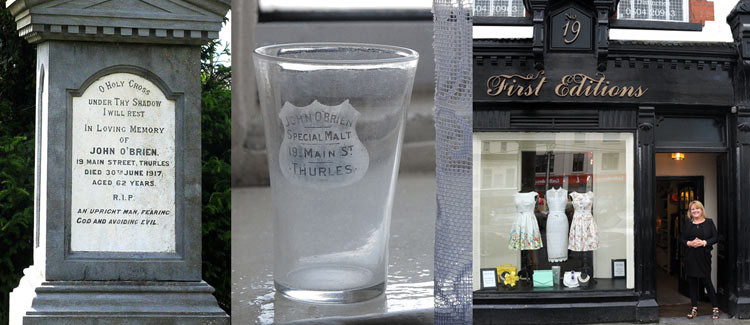 Pic (1) Gravestone of J. O’Brien, No 19, Main St. (Liberty Square) Thurles. Pic (2) A 100-year-old Whisky Glass with the O’Brien name from No 19, Liberty Square (Main St.) Thurles. Pic (3) First Editions today (June 2017) also situated at No 19, Liberty Square (Main St.) Thurles. For the many years that I have been a resident of this town, ‘First Editions’ situated at No 19 Liberty Square, Thurles, (Previously Main Street) has been retailing not just the ‘crème de la crème’ in lady’s fashion and design, but also providing effective fashion guidance; advising ladies of all ages in “what to wear, what to bare, and what to keep under wraps”.
However, No 19 Main Street, Thurles, was not always the home of ‘Haute Couture’ for devoted followers of high fashion. Previously it had been a Licensed Hostelry (Pub, Watering Hole supplying ‘Special Malt’ whiskey) and occupied by Mr John O’Brien. Prior to Mr O’Brien’s tenancy it was occupied by one Mr Adam Cooke, who according to research, possibly ran a Delph and Hardware business before 1843.
Today, following his death almost 100 years ago this month, when we examine his place of burial, we can fairly assume that Mr John O’Brien, was a man of some substance. Born just after the Great Famine and passing away shortly before Thurles became fully involved in the fight for Irish freedom, his headstone epitaph is possibly the only headstone in St Mary graveyard with hammered smooth, lead lettering.
So why letters made using Lead (Symbol Pb, Atomic No 82) ?
Lead lettering on signs and headstones was up to 50 years ago a technique that had been in use for at least the previous three to four hundred years. In our dimmer past, the highlighting of lettering on any type of sign was difficult, due to the absence of long lasting exterior paints, with latter being unfit to endure Irish weathering and thus unable to remain clearly visible to the eye for any great period of time. Lead lettering, therefore, while highly skilled and labour intensive, was the only other option, depending on ones available finances.
Seldom seen today, except in graveyards; this lead lettering would be sketched out on the surface of the stone initially in pencil. The intended inscription would then be incised or scored into the stone using a hammer and different sized sharp chisels, producing a V style cut into the surface. Except for the surface outlines, the stone cutter was not required to finish the carved-out letter shapes cleanly.
Now using a hand driven band drill and a steel bit, the stone mason could drill a series of tiny holes internally into each incised letter. Soft malleable type lead, supplied in sheets and twisted into the shapes of each letter, would then be hammered into each incised letter cutting, using a wooden mallet. The lead would then be sanded down so as to be level with the stone surface. Together with the rough finish and drilled holes the stone mason was assured that the lead would grip tightly for decades and in the case of the O’Brien gravestone, one hundred years this month.
New York publican, Mr Aekerman Jensen, had arrived into Terminal 1 at Dublin Airport. He was on a trip to Upperchurch in Co. Tipperary, in an attempt to chase down his ancestors, latter whom he believed had emigrated from Tipperary bound for the US on board the coffin ship “Ellen Simpson” in 1847.
Arriving here in Thurles for the first time on the 1.00pm Dublin to Cork train, he dismounted with his luggage from the carriage and looked around. His gaze became immediately focused on Mickey Ryan standing behind a long folding table on which were displayed an assortment of what looked like bleached human skulls.
“What are these?” asked Aekerman.
“Oh, I be selling real human skulls”, replied Mickey, “Sure as Fáilte Ireland have already told you in their adverts, this be part of promoting rural Ireland and promotin Ireland’s Ancient East.”
Aekerman suddenly recalled the Fáilte Ireland brochure he had picked up from the travel agents. It had read; “From ancient high kings to modern day poets, saints and scholars to ramblers and fishermen, Ireland’s Ancient East pulsates with legendary tales”.
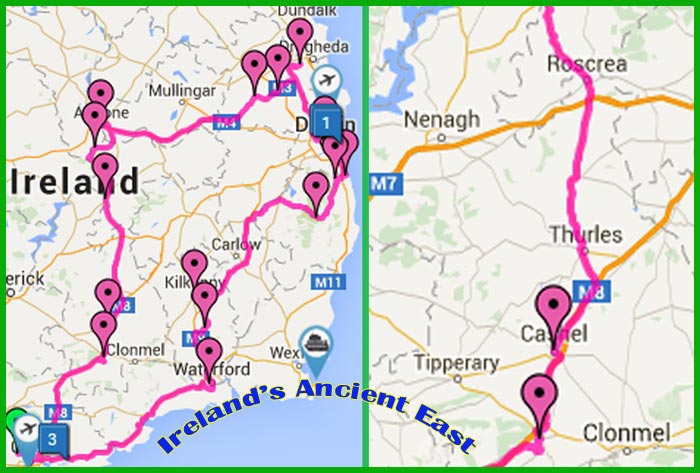
“I never knew Thurles was in Ireland’s Ancient East” said Aekerman, inquiring further, “Do you have any skulls from ancient high kings, famous poets or saints?.”
Mickey raised his eyebrows “Sure don’t I have the skulls of the most famous of Irishmen that have ever lived.”
“That’s really great” said Aekerman, “Can you give me some names?.”
“Begod I can sir!” said Mickey, pointing to his varied collection, “That one there is St. Patrick, the Patron Saint of Ireland, and that one there with the hole in it, is Mick Collins the man who won us our freedom back in 1922.”
Mickey continued “Sure the odd shaped one over there for example, is none other than James Joyce, a famous Dublin author and playwright, and that…..”
Aekerman interrupted, “Sorry but did you say St. Patrick?”
“Begod that is correct sir” said Mickey with a knowing nod.
Aekerman again recalled the wisdom of Fáilte Ireland’s brochure promise, “Learn the stories of a place and you’ll come to understand the soul of its people”.
“I believe I will buy from you St. Patrick” said Aekerman, who immediately paid over the asking price of €3,000 in cash. But then as Mickey correctly explained later “If people want quality, they expect to pay for value.”
Aekerman flew back to New York a week later and proudly mounted the skull of St. Patrick’s on the wall in his Pub. People, especially from the ‘auld sod’, came from every America State to view this famous Skull, making him a small fortune and allowing him to retired early, a truly wealthy man.
It was during this retirement, some five years later, that Aekerman decided to come back to visit Ireland, Thurles, and Upperchurch, the source of his wealth, and to reconnect once more with his ancient ancestors. Walking once again along the Thurles railway station platform, he spotted Mickey and his skull collection.
Anxious once more to get another bargain Aekerman asks “And what skulls do you have today?.”
“Sure begod, I have the skulls of the most famous Irishmen that ever lived” replied Mickey.
“Give me some names”, demanded Aekerman, beginning to tear some €50’s of a rather fat roll of paper currency.
“Well!” said the Irishman, pointing to various skulls. “That one there is Michael Collins, that one is James Joyce, and that one is St. Patrick, the Patron Saint of Ireland, God bless his coming to Éire and the Rock of Cashel, and that one…”
“Sorry” Aekerman interrupted, “But did you say St. Patrick, the Patron Saint of Ireland?”
“Begod, that’s correct!” said Mickey.
“Well”, said Aekerman, “I was here about five years ago and you sold me St. Patrick’s Skull.”
“Begod so I did” said Mickey beginning to place his wares quickly into the back of his van, “Sure don’t I remember you well … now … you see … ah … this scull here today actually is St. Patrick when he was just a boy.”
|
Support Us Help keep Thurles.info online by donating below. Thank you.
Total Donated 2026: €290.00
Thank You!
Daily Thurles Mass Livestream
|





Recent Comments