The world outside your private home is not your personal dump.
Last week I had the privilege, for two days, to show a number of American & Canadian persons around the town of Thurles, all intent on combining together to write a Great Famine TV script. Not having recently visited the “Double Ditch”, on the Mill Road, once a Great Famine project initiated for those starving here in Thurles; imagine my embarrassment on discovering the state of this National Monument.
A National Monument in the Republic of Ireland is a structure or site, the preservation of which has been deemed to be of national importance and therefore worthy of state protection.
Proud people just don’t litter.
This 174 year-old-old famine project has had its Mill Road entrance firstly destroyed by the very contractors employed by Tipperary Co. Council to erect fencing and a short concrete footpath, but now someone has erected posts and barbed wire on this public-right-of-way and once pedestrian Mass Path. It has also been turned into a graveyard for unwanted supermarket trollies. Observe it yourself as I viewed it last week.
“Double Ditch” at Mill Road, Thurles, Co. Tipperary.
A ditch is a narrow channel dug at the side of a road or in a field. Its purpose to either hold or carry away flood water. In Anglo-Saxon, the word ‘dïc’ was pronounced ‘deek’ or ‘deetch’. In digging such a water trench the upcast soil will form into a bank alongside it. This banked soil thus means that the word ‘dïc’ included not just the excavation itself, but also the bank of soil derived from such effort. Later word would later evolve into the words we more commonly use today, e.g.‘dyke’ and ‘ditch’.
The idea of this Thurles “Double Ditch” was firstly to provide work for those unemployed and starving, but was it also possibly erected to provide a dry shortcut for Dr. J.Knaggs himself, when he was wont to cross from his home, (today’s Ulster Bank premises, in Liberty Square, then known as Main Street); travelling via College Lane, The Pike, (today Kickham Street), to visit family relatives in Knaggs Mill, Brewery and Bakery at Archerstown watermill, same later to become Brady’s Mill.
Thurles Committee then responsible in 1846 were :- Rev. Dr Henry Cotton, Rev. Mr Barron, Rev. Mr Leahy, Rev. Dr O’Connor, Rev. Mr Laffan, Rev. Mr Lanigan, Rev. Mr Baker, Mr Joshua Lester Esq., Mr Robert C. Knaggs.
The Double Ditch featured in our video was built in 1846 and remains a well-worn public right-of-way and also later became a Mass Path to the ‘Lady’s Well’ area. During the 19th and early 20th century same naturally became a short cut for all pupils attending schools in Thurles coming from outlying areas and villages e.g. Littleton.
With next year commemorating the 175th year of the Great Famine, [Same officially began on September 13th, 1845 – 1849], today this video must surely bring a blush of shame, not just to the faces of those we have been elected locally to represent us, but also to Tipperary Co. Council officials, who have failed to provide a Recycling Depot in Thurles. Same depots are readily available in the towns of Cashel, Nenagh, Clonmel, Donohill and Roscrea, but Thurles local councillors have once again failed us miserably in every way, except on their social media pages. For the few who hold a driving licence to tow a trailer, a rough costing for those who wish to clean up such litter can be found HERE.
Meanwhile, those of our starving ancestors, must surely be turning in their graves due to the disrespect shown in their efforts to feed their children / families.
The gift to the town of fruit bearing crab-apple trees, once secretly sowed by these people bounding on this double ditch, are now set on fire; the existing young shutes of Japanese knotweed, which featured in many a “Spring rhubarb tart” during two world wars, are now forced to emerge through filth and grime. [Yes, we should be controlling Japanese knotweed by eating it, instead of Tipperary Co. Council inviting specialist companies to destroy it using poisonous chemicals and at considerable cost to rate payers.]
The “Double Ditch” featured in the above video gets mentioned for the first time in the “Minutes of the Thurles Famine Food Committee”, on Monday, April 20th, 1846.
Those attending that 1846 meeting included Venerable Archdeacon Rev. Henry Cotton [Chairperson [(C. of I.)]. Present also were Dr. O’Connor, Very Rev. Fr. Barron, [(R.C.) St. Patrick’s College, Thurles], Rev. Mr Baker, Rev. Mr Lanigan, Mr O’Brien [Treasurer], Dr. Joshua Knaggs [Medical Doctor] and Mr James B. Kennedy [Secretary].
From these same minutes we learn that the Famine Relief Committee have already begun creating work for those unemployed, ensuring that money in the form of wages, will enable those starving to purchase food. Dr. Knaggs reports his having inspected the works to be undertaken at College Lane and the proposed “Double Ditch”; calculating the expense for the works at College Lane at £20, latter sum today the equivalent of £20,000.
It was agreed that barrows should be purchased from Mr Patrick McGrath [½doz @ 9 shillings]; Mr Daniel Carroll [½doz @ 9/6] and also Mr Dan Dwyer; latter if he wishes to make them. It was further agreed that, when necessary, the Committee have the power to hire asses’ carts at 15 pence per day.
The previous day, April 19th 1846, Mr J. B. Kennedy Esq had informed relief commissioners of the state of Thurles: – “243 families containing 739 men, women and children unable to work and almost totally destitute; and 525 families containing 2625 individuals totally depending on the heads and sons to the number of 790 who cannot procure employment; thus, making in the town, 3364 persons to be relieved”. With regards to the immediate environs [referred to as ‘country parts’] of the town he states: – “The country parts of our District are divided into wards and similar enquiries are in progress, the result of which I have reason to believe will be painful in the extreme”.
On the same day we learn from further written communication sent to the Trustees appointed for the distribution of Indian Meal, quote: – “In the town of Thurles alone there are at this moment 768 families containing 3364 inhabitants in actual want; of these 739 are old men, women and children, unable to work and who have no one to labour for them; and the remaining 2625 are depending on the daily hire of the sons and heads of the families to the number of 790 able to work and now out of employment”.
The following rules for labourers employed to work on this ‘Double Ditch’ were adopted: – (1)Hours of labour to be from 7.00am to 7.00pm with 2 hours for meals. (2)Any labourer found to shirk from reasonable and fair work or refusing to follow the directions of his overseer shall forthwith be discharged and not admitted to the works again. (3) That the persons employed shall be paid every evening. (4)That in case a greater number of labourers shall offer themselves than the funds will enable the committee to pay, a preference shall be given to those who have the largest and most necessitous families”.
Work was ordered to commence on the following Tuesday and quote; “Iron is to be purchased to make 20 crow bars, and 6 picks are also to be purchased”.
It was further agreed that, quote: – “Henceforth there be two rates of payment; 8 pence and 5 pence, and that no boy under 12 years old be employed. That tickets of the form now agreed on, should be printed to admit labourers to work – those for men in black ink and those for boys in red ink; Ordered that 500 red and 500 black tickets be printed. Families containing 7 members and over and having 2 men over 17 shall, at the discretion of Committee, be entitled to 2 black tickets; Families having a less number shall, if the Committee wish, get 2 tickets, one red and one black”.
Yes, expect tourists and visiting footfall to flood Liberty Square soon, but in what century I do not know.
No, our H1 heading does not denote a spelling mistake to which we admit to being often prone. Our modern Irish ‘Éire’ initially evolved from an old Irish word ‘Ériu’. Ériu was the name of a Gaelic goddess, same believed to have been the matron goddess of a sovereign Ireland, or possibly a goddess of the land.
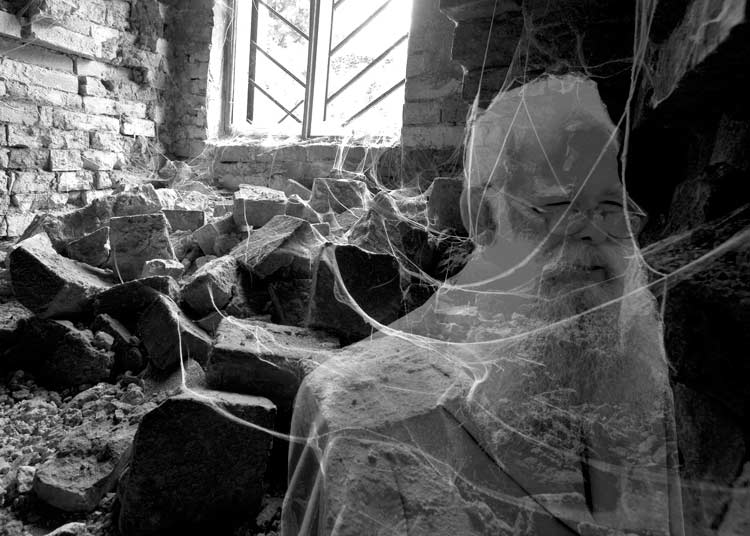
Have you ever observed a ghost?
Which brings me to news emanating from our sister town of Cashel, Co. Tipperary, (latter just a 20 minute drive from Thurles via the M8 or the R639 [22.3 km] ). We travel next to Cashel Library, situated at St. Francis Abbey, Friar St, Cashel, Co. Tipperary, which will host a number of events over Halloween for both adults and children, thus celebrating this age-old tradition.
Adult Event
It is here that a resident historian and well known designated “Witch”, (latter in day light possibly better known as Ms Maura Barrett), will give a lecture on ‘Halloween Traditions’ and discuss in detail “ghosts” that are specific to Ériu (Ireland).
This event takes will take place on Tuesday 29th of October at 7:00pm and is for adults only. Patrons and other interested parties are invited to come by for a“spell”, and dressing up is both optional and acceptable. This event promises to be a fun but a scary occasion and refreshments will be served.
Children’s Events
Mum and Dad please note: Children will not be forgotten in the same venue with “Halloween Storytime”, all thanks to Children Services Manager Ms Aoife Moore. This latter event will take place on Thursday 31st of October, beginning at 3.30pm sharp. Dressing up as your favourite ghost is suggested.
In addition, they are showing the film “Casper” on Tuesday 29th of October, at 2:30pm and fancy dress is also optional for this most enjoyable of events.
Bookings are essential for all events and can be made by simply calling Cashel Library on Tel: 062 63825, during official opening hours.
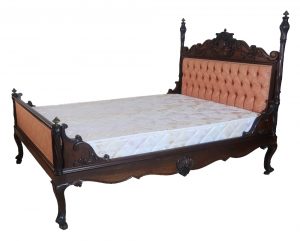
The auction will comprise of furniture, equestrian and other paintings, miniatures, prints, silver, Chinese porcelain, sporting guns, garden furniture, books, and maps. A 4ft 6in, 18th-century rosewood, French bed, latter understood to have belonged to the Empress Joséphine (1763 – 1814), first wife of Napoleon Bonaparte, is included in the items expected to go on sale.
Note: A short 4ft 6in bed does not necessarily mean that people were shorter in the 17th/18th century. Rather people often chose to slept sitting up, in the real belief that for health reasons this was a safer option. By sleeping lying flat out, evil spirits could more easily enter your body as you slept, and your soul could more easily escape from your body.
“Now I lay me down to sleep, I pray the Lord my Soul to keep, If I should die before I ‘wake, I pray the Lord my Soul to take.”
Lots can be viewed at Glengarriff, Thurles, from 10am-5pm tomorrow Monday, September 30th and as already stated the auction will be held in the Anner Hotel at 11:00am the following day.
Earlier this month (August 3rd 2019) the Food Safety Authority of Ireland (FSAI) moved to remove implicated batches of own brand bottled water, supplied by Co. Monaghan company ‘Celtic Pure’, which were on sale and display, in stores and food outlets nationally. Arsenic (chemical symbol As), a heavy metal, had been detected at levels above the prescribed legal limit in several branded ‘still’ and ‘sparkling’ bottled waters.
A more serious Arsenic contamination was discovered during the late 18th and early 19th century, in the form of ‘Paris Green’; also known as ‘Schloss Green’; ‘Scheele’s Green’ ; ‘Schweinfurt Green’; ‘Emerald Green‘; ‘Patent Green’, and ‘New Green’; latter compound invented in 1775 by pharmacist Carl Wilhelm Scheele, himself the initial true discoverer of the gas ‘oxygen’.
The long list of different names associated with this same compound over future years would suggests that manufacturers were anxious to continue selling their product. By ignoring known associated health issues, they simply changed its name in an effort to disguise and mislead consumers.
This product was further improved, in 1814, by chemists working at the Wilhelm Dye and White Lead Company of Schweinfurt, in the Lower Franconia region of Bavaria in Germany.
‘Paris Green’, came into use as a colourant for many household products, e.g.wallpapers and paper hangings; in paints; wax candles; artificial flowers; gloves; sweets; confectionery, particularly cake decorations; medicine; glass; dye in clothing;as a colourant in the painting of children’s toys and the product was ground down more finely, for inclusion in watercolour paints and inks.
Women were passionate about this yellowish-green pigment, same being much sought for being brighter and longer-lasting than other green colours then available in the market place. It became a particular hit amongst the then existing social elite; from the French Emperor Napoleon III’s wife, (the Empress Eugénie de Montijo), to Queen Victoria’s wallpaper decorating bedrooms Buckingham Palace.
On June 4th 1849, Dr. H. Letheby, M.B., Ph.D., a renowned chemist working at a London Hospital, confirmed that the cause of death for a female child was arsenic poisoning. The press of the time were quick to publicize that the arsenic paint used in wallpapers in that family’s home, had killed the child. Dr. Letheby further claimed that to kill any child, it did not need to eat this wallpaper paint, nor even to sleep in a room so decorated. Just a few hours of exposure breathing the dust of such wallpaper; especially flocked wallpaper, was all that was needed to bring about the death of an infant.
A French medical hygienist, known for his work in the field of occupational health and safety, one Maxime Vernois observed ten years later in 1859 that many male workers working with Scheele’s Green dye were found to have ulcerations on their green dyed hands, yellow nails, and crater-like scars on their legs. Their genital area also displayed painful lesions stretching along their inner thighs. Female cloth shapers were found to have poor appetites and suffered constant headaches, while displaying an anaemic skin pallor. His ongoing studies ended in the full knowledge that less than 1/8th of a teaspoon of arsenic, could signify a fatal dose, and this same group of employees were coming into contact with gallons of the dye substance.
Paris Green was also to become a popular colour expended by English romantic painter, printmaker and watercolour artist William Turner, and Impressionist artists like Claude Monet, Pierre-Auguste Renoir, together with Post-Impressionist painters such as Paul Gauguin, Vincent Van Gogh and Paul Cézanne.
At the turn of the 20th century this product was further blended and used as an insecticide by fruit and tobacco producers. During 1944 and 1945 in order to control malaria it was scattered by flying crop sprayers in Italy, Sardinia and Corsica, and further used as a rodent poison in Paris underground sewers.
When Maxime Vernois reported his concluded findings, Sweden, Germany and eventually France recognized the problem and banned the product. England, now its largest consumer and producer, however did not.
It was not until the 1960’s, despite all known and long proven scientific evidence on the highly toxic nature of this product, that the manufacture of emerald green paint was finally banned.
Back in October 2018 it was reported that the remains of 796 children, buried in an unmarked mass grave at a former Bon Secours Mother and Baby Home in Tuam, Co. Galway, were to be exhumed as part of a major forensic investigation.
The story emerged from research undertaken by Irish amateur historian Mrs Catherine Corless. The latter had decided to write an article about this mother and baby institution, based on her own childhood memories of the said institution; having gained an interest in local history, through her attendance at evening history courses.
A slow news day saw national and international media take up the story, likening same to Rwandan genocide, Ireland’s own Holocaust and the Srebrenica massacre of the mid 1990’s. Leading members of our Irish Parliament, the Irish Senate and the Northern Ireland Parliament, latter despite supposedly being well educated, were unaware of Ireland’s past history and now all spent valuable hours in debate, many strongly condemning Roman Catholic church authorities regarding this issue.
But all of Irish society remained defined by its very silence and its total complicity in what was accomplished, in an effort to cover up what we must regarded today as the most shameful of chapters in our Irish history and a crime against Irish women and children.
Since then, the current Fine Gael Minister for Children, Ms Katherine Zappone has confirmed that it is the current governments intention to exhume and if possible, to identify remains. The Minister has further ratified the costs of this project at being between €6m and €13m. The Roman Catholic religious congregation of the Sisters of Bon Secours have offered “a voluntary contribution” of €2.5m.
Thurles & Dublin Foundling’s Hospital
The Dublin Foundling’s Hospital(today the St. James’s Hospital campus and sometime in the future to become part of the new National Children’s Hospital at a cost in excess of €1.4bn) was first established in the early part of the 18th century (1702), with Dean Jonathan Swift and Arthur Guinness being amongst those who served on the Board of Governors. Its purpose was to prevent the deaths, brought about through neglect; malnourishment; climate exposure and murder, all caused due to severe poverty. The Dublin Foundling’s hospital also had one other aim; to educate and rear the children taken into charge, in the Reformed or Protestant Faith, and thereby to strengthen and promote the Protestant Interest in Ireland.
Foundling
A foundling refers to an infant child that has been abandoned by one or both parents at birth. Same is brought about usually due to the mother feeling unable to care for her infant, usually for reasons of poverty, or quite often due to pressures both from family and society in general, latter being unable to accept the existence of an infant born “outside the blanket” or outside of wedlock.
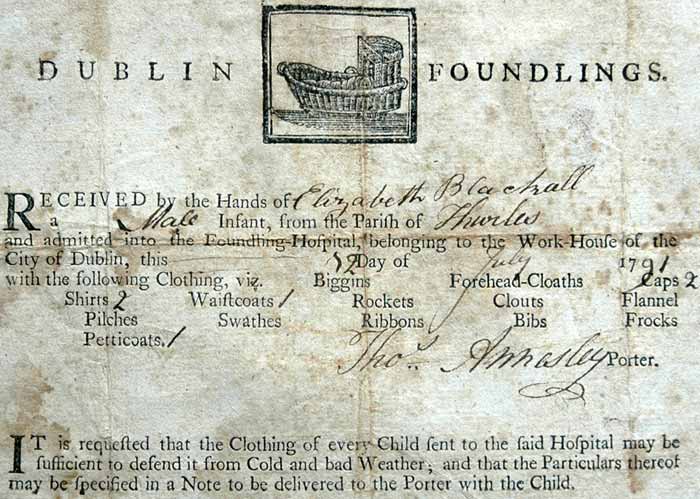
You will note from the picture show above of a billet (A billet in today’s language means a ‘ticket’ or a ‘receipt’ in French, but it originally meant a ‘short note’), that a male child “by the hands of Elizabeth Blackall” from the Church of Ireland parish of Thurles, was admitted to the Dublin Foundlings Hospital on July 12th 1791. The Porter’s name is shown as Thomas Annesley.
Note from the billet, shown above, certain of the clothing names no longer in use today. Biggins – A bonnet tied behind the neck and made of wool or linen. Clouts – Diapers or nappies. Flannel – A square of fabric wrapped around a child over the diaper or a long undergarment. Forehead Clothes – Strip of cloth tied across the forehead to behind the ears for added warmth. Pilches – Layers of cloth tied around the diaper in an effort to prevent leakage. Swathes – Strips of cloth, usually of wool, wrapped around an infant’s body for warmth and to put pressure on the navel. Parents will be aware of the term Swaddling.
Foundling hospital’s turning wheel appliance.
A levy, of £5 per year, would have been imposed on the parish from which the child was sent.
A feature of most foundling hospitals was a turning-wheel type mechanism set in a wall near the building’s main entrance. This particular system was so designed as to encourage mothers to bring their unwanted children anonymously to the hospital building, rather than to abandon them on doorsteps or in other out-of-the-way areas.
The hospital’s turning wheel appliance allowed for a basket to be attached, into which an infant could be placed at any time, day or night. A bell was attached to attract the attention of the hospital porter then on duty. The porter would then rotate the wheel mechanism, thus bringing the infant into the building’s interior. Such porters were instructed to take in all infants left in the basket / cradle and not to have any direct conversation with the individuals who had lodged a child.
Child abandonment due to poverty and illegitimacy has always been a problem in the past, and viewed in private by governments as the unacceptable face of unnecessary expense on state coffers. In medieval times babies were often abandoned in church or monastery doorways, in the hope that the religious, of all denominations, would take on the task of providing sustenance. After all, did not Jesus Christ insist, in the Gospel according to St. Matthew (Chapter 19 – Verse 14), that Christians should – “Suffer little children, and forbid them not, to come unto me: for of such is the kingdom of heaven”.
Once an infant was taken in charge, it was assumed that a mother gave up all future control. Mothers whose circumstances changed and who tried to contact their child, risked having it ‘exchanged’. This was undertaken by transferring infants to a sister institution in Cork in exchange for any Cork infants, who were also considered by authorities to be in similar danger of being re-contaminated by Papist parents.
Death Rates
In the year 1752, of the 691 children taken in charge by the Dublin Foundling’s Hospital, 365 children were dead by the end of that particular year. In 1757, burial of these children was described as being chucked, naked into a hole, some eight or ten infants at a time.
A report ordered by the Irish House of Commons regarding child mortality over the previous twelve years, ending in June 1796; same would reveal that of the 25,000 admitted more than 17,000 had died. Worse facts would be revealed in the five-year period between 1791 to 1796. Here, of the 5,016 infants sent to the Dublin Foundling’s Hospital infirmary, only one solitary child had survived.
The Select Committee to inquire into the Irish Miscellaneous estimates, published in 1829, recommended that no further financial assistance should now be given to the hospital. It stated the Dublin Foundling’s Hospital had not preserved life or and had failed to educate those placed in their care. Overall it found that the mortality rate amongst the foundlings were almost 4 death to every 5 infants taken in charge, while the total expenditure to the state was £10,000 per year. It was eventually shut down in 1838, by Charles Grant, 1st Baron Glenelg (Lord Glenelg then Irish Secretary) to be later used to accommodate South Co. Dublin Union Workhouse inmates.
The Modern-Day Solution to Ireland’s Unwanted Children In our modern-day Ireland; supported by numerous politicians, currently both in government and in opposition, we have now found a new solution to this age-old problem. With effect from May 25th 2018, the Irish people to everyone’s shame, voted by 66.4% to 33.6%, to kill all unwanted infants, but this time while still in the womb.
Today, such wilful murder must be seen as an abuse of children once again funded by the Irish state, without the full consent of Irish taxpayers.
This website uses cookies to improve your experience. We'll assume you're ok with this, but you can opt-out if you wish.AcceptRead More
Privacy & Cookies Policy
Privacy Overview
This website uses cookies to improve your experience while you navigate through the website. Out of these, the cookies that are categorized as necessary are stored on your browser as they are essential for the working of basic functionalities of the website. We also use third-party cookies that help us analyze and understand how you use this website. These cookies will be stored in your browser only with your consent. You also have the option to opt-out of these cookies. But opting out of some of these cookies may affect your browsing experience.
Necessary cookies are absolutely essential for the website to function properly. This category only includes cookies that ensures basic functionalities and security features of the website. These cookies do not store any personal information.
Any cookies that may not be particularly necessary for the website to function and is used specifically to collect user personal data via analytics, ads, other embedded contents are termed as non-necessary cookies. It is mandatory to procure user consent prior to running these cookies on your website.




Recent Comments