The poem “Auld Lang Syne” meaning “Old Times Sake” or “Days Gone By” sung hereunder by Scottish singer, songwriter and composer Dougie MacLean O.B.E., was sent, first in 1788, to the Scots Musical Museum by the Scottish poet Robert Burns. He informed the museum that he understood it to be an ancient song and disclaimed all rights to having composed the song himself; rather stating he had recorded it on paper, possibly for the first time, after an elderly acquaintance had dictated the words to him.
The song is usually performed on New Year’s Eve and encourages every person to remember those who mean most to them in their everyday lives and not fail, but to remember good friends from the past, as we move forward into yet another uncertain New Year.
Since the song is about preserving old friendships and looking back over the events of the past year, we here at Thurles.Info would like to thank our many readers, those who took the time to comment or to email us, together with friends and supporters of the site.
So, to all of you:- Thank You, and it is our fervent wish that the year 2018, and future years, will bring Good Health, Happiness and Prosperity into your homes, wherever in the world you reside.
“Athbhliain faoi shéan is faoi mhaise daoibh”. (Translated from Irish “A Prosperous New Year to you all.”)
The magnificent recently restored Cathedral of The Assumption, situated here in Cathedral Street, Thurles, Co. Tipperary, looks particularly attractive at Christmas time each year; enhanced by the construction of the Nativity Scene. Same takes the form of a manger or crib located in a stable, together with other art objects (e.g. figures of the three wise men or Magi, shepherds, camels, donkeys, sheep and cattle, and of course Mary the mother of Jesus, with her husband Joseph) each and all representing and reminding us of the birth of Jesus Christ, which we celebrate and as recounted to us through Bible stories, to be found referred too, in particular, in some of the 27 books which make up the New Testament.
At this time each year the manger scene annually reminds me of the actions of my now long deceased (1969) grandmother. In her later years she would request her local friendly postman (Mr Walsh) to visit the local crib, giving him between a sixpenny piece and a half crown (latter a former denomination of money, equivalent to two shillings and sixpence or almost one day’s labourer’s pay back in the late 1950’s) to put into the collection box. The postman would remove a piece of straw from the crib and this would be placed in my grandmother’s purse, where it would remain until the following week of Christmas.
This action she assured me would guarantee that regardless of prevailing economic conditions, God would continue to supply all her needs. Strangely, I must admit that despite living in lowly impoverished circumstances all of her 90-year life span, her purse never appeared to empty, and saw her paying all her bills on time, while never having reason to be sent into hospital ever. Today our own home continues with this Christmas and Christian practise.
Of course, it is St. Francis of Assisi, (Patron Saint of Italy and one of the most venerated religious figures in our history) who is credited with creating the first live nativity scene, way back around 1223; his objective to cultivate the worship of Jesus Christ. We are given to understand that he had recently been inspired by his own personal visit to the Holy Land, where he had viewed the traditional birthplace of Jesus Christ. The nativity scene, therefore, which he presented, can be viewed as his ‘physical modern-day holiday snap’.
So if you are in and around town over Christmas or if you are attending tonight’s Service of Christmas Carols in the Cathedral of The Assumption, do visit with your kids; it makes for nostalgia; long remembered reminiscences of happy family togetherness.
One minute after Britain formally declared war against Germany, which took effect on September 3rd, 1939, a Blenheim IV of No 139 Squadron took off to fly the first sortie of the war for the Royal Air Force. Same was a photo-reconnaissance operation. In the future these aircraft were to become involved in the defence of London and would serve with Coastal Command in anti-shipping, reconnaissance, and a variety of other roles, right up until 1942.
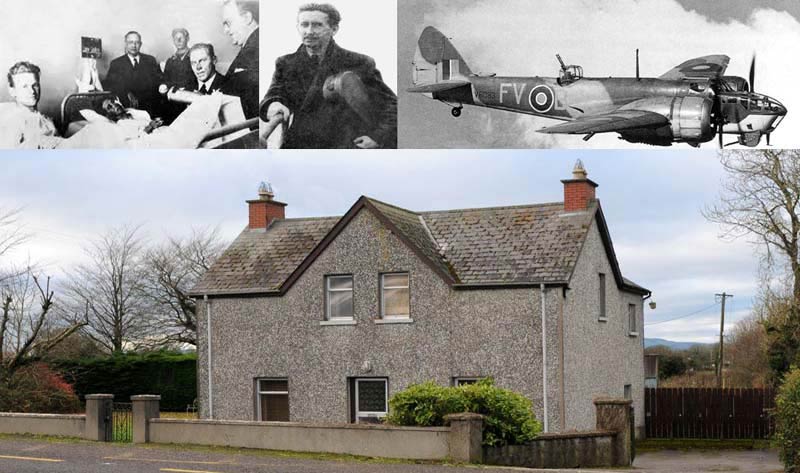
Pictures L-R (1) Laurence Slattery, Littleton Thurles, Co. Tipperary, pictured in a Berlin POW hospital bed. (Celtic studies expert & Nazi propaganda radio broadcaster Dr. Hans Hartmann is to be seen standing on the left of his bed). Picture (2) Rare picture of Laurence Slattery after WW II, with a violin case under his arm. Picture (3) A Bristol Blenheim IV, which Laurence Slattery navigated. Picture (4) Today, the once home of Laurence (Larry) Slattery, and his father Michael Slattery (a National School Teacher), situated in the townsland of Ballymoreen, Littleton, Thurles, Co. Tipperary.
The fighter version of the Blenheim IV aircraft normally carried four machine guns in the bomb bay, while the standard crew would comprise of a pilot; a navigator/bomb-aimer; and a wireless operator/gunner. The navigator would sit in the nose of the aircraft at a plotting table, situated just below the port side of the canopy.
On September 4th 1939, just one day later, Laurence (Known locally by the shortened name of Larry) Slattery, a native of Littleton, Thurles, Co. Tipperary, took off on a Bristol Blenheim IV. His aircraft was later shot down over the sea at Wilhemshaven, west of Hamburg, latter a coastal town in Lower Saxony, Germany, while attempting to drop leaflets; as confirmed by Irish Military Archives.
The aircraft’s pilot, Willie Murphy, a native of Mitchelstown, Co Cork, died some days later from his injuries, whilst Larry Slattery survived, sustaining wounds which included a broken foot and a broken jaw, latter obtained when his face struck a machine gun-turret. The pilot, Murphy would become the first recorded British fatality of World War II, and Larry Slattery from Littleton village, would became the first British Prisoner of War (P.O.W.) to be captured by the Germans.
In Flanders Fields
(Poem by Canadian physician Major John McCrae)
In Flanders fields the poppies blow
Between the crosses, row on row
That mark our place; and in the sky
The larks, still bravely singing, fly
Scarce heard amid the guns below.
We are the Dead. Short days ago
We lived, felt dawn, saw sunset glow,
Loved and were loved, and now we lie
In Flanders fields.
Take up our quarrel with the foe:
To you from failing hands we throw
The torch; be yours to hold it high.
If ye break faith with us who die We shall not sleep, though poppies grow
In Flanders fields.
A Shamrock Poppy badge emblem, to recognises all the Irish soldiers who fought in World War I, has been commissioned to commemorate the 100th anniversary of the Great War, by the Irish branch of the Royal British Legion.
The emblem remembers the 206,000 Irishmen who took part in the fighting; 26,500 of whom, alas, lost their lives in various battles.
Proceeds from this newly commissioned Shamrock Poppy will go to Irish veterans and their families, with a segment retained to go towards the upkeep of memorials to Irish soldiers here in the Republic. Shamrock Poppies can be obtained from the Irish branch of the Royal British Legion.
The full story behind Poppy Sunday can be found HERE.
This commissioned emblem is symbolic of the greater recognition recently afforded in the Republic of Ireland, to the Irishmen who for various reasons chose to fight and die, serving as they did, in the British Army in World War 1, in the years prior to our independence.
The Irish Government previously broke with convention, by attending a Remembrance Day Sunday service in Northern Ireland at Enniskillen, Co. Fermanagh; laying a plain laurel wreath at the town’s war memorial back in 2012, and have done so for every year since then.
This year a representative of the Irish Republic is also expected to attend a service in Enniskillen on next Sunday, November 11th, as the local community marks the 30th anniversary of the notorious IRA Poppy Day bombing in the town, back on that dreadful day on November 8th, 1987.
The Enniskillen IRA Poppy Day bombing, totally disgraced and dishonoured IRA membership to it’s very foundation; this action leading to the spurring of fresh efforts by concerned Irish nationalists, towards finding an agreed political solution to what had now become a cowardly and repulsive bloody conflict.
Some 100 images from around Co. Tipperary, including images from Thurles and Holycross, have now been uploaded to the recently launched and redesigned Dúchas (Translated into English meaning ‘Heritage’) Website. These images can be viewed and indeed downloaded from HERE.
Date: 1945. House Location: Thurles, Co. Tipperary. Photograph: Courtesy Caoimhín Ó Danachair. So who is the woman hiding behind the pillar to the left of the dwelling and where was the house once locally situated? Do you recognize it? We would love to know.
This digitized version of the National Folklore Photographic Collection was launched at the National Library by the Minister of State with responsibility for Gaeilge, Gaeltacht and the Islands, Mr Joe McHugh.
This photographic collection remains the latest supplementary source to be uploaded to the Dúchas website, where, in all some 10,000 photographs having been digitized, catalogued and now made available to the Irish people and the Irish diaspora.
Possibly the largest number of the photographs featured, date from the early 20th century, taken by professional photographers and those working with the National Folklore Commission, and others.
Current surfers of the Dúchas website can be tracked to locations in the USA, Australia, Canada, and the British Isles, most anxious to trace and research local history and native folklore provided, from almost every parish in Ireland.
This website uses cookies to improve your experience. We'll assume you're ok with this, but you can opt-out if you wish.AcceptRead More
Privacy & Cookies Policy
Privacy Overview
This website uses cookies to improve your experience while you navigate through the website. Out of these, the cookies that are categorized as necessary are stored on your browser as they are essential for the working of basic functionalities of the website. We also use third-party cookies that help us analyze and understand how you use this website. These cookies will be stored in your browser only with your consent. You also have the option to opt-out of these cookies. But opting out of some of these cookies may affect your browsing experience.
Necessary cookies are absolutely essential for the website to function properly. This category only includes cookies that ensures basic functionalities and security features of the website. These cookies do not store any personal information.
Any cookies that may not be particularly necessary for the website to function and is used specifically to collect user personal data via analytics, ads, other embedded contents are termed as non-necessary cookies. It is mandatory to procure user consent prior to running these cookies on your website.
 In Flanders Fields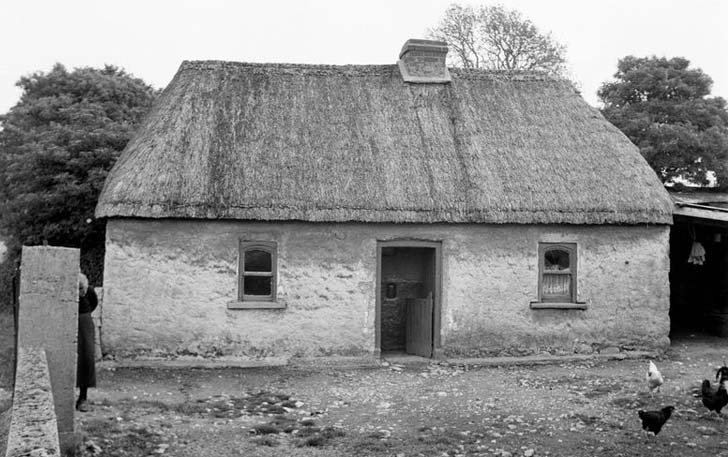





Recent Comments