New premises to which An Post is expected to set up shop.
The ‘Stop the Move – Save our Square’ action committee here in Thurles have announced their intention to hold a public rally; same to take place on Friday morning, March 29th next.
The rally will start at 11.00am on Friday morning; with protesters first assembling in the area of the Parnell Street Car Park. Those attending will then make their way out onto Liberty Square, following a route around the Square, before halting outside the current An Post offices.
An Post has repeatedly proclaimed their now existing work premises in Liberty Square as not being ‘fit for purpose’ and also that it would not be financially cost effective to undertake any necessary renovation.
An Post representatives also informed the ‘Stop the Move – Save our Square’ action committee, on Wednesday last, at what was described by the latter as “a disappointing meeting”, that a lease agreement had already been signed to rent their new premises; same having been already selected 500 metres away in the Thurles shopping centre.
The organisers are encouraging as many people as possible to come out in force for this rally, thus sending a message to An Post officials that remaining businesses wish the An Post office to remain at its present location, attracting continued footfall in the town centre area.
A post of Minister for Posts and Telegraphs initially took on the responsibility for Ireland’s postal and telecommunications services for some 60 years, from 1924 right up until 1984. One of the largest civil service departments in the Irish State at its apex; attempts to reform this sector were began in 1978, with the creation of a Posts and Telegraphs Review Group.
Following the delivery of a report from the latter in 1979, same then led to the creation of An Bord Poist, then chaired by Mr Feargal Quinn, and An Bord Telecom, then chaired by Mr Michael Smurfit. Both entities continued to trade until they were replaced in 1984, as state-sponsored agencies.
Its powers and responsibilities were transferred to the newly created Department of Communications. This was one of the largest reorganisations of the civil service in modern times, the old department having had a workforce of some 30,000 employees prior to its dissolution. With the transfer of personnel to the new agencies, the number of civil service employees were almost halved overnight.
Thus An Post, our Irish postal administration, first came into being in 1984 when, under the terms of the Postal & Telecommunications Services Act of 1983, the Post Office services of the Department of Posts and Telegraphs (P&T) were divided between An Post and Telecom Eireann; with the telecommunications operator today known as Eir.
Thurles Post Office moved once before, previously having existed on the south side or ‘Money Side’ in that building known today (2019) as The County Bar, before moving across the road to the north side; where it is presently located on the ‘Sunny Side’.
The positioning of Thurles Post Office during the latter half of the 1800’s, in the then Main Street of Thurles, now renamed Liberty Square.
It was at its present location that, in 1902, the great, late General Richard (Dick) Mulcahy joined the post office’s engineering department, working first here in Thurles. Elected to the First Dáil in the 1918 General Election for Dublin / Clontarf, Mulcahy was appointed Minister for Defence in the new (alternative) government and later to the post of Assistant Minister for Defence. In March 1919 he became IRA chief of staff, a position he held until January 1922. It was he, who together with Michael Collins, was instrumental in developing IRA military strategy against the British, during the War of Independence. General Richard Mulcahy of course was buried following his death (16th December 1971) in Ballymoreen Cemetery, Littleton, Thurles, Co. Tipperary.
Well-known Irish painter, Richard Thomas Moynan (27th April 1856-10th April 1906) was born in Dublin at No.1 Eldon Terrace, off the South Circular Road. He was the fourth of eight children; three sons and five daughters, born to Mr Richard Moynan (Sr.) and his wife Harriet (nee Nobel and daughter of Arthur Nobel, a Church of Ireland clergyman). The father of Richard Moynan (Jr.) held a managerial position with the fabric importers Ferrier, Pollock and Company, who had registered offices at No. 59 William Street, Dublin 2.
Richard Moynan (Jr.) initially studied medicine; however, his artistic instincts would prove to be too strong to be resisted and shortly before his final medical examinations, he decided instead to commence his training in the arts, at the Dublin Metropolitan School of Art, in January 1880.
Somewhat older than his fellow students and perhaps better educated; Richard Moynan was soon winning prizes in the Taylor and Cowper competitions. [The Taylor Art Trust was formed in 1878 in response to the will of Captain George Archibald Taylor, latter who died in 1854 leaving £2,000 for the “the promotion of art and industry in Ireland”.]
In 1882 he moved on to the Royal Hibernian Academy, winning both silver and bronze medals for his talents and in the following year, 1883, achieved the Albert Scholarship for the best picture shown at the Royal Hibernian Academy by any student. This painting entitled “The Last of the 24th at Isandula” (RHA, 1883), portrayed an imaginary episode in the Zulu wars fought in 1879 between the British Empire and the Zulu Kingdom.
The Chairman of the Oireachtas Committee on Health, Dr. Michael Harty; latter an Independent TD for the County of Clare, has stated he will support a vote of ‘No Confidence’ in respect of Fine Gael Wicklow politician and Minister for Health, Mr Simon Harris.
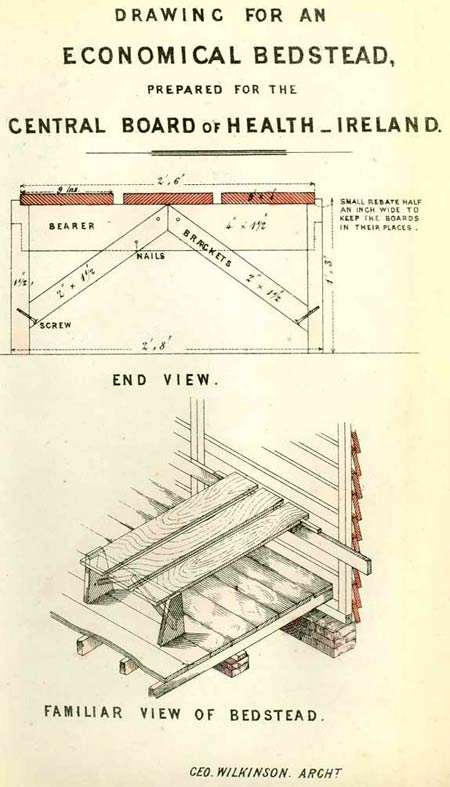
Infirmary bedstead designed by architect George Wilkinson in 1847, for the Thurles Workhouse.
The ‘No Confidence’, motion in Mr Harris has been proposed by Sinn Fein, following a number of failures in the department, under the governance of Mr Harris, which came fully to a head in recent weeks; most notably the Cervical Cancer scandal and the apparent significant cost overruns cover-up with regards to the construction of the National Children’s Hospital; latter funding for which has now caused delays in promised funding for Limerick University Hospital; same the most overcrowded medical facility in Ireland, servicing North Tipperary.
An angry and disappointed Dr. Harty, summed up his overall feelings describing the decision as; “Shocking news”; “An abysmal failure by government”; A dysfunctional health system spiralling out of control; further stated; “It is an indictment of both the Government, the Minister for Health and in particular Fine Gael TD’s in Clare and Limerick, who have failed to ensure that University Hospital Limerick is a properly functioning 21st century health care facility.”
New would-be Tipperary Fine Gael hopefuls, who sit with their tongues hanging out, in the hope of collecting large salaries and pensions into the future; e.g. Mrs Mary Newman Julian(MaryforTipperary who has set up a promotional stall in Liberty Square, Thurles) and Mr Garret Ahern, would do well to take note.
Dr Harty had previously indicated that he would abstain on the vote of ‘No Confidence’ in Minister Harris, to ensure the government did not fall in the run up to ‘Brexit’. However, the TD now says he has “lost trust in this Minister and this government”.
Interest Note: The now demolished old Thurles Workhouse was erected in 1841-2 on a 6.5-acre site, on the east side of New Street (now Racecourse Road).[For younger readers, same in later years became known as the Hospital of the Assumption].
Erected by architect Mr George Wilkinson, at the request of the then Poor Law Commission, the completed building, designed to accommodate 700 inmates, was based on one of his standard declared building plans for such building, and deemed fit for the reception of all local paupers on 25th April 1842.
Mr Wilkinson’s design for beds in the Thurles Workhouse infirmary and fever hospital in 1847, declared that they should be a minimum of 18 inches(45.72 centimetres), distant between each bed, (Remember the year was 1847).
In 2019, 172 years later, the distance between trolleys on corridors at Limerick University Hospital, are often less than 4 inches(10.16 centimetres) apart, as busy medical staff attempt to treat all attending patients, to the very best of their ability, leaving very little space for themselves to distribute their great and necessary skills.
Apart from our present government doing their very utmost to eradicate people living in rural Ireland, it is also obvious that when it comes to health, the people of North Tipperary are destined to remain in the dark and distant past.
Historians of the future will most surely ponder as to why a supposedly well educated people, residents of North Tipperary, failed to rebel, thus allowing this present calamitous and catastrophic health scenario to transpire.
Certainly one of the top five sought-after private estates in Ireland presently; positioned on the banks of the River Clodagh, close to Thurles, Co. Tipperary, is currently being offered for sale.
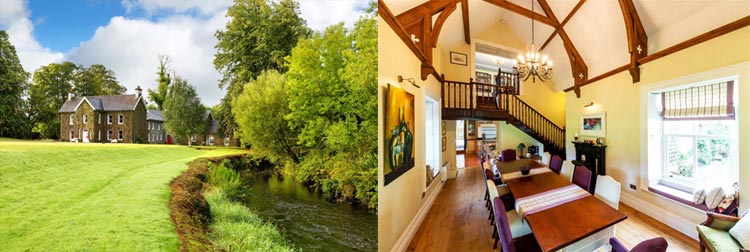
The fully restored Moyaliffe House Estate, at Ballycahill, Thurles; situated on 4.85 hectares (some 12 acres)comes on the market with an initial price tag of €850,000.
Moyaliffe Castle was to became the home of the Armstrong family circa 1695, when Thomas Armstrong (1671-1741) purchased the townland and the ruins of a tower-house which had been built here, by the Butler family in the early fourteenth century. Thomas was the younger son of Captain William Armstrong of nearby Farney Castle who had come to Ireland to fight for the royalist cause in the Irish Confederate Wars.
The Armstrong family were originally of Scottish origin and are said to have derived their name during the Battle of the Standard(22nd August 1138), when a warrior of the Armstrong clan lifted a fallen King David I (Dauíd mac Maíl Choluim) back onto his horse by using just one arm. The family motto, “Vi et armis invictus maneo”(Translation – ‘By force and arms I remain unvanquished’), truly reflects the warlike nature of this then famous clan.
The Armstrongs held on to the Moyaliffe Estate more than three hundred years, from 1695, until 1999, during which time, despite the property remaining vacant for many years, they kept the house in reasonable repair. The property was then purchased by Mr John & Mrs Breda Stakelum and their daughters Laura & Ashling, [Stakelum’s Hardware Retail Park, Nenagh Road, Thurles]. Their timely purchase now ensured a full, extremely sensitive restoration of this estate, ensuring the retention of Georgian symmetry; Victorian charm; down to the two-person, hidden, secret compartment for females, complete with water supply, being retained within the main house structure.
The Armstrong family were extremely sensitive and considerate landlords down through the years, offering considerable employment and feeding the local poor during the Great Famine, 1845-1849. One of the family, John Armstrong died from a fever contracted while working to support the poor during this period. During the period immediately prior to Ireland gaining its Independence; while many of the estate houses of Protestant landlords were burnt to the ground; Moyaliffe House was actually guarded by Irish Republican Army (IRA) members, who operated locally.
Moyaliffe House Grounds
The 4.85 hectaress (12 acres) grounds at Moyaliffe include landscaped gardens with mature trees; the site ruins of the original Butler tower-house; a walled garden; and a rare long Gallipoli beech tree walk, running close to the banks of the trout filled River Clodagh, latter which runs through the property; and all of which offers truly exceptional peace and privacy to the occupier.
A sheltered, sunny inner patio leads off the now modernised Victorian kitchen, while another extends from the drawing room / library, French windows, giving a marvellous view from both the inside looking out and outside looking in house.
Situated in the heart of some of Tipperary’s picturesque countryside; these private grounds offer leisure amenities, including pleasant walkways, and a hard-court tennis court. There are also Victorian outhouses in a separate coach yard, an arrangement which could suit either dedicated equestrians, or others, with an eye for renovation and redevelopment.
You can get further information regarding this most historic of properties and the Armstrong family, who once owned it HERE.
The Environment unit of the Irish conservation charity, An Taisce, has recently updated and published their directory of Ireland’s most at-risk buildings. One such structure added to their list, is located here in our own County of Tipperary.
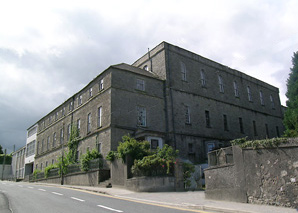
The latest Tipperary building listed is the once Sacred Heart Secondary School, situated at Parkmore, Roscrea, Co. Tipperary, which currently sports unsightly, boarded-up windows on its road side, displaying all the future promise of total dereliction.
Originally constructed about 1865, this still solid stone, large-scale structure is one of a number of interesting buildings within a former school complex.
According to the National Inventory of Architectural Heritage same, until more recent years, once added variety of form and texture to the local street scape. Its imposing façade is further enlivened by well executed features; e.g. the stone string courses, and the fine porch with steps.
An Taisce warns that the named buildings all of national importance could be lost to future generations if action is not immediately taken, and further point out that some of the named listed structures could be restored to provide affordable housing.
“Given the critical homeless situation in the country, some of these heritage buildings could be restored to provide affordable housing for families and individuals.” An Taisce stated.
An Taisce confirm that a number of buildings on their list are in such disrepair, that they may now be dangerous or unusable.
This website uses cookies to improve your experience. We'll assume you're ok with this, but you can opt-out if you wish.AcceptRead More
Privacy & Cookies Policy
Privacy Overview
This website uses cookies to improve your experience while you navigate through the website. Out of these, the cookies that are categorized as necessary are stored on your browser as they are essential for the working of basic functionalities of the website. We also use third-party cookies that help us analyze and understand how you use this website. These cookies will be stored in your browser only with your consent. You also have the option to opt-out of these cookies. But opting out of some of these cookies may affect your browsing experience.
Necessary cookies are absolutely essential for the website to function properly. This category only includes cookies that ensures basic functionalities and security features of the website. These cookies do not store any personal information.
Any cookies that may not be particularly necessary for the website to function and is used specifically to collect user personal data via analytics, ads, other embedded contents are termed as non-necessary cookies. It is mandatory to procure user consent prior to running these cookies on your website.







Recent Comments