Tipperary marked the centenary of Bloody Sunday with a truly excellent performance at Páirc Uí Chaoimh today, seeing off Cork to win the Munster Senior Football Championship (SFC) ending their 85 year drought; last achieved back in 1935.
Today November 22nd, from the 16th minute of commencement Tipperary were on top and despite Cork’s efforts remained there throughout the rest of the game, with Conor Sweeney (0-07, 0-02f, 0-02m) and Michael Quinlivan (0-05, 0-01f) jointly providing 12 points between them, ably assisted by Evan Comerford (0-01 45), Kevin Fahey (0-01), Liam Casey (0-01m) substitute Philip Austin (0-01) and Steven O’Brien (0-01).
Representing Tipperary today were: Evan Comerford; Jimmy Feehan; Alan Campbell; Colm O’Shaughnessy; Bill Maher; Kevin Fahey; Robbie Kiely; Liam Casey; Colin O’Riordan; Brian Fox; Conal Kennedy; Steven O’Brien; Conor Sweene; Colman Kennedy; Michael Quinlivan.
Subs: Liam Boland replacing Kennedy, Paudie Feehan for Fahey, Emmet Moloney for Fox, Pádraic Looram for Kiely and Philip Austin for Casey.
Final score at close of play today, Tipperary 0-17, Cork 0-14.
Today, Tipperary were wearing the white and green banded jerseys of Grangemockler, as their county had done on that fateful afternoon back in 1920, when thousands of football fans were assembled in Croke Park, to watch a challenge match between two of the game’s giants, Co. Tipperary and Co. Dublin.
Troops from the Duke of Wellington’s regiment, together with 2 police units, one of undisciplined Black and Tans and one of Auxiliaries, deploying into Croke Park, before Black and Tans began opening fire on the assembled gathering, discharging was over one hundred rounds of rifle fire, and an unknown number of pistol rounds.
The Tipperary team, which had assembled at Croke Park, on November 21st 1920.
All the shots were fired indiscriminately by the Black and Tans before control was regained by Major Edward Mills (latter Commander of the Auxiliary force). Major Mills would later report to his immediate superior, Brigadier-General Frank Crozier, stating “A rotten show, the worst I’ve ever seen.” Following the aftermath of the firing, there were dead and injured civilians, both players and spectators, strewn across the field, 14 of whom would never see home alive again. The true number of injured has never been agreed upon, but is suggested possibly somewhere between sixty and one hundred. Despite searches undertaken on that November afternoon, on every person still within Croke Park, not one weapon was ever located.
Left to Right: – Picture (A) Tipperary & Dublin Jerseys. Picture (B) Michael Hogan. Picture (C) Rear of Tipperary Jersey worn on that day in 1920.
Tipperary Gaelic Athletic Association (GAA) have confirmed that its county footballers will wear a replica jersey of that which was worn by the Premier county players on ‘Bloody Sunday’, when they take on Cork in the Munster final officially set for November 22nd 2020.
This decision was taken initially and announced by Tipperary GAA at a press conference in Semple Stadium, Thurles, Co. Tipperary, on February 22nd 2020, as part of the counties Bloody Sunday Commemoration Day. Croke Park has recently approved this jersey as the first official Tipperary Bloody Sunday replica, which will feature an image of Tipperary Football player Michael Hogan on the sleeve, along with the official Co. Tipperary and GAA crests.
Michael Hogan Michael Hogan (Irish – Mícheál Ó hÓgáin), from Grangemockler, South Co. Tipperary, had been chosen to take part in a challenge match between Tipperary and Dublin on November 21st, 1920, and was one of 14 people killed by British military forces in Croke Park, Dublin.
The 2020 Munster Senior Football final will take place this year on Sunday November 22nd 2020; a day after the 100th anniversary of those who sadly were shot during the match, by “Black and Tans” who entered Croke Park and opened fire on the crowd.
On the Saturday prior to match day, November 20th 1920, Michael Hogan had travelled on the train to Dublin with some other members of his team. He and others got involved in a fight with soldiers from the Lincolnshire Regiment, before throwing them from the train.
Having arrived at Kingsbridge Station Dublin (Now renamed Heustan Station), they decided to split up going their separate ways in anticipation of possibly being arrested. Michael and another man, named as Thomas Ryan, both IRA team members, stayed at Philip Shanahan’s pub in Monto (Montgomery Street, latter then the largest red light district in Europe at the time), on that night, rather than staying in Barry’s Hotel as had been planned. Here both men became aware that some IRA action being planned, but were unaware of any of the actual details.
It was during this challenge match, in front of a crowd of some 15,000 people that Black and Tans entered Croke Park and opened fire. Michael Hogan was one of 14 people who sadly lost their lives. Also among the thirteen other victims were fourteen-year-old John Scott and eleven-year-old William Robinson, latter shot while sitting in a tree watching the game.
Today, the Hogan Stand within Croke Park; latter built in 1924, is named after the Co. Tipperary player Michael Hogan.
In a recent post entitled, “Ní neart go cur le chéile. – No strength without unity”, (View Here), we shared a directory of links to local businesses who promote an online presence.
Today we place ‘the spotlight’ firmly on one such successful Thurles business that has cared for Thurles and Co. Tipperary customers, for 3 generations.
Frank Roche & Sons Since its establishment in 1960, Frank Roche & Sons has evolved and expanded to sell a diverse and comprehensive range of products including wallpapers, paints and decorative accessories, housewares, china, glass, giftware, domestic appliances and so much more.
Do check out the video hereunder, which showcases just some of the brands and products, available to purchase for loved ones this Christmas.
If you can’t decide what exactly to purchase for that ‘someone special’, do contact Frank Roche & Sons to arrange a Voucher, allowing for your loved one to easily find a gift to treasure always.
Early History of the Building Housing the Premises Operating as Frank Roche & Sons, No 57, Liberty Square, Thurles, Co. Tipperary.
In 1846 the building at No 57, Main Street Thurles (Now Liberty Square, Thurles) was a Warehouse owned by Thomas Moloney, the rear of which was easily accessed by Cooke’s Lane [Latter situated immediately to the right, as you stand facing the current attractive shop front] The lane was named after Archibald Cook, himself in 1846 trading next door as a Sadlier and Grocer and now occupied today by a Turkish Barbers Shop. Cooke’s Lane also gave access to a pawn shop and a forge at the rear of the featured premises.
In 1846 Mr C. Duan resided to the left of Roche’s and same premises traded as a Bakery and Toy Store. This latter premises would later become Thurles Post Office occupied by An Post until September 2019, before moving to Thurles Shopping Centre, some 500 metre south of Liberty Square.
Former occupiers prior to Frank Roche& Sons.
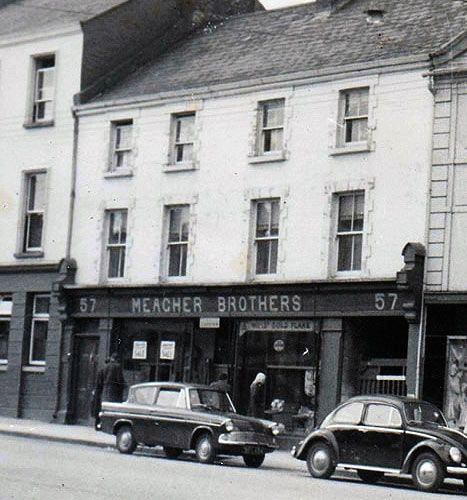
The building would next be acquired by Meagher Brothers who sold clothing from the premises.
Frank Roche Snr. fulfilled a long held ambition, when he opened his own business, having previously worked in Molloy’s hardware shop, (Just a few doors further up the street, currently today occupied by AIB Bank), for over 35 years. Himself a native of Skibbereen, Co. Cork, Frank Snr. had served his apprenticeship in Kelleher’s Hardware in Skibbereen, before moving to Thurles in 1925. He had been chief buyer for Molloy’s for many years, when his eldest son Allen joined him as a staff member and served his own apprenticeship there.
Frank Roche Snr. had met his wife Maisie Mullaney from Cathedral Street Thurles, before getting married in 1936. They raised a family of six children, with Allen, Frank Jr. and Mary continuing to work in the business.
From small beginnings the company grew under the careful stewardship of Frank Snr. who set about securing agencies for iconic brands such as Waterford Glass, Belleek China, Wedgewood, Royal Doulton, Ladro and Hummel, making them available to the people of Thurles and its hinterland. Home decorating became a key part of their business with brands such as Crown, Colortrend, Sadolin and Farrow & Ball.
Members of the third generation of the Roche family now work in the company, ensuring continuity of the business in providing their iconic brand products to not just the people of Thurles and Co. Tipperary, but also to any address within the islands of Great Britain and Ireland.
The Unanswered Question: “Will the planned Thurles inner relief road impinge, in a negative way, on the 1846 Thurles “Double Ditch”, which has been a right of way and a Mass Path for almost 175 years and which is the property of the people of Thurles and a national monument?
The Double Ditch Exists
My articles over the last number of weeks have tried to erase any doubt as to the actual existence of a ‘Double Ditch’, at Mill Road, Thurles, Co. Tipperary; thus correcting the nonsense statement by Ms Janice Gardiner (Acting District Manager, Thurles, Municipal District) that, quote, “Tipperary County Council has reviewed all documentation relating to the planning aspects of the Thurles Inner Relief Road Project and can find no reference to the existence of the feature/path/monument you describe.”
It is my firm belief that no review ever took place and this reply, in combination with the ongoing silence from elected Councillors, elected Tipperary Politicians and Council Officials on the matter, has done little to reassure myself and others who care about our town that the “Double Ditch” is safe from destruction. Surely it is reasonable to assume that if the answer to the question asked is not NO, then it must be YES?
Furthermore, same previous articles published were and continue to be aimed solely at sounding alarm bells, ensuring that a piece of our rich Thurles heritage is not placed under serious threat; brought about through either genuine ignorance; wanton deliberate destruction; conplacency or greed, by TD’s we elected to protect our interests, namely Mr Jackie Cahill and Mr Michael Lowry.
The maps, aerial and ground videos, together with primary sources, which I have published and shared, following detailed research regarding this famine period, prove beyond doubt, the very existence of this “Double Ditch”, together with its origins and its massive historical significance.
To this end it must now be developed as an attraction, for what it is currently and for what it can be into the future; to the benefit of the local business community, through correctly marketed tourism and job creation.
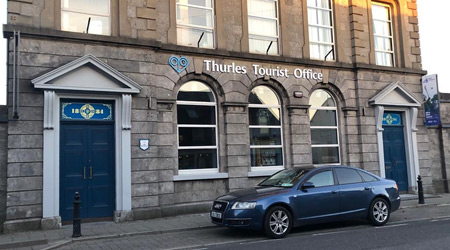
New Tourism Office: We now have a second new tourism office in Slievenamon Road, Thurles. We also have a new Thurles logo, “Halt Awhile”.
But, is this new Tourist Office in Thurles to be used to send our visitors to excellent attractions like Kilkenny castle; Trinity College Dublin; The Guinness Store House, Dublin; the Titanic Centre, Cobh, Co Cork etc. or are we going to try to develop already existing historical attractions within our own town and county?
Currently, all that exists in Thurles is what I call “Hobby Tourism“, with limited attractions unable to open on Saturdays or Sundays, or closed because a relative is “expecting a baby in July”. Indeed I led a walking tour group last year to a visitor centre here in the Thurles area, manned by a reluctant female guide who declared to the visiting group, “I hope ye won’t be long now, my mother is minding my baby”.
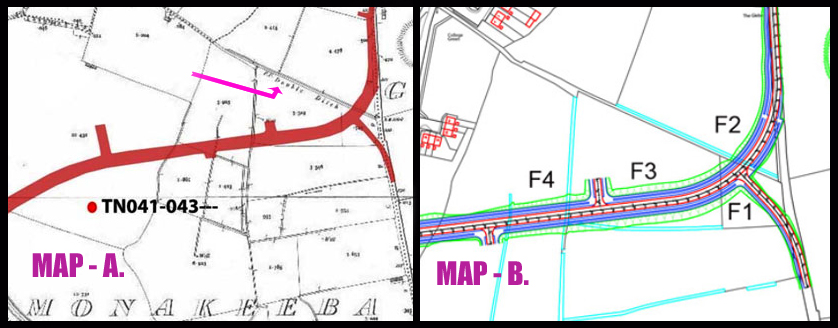
But enough of that; time to examine MAP-B shown above and contained in the Archaeological Impact Study on the inner relief road, undertaken by Mr Frank Coyne(BA MIAI, director of Aegis Archaeology), for client Mr Michael Devery, Road Design, (North Tipperary County Council, Civic Offices, Nenagh, Co. Tipperary.)
In MAP-B our interests are entirely focused on F1, F2, and F3(Shown above) described in the Archaeological Impact Study as quote: – “The subject site is a series of fields. For ease of reporting they were numbered in the direction in which they were walked, from east to west, and numbered F1 to F9.
Field 1 is a small field, covered in short grass and grazed by horses. Field 2 is a large open grassy field, covered in short grass and grazed by horses. Field 3 is a large open grassy field, covered in short grass and grazed by horses. It is very wet underfoot.
Spear Head & Sacrificial Axe Head. The afore mentioned Field 3, which is known as the “Well Field”, was where in 1996 the Monakeeba Bronze socketed spearhead was found, as stated in this same Impact Study.
The Monakeeba Bronze socketed spearhead together with the Monakeeba Stone Age Sacrificial Axe Head, latter found earlier, were both handed over to the National Museum by George Willoughby in 1996. [The Monakeeba Bronze socketed spearhead gets a mention in the Archaeological Impact Study, but for some reason the Stone Age Sacrificial Axe Head found on the Double Ditch was left out].
Please examine the fields again on the above map.
Field (1) bordering the south side of the Famine Double Ditch is small, containing a mere .745 acres. No photograph is taken to provide south to north landscape features, which incorporates the raised Double Ditch. Field (2) bordering the north side of the Famine Double Ditch contains 4.478 acres. No photograph identifies the raised Double Ditch. Field (3) Which contains 3.319 acres, “The Well field”; again no photograph taken to provided south to north landscape, which would incorporate the physical feature of this raised Double Ditch.
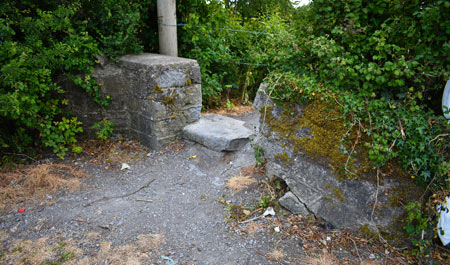
All photographs contained in the study were taken from an east to west prospective, so how did the road entrance to the ‘Double Ditch’ shown hereunder, sandwiched between field 1 and field 2 go unnoticed by Mr Coyne and remain unseen, even on road photographs provided in this same Archaeological Impact Study.
The Mill Road, Thurles looking west on the roadside entrance to the Double Ditch. Question; how despite being only 5ft (1.5 metres across) did this entrance, sandwiched between field 1 and field 2, get mysteriously ignored by Aegis Archaeology
Now go back to MAP-A above, again used in the survey and note the cartographers Ref. ‘F.P.Double Ditch‘. Then understand that the same Archaeological Impact Study contains an ‘Aerial View Image’ of that site, showing clearly the ‘Double Ditch’ using the website https://www.bing.com/
Again, as with MAP-A, while the ‘Double Ditch’ is clearly visible (both on the map and the ‘Aerial view Image’), its existence on the landscape has been totally disregarded by the ArchaeologicalImpact Study. Mr Coyne should now be recalled to re-examine his Impact Study.
Silence from Councillors, Politicians and Council Officials.
One thing has been learned from all of this; none of our elected representatives, sad to say, have any interest in promoting Mid-Tipperary tourism, except in the glossy brochures produced every 5 years, one month prior to General Elections or indeed Local Elections.
The now long forgotten Tipperary half promoted marketing ploywhich yielded nothing! Pictured some years ago: (Left)Siobhan Ambrose[Former Council Chairperson FF]; (Centre)FormerEnterpriseMinisterMary Mitchell O’Connor (FG) and (Right)Mr Joe MacGrath[Current CE, Tipperary Co. Co.]
When I set out initially to explore what, if any, new impact developments in our town of Thurles could have upon aspects of our rich history, it was never my intention to anger any individual.
My aim was to ask three questions to reassure both myself and others that valuable aspects of our town’s heritage where not placed in danger of being lost or destroyed.
Two of my three questions were eventually and reluctantly answered. My third question, which related to the possible destruction of the ‘Double Ditch’, was not answered, despite repeated enquiries.
The closest thing to an answer came in the form of an official communication (aforementioned) that clearly skirted around the issue, by essentially stating that there was no record of the “Double Ditch” that I referred to in my question. The implication being that if there was no record, then there was no issue.
This reply, in combination with the ongoing silence from Councillors, politicians and officials on the matter, has done little to reassure myself and the Thurles electorate, that the Double Ditch will remain safe from total destruction.
Finally, it is my strong belief that Tipperary County Council, still intend to totally destroy this piece of valuable history, without the consent of the people of Thurles, thus depriving them of their heritage and a major future tourist attraction.
To be continued.
Part 3 of “Tipperary Co. Co. Intent On Destroying Thurles Heritage” will be published in the coming days.
10 New killer COVID-19 virus cases confirmed in Co. Tipperary
With nearly 8,000 new cases of Covid-19 having been confirmed in Ireland in the past two weeks, the Department of Health have confirmed this evening that there have been sadly 3 new deaths caused by the Covid-19 pandemic; leaving the overall death toll here in the Republic of Ireland remaining at 1,830.
However, there are 811 new additional cases reported today, leaving the current total number of confirmed cases, since conception in the Irish Republic, at 44,159.
Of this evening’s confirmed cases; 10 are in Tipperary(Overall total of 895); 90 in Dublin; 141 in Cork; 62 in Wexford; 51 in Kerry; 50 in Clare; with the remaining 307 cases located across all remaining counties.
Currently hospitalised are 234 Covid-19 patients of which 32 are in ICU’s.
There have been 863 new cases of coronavirus recorded in Northern Ireland and sadly 7 further death.
Total global cases this evening now stand at almost 38 million [37,965,809] with global deaths at almost 1.1 million [1,083,040].
Please do try to make an effort to stay safe by reducing social contacts; avoiding crowds; physically distancing; while wearing face coverings and washing your hands regularly.
This website uses cookies to improve your experience. We'll assume you're ok with this, but you can opt-out if you wish.AcceptRead More
Privacy & Cookies Policy
Privacy Overview
This website uses cookies to improve your experience while you navigate through the website. Out of these, the cookies that are categorized as necessary are stored on your browser as they are essential for the working of basic functionalities of the website. We also use third-party cookies that help us analyze and understand how you use this website. These cookies will be stored in your browser only with your consent. You also have the option to opt-out of these cookies. But opting out of some of these cookies may affect your browsing experience.
Necessary cookies are absolutely essential for the website to function properly. This category only includes cookies that ensures basic functionalities and security features of the website. These cookies do not store any personal information.
Any cookies that may not be particularly necessary for the website to function and is used specifically to collect user personal data via analytics, ads, other embedded contents are termed as non-necessary cookies. It is mandatory to procure user consent prior to running these cookies on your website.







Recent Comments