It happened 100 years ago on Monday evening June 23rd, 1919. Remember Ireland’s National Heritage Week 2019 begins August 17th – August 25th.
A centenary commemorative service will be held at 2.30pm on Saturday next, June 22nd 2019, in Passlands Cemetery, Monasterevin, Co Kildare. The service will be held at the graveside of District Inspector Michael Hunt, Royal Irish Constabulary, (55727 D.I., R.I.C.), killed while on duty in Thurles, Co. Tipperary one hundred years ago on Monday evening, June 23rd, 1919.
The Royal Irish Constabulary remained at the front line of the British government’s war against the IRA especially between 1919 and 1921. Policemen were targeted by the IRA while alone or sometimes when off duty. They were by far the highest number of crown force casualties, with more than 400 killed, almost double the number of army fatalities during the same period. The number of R.I.C. officers killed in Tipperary numbered 46 during the War of Independence; with the vast majority of them being Irishmen.
Some of those R.I.C. Officers killed in Tipperaryincluded:- Toomevara: Constable James Rocke aged 26 and Constable Charles Healy aged 25. Rearcross / Newport: Constable William Finn aged 22 and Constable Daniel McCarthy aged 27. Gooldscross / Clonoulty: Sergeant Patrick McDonnell Tipperary: RIC Constable Michael Horan, Constable Joseph Daly aged 20, Constable Thomas Gallivan aged 20, Head Constable Christopher Davis aged 41, and Constable William Cummings aged 25. Templemore: District Inspector William Harding Wilson. Mullinahone: Constable William Campbell. Ballylooby: District Inspector Gilbert Norman Potter aged 42. Cloughjordan: Constable John Cantlon and Constable William Walsh, Constable Martin Feeney and Constable James Briggs. Carrick-on-Suir: Constable Dennis Patrick O’Leary. Soloheadbeg: Constable James McDonnell aged 50 years and Constable Patrick O’Connell. Lorrha: Sergeant, Philip Brady Thurles: Constable Luke Finnegan and District Inspector Michael Hunt. Inch (The Ragg); Constable John Heany.
The then British Prime Minister David Lloyd George had emphasised that this same Irish conflict was for police to handle, supported by military personnel and not vice versa. It was logical therefore that members of the IRA should target armed police, in order to acquire necessary weapons.
This commemorative event on Saturday afternoon next will be followed by light refreshments; same to be served appropriately in a former R.I.C. Barracks, which today serves as the Monasterevin Local Community Centre.
District Inspector Michael Hunt
Born the son of a Co. Sligo father, Mr Martin Hunt, on September 3rd, 1873, Michael Hunt joined the Royal Irish Constabulary on January 2nd, 1893, serving in Co. Longford, Co. Kerry and later in Co. Tipperary.
He was married on May 16th, 1900, to Ms Kathleen Mary Bell, the daughter of Mr John Bell, Co. Kildare. They parented six children; with their eldest son, Michael John Hunt, going on to receive a commission in the Royal Irish Regiment; quickly to be promoted to the rank of Captain, before later joining the R.I.C. in his own right.
His younger sister Eva Hunt, aged 15 years, had passed away just seven months prior to her father’s murder. Buried in Thurles; her later erected small white marble headstone reads:- “In loving memory of Eva Hunt, daughter of the late Michael Hunt, (55727 D.I., R.I.C.) Thurles, died 27th Nov 1918, aged 15 years.”
It was on Monday June 23rd, 1919, one hundred years ago this coming week, that District Inspector (DI) Michael Hunt was murdered, as he carried out police duties during a Thurles Race meeting and while in the company of at least two other RIC officers.
Uniformed and walking near the top of Main Street, Thurles (Today renamed Liberty Square), at approximately 5.30pm in the evening, he was shot from the rear at very close range, the ammunition used – large calibre, blunt nosed revolver bullets.
Colleagues R.I.C officers Sergeant Joseph Grove and Constable Patrick Murphy, were both walking some yards ahead and on hearing the gun retorts, they rushed back to find Hunt’s prostrate form face down in the street, before lifting him to the safety of the footpath. Race goers and others, on witnessing the action, now in fear scattered in all directions, thus aiding his murderers to escape with ease into their midst.
Thurles doctor, Thomas Barry attended to District Inspector Hunt, however he was declared dead at the scene. His lifeless body was taken to the nearby home of a Mrs Scully. Further investigation showed that three shots had been fired, two of which achieved accuracy, with one shot severing two of the largest blood vessels in his body, directly causing him to bleed to death; while a third shot fired wounded a nearby child, named as Danny Maher, in the left kneecap. According to a local doctor’s statement to police, the injured 12-year-old boy was spotted soon after the initial mayhem had subsided. He was taken to the doctor’s house for treatment, before being allowed to go on his way.
At Monasterevin Railway Station, Hunt’s coffin was met by a party of constabulary colleagues together with his son, the aforementioned Captain Michael John Hunt (Royal Irish Regiment), latter who had journeyed from London to be in attendance.
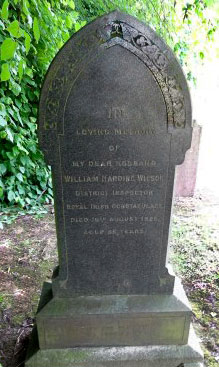
Grave of William Harding Wilson in Templemore.
The gun used in the murder had been brought to Thurles town from the area of Loughmore village; transported in a pony and trap and hidden under the clothing being worn by a baby. Some 20 soldiers with fixed bayonets were on duty at the race meeting and persons were being searched entering the town. At least two of the three shots were fired at close range, with the gun being fired through the pocket of an overcoat, possibly touching the District Inspector’s vertebrae.
Two days later at an inquest in Thurles, held on Wednesday, June 25th, 1919, it was revealed by witness Sergeant Joseph Grove, that a crowd had began to again collect around the dead man on the pavement. District Inspector William Harding Wilson asked if they offered assistance, to which the witness replied in the negative, further confirming that some of those who gathered were observed to be laughing and jeering.
The then Foreman of the Jury, after brief consultation with Jury members, stated that their majority verdict, was that Mr Hunt met his death in accordance with the reasons stated in the medical evidence put forward and that the bullet wounds were inflicted by a person or persons unknown.
District Inspector Wilson then enquired if the Jury did not confirm that it was “Wilful Murder”. The Foreman confirmed that the Jury were not unanimous. Inspector Wilson then declared that he couldn’t understand their hesitation regarding this case. In his opinion it was very clear that Mr Hunt had been shot twice in the back, in a position where he could not view his assailant. This to him was a case of wilful murder and he remained at a loss as to what other interpretation could be honestly construed.
Note: District Inspector William Harding Wilson would have a narrow escape himself in June 1920, when his head was grazed by bullets fired at an R.I.C. patrol, as they passed through the village of Templetouhy. On August 16th 1920 an IRA party was dispatched to Templemore to kill Wilson. At 6.45pm as Wilson was about to enter Templemore post office, he was shot once in the head from an adjoining lane way.
The epitaph on his headstone reads “In loving memory of my dear husband William Harding Wilson, District Inspector Royal Irish Constabulary. Died 16th August 1920 aged 56 years. His life for his country, his soul to God”
District Inspector Hunt was buried with full military honours, with his coffin covered in the Union Jack, in Passlands Cemetery, Monasterevin, Co. Kildare on June 26th, 1919. He was interred in the family burial plot of his wife, (nee Bell). Shots were fired over his grave.
On September 9th, of the same year, Hunt was posthumously awarded £5 for excellent police duty in connection with the successful suppression of a Sinn Fein meeting on Sunday May 25th, 1919 in Co Tipperary, latter which resulted in the arrest of the Sinn Fein MP for North Monaghan, Ernest Blythe.
Blythe was found to be in possession of an incriminating document, latter which contained instructions on how to intimidate police through terrorizing their known associates and next of kin. Blythe was convicted by a court-martial in Dublin and sentenced to 12 months imprisonment.
A Tipperary Court awarded £5,800 to the widow of Hunt, latter who had initiated a compensation claim amounting to £12,000. She successfully appealed against the sum awarded and at the Four Courts, Dublin, in March 1920 his widow and their full siblings were awarded £7,800 in final compensation.
Two first cousins Jim and Tommy Stapleton from Finnahy, Upperchurch and Jim Murphy (Latter known as “The Jennett”), from Curreeney, Kilcommon, would later be named as responsible for the killing of R.I.C. District Inspector Michael Hunt; named in a statement made by James Leahy, Commandant No.2 Irish Republican Army (I.R.A.)(Mid) Tipp-Brigade.
Jim Stapleton was also named for the aforementioned killing of District Inspector William Harding Wilson outside Templemore post office.
Unlike other military or civilian cataclysms, to date here in Ireland no single memorial now exists to remember all R.I.C. officers, latter killed in the line of what they saw as their duty. Perhaps Tipperary could now rectify this situation, thus allowing those, mostly young Irishmen who lost their lives, to be remembered by their relatives and indeed the public in general.
“History is who we are and why we are the way we are” – Quote by David McCullough
Here on thurles.info we raised the issue of required entry road signage for Thurles back in July 2018, and again on March 21st, 2019. The current signage into our Cathedral Town remains 12 years outdated, outworn, archaic and a source of shameful embarrassment to local business and residents.
On April 3rd, 2019, we again wrote about this signage. Amazingly and just prior to our recent local Municipal District election, new approach road sinage for Thurles was, shall we say, “conveniently mooted”.
The four key strengths of the town which were identified were:- Arts & Culture, Business, Sport and Education.
According to the Minutes of our Municipal District, dated March 27th last, the four key strengths of Thurles, identified above, were recognised following public consultation. How come town residents, missed this public consultation invitation? Did any member of our electorate get an invitation? In the case of secretarial error, will these minutes be now fully corrected? After all (See picture (4) above) Tipperary Co. Council are committed to :- “AG OBAIR LEIS AN BPOBAL” – “WORKING WITH THE COMMUNITY“.
Suggested New Thurles entry road signage
We here on Thurles.Info noted, with disappointment, that while Thurles is more often referred to as the “Cathedral Town”, no Cathedral building appears to feature in any of these hastily prepared proposals, that we have so far previewed.
Where is that “Identified Strength” known as ‘Thurles History’ recognised?
“A people without the knowledge of their past history, origin and culture is like a tree without roots”. Quote by Marcus Garvey
Thurles Chamber of Commerce take note:- From purely a local economic prospective; Thurles Cathedral possibly brings more footfall to our Thurles town centre, than even the Gaelic Athletic Association (GAA); attracting people through their daily Mass, Funerals, Weddings, Communions, Confirmations etc. Unless I am gravely mistaken, Thurles Cathedral will never be driven out by Tipperary Co. Council’s crippling parking charges, to move to the freedom generated by Thurles Shopping Centre, unlike so many of our other fine town centre businesses.
Arts & Culture; are they really a local strength or simply consist of a theatre and exhibition space, built with taxpayers money, to be controlled, once again, to provide financial benefit to Tipperary Co. Council. For the most part our Arts & Culture strengths locally consist of inviting lesser talented Dublin based theatre companies, to rent our ‘The Source’ theatre space, before racing back to Dublin, clutching tightly our €25 Euro per head ticket charge.
Our history, on the other hand, is a real strength and by not identifying same with intense pride, we greatly disrespect and gravely slight those who have gone before, latter having achieved so much on behalf of this present, often ingrate, generation.
According to Minutes published, it was agreed that this signage would be erected on the N75 (Dublin Road), N62 (Templemore Road), N62 (Slievenamon Road) and the R498 (Nenagh Road, Thurles). The time frame for completion of the signage is dependent on the selection of an agreed design.
There were, it appears, some conflicting views expressed on the imagery being used on this proposed signage and it was therefore unanimously agreed that a separate meeting should be convened on Tuesday 2nd. April, 2019 at 5:00pm to finalise the design. Any decisions agreed at that same meeting once again remain withheld from the ears of the great unwashed electorate.
In our most recent local Municipal district elections we, the electorate, voted for “more of the same”, and it was therefore with some further disenchantment, not to mention cynicism, that I listened to a radio pod-cast, featuring the newly elected Cathaoirleach (Chairperson) of Tipperary County Council, Mr Michael Murphy (Fine Gael), speaking on what was to be “high on his agenda”, over the next 12 months. Mr Murphy appeared to be solely focusing on projects in his home town of Clonmel. May we take this opportunity to remind Mr Murphy that he was elected as Cathaoirleach to serve all of Co. Tipperary, not just Clonmel.
Ireland’s National Heritage Week 2019 – August 17th – August 25th.
Over the coming weeks in preparation for Thurles National Heritage Week; Thurles.Info will attempt to highlight the massive national, historical importance and physical presence of Thurles Cathedral of the Assumption.
Forgetting briefly the everyday religious benefits obtained by Thurles and Tipperary people, not to mention that same religious spiritual advantage enjoyed by hundreds of visiting day-trippers down the centuries; it is important to again reveal the many untold stories relating to this iconic building, latter which symbolises a Cathedral Church, built to the glory of God; holding many now forgotten yet true stories.
“We learn from history that we don’t learn from history”. Quote by Bishop Desmond Mplio Tutu, latter South African Anglican cleric, theologian, awarded the 1984 Nobel Peace Prize.
New historical birth, marriage and death registers have now become available for the public to access online.
These records, available to view online HERE, without charge, will show:- *Births for the years 1917 and 1918. *Marriages which took place between 1864 / 1869, 1942 / 1943. *Deaths for the years 1878 through to 1968, adding 2 further years to previous online civil records.
As researchers will be aware back in 2016, more than 2.5 million historic records of deaths, marriages and births were made freely available online by the Irish Government. Ireland continues to lead the way in giving such access to historical genealogical information, by now adding 2 further years of historic records to those already available.
This latest release is part of an initiative to provide online access to historical records and registers, compiled by the Civil Registration Service.
As already stated, there is no financial charge for those wishing to access these records available to research in both Gaeilge and English.
“Things I Remember About My Father and Mother” was a published document written by Ms Charlotte L. Roberts, whose mother was Charlotte Knaggs-Roberts, latter originally from Thurles, in Co. Tipperary.
Charlotte L. Roberts writes fondly about her mother:-
“We walked to church and mother always went except when she had a small baby or someone was ill. Mother loved music but had never had an opportunity to learn to play. She sometimes played on a Jew’s Harp. Will Atkins, a brother-in-law, directed the church choir at the First Methodist Church. She sang in the choir whenever possible. Sunday evenings she could go because my father would stay home with Olive and me. He would hold me on his lap and sing many hymns – usually gospel hymns.
Mother was a very good cook and we always had plenty of good food. She made pickles of the little cucumbers; mustard pickle, red cabbage pickle which was kept in a big crock down cellar; string bean pickles and many kinds of jelly. She also made her own bread and pies and cakes. We had many family picnics, usually at the Trout Ponds.
Mother was always patient with her children. She was born in Thurles, Ireland. Her father and mother were staunch Protestants. There were, Jane, Annie, Sarah, and Charlotte and several sons: Tom, Jim, George, and I think,one other. There was an Anne Jane, two with the name Hannah, [one died as a baby], Elizabeth, Robert, and Benjamin.
They came to America in 1864 and stayed in New York City for a few years. At Duane Street, Methodist Church they met many young people. My mother married John Oliver Roberts. They lived in Ohio for a time where my father bought butter and eggs and shipped them to New York. Later he came to Smithboro and finally to Newark Valley (New York) where they spent the rest of their lives”.
Charlotte L. Roberts writes also about her father John Oliver Roberts:-
John Oliver Roberts 1848 was from Middleton. Co. Cork, was the son of John Oliver Roberts. We were always at church every Sunday. My father was treasurer of the Sunday School. Also, teacher of a men’s class. He knew the Bible well. I found books that had been given to him as awards for his Bible study. I believe Father was also on the Official Board. He always liked to have his family look nice and he himself, was very meticulous about his own appearance.
He was a wonderful gardener – no weeds in his garden. He raised all kinds of vegetables, so we had good food summer and winter. Apple trees in the back garden furnished fruit and jelly.
He was fond of games. On afternoons when he could get away from the store, he would go with Bert Livermore to the Trout Ponds to play croquet. They each had their own special mallet and ball. At home he liked to play Checkers and Crokinole, (Latter a dexterity board game similar to marbles, and shove ha’penny).
As children we had Parcheesi (Played with two dice), Dominos, Authors (Card Game), Devil Among the Tailors (Table skittles), Jack Straws (Game involving a bundle of “sticks”, between 8 and 20 centimetres long, which are dropped loosely in a bunch onto a table top, jumbled into a random pile), and Croquet. He enjoyed company and we had cousins from Jersey who used to visit us in the summer. One year 15 cousins had their pictures taken at our home, though all were not visiting us.
Father was born in Middleton, Co. Cork, Ireland. Roberts is a Welsh name, but I know nothing about his family, his ancestors. There was an Uncle Ben who lived in London. Father’s brother James lived in this country and all his later years were spent in Smithboro. There were two sisters who visited in New York, but there is no further information about them. My father came to this country when he was 18 years of age in 1865″.
James Knaggs, eldest son of Robert Knaggs, Archerstown Mills, Thurles, Co. Tipperary
Our brief research undertaken will first deal with Mr James Knaggs who through a Codicil in 1816 [Codicil being an additional formal legal document, added to a will, through which the Testator can make valid changes to their estate], obtained a lease from his father, latter Robert Knaggs (Surveyor of Excise), with an address at New Ross, Co. Wexford; of cabins including mills and a brewery on Littleton Road, Thurles, for 3 lives.
Mr James Knaggs married Ms Elizabeth Langford on February 11th, 1839 here in Thurles. They had 10 children – five daughters; Charlotte, Sarah, Anna Jane, Hannah Marie and Elizabeth, together with 5 sons; James, George, Robert, Benjamin and Thomas.
We are aware that Ms Ann Jane Knaggs, daughter of above named, Mr James & Elizabeth Knaggs, married Mr Sexton Roane, here in Thurles on June 29th 1860.
The Archerstown brewery and bakery, in 1846, was situated on the left side of the road, while the Archerstown water mill was situated on the right-hand side, as commuters travelled southwards from Thurles to Littleton via the Mill Road, latter formerly known as “Manor Mill Road”.
‘Poulaneigh’ is a pond in the townland of Galboola near Littleton. Same is the source or starting point of the Poulaneigh river. Joined by the river ‘Bréagagh’ same fed this 6-acre property of Archerstown mill, leased to Mr James Knaggs.
[Take time to halt and view the Ordnance Survey map, 6-inch to a mile, first edition, first surveyed 1840-1841, engraved in 1843, in the video shown above.]
‘Poulaneigh’ –(“Poll an eigh”) Irish translation “the pool of the horse”.‘Bréagagh’ – Irish adjective for “false, deceptive or lying”, from the noun ‘bréag’ meaning a lie.
Regrettably today, Archerstown Mill (later which later become Dan Brady’s Mill) no longer exists. All that remains today is a narrow section of the millrace that provided fast running water to the old mill wheel. The archway leading into the once Brewery yard, (also shown in the above video) stands situated across the roadway remaining today, somewhat in decline.
You can read more about Knaggs Mill, same later to be known as Dan Brady’s Mill, by clicking HERE.
As exists today; the Poulaneigh river then continues on, to be joined by the ‘Drish’ river, as a tributary, and then continues to the Manor Mills [The Manor Mills, today better known as Byrne’s Mills, are marked on the 1840’s map as the “old tuck mill” and the “old flour mill”] situated on the Mill Road side of today’s Drish Bridge [Marked on the map as the “Old Mills bridge”] near the entrance to Lady’s Well. The output or mill-race from the Manor Mills is still marked as the “Poulaneigh or Manor river” until it feeds into the Suir river, just beside ‘Lady’s Well’. The river Breagagh is marked as a tributary of the Poulaneigh river, joining it just after it has begun to flow out of Poulaneigh pond.
The Old Tuck Mill Reference
Cloth washing areas go back a long way. Old Testament Bible Quote: “Then the LORD said to Isaiah, “Take your son Shear-jashub and go out to meet King Ahaz. You will find him at the end of the aqueduct that feeds water into the upper pool, near the road leading to the field where cloth is washed”. [From Book of Isaiah: Chapter 7, Verse 3. Written in the 8th century before Christ (BC)]
The concept of ‘Tucking’, also known as ‘Fulling’, ‘Walking’ or ‘Waulking’; was a stage in the manufacture of woollen cloth, which in turn involved the cleansing of cloth (particularly wool), thus eliminating oils, dirt, and other impurities, and to make it thicker. The workers undertaking this work were known as ‘fullers’, ‘tuckers’, or ‘walkers’.
Tucking involves two processes: (1) Scouring and (2) Thickening; each carried out originally by the pounding of the woollen cloth with a club, or the tucker’s own feet or hands.
By the time of the Crusades; in the late eleventh century, ‘Fulling / Tucking Mills’ were active throughout the medieval world. From this medieval period, tucking was often carried out in a water mill, followed by the stretching of the cloth on large frames known as ‘tenters’, to which the ‘Tucking’ product is attached by hooks. [It is from here that the phrase“being on tenterhooks”is derived, usually meaning that one is being held in suspense.]
The second function of fulling (Thickening) was to thicken cloth by matting the fibres together thus giving it strength and increased waterproofing (known as felting). After this stage, water would then be used to rinse out any foul-smelling residue.
‘Tucking’ or ‘Fulling’ in Roman times was labour consigned usually to slaves who worked the cloth, while ankle deep in tubs of human urine. Stale urine, known as ‘Wash’, was a source of ammonium salts which assisted in cleansing and bleaching the cloth. It is understood that urine from the Thurles Workhouse (Hospital of the Assumption, Thurles) and from the wealthier houses was collected and used to bleach such cloth.
As already stated, marked on the 1840’s map, the Breagagh river finished where it flowed into the Poulaneigh river, latter which then continued on as the Poulaneigh river, to feed Archerstown [Brady’s] Mill first and having being joined by the Drish river; to feed Manor [Byrne’s] Mills.
Same river in turn would then also contribute to the running of the Turtulla Mill, same once existing close to the Meagher residence, better known today as Thurles Golf Club. In all 4 mills operated on this less than 1 kilometre stretch of water.
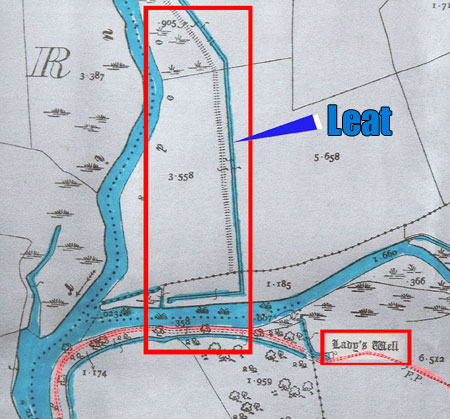
On the 1904 Ordinance Survey map a new feature or attribute appears in 1846, on the Thurles landscape – namely a Leat.
Leat (also spelt lete or leet) is the name for an artificial watercourse or aqueduct dug into the ground, especially one supplying water to a watermill or its mill pond. Here also we come across the welcome activity of yet another of the Knaggs Family; namely Robert Charles Knaggs [Medical Doctor (MD)], latter who resided where the Ulster Bank operates today, at no 49 Liberty Square, Thurles previously then known as Main Street Thurles.
Dr. Robert Charles Knaggs (MD) Main Street Thurles
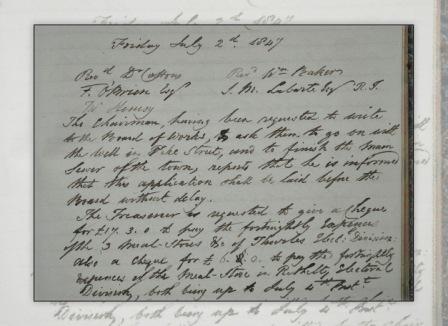
Monday April 20th, 1846 On Monday April 20th, 1846; according to the ‘Minutes of the Thurles / Rahealty Famine Food Committee’ [Minutes of Great Famine 1845 -1849]; members of same met with Rev. Henry Cotton (Chairman), Dr. O’Connor, Rev. Mr Barron (RC), Rev. Mr Baker, Rev. Mr Lanigan, Mr. Francis O’Brien (Treasurer), Dr. Robert Charles Knaggs and Mr J. B. Kennedy present.
We learn: “Dr R.C. Knaggs also reports – he having inspected the works to be done at Limekiln Lane, College Lane and the Double Ditch – calculated the expense of the works at College Lane at £20. Proposals from P. MGrath and Danl Carroll for barrows – ½ a doz ordered from MGrath at 9/- each. ½ doz from Carroll at 9/6 each. ½ doz also to be got from Dan Dwyer, (if he wishes to make them)”. (1.) Hours of labour for all employees to be from 7:00am to 7:00pm; minus 2 hours for meals. (2.) Any labourer found to shirk from reasonable and fair work or refusing to follow the directions of his overseer, shall forthwith be discharged and not admitted to the works again. (3.) That the persons employed shall be paid every evening. (4.) That in case a greater number of labourers shall offer themselves, than the funds will enable the committee to pay, a preference shall be given to those who have the largest and most necessitous families.
The ‘Double Ditch’ would act as a badly needed short cut / raised path to James Knaggs mill in Archerstown, beginning from College Lane, Kickham Street.
Later a ‘Leat’ would travel from the grounds of today’s St. Patrick’s College as far as ‘Lady’s Well’, before travelling under the Poulaneigh river, thus removing flood water from the Thurles river Suir end; draining it further downstream back into the River Suir once again. This ‘Leat’ remains visible to this very day.
17th Oct 1846 On October 17th, 1846 we also learn that:- “On discussion as to the appointment of an assistant secretary and providing the use of a room for a future sitting of the Committee; it was deemed advisable to do so and it was accordingly arranged with Dr. R.C. Knaggs to allow his parlour (in the now Ulster Bank building) to be continued to be used by them and that he should be appointed assistant secretary and paid a stipulated sum to be hereafter agreed upon, out of the sums of money granted by the Lord Lieutenant.”
Friday November 13th 1846. At the 3:00pm meeting on Friday November 13th 1846 we read:- “Dr. R.C. Knaggs states that a large number of men could be employed on making sewers through the town, if there was a quarry to be had. Venerable Archdeacon Dr. H. Cotton offers the use of a quarry on his land.”
Note: Here we have the first ever sewage system being built here in Thurles, making the then existing ‘Shit Wells’ / ‘Honey Wells’ positioned in the back lanes of the town, now redundant. Indeed, so well designed was this sewer system; that in more modern times pipes were, for the most part, laid directly into this same old sewer system, when it was being upgraded.
According to Griffith’s Valuation of Ireland, Dr. Robert C. Knaggs owned property at Pike Road (Today’s Kickham Street, Thurles), at Wrensborough, Thurles (Dublin Road), and at Monakeeba, Thurles.
Perhaps the existing Knaggs Clan around the world, might like to take a trip back here to Thurles, Co. Tipperary, in the not too distant future and we will be happy to walk you in the footsteps of your ancestors.
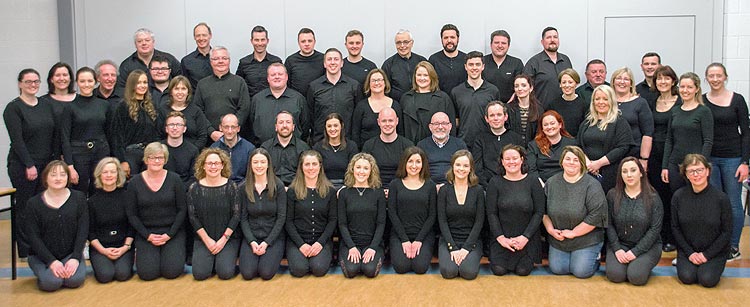
Thurles Muscial Society – Just some of the experienced Cast & Crew performing in the musical drama “Michael Collins”, all anxious to meet their audience for the first time on stage tonight, Tuesday 26/3/2019.
Even within the comparatively small community of Thurles Musical Society, the story of Michael Collins; the Treaty; the War of Independence and Eamon de Valera still resonates.
We could hardly have chosen a better year to stage a musical about his life and times given that the centenary of the Sologheadbeg incident, which kick- started the Irish War of Independence, commemorated just a few weeks ago just a few miles from our Cathedral Town.
The spotlight has certainly been cast upon the exigencies of those days, the fallout, the follow-up, the human tragedy and the loss of life, in a civil war which could be described as anything but civil.
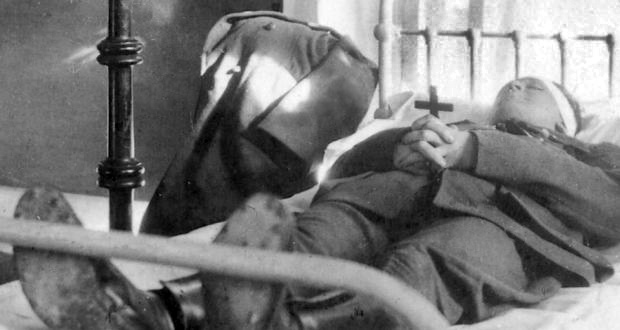
The bandaged body of Michael Collins with bloodied army jacket and Crucifix clasped in his fingers, before being prepared for final burial.
Michael Collins was out of the country at the time of the Sologheadbeg, Co. Tipperary incident, however his connections with Dan Breen, Sean Treacy, Seamus Robinson, Sean Hogan and the flying columns remained close. Many Tipperary freedom fighters were assigned duties in the capital when the heat was on back at home. A number took part in the killing of British intelligence agents in Dublin on November 21st 1920. Thirty-two people were killed or fatally wounded on that ‘Bloody Sunday’: thirteen British soldiers and police, sixteen Irish civilians, and three Irish republican prisoners.
The day began with an IRA operation, organised by Collins, to assassinate the ‘Cairo Gang’ – a team of undercover British intelligence agents working and living in Dublin. IRA members went to a number of addresses and killed or fatally wounded fifteen people: nine British Army Officers; a Royal Irish Constabulary Officer; two members of the Auxiliary Division; two civilians; and another man who is believed to have been an intelligence agent.
Later that afternoon, members of the Auxiliary Division, the Black and Tans, and RIC opened fire on the crowd at a Gaelic football match in Croke Park, Dublin, killing or fatally wounding fourteen civilians and wounding at least sixty others. That evening, three Irish republican suspects, latter being held in Dublin Castle were beaten and killed by their captors, who claimed they were trying to escape. Overall Bloody Sunday was considered a victory for the IRA, as the Collins operation severely damaged British intelligence, while the later reprisals did no real harm to the guerrillas; instead increasing support for the IRA both at home and abroad.
‘But, Bloody Sunday has many connections to this locality – not just for the fact that Tipperary were playing Dublin in a football tournament game at the time. Michael Hogan, a Tipperary player, was killed on the field – his name forever remembered these days through ‘The Hogan Stand’ in Croke Park. Also, Jim Ryan and Bill Ryan‘Laha’ from just out the road in Loughmore / Castleiney were on that Tipperary team and TMS has many connections with the parish of Loughmore Castleiney.
Furthermore, one of the umpires on Bloody Sunday was Thurles man John Joe Callanan, who would go on to captain Tipperary to win the 1930 All-Ireland hurling final (He was the only Tipperary man to win senior All-Ireland’s with two different counties at the time, having won an All-Ireland in 1920 with Dublin. Many of John Joe’s relatives are involved in Thurles Musical Society today, including Mary and Rita Callanan, and Gary Dempsey. John Joe hurled in Dublin with the Faughs club – Harry Boland played full forward for that club and was also chairman of the Dublin County Board from 1911-1916. Throughout this time too, the famous Bob Mockler of Horse and Jockey was a major influence for Faughs in what was their most successful era.
Back to John Joe; the story goes that he held a revolver in his pocket as he umpired the game for the Galway referee Joe Sammon. As people, particularly men of his age at the time, were being searched as they raced from Jones Road in a panic, which followed the shootings, John Joe disposed of the revolver, throwing it over a wall, and therefore getting away to tell the tale.
Further links to Michael Collins and our Society – Thurles man Denis Byrne was one of those who fired the gun salute at his funeral and also flanked the cortège, in uniform, as thousands lined the street to pay their final respects. Denis Byrne, father of legendary Tipperary hurler Mickey ‘Rattler’ Byrne, is great grandfather of John Hayes, who, ironically, plays the part of Harry Boland in our production.
There are many, many more local connections to Michael Collins, De Valera and the events which have framed our history – far too many to get into in this brief account. The happenings have left a real mark on our psyche and even within our on-stage company, it has been very interesting to see the dynamic of Collins people having to play anti-treaty roles and vice versa. As one quipped – “If my father was alive today he’d die of the shame.”
Perhaps though, what this show highlights more than anything else, is the sense of lost opportunity for our country. Had Collins and De Valera gotten back on track and together, where would we be today? It’s a question to which there are so many answers – the answers raising possibly even more and more questions.
History might all be in the past, but each expiring day is shaping our future more and more.
Yes, as Thomas Davis once stated, “Where Tipperary Leads, Ireland follows”.
This website uses cookies to improve your experience. We'll assume you're ok with this, but you can opt-out if you wish.AcceptRead More
Privacy & Cookies Policy
Privacy Overview
This website uses cookies to improve your experience while you navigate through the website. Out of these, the cookies that are categorized as necessary are stored on your browser as they are essential for the working of basic functionalities of the website. We also use third-party cookies that help us analyze and understand how you use this website. These cookies will be stored in your browser only with your consent. You also have the option to opt-out of these cookies. But opting out of some of these cookies may affect your browsing experience.
Necessary cookies are absolutely essential for the website to function properly. This category only includes cookies that ensures basic functionalities and security features of the website. These cookies do not store any personal information.
Any cookies that may not be particularly necessary for the website to function and is used specifically to collect user personal data via analytics, ads, other embedded contents are termed as non-necessary cookies. It is mandatory to procure user consent prior to running these cookies on your website.







Recent Comments