“What a tangled web we weave, when first we practice to deceive.“ Sir Walter Scott.
I received an email from the office of Mr Micheál Lowry on Monday, March 15th, 2021, at 17:08 (7 days ago).
It should be noted that the sender of the email, (content shown hereunder), appears to originate from the son of Mr Michael Lowry, Teachta Dála (TD); the former being a member of the “Lowry Team” group of Co. Councillors. Same in no way should be attributed to his father, latter TD, who also has refused to reply to any of my previous attempts to correspond.
The sender is the same man whom readers will remember, enquired from me, during a mobile phone call, (September 2020), asking quote “Who the f..k do you think you are?”
This confusing content contained in Mr Lowry’s only communication ever sent to me in relation to the destruction of the Great Famine Double Ditch is shown directly hereunder, in full; same raising more questions, than it offers answers.
Read Carefully between the lines
George In relation to your email dated the 4th of March, I wish to put on record that I nor to my knowledge any of my council colleagues have any desire to “destroy” the double ditch which you write about.
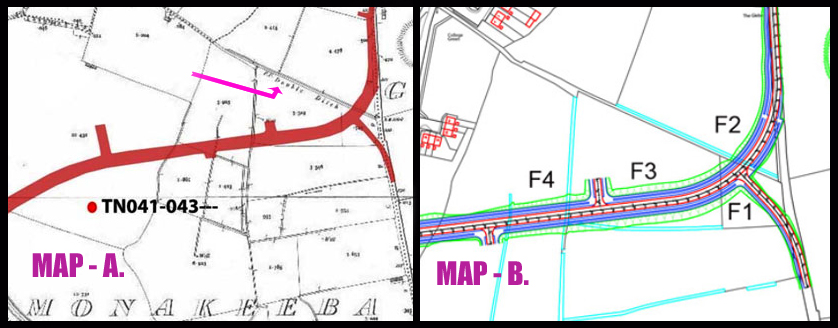
A small section of the walkway will potentially be removed to facilitate the proposed inner relief road for Thurles Town. While a map exists which outlines the proposed route (you have displayed same in previous articles) the fact remains that the County council have not at time of writing acquired the lands over which the proposed route will traverse. Should the lands be acquired and funding confirmed I along with my council colleagues will do all we can to ensure that minimum disruption is brought to bear on the double ditch walk way.
If you have any proposals as to how you would like to see the walkway promoted internationally as stated in your article dated March 5th please forward same to the area councillors for discussion as part of the Thurles Municipal projects development plan.
Regards Micheál Lowry.
Questions Raised: In Mr Lowry’s opening paragraph he states, “I nor to my knowledge any of my council colleagues have any desire to “destroy” the double ditch“. Then in his second paragraph he states, “A small section of the walkway will potentially be removed to facilitate the proposed inner relief road for Thurles Town.” Readers will no doubt find this statement contradictory.
Firstly, if this is the case why the refusal by all Municipal District / Co. Councillors and Council officials to initially communicate; forcing me to contact the Standards In Public Office Commission (SIPO)?
I have done the measurements. Is it not true that over half the double ditch, 250 yards approximately, will be eradicated, including its eastern 175 year old stone entrance?
Is it not true that contractors employed by Tipperary Co. Council have already partially undertaken the destruction of the 175 year old Great Famine Double Ditch, through digging out and flooding the northern side; breaking the eastern 175 year old stile entrance, while allowing the area to become a ‘fly-tippers paradise’?
Mr Lowry Jr. states, “the County council have not at time of writing acquired the lands over which the proposed route will traverse. Should the lands be acquired and funding confirmed I along with my council colleagues will do all we can to ensure that minimum disruption is brought to bear on the double ditch walk way.”
While I accept that Tipperary County Council may not have acquired the lands as yet as purchasers, we must believe that some sort of an agreement / consensus / accordance or indeed rapport has been entered into with all / any future vendors.
Who drew up the map, shown above, without the consent of the owner of the lands involved?
Who sought planning permission through An Board Pleanála, on land that are not yet acquired or entered into by agreement?
Who also sanctioned the undertaking of an EIA Screening report, (OCSC Project T189) on lands, where no previous agreement has been entered into?
Who requested the poorly carried out Archaeological Impact Statement from ÆGIS(REF.: 210-11), which failed to identify the double ditch shown clearly on the 1883 Ordinance Survey(5 inch) map, and more recently again also shown clearly on the 1951 ordinance survey map?
Who gave all these consultants and archaeologists permission to trespass on lands, where no agreement with the owners had been entered into between the vendors and by Tipperary Co. Council?
Will this land be acquired without the consent of the owners, by means of a Compulsory Purchase Order (CPO)? It is with regret that Cllr. Mr Jim Ryan, latter who lives close by the Great Famine Double Ditch, has failed to reply to two questions, sent to him on March 3rd last, (see request HERE).
In relation to your final paragraph and your request regarding “walkway promoted internationally”. When I am convinced that the 175 year old Great Famine Double Ditch will been retained in full, together with the provision of a small parking area for tourist traffic; God willing, I will begin the process of promotion and marketing, something that Tipperary Co. Council’s Tourism committee has failed miserably to achieve for Thurles. You will remember the disastrous costly promotion entitled, “Tipperary The Place, The Time” launched back in early 2017. Where did all of the TD’s, Ministers, Councillors and Celebs that were rounded up, go after the photographs and the expensive promotional banquet?
Our readers should note that I have not replied personally to the above email sent by Mr Lowry Jr., nor indeed currently do I intend to do so.
The original Ellis Island Immigration Station in New York Harbour was officially opened in 1892 and the first immigrant to pass through its doors was a 15 year old girl from County Cork, by the name of Annie Moore, (April 24th, 1877 – December 6th, 1924). Annie arrived from Cobh (Queenstown) in Ireland, aboard the steamship ‘Nevada’ in 1892. Her brothers, Anthony 14 and Philip 12, had journeyed with her.
Now a virtual exhibition entitled “Irish Famine Migrant Stories In Ontario” will tell the story of Ontario’s Irish migrants from 5 years earlier, “Black 47”(1847) and the caregivers who put their lives on the line, during one of the worst health-care crises recorded in Canadian history.
As officials in Tipperary Co. Council, together with local elected representatives and politicians (namely Mr Michael Lowry and Mr Jackie Cahill) support the destruction of our Great Famine history here in Thurles; this new exhibition will apprise the untold tales of Irish Great Famine migrants, who endured a typhus epidemic, while emigrating to Canada.
Created by the Ireland Park Foundation (IPF), this virtual exhibit, which took more than four years to assemble, will follow the lives of 100,000 famine migrants, latter who crossed the Atlantic Ocean landing in Grosse Isle, an island located in the St. Lawrence River in Quebec, Canada, and onto the shores of Ontario during this Great Hunger, on board ‘coffin ships’ that would claim the lives of some 20,000 people.
Some 16% of the population in Ontario, Canada, today can correctly claim Irish decent. Toronto back then, was largely a Presbyterian/Protestant city, while 80% of the Irish migrants arriving were Roman Catholic. This human melting pot of the late 1800’s laid the seeds to a diverse Canada population, the envy of the world, that we as Irish people today know and love.
In relation to our Double Ditch Survey sent to local elected representatives; same due to be returned last Sunday evening, March 14th; we can confirm that we have received some answers which will be published later.
St. Patrick’s Day greening of World Heritage sites puts Cashel in the shade.
Ireland’s efforts to green global historic sites, such as the Sydney Opera House, the Leaning Tower of Pisa and the Pyramids of Giza for St. Patrick’s Day is in marked contrast to “lacklustre efforts to win recognition for historic sites in Tipperary and elsewhere around the country”, according to Deputy Michael McNamara.
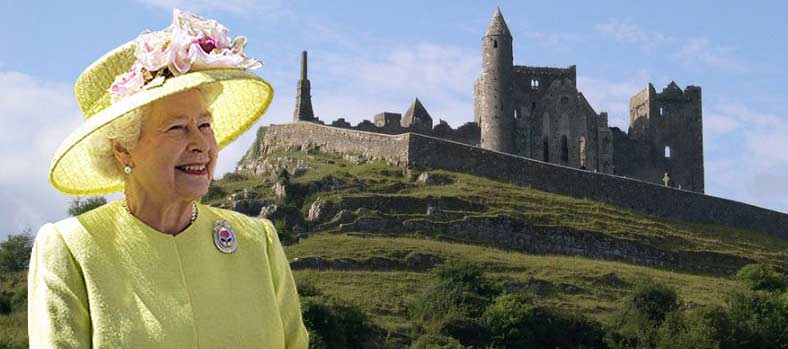
Queen Elizabeth II visited the Rock of Cashel on the final day of her four-day 2011 state visit.
The Clare Independent T.D.’s comments come ahead of a June 30th deadline for local authorities, community organisations and State bodies to submit applications for Ireland’s Tentative List for future World Heritage nominations to UNESCO.
The Irish list was last updated in 2010 and includes Royal Sites of Ireland such as Cashel (Tipperary), Tara (Meath), Dún Ailinne (Kildare), Hill of Uisneach (Westmeath) and the Rathcroghan Complex (Roscommon). It also includes Georgian Dublin, the Burren, and groups of related Early Monastic Sites, comprising Clonmacnoise (Offaly), Glendalough (Wicklow), Inis Cealtra (Clare), Kells (Meath) and Durrow (Laois), and Western Stone Forts, including Dun Aonghusa (Aran Island, Galway), Cahercommaun in north Clare and the Kerry forts of Benagh, Caherconree and Staigue.
Deputy McNamara said, “Tourism Ireland’s Global Greening project comes about as a result of much effort and some cost to the State (€48,583 in 2019), but I accept that it results in a benefit, not limited to direct income, to our State. We have, however, neglected to progress various sites in Ireland to UNESCO world heritage status over the past decade.”
“We currently only have two sites on the UNESCO world heritage list, Skellig Michael and Newgrange,” he explained. “By comparison, Austria and Denmark have ten world heritage sites, the latter having advanced five sites to designation in the past decade.”
“In 2014, I met with UNESCO representatives and learned that there had been little or no communication from the Irish government on the matter for some time and little effort had been made to advance the Irish tentative list since it was handed over in 2010″.
“When I raised the matter with the then Minister for Culture, Heritage and the Gaeltacht in 2015, I was informed that Kerry County Council had informed the Department that it did not wish to be involved in progressing the potential Western Stone Forts nomination. This was also the case in Clonmacnoise, which had obvious implications both for the potential nomination of the site in its own right, as well as for its status as a crucial element of the potential group nomination of the Early Medieval Monastic Sites.”
“Since then, successive governments have failed to progress the designation of this tentative list, despite the fact that it would bring worldwide attention to our unique patrimony and to the natural and built heritage sites themselves. As well as a requirement to ensure any development is sympathetic to and protects the integrity of the sites, which may explain the reluctance of some, more cavalier local authorities, designation also typically results in an increase in tourism, with associated economic benefits”.
In response to a recent parliamentary question, Deputy McNamara was informed that a new tentative list is being developed by the National Monuments Service, with a June 30th deadline for applications from local authorities, State bodies, community organisations and individuals, for sites or properties of natural and/or cultural heritage to be included.
He continued, “Given the increase in tourism typically generated by World Heritage site designation, and the unprecedented challenges that will face the domestic and international tourism sector when we open up to world again, every effort must be made to advance built and natural heritage sites across Ireland to the World Heritage list.”
“Unless the government prioritises the list that will be developed and puts the same effort into obtaining world heritage status for our own sites as it puts into “greening” other states’ world heritage sites, I fear the list will be as useless an exercise in bureaucracy as its predecessor. Our annual celebration of international World Heritage sites being lit up in green must be matched by a similar enthusiasm for securing similar designation for our own world class heritage sites,” concluded Deputy McNamara.
The two x 207metre high Poolbeg industrial chimneys situated standing at the mouth of Dublin Harbour were built and came into operation in the 1970’s and are amongst the tallest, hideous, eyesore structures in Ireland, visible from most areas of Dublin city.
The twin chimneys, with their distinctive red and white, dirty, rust streaked facades, when built had only a planned operational lifetime of 30-40 years. While Poolbeg itself continues today to be an operational power station, the existing chimneys were decommissioned back in 2006 and 2010; same no longer required for the 470MW gas turbine plant, which generates electricity for more than half a million Irish homes.
Bear this information in mind, when you hear that Dublin City councillors have called for the 50 year old chimneys to be listed as protected structures. To this end they have commissioned an architectural historian to research and report on the state of the chimneys, with a view to encasing them in concrete or fibreglass at a cost of several million euro.
Here in Thurles, Tipperary Co. Council officials, elected County Councillors and TD’s are on a totally different thought wave length.
Surely, the Poolbeg chimneys built in the 1970’s can hardly be observed as an international tourist attraction, while the Great Famine Double Ditch situated on Mill Road, Thurles Co. Tipperary has major tourism attraction potential, bringing benefit to a town centre currently on its knees.
Tipperary Co. Council officials, elected County Councillors and TD’s have now condemned the 175 year old Great Famine Double Ditch to total eradication, without the consent of those residents of the county who elected them and who continue to pay their massive salaries.
In the words of U.S. President Dwight D. Eisenhower’s Secretary of Defence, Mr Charles Erwin Wilson, which of these scenarios offers“most bounce for ounce” or “bang for your buck”, for the Irish taxpayer.
Choose! Restore and protect a 50 year old defunct and hideous eyesore, known as the Poolbeg chimneys; costing “Several million euro”, placing the debt burden on a State-owned company, who will be required to foot a continuous annual maintenance bill. Or Restore and protect an historic 175 year old Great Famine Double Ditch, Right-Of-Way and Mass Path, already slightly damaged by Tipperary Co. Council officials; which offers major tourism attraction potential, costing “Between €15,000 and €20,000”.
Survey Sent To All Thurles Elected Representatives Including Teachtaí DálaMr Jackie Cahill and Mr Michael Lowry.
A simple definition of the word “Hypocrisy“, is the practice of claiming to have higher standards, virtues, principles and beliefs that one in fact does not have and in most cases are unlikely to attain.
For examples of real “Hypocrisy” one does not have to go outside of County Tipperary or past page 4 of the “Tipperary Heritage Plan 2017 -2021” to find 2 major examples. View same by simply clickingHERE
First example of “Hypocrisy” comes from Cllr. Siobhán Ambrose, (Back between the years 2017 – 2021 Ms Ambrose was for a term Cathaoirleach, of Tipperary County Council.)
Quote: “The aim of the plan is to connect the citizens of Tipperary to their heritage and to make it an integral part of everyday life at the core of our communities. ……The aim of the plan is to connect the citizens of Tipperary to their heritage and to make it an integral part of everyday life at the core of our communities. Tipperary is a county with a rich heritage of which the Council and the citizens of Tipperary are very proud. Heritage projects provide a great opportunity for communities to come together and across the county local groups are working together to promote their localities. I have attended numerous events in the last months where people are celebrating their heritage, be it Built Heritage, Biodiversity and Wildlife, Culture, Music or Folklore. This strengthens our communities and contributes to our sense of place and puts heritage at the heart of our communities. I would like to acknowledge the work of these groups and individuals and hope that through the actions of this plan that we can work in partnership to look after this valuable asset and protect it for generations to come”.
The second example comes from the current reigning Chief Executive of Tipperary County Council, Mr Joe MacGrath.
Quote: “Our heritage is about our past, our present and our future and contributes greatly to the quality of life in our urban and rural communities. It is shared by all and is fully inclusive. Interaction with our heritage not only provides physical and mental health benefits, but contributes to overall well-being, while biodiversity is an essential component in the functioning of our environment.”
While we can’t be sure who wrote the above two introductory paragraphs to this ‘Tipperary Heritage Plan‘ document; we do know that both the Tipperary Co. Council officials named above, signed them; while receiving hefty salaries from Tipperary taxpayers.
Elected Representatives Questionnaire/Survey
The above survey is being sent to the following persons.
Elected Co. Councillors, Templemore / Thurles Municipal District.
Of the 6 questions forwarded to all elected representatives; the first 3 questions require only a simple YES or NO answer.
(1) Do you support the continued destruction of Thurles history and its historical sites, as in the past?
(2)Do you support the recently confirmed plans by Tipperary County Council to destroy the Great Famine Double Ditch historical site?
(3) As part of the Tipperary County Council development plans, in relation to this proposed inner relief road; has any alternative to the destruction of the Double Ditch been explored at Municipal district level or County level, Chaired by Tipperary Co, Council Chief Executive Mr Joe MacGrath?
(4) If you agree that the Great Famine Double Ditch should be taken from the people of Thurles and destroyed as part of Tipperary Co. Councils development plans, please now outline why you believe this to be so justified?
(5)If you disagree and believe the Double Ditch should be protected and marketed to the world; what action do you propose should now be undertaken to prevent its destruction?
(6) Will you be inviting ÆGIS and their Archaeological Impact Statement report author, namely Mr F. Coyne BA MIAI to return and acknowledge that the Great Famine Double Ditch actually exists? The qualified professional author Mr Coyne, should also explain how and why he excluded the phrases: “Double Ditch”, “Public Right-of-Way”, “Mass Path” and “Great Famine” from his Archaeological Impact Statement and declare that he was not requested to do so by any engineer or other official within Tipperary Co. Council. (See page 5 & 6 of link shown HERE.)
NB: The Questionnaire/Survey must be returned by Sunday 14th March 2021 and in the interests of openness & transparency, all detailswill be published in full, on this website for our readers.
This website uses cookies to improve your experience. We'll assume you're ok with this, but you can opt-out if you wish.AcceptRead More
Privacy & Cookies Policy
Privacy Overview
This website uses cookies to improve your experience while you navigate through the website. Out of these, the cookies that are categorized as necessary are stored on your browser as they are essential for the working of basic functionalities of the website. We also use third-party cookies that help us analyze and understand how you use this website. These cookies will be stored in your browser only with your consent. You also have the option to opt-out of these cookies. But opting out of some of these cookies may affect your browsing experience.
Necessary cookies are absolutely essential for the website to function properly. This category only includes cookies that ensures basic functionalities and security features of the website. These cookies do not store any personal information.
Any cookies that may not be particularly necessary for the website to function and is used specifically to collect user personal data via analytics, ads, other embedded contents are termed as non-necessary cookies. It is mandatory to procure user consent prior to running these cookies on your website.




Recent Comments