Tipperary County Council officials & councillors, since the foundation of the Irish State, have managed successfully to destroy/eradicate a massive amount of local Thurles history e.g. the Thurles Workhouse, Larry Hickey’s pub (Griffin’s newsagents Liberty Square), the Thurles Moat on Parnell Car Park, Bridget Fitzpatrick’s family home at the Turnpike, Two-Mile-Borris, Moat Lane on Parnell Street and soon (if they get their way), the 175 year old Great Famine Double Ditch on Mill Road, Thurles, Co. Tipperary.
If Thurles town centre is to be preserved as a thriving place for business, its history must now be heavily underscored; brightly highlighted and marketed properly, as a tourist attraction incorporating the other villages and towns, part of the Thurles town hinterland.
[Note: In this factual piece of text hereunder, three hamlets and one town, namely Two-Mile-Borris, Littleton, Upperchurch, and Templemore, in Co. Tipperary, are important to those lovers of heritage wishing to visit within Tipperary and Thurles area.]
A special thanks to Mr Gerry Bowe and Mr Michael Dempsey, both of whom provided historical facts. To Mr Dempsey also, our thanks for allowing us use pictures taken by his own family, some of which are included in the video slide-show hereunder.
So how important historically is Liberty Square, Thurles, Co. Tipperary? I will allow our 2 thousand to 8 thousand daily readers to decide.
Bridget Fitzpatrick (1892-1977)
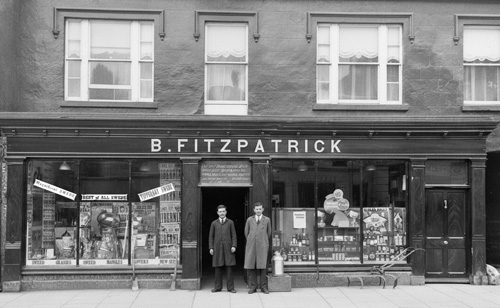
After the Easter Rising of 1916, Bridget Fitzpatrick admits her political sympathies were wholeheartedly aligned with the Irish Volunteers and with Sinn Fein. At that particular time, Bridget was employed, holding a clerical post at the premises of Mr. Bernard Fitzpatrick on Liberty Square, Thurles, Co. Tipperary. A working colleague also employed at that premises was Mr. John McCormack, who later became the Quartermaster of the Irish Republican Army’s 2nd Mid-Tipperary Brigade.
Máire Aoife (Mary Eve) Comerford (1893-1982), an Irish republican born in Rathdrum, Co. Wicklow and who resided for some time at an address in Courtown, Gorey, County Wexford, came to Thurles from Dublin in 1918; her purpose, to organise “Cumann na mBan” [latter translated from Irish as “The Women’s Council”], in the Thurles area.
Miss Comerford had volunteered to aid Constance Georgine Markievicz (née Gore-Booth) in St. Stephen’s Green, and was put to use carrying despatches for the General Post Office (G.P.O.) garrison. She would later return to Gorey, Co. Wexford, following the 1916 rising and worked alongside Sinn Féin politician Sean Etchingham [latter who died in prison in 1923 from natural causes].
Bridget Fitzpatrick was instructed to help and assist her locally, becoming herself a member of the local Cumann na mBan branch. In 1918 Bridget was named as the Executive and Courier for Richard Mulcahy and Michael Collins, entrusted with the responsibility of receiving undercover communications in Thurles. Immediately she began receiving a steady stream of dispatches from General Head Quarters (G.H.Q.), same to be distributed to Volunteer Officers for the major portion of the south of Ireland.
Video: Courtesy G. Willoughby.
The chief central headquarters for dispatches was another business premises, situated on the southside of Liberty Square, Thurles, with all activities being directed by an employee Mr. James (Jimmy) Leahy and Michael (Mixie) O’Connell; latter the proprietor of that establishment. Thurles would now become a dispatch centre for a major portion of the south of Ireland.
It was in a storage room at the back of Mixie O’Connell’s shop on Liberty Square, that crudely manufactured mines were made, packed with gelignite and concealed in boxes which had contained cart wheels. Same explosives were used to attack the R.I.C. Barracks on the Holycross-Cashel road.
Dispatches from G.H.Q., Dublin, were sent by post to Miss Fitzpatrick, and she in turn handed them over to Mixie O’Connell who, in turn, arranged to have them forwarded to their intended destinations. Dispatches were being carried at night as the volunteers involved could not be observed as being missing from their daytime employment. Later this work would be undertaken by members of Cumann na mBan.
The dispatches were invariably from Michael Collins. Those pertinent to local Volunteer Officers were delivered by Miss Fitzpatrick herself, while those which had to be sent some distance, were handed over to John McCormack at her place of work or taken directly to Mixie O’Connell, latter who arranged to forward them to their ultimate destination.
Miss Fitzpatrick lived indoor on her employer’s premises, so post addressed to ‘Miss B. Fitzpatrick’, could have easily been opened in error by her boss, Bernard Fitzpatrick, whose political views were known to be different from those of Sinn Féin.
Later, Miss Leslie Price (who later married Mr. Tom Barry of Cork) came to organise other dispatch centres and lines of communication, and Miss Fitzpatrick became associated with her also in this work, while the former resided in the Thurles area.
On the morning of 19th May 1919, Miss Fitzpatrick received a postal dispatch from Michael Collins with a covering note addressed to her personally. The note informed her that the dispatch she had received was extremely urgent and requesting her to have it forwarded to its destination immediately.
This dispatch concerned the arrest of Sean Treacy. She learned that Sean Hogan, who was wanted by the Royal Irish Constabulary (R.I.C.) in connection with the Soloheadbeg ambush, had been arrested in the early hours of that morning at Maher’s of Annfield, Thurles and that Sean Hogan was a prisoner in the R.I.C. Barracks in Friar Street, Thurles. She learned from John McCormack that it was expected that Hogan would be sent to Cork Prison, under escort on the train during the day, and that arrangements must be made to watch the barracks.
If Sean Hogan was being sent to Cork it had been decided that Mixie O’Connell would send a coded telegram with the wording, “Greyhound on train”, giving the time of the departure of the train to brothers Tom and Mick Shanahan at the Coal Stores, in Knocklong, Co. Limerick.
John McCormack sought permission to use Bridget Fitzpatrick’s name as the sender of this coded telegram, which she willingly gave.
Throughout that day the barracks in Friar Street Thurles was constantly watched by an elderly lady named Mrs. McCarthy, her daughter Margaret and a Miss Maher of Annfield (later Mrs. Frank McGrath of Nenagh) at whose house Sean Hogan had been arrested and who had followed the police into Thurles.
These women had made several efforts to secure a visit to the prisoner, but without success. Mrs. McCarthy at different times during the day brought fruit, tea and fresh socks to the barracks for the prisoner, each time pleading to be allowed to see him for a few minutes, but was refused by the R.I.C. .These visits, however, provided Mrs. McCarthy with the excuse which she needed to remain in the immediate vicinity for long intervals. Eventually, that evening Mrs. McCarthy due to her persistence, secured information from an R.I.C. officer that Hogan was being taken to Cork by a train, which left Thurles around about 6:00pm. This information was immediately reported to Mixie O’Connell, who would send the coded telegram, “Greyhound on train”.
While the rescue of Sean Hogan on that evening, May 19th 1919, was a success, Bridget Fitzpatrick was informed by Mr. O’Carroll, (latter a Supervisor at Thurles Post Office), that the R.I. C., in the course of their investigations, had taken possession of the original copy of the telegram to Tom and Mick Shanahan, which bore her name as the sender.
About three weeks later, the aforementioned Tom and Mick Shanahan; Patrick Maher; Edmond Foley; (all of whom were from the Knocklong district), together with another man named Murphy, latter a porter at Knocklong Railway station; and Mixie O’Connell from Thurles were all arrested by the R.I.C. on suspicion of being involved in the rescue of Sean Hogan.
On the morning of Mixie O’Connell’s arrest, Bridget Fitzpatrick was also honoured by a visit from the R.I.C., led by District Inspector Michael Hunt, who interrogated her, taking a statement.
Inspector Hunt questioned her about the telegram, of which she denied having any knowledge. He then proceeded to question her about Mixie O’Connell and what she knew about his Sinn Féin and Volunteer activities. She informed Inspector Hunt that she knew him only as a neighbour in business, but beyond that she had no idea of his other activities or interests. Meanwhile, the six prisoners arrested by the R.I.C. were taken to Limerick Prison.
Within a few weeks of his taking that statement from Bridget, District Inspector Michael Hunt, (son of a Co. Sligo father, Mr. Martin Hunt), was murdered; shot dead on Liberty Square, Thurles on Monday evening, June 23rd, 1919. Two first cousins “Big Jim” and Tommy Stapleton from Finnahy, Upperchurch, Thurles and Jim Murphy (latter known as “The Jennett”), from Curreeney, Kilcommon, Thurles would later be named as responsible for the killing of R.I.C. District Inspector Michael Hunt; [Note: all three assassins are named in a statement made by James Leahy, Commandant, No.2, Irish Republican Army (I.R.A.) (Mid) Tipp-Brigade. Jim Stapleton was also named for the killing of District Inspector William Harding Wilson outside Templemore post office, leading to the newspaper headlines, “Night of Terror” and “Templemore Attacked by Police & Military”.]
Acts of savagery country-wide, would now continue on both sides. Note one gruesome picture in the attached slide-show refers to the brothers Pat and Harry Loughnane, Co. Galway who were arrested, beaten, tied to the tailgate of a lorry, dragged along country roads, then further assaulted, wrists and legs broken, letters `’I.V.’ cut in their flesh, before being shot, hand grenades put in their mouths and exploded, and finally set on fire, before being dumped in a pond because they didn’t burn.
The Knocklong incident appeared to be a closed book, until the following January (1920), when Bridget Fitzpatrick was notified by the R.I.C. that she was obliged to appear as a witness in the case, at the trial of the prisoners in Limerick. The R.I.C. spoke about sending transport for her but she informed them that she would find her own way as she would be publicly ostracised by the Thurles Community, if observed in their company.
Bridget Fitzpatrick went to the railway station to take the train bound for Limerick on the day of the trial, to find a number of R.I.C. personnel were already in place; entering into the same carriage with her. On arriving in Limerick, they escorted her to William Street, R.I.C. barracks. There she was taken to a room to be further interrogated by three British Military officers who took a fresh statement from her. She had already been well briefed in advance by James (Jimmy) Leahy and by working colleague John McCormack; told to say exactly what she had told Inspector Hunt.
With a new statement given, she was taken to another room, the occupants of which were R.I.C. men and here she waited to be called into the Courtroom to give evidence.
In being escorted into the Courtroom by the R.I.C., she had to pass close to the six prisoners. As she passed, she remarked to Mixie O’Connell “Poor show from Ballyhooly”, which was his favourite saying. Same led to some laughter and excitement and orders were shouted not to allow Miss Fitzpatrick to speak to the prisoners. Giving evidence she stuck to her story adding that she knew none of the prisoners except Mixie O’Connell with whom she only knew as a business man residing in Thurles.
The final decision of the Court was to remand all six prisoners in custody for trial at a later Court. Miss Fitzgerald was held at William Street Barracks until 6:00pm that evening, until she insisted that she had to call to see a friend in Limerick. The R.I.C. then allowed her to leave, on the undertaking that she would be back at Limerick Railway Station, in time to catch the 7:00pm train back to Thurles.
She returned to the station in time to catch the 9:00pm train, in the vain hope that the R.I.C. would have left by an earlier train, but they had awaited her return and she had to endure their company back to Thurles, which was reached about midnight.
Meanwhile, Bridget had an interesting visitor in Thurles in the person of Mrs. Ethel Snowden (née Annakin), socialist, human rights activist, and feminist, the wife of Sir Philip Snowden, who later in 1924, became Chancellor of the Exchequer in a British Labour Governments. She had come to Ireland as a member of the British Labour Party’s Fact Finding Commission and when she arrived in Thurles, she had a letter of introduction to Bridget from Cumann na mBan Headquarters in Dublin. On the night prior to her visit, the R.I.C. and Black and Tans had run amok in Thurles and had done considerable damage to business premises. She showed Ethel around and let her see the havoc wrought by the Crown forces and she took her to visit the relatives of James McCarthy. [James McCarthy, Thurles, Co. Tipperary had been shot dead by an R.I.C. murder gang, after they had sent him a death threat on Dáil notepaper in an effort to incriminate Sinn Féin]. Bridget reported that Ethel Snowden appeared to be most sympathetic, making notes of all she had seen and heard.
The next trial date for the six Knocklong prisoners took place at Armagh Assizes in July of 1920 and the R.I.C. now served Bridget with a summons to attend as a witness. To avoid travelling with an R.I.C. escort she left Thurles a few days in advance of the trial, travelling to Armagh via Dublin and Dundalk.
In accordance with the instructions on the Summons, she called to the Courthouse in Armagh on the day before the trial opened and after waiting for some hours, she was interviewed by an official who just took her name and address. Accommodation was provided for her in a hotel with other witnesses.
The trial lasted for two days in front of a Judge and Jury with Bridget conveying similar evidence as imparted in Limerick and in the statements taken by D.I. Hunt. Cross-examination lasted about 15 or 20 minutes by the Counsel for the Prosecution. The two Shanahans and Murphy were found not guilty and acquitted, but the Jury disagreed in the case of Mixie O’Connell, Foley and Maher, with the latter three remanded in custody to Mountjoy Prison, to await a new trial.
Mixie O’Connell secured his release by going on hunger strike. He returned to Thurles but was only a few minutes back in his house, when he learned that he was likely to be re-arrested. He then left Thurles and went on the run. Edmund Foley and Patrick Maher did not take part in the hunger strike with O’Connell. Being innocent of the charges which had been preferred against them, they felt confident that they would not be found guilty when their next trial took place.
In January 1921, Commandant Jerry Ryan (later who would become Bridget Fitzpatrick’s husband) was arrested in Thurles by the R.I.C. and taken to Limerick Prison. In a letter to Bridget, which was smuggled out of the prison, he told her to warn Commandant Small not to carry out two planned ambushes at two points, which were marked on a map found on his clothing by the R.I.C.. Having warned Small she tore up that portion of the letter but retained the remainder of it, as it contained some instructions regarding money matters which Jerry Ryan wanted fixed up between the Quartermaster and the battalions Vice-Commandant.
Shortly afterwards, Bridget travelled to Limerick to visit Jerry Ryan and on her way back she was met at Oola railway station (Limerick/Tipperary border) by Miss McCarthy (daughter of the Mrs McCarthy previously referred to), latter a teacher in Oola. Miss McCarthy had received instructions from Bridget’s fellow worker, Mr John McCormack, to meet Bridget to prevent her from returning to Thurles, as the R.I.C, were searching for her. During her absence the R.I.C. had raided her accommodation in Fitzpatrick’s and had found in her trunk the portion of the letter from Jerry Ryan which she had retained. She stayed that night in Oola with Miss McCarthy and then went on the run, staying with friends in various places until after the ‘Truce’ in the following July.
In February 1921, the two remaining members of the Knocklong prisoners, namely Edmund Foley and Patrick Maher, were put on trial again, this time by court martial in Dublin. Before going on her visit to Limerick Prison, Bridget had received the usual notice from the R.I.C. to appear as a witness, but as she was on the run when the court-martial took place, she did not appear. Both men were found guilty and sentenced to death with both being executed by hanging in Mountjoy Prison on 30th May 1921.





Recent Comments