In Latin America – “Día de los Muertos” (Spanish – Day of the Dead).
Celtic nations firmly believed that at certain times of the year the boundaries between the mortal and unearthly realms briefly thinned or broke down. It was further accepted, as being true, that this veil between the two worlds was at it’s thinnest at this time of year; on Halloween (Samhain), All Saints’ Day, and All Souls’ Day.
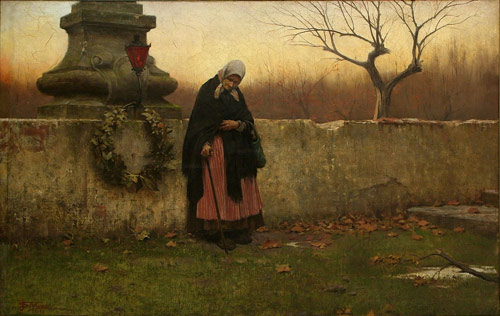
“All Souls’ Day”, a painting by Czech artist Jakub Schikaneder, 1888
All Souls’ Day is a day to honour and pray for the dead, especially those who are believed to be in purgatory. It is believed that Saint Odilo, Benedictine Abbot of Cluny, France, (son of Berald de Mercoeur and Gerberga) first designated a specific day for remembering and praying for those in the process of purification or temporary punishment in which, according to medieval Christian and Roman Catholic belief, the souls of those who die, in a state of grace, are made ready for acceptance into heaven.
On All Souls’ Day, those who have left us can come back for a brief visit on this night. As they pass through your home, they leave their love and blessings, and take away your troubles. Your personal energy and love for them is the path which attracts them back amongst the living.
Ancient Irish people believed that the souls of the dead would return to their family home. The dead were believed to be repositories of wisdom and lore and that during this blessed period they would return to speak to their descendants here on earth.
Great care was taken, therefore, on All Souls’ Night to ensure they felt welcome. Returning ancestors, it was believed, would bestow two main gifts; (1) the ability to remember old days and traditions and (2) the ability to hold a deeper understanding of how we are forever linked to our bloodline.
To this end, earlier in the day graves would be visited and cleaned, with a candle left to burn. At home, to prepare for the arrival of the dead, Irish families would light a warm fire, sweep the floor, put a place setting of available cutlery on the kitchen table for each current generation deceased relative. A bowl of spring water and a container of salt was also present, latter representing the meal you would have prepared for them, when they were on this side.
With the door to the house left unlocked for the night, a candle, for each of those who had passed over, was lit and placed in the window that faced in the direction of the cemetery. When evening prayers were said before bed, these candles would be extinguished, with possibly one allowed to burn out.
Many of these traditions have now died out in Ireland, but today on our island, All Souls’ Day still remains a day of commemoration when prayers and Masses are said for those dearly beloved who have passed on.
During WWII, between early May 1940 and the end of July 1941, British cargo ships were being sunk by German U-boats and battle ship surface raiders, at an average rate of some 66 per month. Before WWII finished in 1945, the British would lose 2,426 merchant ships and 19,180 seamen in the North Atlantic. Between June and October 1940 alone, more than 270 allied ships had been sunk in the North Atlantic.
One such incident, which happened on the 5th November 1940, on the North Atlantic route, involved Captain Edward Stephen Fogarty Fegen, latter commanding HMS Jervis Bay, which was escorting a convoy of 38 ships carrying merchandise, (merchantmen), Convoy HX.84.
Captain Edward Stephen Fogarty Fegen, was the son of Mary Catherine (née Crewse) and Vice Admiral Frederick Fogarty Fegen of Ballinlonty, Borrisoleigh, Thurles, Co. Tipperary. Born on October 8th 1891, in Knightsbridge, London; Edward Fegen came from a strong naval tradition, with both his father and grand-father being naval officers. His Fogarty Irish family history, indeed, can easily be traced back to the 5th century, to one Fergus Cearbhall, latter the 133rd monarch of Ireland.
We first get to hear about Captain Edward Stephen Fogarty Fegen on March 24th 1918 (end of WWI), when a British Merchant steamer the ‘SS War Knight‘; on route from New York to Britain with supplies, led by ‘HMS Syringa’, accidentally collided with the ‘SS O.B. Jennings‘ off St. Catherine’s head, at the southern tip of the Isle of Wight. This collision resulted in the release of naphtha cargo (a flammable liquid hydrocarbon mixture) being carried by ‘SS O.B. Jennings‘, which then flowed across the deck of the ‘SS War Knight‘. A fire now began on both ships, but also on the surface of the water surrounding both ships.
The ‘SS War Knight’ had an international crew, on board, made up of Irish, English, Scottish, Welsh, Norwegian, Swedish, Belgian, Newfoundlanders, Jamaican, American and Australian.
‘H.M.S. Garland’, under the command of Lieutenant Edward Stephen Fogarty Fegen, with other destroyers, were proceeding to the spot to render assistance, when it was seen that one boat which had been lowered from the ‘O.B. Jennings’ had been swamped. The H.M.S. Garland closed in on the O.B. Jennings, rescued the men from the swamped boat, and then proceeded alongside the ship, which was still blazing, rescuing those who were still on board. She afterwards proceeded to pick up the others who had left the ship in boats; rescuing in all four officers and twenty-two men. Lieutenant Fegen handled his ship in a very able manner under difficult conditions during the rescue of the survivors, while Quartermaster Driscoll worked the helm and saw that all orders to the engine-room were correctly carried out. Lieutenant Fogarty Fegen actions during this rescue resulted in both men being awarded Silver Sea Gallantry Medals, latter medal first struck in 1855 for saving life at sea.
Captain Edward Stephen Fogarty Fegen’s Service Record: – 1922. Jan. – promoted to Lt. Cmdr. Seniority 15/10/1921, serving in HMS WHITLEY. 1922. Dec. – appointed to HMS SOMME. 1924. Jan. – appointed to HMS VOLUNTEER. 1925. Jun. – appointed to HMS COLOSSUS Accommodation ship, 20,000 tons, Boys training ship. 1926. Jul. – appointed to HMS FORRES as Lt/Cmdr in command. 1927. Nov. – on S.O.T.C (Senior Officer`s Technical Course) at Portsmouth. 1927. Dec – appointed to R. A. N. – ( R A N C at Captains Point, Jervis Bay ) on Naval staff. 1928. Jan – believed promoted to Cmdr on 20/1/1928. 1929. Dec. – still at R. A. N. 1932/1934 – HMS OSPREY. 1934 – on S O W C (Senior Office`s War Course) at R.N. College at Greenwich from 15/10/34 to February 1935 1935. Mar. – HMS DAUNTLESS to June 1935. 1935. Aug – HM Dockyard, Chatham to August 1938. HMS CURLEW – Reserve Fleet, and HMS DRAGON – Reserve Fleet. 1939. Jul – HMS EMERALD, Cruiser, 7,550 tons, Reserve Fleet at the Nore. [Interesting to note that the Capt. of HMS EMERALD was Capt. A.W.S.Agar, VC, DSO.] 1940. Feb. – appointed Acting Capt. of Armed Merchant Cruiser, HMS JERVIS BAY.
History of HMS JERVIS BAY. The HMS Jervis Bay was built originally as a passenger ship; its purpose, to carry emigrants to Australia. With WWII beaconing, it was taken over by the Admiralty in August 1939. She was fitted with seven 6-inch guns, dating from the turn of the century, which were distributed around her decks and was repainted grey. Now, lightly armed and riding high in the water, her crew would refer to her as so many other such refurbished ships, as an “Admiralty-made coffin.”.
Her role was designated as that of an ocean escort ship, to guard Atlantic convoys. The British Admiralty were well aware that Germany in the First World War, had frequently employed armed liners, for raiding allied ships and in the Second World War, against such similar liners the HMS Jervis Bay would have had an equal chance of a successful defence, but was no match against an armoured ship.
On the November 5th 1940 in the Atlantic, Captain Fogarty Fegen, was commanding the HMS Jervis Bay, while escorting 38 merchantmen, when they were attacked by the German Pocket Battleship ‘Admiral Scheer‘, commanded by AdmiralCaptain Theodor Krancke; latter commanding all German naval forces in Western Europe.
History ofADMIRAL SCHEER.
The Admiral Scheer was a Deutschland-class heavy cruiser (often termed a pocket battleship) which served with the Kriegsmarine (War Navy) of Nazi Germany, during World War II. [The vessel was named after Admiral Reinhard Scheer, German commander in the Battle of Jutland.] She was built at the Reichsmarinewerft shipyard in Wilhelmshaven, in June 1931 and was completed by November 1934. Originally classified as an armoured ship (Panzerschiff) by the Reichsmarine, in February 1940 the Germans reclassified the remaining two other ships of this class as ‘heavy cruisers’.
The ‘Admiral Scheer’ had slipped through the Denmark Strait and into the open Atlantic on the night of October 31st, on her first combat offensive of WWII. Now hunting in the North Atlantic, her radio intercept equipment quickly identified convoy HX-84, as being in the surrounding sea area. An on board seaplane (Heinkel He 60) launched from a catapult on the ‘Admiral Scheer’, eventually located the HX-84 convoy on the morning of November 5th, some 144 km, (90 mls) from their then North Atlantic position.
Sometime in the late afternoon a lookout on board the ‘SS Rangitiki’, latter the tallest of the convoy ships, observed the mast of the Admiral Scheer on the horizon. At about 4:45pm Capt. Fogarty Fegen sounded action stations and began accelerating his ship out of its convoy position; to head toward the Admiral Scheer, firing the ship’s 6-inch guns, while aware he was well out of range of the enemy craft.
It was only Admiral Scheer’s third salvo that struck the Jervis Bay’s bridge, knocking out her rangefinder, wireless, and fire-control equipment, while also killing several officers and crewmen in the blast. Captain Fegen’s left arm was very badly injured in the strike.
Darkness was falling as Admiral Krancke continued to train his big guns on the Jervis Bay, with each salvo launching two and a half tons of ordnance at the stricken vessel. Admiral Krancke knew he needed to quickly sink Jervis Bay in order that he would have sufficient time to attack the rest of the convoy.
However, Jervis Bay continued steaming towards Admiral Scheer while firing her guns, until her steering gear was knocked out. Nevertheless, the heroic actions of the Jervis Bay had now saved most of the convoy, but Capt. Fegen’s actions would cost him his life and that of his ship.
With Captain Fegen now dead, Lt. Cmdr. George Roe, in assumed command, ordered the remaining crew members to abandon ship. Most of the surviving Jervis Bay crew simply jumped into the icy, sub-Arctic sea, some making it to existing rafts, while others made do with what debris they could find floating on the water’s surface.
Captain Olander of the Stureholm, impressed by the courage shown by Captain Fegen and Jervis Bay, called his ship’s crew together and proposed they return to the scene to search for possible survivors. The crew of this Swedish ship agreed, and the freighter returned to the battle scene, where it was able to pull just 68 men of Jervis Bay’s crew (of the 266 man crew) from the freezing sea, (three of same died after being rescued and were buried at sea that night).
Stureholm then returned to Halifax, Nova Scotia, Canada, considering it the safer of two options; arriving back there on November 12th.
The remaining 38 ships of the convoy, which had taken advantage of the time the Jervis Bay had bought for them, had scattered. With Jervis Bay sunk the ‘Admiral Scheer’ continued in search of the now scattered convoy ships managed to sink only five of them.
Note: – Names of Officers of ‘H.M.S. Jervis Bay’, are hereunder coloured in Purple denoting those known ‘Killed’, while names coloured in Red denote those as ‘Missing, Presumed Killed’. Back row – left to right – Gunner E.R. Stannard, Lieut. Richard Shackleton, Surgeon-Lieut. H.St.J. Hiley, Paymaster Lieut. A.W. Stott, Lieut. Hugh Williamson (chief radio officer), Lieut. A.H.W. Bartle, Lieut. Norman E. Wood, Lieut. Walter Hill, Lieut.-Commdr. George L. Roe, Lieut. H.G.B. Moss, Paymaster Lieut. J.G. Sargeant. Middle row – left to right – Paymaster Commdr. E.W. White, Lieut. Commdr. K.M. Morrison, Commdr. J.A.P. Blackburn, D.S.C., Capt. E.S. Fogarty Fegen , V.C., Engineer Commdr. J.H.G. Chappell, Lieut. Commdr. A.W. Driscoll. Front row – left to right – Wireless Operator Donald Curry, Midshn. Owens, Midshn. Ronald A.G. Butler, Midshn. C.C.T. Latch, Midshn. W.B. Thistleton.
Other senior officers of the vessel, including Surgeon Lieut. Commdr. T.G. Evans, Lieut. Dudlet J.H. Bigg, and Sub-Lt. Guy Byam-Corstiaens, are not shown in the picture on the above video.
In one of Winston Churchill’s War Time Speeches entitled. “Forward, Till the Whole Task is Done”,communicated on May 13th, 1945. he states: – “When I think of these days I think also of other episodes and personalities. I think of Lieutenant-Commander Esmonde, VC, or Lance-Corporal Connally, VC, and Captain Fegen, VC, and other Irish heroes that I could easily recite, and then I must confess that bitterness by Britain against the Irish race dies in my heart.”
The war ended for the Admiral Scheer in April 1945, when she was capsized in about 50 feet of water during a 300-plane air raid at Kiel harbour, on the southwestern coast of the Baltic Sea.
Captain Edward Stephen Fogarty Fegen was recommended for the Victoria Cross by Britain’s King George VI, who was said to be “stirred deeply” by Fegen’s sacrifice. “When [Captain Fegen] attacked by the Admiral Scheer,” wrote King George VI in his diary, “he knew he was going to certain death.” The medal was awarded to Fegen’s sister, Miss M.C. Fegen, by His Majesty King George VI, at an investiture at Buckingham Palace, in June of 1941.
A citation for Capt. Fegen’s Victoria Cross was published in the London Gazette on November 22nd 1940.
It read: – “The King has been graciously pleased to approve the award of the Victoria Cross to the late Commander (acting Captain) Edward Stephen Fogarty Fegen, Royal Navy, for valour in challenging hopeless odds and giving his life to save the many ships it was his duty to protect”.
Memorials can be found to Captain Edward Stephen Fogarty Fegen at; Chatham Naval Memorial, Chatham, Kent, UK (Marker: 34. 1); on a sundial, at Hamilton, Bermuda; on a 4 meter high Column in the Hospital grounds at St John, New Brunswick, Canada, the Seaman’s Institute, Wellington, New Zealand and on a little known Naval Memorial headstone the walled-in old graveyard, beside the ivy covered, ancient ruins of a Church in Drom, Borrisoleigh, Co. Tipperary, Ireland. His body was lost at sea never to be located and thus he remains listed as ‘Missing, Presumed Killed’.
A Certificate from the Commonwealth War Graves Commission (CWGC) archives, can be downloaded directly fromHERE.
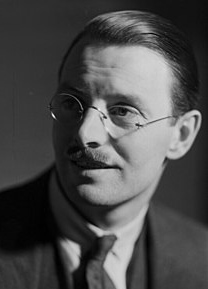
Cork born, John Francis Whelan [1900 -1991] possibly better known as Sean O’Faolain was one of the most influential figures in 20th-century Irish culture. A short-story writer of international repute; he was also a leading commentator and critic.
Sean O’Faolain
In his book “An Irish Journey”(from the Liffey to the Lee), latter published first in 1940, he reflects on his visit to Liberty Square, here in Thurles, Co. Tipperary.
Sean O’Faolain writes,
“Wild or not, these Thurles people have much more edge to them than the easy-going Clonmel folk. Their town shows it. The great wide square, concrete from pavement to pavement, the bright shops, every one of them well-dressed, the busy air of the streets even on an ordinary afternoon and the almost total absence of antiquities, marks this out as a modern business-town, “with no nonsense about it.”
And it has gone on improving every year. Old residents tell me that their fathers have handed to them a very different picture of an older Thurles, when as one of them said to me, “you could step from dung-heap to dung-heap in the square”. Hovels surrounded the centre of the town. The elder Dr. Callanan, the father of the present Dispensary doctor, told me he once handled 175 cases of fever in a single epidemic and he had handled typhus as well as typhoid.
Older traditions can revive the famine days, when people died in the fields by the ditches, their mouths green from eating nettles, even as Spencer records from an earlier period; while, in those unions which Dan O’Connell opposed so inexplicably, the dying were laid in rows upon rows on the floor.
An old man I met on the bridge told me he recalls the time when the town might have been thought of as composed of six shopkeepers, who made “pots of money” out of the Big Houses all about, and who were so many Gombeen-men, or tight-fisted, hard-screwing middle-men to the farmers. But he said they are gone now with the froth of the river.
(The River, by the way, is still the Suir: it rises not that much more than a mile away from the Nore up near the Devil’s Bit).
“They’re gone with the big houses on which they relied”, and he waved his hand over the river, past the old 12th century castle, the town’s only relique, down towards Fethard and up the river towards Templemore. “Archerstown House, Lanespark House, Killeen House, Ballysheehan, New Park, Mobarnane, Coolmore, Derryluskan, Brownstown House, Ballyronan , Lloydsboro, Inch…. How many of them are left now?. Ah, ‘tis a pity. For they were fine houses and gave great employment.”
“But surely the beet factory“, I protested, “must employ as many as the whole lot of them put together.” “Tisn’t alike”, he insisted, morosely. “Tisn’t alike, what’s a factory? Here to-day, gone tomorrow. What am I to a factory? No more than that shtone”, as he slapped the bridge parapet as if he wanted to crack his hand.
“They were dacent people – or the most of them were – and they attinded to the min that was working for ‘um. If a man got sick they’d give him the besht of the attention. If you get sick in the factory, what happens you, only to lie up and lose your wages, or maybe your job. Ah, tisn’t alike! There’s no nature in a factory.”
Nobody regrets more than the artist the passing of that old hierarchical form of society, so complete in its gradations of human order, still humanized in Ireland by contact with the natural life for the land, long after it had become dehumanized in England by the industrial revolution. But it had many faults even here. Its fatal weakness was that the Big House people felt themselves here, not merely of a different class to the worker and the farmer – which was natural since it happened to be true – but of a different race or religion or life mode and they took their political philosophy from England, whose problems were of a quite different nature. Master and man were not one entity, with right and proper distinctions between them, but two separate entities. And that does not work”.
To Be Continued. [Note: Part 2, the final part can be read HERE.
An Taoiseach Mr Micheál Martin, has remembered the life of Seán Treacy, latter one of the leaders of the 3rd Tipperary Brigade of the Irish Republican Army, during the Irish War of Independence; describing the Tipperary man as one of the great patriots of our revolution.
Mr Martin was speaking at the 101st Anniversary Commemoration of his death at his grave in Kilfeacle, Co. Tipperary.
Speech by An Taoiseach, Mr Micheál Martin TD, on the occasion of the 101st Anniversary Commemoration of the death of Seán Treacy, on Sunday 17th October 2021
“It is a great honour to stand with you in this place today, to remember the life of Seán Treacy, one of the great patriots of our revolution.
When the 3rd Tipperary Brigade Old IRA Commemoration Committee was formed 100 years ago those they sought to remember had only just left us. Their voices still resonated in the houses and hillsides of Tipperary – a tremendous source of pride and also of sadness about young lives cut short. Their friends, families and colleagues were determined that they would not be forgotten – that generations to come would learn of their names, their sacrifices and their dramatic achievements. They faced-down the military of the greatest empire the modern world would ever see – and they did this in the cause of inclusive republicanism. The roll of honour of the 3rd Tipperary Brigade includes people from throughout this area and reflects the determination of the people of Tipp to take a lead.
Picture shows aftermath of the shooting of Seán Treacy and Lieutenant Arthur Gilbert Price on Talbot Street in Dublin, on 14 October, 1920.
Seán Treacy, who regularly deferred to others when appointments were being made, would be embarrassed to know that his name stands above those of his comrades. But this is inevitable because of how many roles he filled not just in 1919-1920, but in the organisations leading the national revival in the following years. In a short 25 years he lived many lives – and it is no exaggeration to say that he reflected each of the elements which came together in the success of our revolution. The revolutionary generation was one inspired by language and culture – and dedicated to using education to achieve renewal.
Less than a lifetime after the national catastrophe and humiliation of the Famine, a new vision was being formed of a country with strong communities, a strong national culture and a belief in an Ireland which took its place amongst the nations of the world.
Treacy had the great fortune to be taught here in Tipperary by an exceptional personality, Cormac Breathnach – who was also known as Charlie Walsh. Into his class came Seán Treacy, Dinny Lacey, Dan Breen and Seán Hogan – leaving an indelible mark on them and in the future of our country.
Breathnach later became president of Conradh na Gaeilge, President of the INTO, Chairman of the Fianna Fáil Árd Comháirle, a TD and then Lord Mayor of Dublin. But even after holding all of these important roles, he always said that his proudest achievement was teaching these young men in Tipperary.
Treacy became an activist in Conradh na Gaeilge, joined the Volunteers and, at only 16, joined the IRB. Everyone who met him saw him as a man of determination and action. It was only a coincidence that the action in Soloheadbeg took place on the same day as the first meeting of Dáil Éireann – but it was remarkably symbolic.
Alone of the many revolutions which Europe saw in those years, the Irish one not just military, it was also democratic, administrative and legal. Popular legitimacy was sought and repeatedly retained. Fundamentally it was not a revolution about just repeating the methods of the past, it was about creating new realities and new possibilities for the Irish people.
In 1919 and 1920, the deeds of Seán Treacy inspired people throughout our island and abroad. The audacity of the rescue of Seán Hogan at Knocklong. The exploits of the Brigade’s flying column. The attempted ambush of Lord French and the escape from Fernside in Dublin, these and many more incidents made Seán Treacy and Co. Tipperary famous throughout the world, as symbols of a rising nation.
His tragic death in Talbot Street on 14th October 1920 cost us one of our finest, leaving us to wonder how much more he would have achieved had he lived. Perhaps the most striking thing is that even while he was under almost inhuman pressure as the Crown Forces hunted him through Dublin, his focus was still on the future.
May Quigley May Quigley was so saddened by the death of Sean Treacy that she left Ireland to start a new life in Australia.
Seán Treacy was due to marry May Quigley only days (11 days) after his shooting. We can only imagine how she felt, as their plans for building a life together in a new Ireland were shattered irrevocably. In his short 25 years on this earth Seán Treacy was a restless and determined figure. Improving himself, participating in a great cultural revival and then dedicating his life to his community and his country.
There is something wonderful and poignant about the commemoration which is held on Talbot Street every time Tipperary gets to the All-Ireland Final. On a festive day for the whole community, time is made to honour Treacy and what he represents. A community passionate about its sporting heroes of today, stops to remember its greatest hero of the past.
A modern community, at the forefront of many new technologies as well as innovative traditional industries, having the self-confidence required to pay respects to the giants on whose shoulders we all stand. I have always believed that it is up to each person to find their own connection with and understanding of our revolution. We owe it to them to those who sacrificed so much for us to understand their times and to continually renew the traditions which they personified. They both represented major international intellectual and cultural movements – and established our own distinct identity. They were not little-islanders as some have tried to say.
The state which we live in today is one of the oldest continuously democratic countries in the world. The national movement which Seán Treacy and the people of Tipperary played a leading role, was deeply international – and it was republican to its very core. The founding document of our revolution, the Proclamation of 1916, inspired so many because of the vision it presented of a diverse and inclusive nation. Ours was the only European revolution of that time which demanded that women play a full part in the political nation – and the only revolution which said that different traditions all form part of Irish identity.
Tipperary’s own Thomas MacDonagh was, just like so many others, inspired by the language movement – but his greatest work of literary criticism, one which is still taught in our universities today, insists on the unique Irish voice of literature written by Irish people in English.
The message of our revolution was of a people who wanted to work with other nations in a spirit of friendship. That is why in 1937, at a dark moment in world history the Irish people, led by the most senior survivor of the Rising, adopted in a free referendum a constitution which honoured international law and rejected the growth of extreme ideologies of the right and left.
If we want to know why Ireland is one of a handful of European countries to have avoided these violent extremes, all you have to do is look at our great revolutionary generation. With legitimacy from the communities they never lost touch with, and a commitment to a generous republicanism, they gave us a priceless inheritance. And of course, the final action of our great revolutionary generation was to set on the course for membership of what is now the European Union.
Like Treacy, Seán Lemass was only a teenager when he began to risk his all for his country – and as he headed towards retirement, he devoted his great energy to the cause of reconciliation on this island and securing our place as part of a powerful community of nations. And it is because we are positive Europeans that Europe has stood so steadfastly at our side as we all try to manage the impact of Brexit.
What we’ve seen in recent months and years is a remarkable willingness to engage with and respond to the views of the Irish people on all parts of our island. In 1998 we saw the triumph of a democratic republican vision of working for lasting reconciliation and peace on our island. For the first time in our history we created a shared vision of how to work together and how to deal with problems. From the very first moment the European Union has been a fully committed partner for peace. The Union has supported peace financially and it has shown a unique flexibility at every moment in terms of trying to protect and promote the Good Friday Agreement. Indeed, if you look at the text of the Agreement, you will find Europe mentioned repeatedly in terms of both North/South engagement and the operation of Northern Institutions.
Europe is in the DNA of the Agreement – a binding treaty which was ratified by two referendums and two sovereign parliaments. But equally, we have all accepted the reality of the decision of Brexit referendum, even though it was rejected by the people of Northern Ireland. This week the European Commission responded to the concerns of people in Northern Ireland in a comprehensive and ambitious way. The package they have proposed manifestly provides the basis for concluding negotiations and getting back to the work of co-operation and development. The Irish people and the Irish government have demonstrated good faith at every stage. The European Commission has gone to exceptional lengths to demonstrate its good faith in responding to issues which were not of its making. If everyone demonstrates this good faith, then we can deal with this quickly and move on.
The people of this island have shown remarkable resilience and growth over the last century. We have achieved incredible things, while always demanding of ourselves that we must do better. We have been able to do this because of a generation of men and women who committed themselves to renewal and a republican commitment to building a state which seeks to serve its people and build partnerships with others. Twenty five years were not enough to show us everything which Seán Treacy could achieve for the people he was so passionate about – but they were enough to mark him as a great Irishman and a great republican. Some 101 years after he was shot down on a Dublin Street it is right that we continue to come to this place to honour him. To honour his comrades and to honour everything which they achieved for the Irish people”.
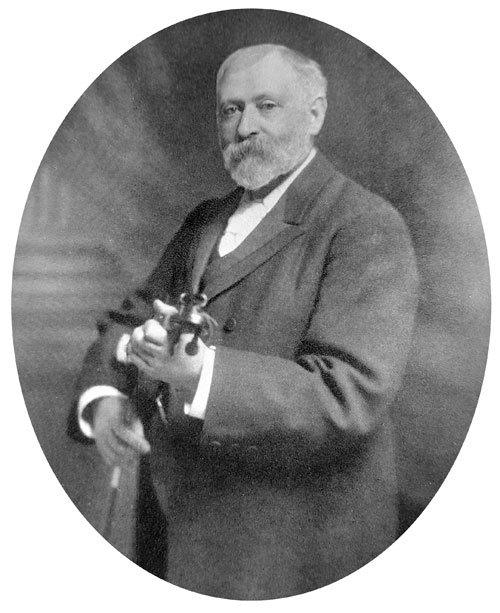
The year was 1914; the visiting English tourist to Thurles was Mr M. W. Quirke. Details of his experience as a tourist here in Thurles is contained in a book entitled “Recollections Of A Violinist”, with same dedicated to his seven sons, Conal, Dathy, Brian, Frank, Terence, Raymond and Septimus.
Those responsible for marketing our ‘Tourism Product’, take note.
With the chat locally nowadays mostly about the supposed 9 – 12 million upgrade to Liberty Square in Thurles, this unabridged passage from Mr Quirke’s published travel book reads as follows:-
Thurles
“I continue walking along the dusty road, and after a long weary plodding, I come to two rows of houses facing each other. On the whitewash walls of each facing me is an advertisement running thus:-
Mary Doolin Entertainment for man and beast, To be drunk on the premises.
and a curious drawing of two pipes crossed. I have now arrived at Thurles and on entering one of those houses I asked if I can have lunch.
I am received with a look of curiosity mixed with surprise and asked if I didn’t know it was Friday, as of course there is no meat in the house. I thank the good woman and enquire if there’s anywhere else I might find accommodation and start for a place indicated, but history repeats itself, only this time I am informed that “Friday is the day the Lord died, there would be no use at all, at all cooking mate, as no dacent-minded Catholic would ate it”.
After this second defeat, which, by the way, did not appease my hunger in the least, I proceed through the city in quest of an hotel, and arrive at a kind of square in the centre of which stands a large haystack. This looks strangely incongruous with shops around it. But, welcome sight, an Inn occupies a corner and not far off is a Cathedral with beautiful stained windows. Albeit a somewhat small building to be so termed, it contains paintings and a sculpture of a high order.
I now direct my steps to the hotel, which I find is Mr Michael Ryan’s Inn. This establishment is reached by mounting three stone steps, but as the second one has, for some reason been removed, or fallen out, I find it necessary to jump from the bottom step to the top, holding on to the half-door meanwhile.
I am soon in a small space, presumably the bar, behind which stands a young woman, to whom I address myself and ask if I can have lunch. With a look of surprise she says “Why sir today is Friday”. I acknowledge I have been reminded of that fact several times before. She continues, “I don’t think we have anything in the house, but will you please ask Mr Ryan”, pointing to the yard where I can see but one man who looks like an ostler [Latter a man employed to look after the horses of people staying at an Inn], with a sponge in one hand and a bucket in the other.
Approaching, I enquire if he is Mr Ryan, and ask if I can have some food, as I have a long journey before me, being on my way to Dublin. He scratches his head and says, “You see, Sir no respectable Catholic would be seen doing business with a butcher on the day the Lord died, but I don’t like to be beaten for I know you won’t have another chance of getting a meal until you get to Dublin. Could you put up with a salmon?” My reply is “Certainly and only too happy to be so well provided for”.
“Well so just take a walk over to the Cathedral, if you have never been inside of it before. If you have time ask Timm Cassidy, the cobbler whom you will observe sitting near the haystack, why the people allows such a disfigurement to exist in the heart of the city. Be here in half an hour’s time and we will have something for you. Don’t worry about the train” he adds, “as it will be time to leave here when it is supposed to leave the junction, for goodness knows what time you may get away”. I assure Mr Ryan I am quite content to place myself in his hands and went my way to the Cathedral.
Passing the haystack I am again struck with the absurdity of its position, as with the loose hay lying about in the vicinity, it gives a most untidy appearance to what would otherwise be a nice little Square. But here I observe a man sitting at one end of the stack, sewing with waxed thread, a shoe held between his knees; and every time he draws the thread through his hands he makes a peculiar noise by breathing hard through his teeth. This interests me, so I draw near to him and one or two other idlers who seem to be also interested.
Remembering the hotel keeper’s hint, I asked him, “Why do the people allow this haystack to stand here?” I am at once treated to a heated denunciation of the family who persist in their old claim to have a haystack in the heart of the town, which at every election or other gathering is sure to get burnt down. And the people of the Square pay for it’s resurrection, as they have done hundreds of times before.
A peculiar hissing noise made whilst the wax thread is being used and the quick spasmodic tones of the speaker, add a most grotesque accompaniment to his tale.
I now remember the Cathedral and quicken my pace for I have used a good deal of my half hour. After making a fairly good jump I land on the other side of a large lock and in one step am just outside the building.
How shall I describe the view that meets my eye? Here is wealth, beauty and art; splendid marbles, superb paintings and every indication of culture, taste and comfort, all provided by subscriptions from the poor hard-working peasantry. Lost in reflection on a museum of such refinement existing in the midst of the deepest poverty, I retrace my steps and again jump the small swamp which separates all this grandeur from the real hard life around it.
Soon I am comfortably seated before a fine salmon weighing 7 or 8 pounds; a large dish full of floury potatoes; two or three tiny bottles of the Claret one meets with in the cafés on the other side of the Channel; and a large rhubarb tart.
I soon make a good meal off the salmon’s shoulder and after a most satisfying lunch seek the proprietor to thank him for his courtesy and settle my bill. I cannot help noticing a merry twinkle in his eye as I approach him. And now occurs a scene which I venture to say could not have been enacted anywhere but in Old Ireland.
Inquiring the amount of my indebtedness, Mr Ryan, taking two steps back, explains, “Do you think, Sir, I could charge anybody for a little bit of salmon after the treatment you have received in the city?I should be ashamed if you went to England and told them what a mean lot we were over here. Tis a nice opinion they would have of us. I am only sorry you did not have any good solid food, only I had none in the house and I am ashamed to own it”.
“Mr Ryan”, I reply, “I cannot allow myself to leave Thurles without discharging my obligations. I assure you I heartily appreciate your extreme kindness in the treatment I have received, but beg of you to be kind enough to allow me to pay”.
Here he burst into a fit of laughter and says, “I suppose you will be by asking next for me to make a special charge for the Claret, for drinking which, heaven knows, the Humane Society should award a medal”.
Seeing I have no chance of settling what I have had, I now boldly invite him to have some of the best whiskey in the house with me. He responds he will do so with pleasure and adds “I have an old drop my mother gave me years ago and it is the real John Jameson”.
Together we repair to an inner room, passing on to which I overheard Mr Ryan instructing his assistant to say that if anyone wishes to see him he is very particularly engaged. Then he opens a box of Havana cigars and ere I can possibly prevent him, forces nearly a dozen into my overcoat pocket. He also put two more on the table to be smoked with the whisky.
What amazing intelligence did I find in this man! How comprehensive was his query “Did I form any opinion as to how much of the money spent on the Cathedral might have been devoted to relieving the poverty round it?
To conclude he put a horse into a trap and drove me himself to the train, leaving me sore from kindness and with plenty of time to ruminate over one of my experiences in this remarkable country. Nor can I easily forget his last words as turning away from me with an air of impatience, when I tried to thank him for his generous conduct, he said “Goodbye come again any day but Friday and we will try to redeem our characters for the shabby treatment we’ve given you and remember you can’t lose your train, for ’tis always most conveniently late.”
This website uses cookies to improve your experience. We'll assume you're ok with this, but you can opt-out if you wish.AcceptRead More
Privacy & Cookies Policy
Privacy Overview
This website uses cookies to improve your experience while you navigate through the website. Out of these, the cookies that are categorized as necessary are stored on your browser as they are essential for the working of basic functionalities of the website. We also use third-party cookies that help us analyze and understand how you use this website. These cookies will be stored in your browser only with your consent. You also have the option to opt-out of these cookies. But opting out of some of these cookies may affect your browsing experience.
Necessary cookies are absolutely essential for the website to function properly. This category only includes cookies that ensures basic functionalities and security features of the website. These cookies do not store any personal information.
Any cookies that may not be particularly necessary for the website to function and is used specifically to collect user personal data via analytics, ads, other embedded contents are termed as non-necessary cookies. It is mandatory to procure user consent prior to running these cookies on your website.





Recent Comments