Here in Co. Tipperary, we remember two victims of the Dublin bombings; both murdered in the city, forty seven years ago today.
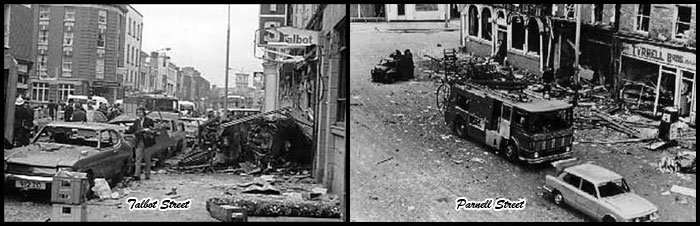
In Dublin city three car bombs were detonated without warning, during rush hour on the 17th of May 1974.
The first victim, Miss Breda Turner, then aged just 21, was working in the Office of the Revenue Commissioners; the primary State Body responsible for the assessment and collection of taxes and other duties, here in the Republic of Ireland. Originally from Thurles, in Co. Tipperary, she had moved to Dublin and was engaged to be married on the following Easter.
Ms Turner sadly was murdered in the Parnell Street explosion. (See second picture above).
The second victim was Mrs Maureen Shields, aged 46, originally from the village of Hollyford, Co. Tipperary. Mrs Shields had moved to Dublin, where she worked in the Civil Service, until her marriage to husband Leo in 1953. The couple had one son and two daughters.
Mrs Shields, sadly, was murdered in the Talbot Street explosion. (See first picture above).
While the Dublin bombings, in 1974, were the biggest mass murder in the history of the Irish State, no one person has ever been charged with these crimes.
The Ulster Volunteer Force (UVF), a loyalist paramilitary group from Northern Ireland, claimed responsibility for the bombings in 1993.
Former Northern Ireland Police Ombudsman, Baroness Nuala O’Loan(Member of House of Lords of the United Kingdom), found that Special Branch officers gave the killers immunity and ensured that the murderers were never brought to justice.
It is at this time that we also remember MrGeorge Bradshaw, a Tipperary victim of the Dublin bombing of the 1st of December 1972.
Mr Bradshaw, aged just 30 years, was a bus conductor from Fethard, in Co. Tipperary; one of two male victims who died when a car bomb exploded at Sackville Place, Dublin at approximately 8.15pm on that fateful day. Both victims were bus drivers with CIE and brutally murdered, having just left the nearby CIE Workers’ Club.
Mr Bradshaw had only moved to Dublin less than two years previously. Married to wife Kathleen, a nurse from Belfast; both then parents to two young children, Lynn and Rory.
In a statement today, the Government said is was fully committed to seeking out the truth behind those events and, hopefully, to secure some measure of comfort for the victim’s families and the survivors.
They further stated they would continue to develop and establish effective ways to address the legacy of the troubles, including implementation of measures agreed in the Stormont House Agreement, so as to meet the legitimate needs and expectations of all victims and survivors.
With the country wisely making staycation holiday plans this year, the government has given hard-pressed families an uplift, by waving the cost of admission charges at all OPW sites for the rest of 2021.
Traditionally, except for the first Wednesday of each month, families had to shell out for an annual OPW heritage ticket to avail of free access to our best-loved castles, gardens and ancient sites, latter costing some €90 for a family pass.
In announcing this decision, Minister of State Mr Patrick O’Donovan stated that with a growing list of open heritage sites and the easing of travel restrictions, we have a renewed opportunity to explore the treasures which the OPW has in trust for the nation.
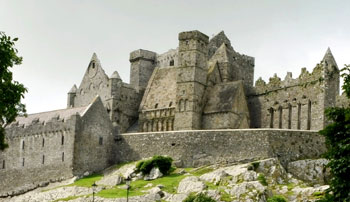
While the news is no doubt a limited blessing for holidaying families here in Tipperary, currently as yet only some OPW sites in the county are open and those that are, namely Cahir Castle, Ormond Castle and the Rock of Cashel, are only offering admission to their outside areas.
The Library Service of Tipperary County Council is undertaking an exciting and important project that will see library staff digitise a wealth of historical documents currently held by the service.
These documents include Poor Law Union Minute Books, Rate Books, and Workhouse Registers. Since January 2021, staff have focused on digitising the 90 or so books in its collection that relate to the pre-famine and Great Famine era beginning in1846.
These books provide a fascinating and detailed insight into the harrowing life and workhouse conditions faced by our ancestors across the six Poor Law Unions of Thurles, Borrisokane, Cashel, Clogheen, Clonmel, Nenagh, Roscrea and Tipperary.
Once digitised, the records will be made available to view in full and for free via the Tipperary Studies digital website tippstudiesdigitsl.ie.
The scope and significance of the project, the bulk of which will be undertaken in Thurles Library, deserves much praise and recognition. By digitising these records and making them freely accessible, people across Ireland and the world will be gifted with details and descriptions that will further enrich our understanding of the Great Famine era. The digitised records will also enable individuals, no matter where they are in the world, to research their ancestry. For more information on this welcomed and praiseworthy initiative visit tippstudiesdigital.ie.
Double Ditch, Mass Path, Right of way
Another artifact from the Great Famine era of significant historical importance to the town of Thurles is the Double Ditch Mass path. Built by our starving Thurles ancestors during the Great Famine, this historical walkway now faces destruction as part of a planned development by the same Tipperary County Council.
Thus it would appear that as one branch of Tipperary County Council dedicates its efforts to the preservation of history from the Great Famine era, another branch seems determined to demolish it. It is difficult to understand this contradiction in practice, between Tipperary County Council departments, led by Chief Executive Mr Joe MacGrath. The admirable actions of the Library Service are regrettably inconsistent with the actions of other services. One service sets out to preserve history, as another sets out to destroy it.
Although the future of the Double Ditch remains uncertain for the moment, its fascinating history and related primary sources have been documented on Thurles.info, together with aerial video and photography of the walkway as can be viewed today.
Maybe the digital records shown on Thurles.info will be all that remains of the Double Ditch for future generations, particularly if local TD’s, councillors and council officials get their way?
Let’s hope other historical treasures don’t succumb to the same fate and find that their only record is a digital one.
For more information on the Thurles Double Ditch click HERE and HERE.
Thursday, April 22nd next, is ‘World Earth Day’ and the Rediscovery Centre and the Natural History Museum of Ireland are offering a unique and free opportunity for primary school pupils.
This free 1 hour online event, for 3rd to 6th class pupils, takes place from 11:30 am to 12:30pm, as already stated on April 22nd. The session, entitled “Cool Fossils and Hot (Climate) Facts”, begins with a half hour exploration of Ice Age fossils from Ireland. Pupils will be enabled to learn about the Woolly Mammoth, Spotted Hyena, Giant Deer, Brown Bear and Grey Wolf.
The second half of this not-to-be missed session, invites pupils to learn about climate change. Pupils will be enabled to investigate how CO2 causes global warming, with the help of some fascinating experiments.
To take part in this event and to view its associated resources you can register via eventbrite.ie, by simply clicking HERE.
The theme for this year’s ‘World Earth Day’ is ‘Together, We Can Restore Our Earth’. For more information on ‘World Earth Day’ visit HERE.
Royal Irish Constabary (RIC) Barracks, Drombane village, Thurles, Co. Tipperary 1920.
Holycross barracks is about four miles from Thurles and five (miles) from Drombane. The barrack stands in the middle of a thickly wooden country, about one mile beyond the historic Abbey of Holy Cross, on the road to Cashel and there are few houses in the vicinity.
Image above – Main StreetThurles, 1920.
Same image 100 years later – Liberty Square, Thurles, (previously Main Street) 2021.
The attackers opened a fierce fire, shortly before 9 o’clock, some of the bullets evidently coming from the tree tops and front roof of a dwelling opposite the building. The police garrison of 9 men vigorously replied; the besieged citadel spitting out an incessant stream of bullets and hand grenades, while occasionally relief rockets were sent up.
Like an earthquake. In the thick of the onset, a party of the attackers dashed right up to the barracks carrying ladders, pickaxes, sledges and crowbars. They made for the eastern gable, which having no windows or opening, when once reached, would place the attackers out of the danger zone. Two bombs were placed in position and a loud explosion followed. The noise of the explosion was heard in Thurles and according to defending constables, the whole building rocked and reeled as if there was an earthquake.
Nobody, however, was injured but a portion of the roof was blown away and a huge hole was made in the ground. During the attack the raiders placed a long ladder against the gable and hacked a hole, about 2-ft square, on the top portion of the wall, but did not penetrate fully. Evidently it was intended to hurl explosives through the aperture on the defenders.
The battle raged with unabated vigour and occasionally above the din could be heard, now and then, the screaming of the children in the house opposite the barracks; the roof of which was occupied by snipers.
Notwithstanding that rockets were frequently sent up by the garrison, no relief came and at 10:30 the attackers fire ceased, owing it is believed to a lack of ammunition. Another theory is that the ceasefire was ordered because it was thought, owing to the screaming of the children, that somebody in the house had been hit. During the attack all roads leading to Holycross were blocked by felled trees, while all telegraph wires in the neighbourhood had been cut. All person’s travelling in the district were held up and kept prisoner by armed outpost.
Policeman Captured. Constable Donoghue (Name may be incorrect as other reports state Constable McCloskey), when returning to his station, was captured, blindfolded, searched and held prisoner, while the attack was in progress. A party of card players returning home were also held up and detained in custody by the attackers. The mansion of Mr C. N. Clark D.L. (Deputy Lieutenant) landlord of the barracks is 100 yards away and this was closely guarded during the attack; nobody being allowed in or out.
Question in Parliament:
Mr. James Lonsdale, (Unionist Member of Parliament for Mid Armagh from January 1918 until his death in 1921). To ask the Chief Secretary to the Lord-Lieutenant of Ireland whether he has received particulars of the attack made by a crowd of persons on the house of Mr. Charles N. Clarke, D.L., at Holycross, County Tipperary, on the night of the 17th (18th) instant; what damage was done to the house; were any of the police injured; and have any proceedings been taken against those who organised the attack.
Answered by Mr. Augustine Birrell. (British Liberal Party politician, who previously was Chief Secretary to the Lord Lieutenant of Ireland from 1907 to 1916.) Eight arrests have been made this morning in connection with this case. As proceedings are pending, it is not desirable to enter into further particulars.
All the windows are smashed, some bullets having pierced the steel shutters, while all the woodwork is riddled with bullets, some of which can be seen sticking out of the timber. Notwithstanding all the bullets and grenades fired not one drop of blood was spilled. (Some of the police did receive cuts from glass splinters) The force of the explosion was so great that some of the houses in the village where shaking.
An old age pensioner living a mile from the scene said that as soon as he heard the firing and saw the flare of the rockets, he knew “there was some devilment going on”, and he went to bed on the spot.
The newspaper article concludes.
Involved in the Holycross attack on the barrack on that Sunday night, January 18th, 1920 where:- Paddy Ryan, Richard and James Phelan, James Kelly, Hugh Long, Patrick Lennon, Michael Bartley, Richard (Dick) Scott, Richard (Dick) Purcel, Mathew Connolly, Edmund Maher, Thomas Moore, William Phelan, Jack Moore, James Kealy, Jack Darcy, Christy Cody, Michael (Mick) Coady, Michael (Mick) Ward, Bill Buckley, Patrick Purcell, Watt Buckley, James Alexander, John McConnell, Michael Maher and Patrick Moore. The main purpose of the attack was to acquire further arms, explosives and ammunition.
This website uses cookies to improve your experience. We'll assume you're ok with this, but you can opt-out if you wish.AcceptRead More
Privacy & Cookies Policy
Privacy Overview
This website uses cookies to improve your experience while you navigate through the website. Out of these, the cookies that are categorized as necessary are stored on your browser as they are essential for the working of basic functionalities of the website. We also use third-party cookies that help us analyze and understand how you use this website. These cookies will be stored in your browser only with your consent. You also have the option to opt-out of these cookies. But opting out of some of these cookies may affect your browsing experience.
Necessary cookies are absolutely essential for the website to function properly. This category only includes cookies that ensures basic functionalities and security features of the website. These cookies do not store any personal information.
Any cookies that may not be particularly necessary for the website to function and is used specifically to collect user personal data via analytics, ads, other embedded contents are termed as non-necessary cookies. It is mandatory to procure user consent prior to running these cookies on your website.







Recent Comments