The Battle of Trafalgar (21 October 1805) was a sea battle fought between the British Royal Navy and the combined fleets of the French and Spanish Navy and was the most decisive British naval victory of the Napoleonic Wars (1803–1815). Let’s now look at it from a modern day good humoured perspective.
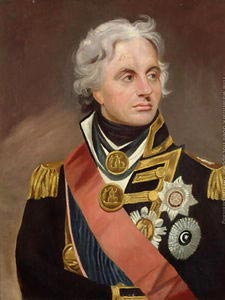
Admiral Lord Horatio Nelson
Admiral Lord Horatio Nelson aboard HMS Victory : “Order up the signal, Hardy.”
Captain Thomas Hardy: “Aye, aye Sir.”
Nelson: “Hold on here, that’s not what I dictated to Signals. What’s the meaning of this?”
Hardy: “Very sorry sir?”
Nelson (reading out aloud): “England expects every person to do his or her duty, regardless of race, gender, sexual orientation, religious persuasion or disability! From whence cometh this gobbledygook?”
Hardy: “ New Admiralty policy Admiral, I’m afraid, Sir. We’re an Equal Opportunities Employer now. We had the devil’s own job getting it past the censors, lest it be considered racist.”
Nelson: “This is madness Captain, hand me my pipe and tobacco.”
Hardy: “Sorry Sir. All naval vessels have now been designated smoke free working zones.”
Nelson: “In that case, break open the rum ration. Let us splice the mainbrace and fortify the men before going into battle.”
Hardy: “The rum ration has been abolished, Admiral. Its part of the Government’s policy on binge drinking.”
Nelson: “Good heavens, Hardy! Well I suppose we’d better get on with it, full speed ahead.”
Hardy: “I think Admiral, you’ll find that there is a 4 knot speed limit in this stretch of waterway.”
Nelson: “Damn it man! Here we are on the eve of the greatest sea battle in the world’s history. We must advance with all dispatch. Report from the crow’s nest immediately.”
Hardy: “That will not be possible, Sir. Health and Safety have closed down the crow’s nest, Sir. There is no harness and they said that rope ladders don’t meet with present EU regulations. They won’t let anyone up there until a proper scaffolding can be erected.”
Nelson: “Then get me the ship’s carpenter without delay.”
Hardy: “He’s busy knocking up a wheelchair access to the foredeck, Admiral.”
Nelson: “Wheelchair access? I’ve never heard anything so absurd.”
Hardy: “Health and safety again, I’m afraid Sir. We have to provide a barrier free environment for the differently abled.”
Nelson: “Differently abled? I’ve only one arm and one eye and I refuse even to hear mention of this word. I didn’t rise to the rank of Admiral by playing the old disability card.”
Hardy: “Actually, sir, you did. The Royal Navy is under represented in the areas of visual impairment and limb deficiency.”
Nelson: “Whatever next? Give me full sails, come the salt spray beckons.”
Hardy: “A couple of problems here too, Sir. Health and safety won’t let the crew up the rigging without hard hats. And they don’t want anyone breathing in too much salt water, haven’t you seen the TV and newspaper adverts?”
Nelson: “I’ve never heard of such infamy. Break out the cannon and tell the men to stand bye at the ready.”
Hardy: “The men are a bit worried about shooting at anyone, Admiral.”
Nelson: “What? This is mutiny!”
Hardy: “It’s not that, Sir. It’s just that they’re afraid of being charged with murder if they actually kill someone. There’s a couple of free legal-aid lawyers on board, watching everyone like hawks.”
Nelson: “If England expects that every man will do his duty, then how in gods name are we to sink the French and the Spanish ships?”
Hardy: “Actually, sir, we’re not.”
Nelson: “We’re not?”
Hardy: “No, sir. The French and the Spanish are our European Union partners now. According to the Common Fisheries Policy, we shouldn’t even be in this stretch of water. We could get hit with a claim for compensation.”
Nelson: “My men must hate the French and Spanish as they hate the devil himself.”
Hardy: “I wouldn’t let the ship’s diversity co-ordinator hear you saying that Sir. You’ll be up on Disciplinary Report.”
Nelson: “You must consider every man an enemy, who speaks ill of your King.”
Hardy: “Not any more, sir. We must be inclusive in this multicultural age. Now put on your Kevlar vest; it’s the rules. It could save your life.”
Nelson: “Don’t tell me, it’s health and safety again. Whatever happened to rum, sodomy and the lash?”
Hardy: As I explained, sir, rum rations are cancelled and there’s a ban on corporal punishment.”
Nelson: “What about sodomy?”
Hardy: “I believe that sodomy is now legal, sir.”
Nelson: “In that case you can kiss me, Hardy.”
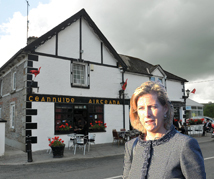
Sophie Rhys-Jones wife of Prince Edward visits Upperchurch, Co.Tipperary
Members of the British Royal family and billionaires mixed with local mourners yesterday when the picturesque village of Upperchurch bade farewell to a former close confidant of Princess Margaret.
The late Ned Ryan, from Upperchurch, Co Tipperary, got an emotional send off in his home village from all sections of society including the Countess of Wessex, Sophie Helen Rhys-Jones, wife of Prince Edward who attended on behalf of the British Royal Family. Also in attendance was Joseph Cyril Bamford, (J.C.B) Norma Smurfit, Galen Weston (Brown Thomas), Lord David Linley, son of Princess Margaret, Countess of Snowdon and the 1st Earl of Snowdon and Tipperary All-Ireland winning manager Liam Sheedy.
Armed gardai supported by local officers were keeping a close watch at yesterday’s funeral where security was tight on all approach roads to the Sacred Heart Church in Upperchurch where over 1200 people gathered to pay their last respects to Mr Ned Ryan, latter who during his lifetime returned home to Upperchurch regularly and was in constant contact with family.
Local priest Fr. Loughlin Brennan, a family relative of the deceased, who conducted the funeral ceremony, told the congregation: “Ned did not die alone but with the people he loved most. At 78 years of age, I would have wished him a longer life, but couldn’t have wished him a better life,”
Mr Ryan’s sister-in-law, former teacher Joan Ryan, thanked all who had travelled from near and far including the many distinguished people who had attended to say their last goodbye’s.
A large marquee had been erected in the village for the mourners to gather for refreshments, following the burial and the Countess of Wessex returned to Kinnane’s public house for tea and scones, hosted by Niamh and Siobain Kinnane, before leaving the area by helicopter.
Prince Edward’s wife Sophie Helen Rhys-Jones, as their helicopter passed over Thurles sky’s, was probably unaware that her husband is a direct descendant of Viscount and Lady Thurles through their eldest son, the Duke of Ormond and that Thurles is the home of the present heirs to the British Crown. The Duke of Ormond’s daughter, Elizabeth, married Philip Stanhope, 2nd Earl Chesterfield, and their daughter Elizabeth Stanhope married John Lyon, 4th Earl Strathmore. Six generations later in direct line was the 14th Earl Strathmore whose daughter, Elizabeth Bowes-Lyonmarried the future King George VI; parents of reigning queen, Her Majesty Elizabeth II and the grandparents of Prince Edward, now seventh in line to the throne.
Persons wishing to convey a message of condolence can do so by clicking “Comments” hereunder.
One of the last links with the late Princess Margaret, Countess of Snowdon (Margaret Rose; 21 August 1930 – 9 February 2002) younger sister of Queen Elizabeth II and the younger daughter of King George VI and his wife Queen Elizabeth, has been lost, with the death earlier this week of Mr Ned Ryan, the Irish-born property figure who became one of the late Princess’s closest confidants.
The Late Ned Ryan Pictured with Princess Margaret, Actress Joan Collins, Jane Spencer-Church and Ned himself attending the Funeral of Robert Sangster in London.
Ned, The Line, Shevry, Upperchurch, Thurles and Ovington Street, London who never married, died on Tuesday after a lengthy battle with cancer, at the Chelsea and Westminster Hospital .
The son of a Tipperary farmer, Ned, a one-time London bus conductor, had an antique stall in Portobello Market when he first got to know Princess Margaret some time in the 1970s. His first introduction came about when he was seated next to her at a dinner party held by the Russian/Swiss actress,designer Anouska Hempel. (Latter born Anne Geissler of The Kiss of the Vampire, On Her Majesty’s Secret Service, Space 1999 fame.)
During Margaret’s turbulent romantic life, it was to Mr Ned Ryan that she turned as a friend and escort for outings to the theatre and ballet. Once he even took her to a Rolling Stones concert where he famously shielded Margaret’s gaze from prying press reporters with his jacket. They would often be seen dining out together in restaurants such as Poissonnerie de l’Avenue in South Kensington, or Le Caprice and Harry’s Bar in Mayfair. He would also cook Irish stew for her in his Knightsbridge kitchen.
Of his friendship with Princess Margaret he recalled: “When we met at that dinner party, I had begun running a stall selling antique silver in the Portobello market and she wanted to know where I got my stock from. I told her I went to Bermondsey early on Fridays and she asked if she could come with me. So next Friday I took her there very early in the morning and she sought out pieces of porcelain as I looked for silver. She loved it and we became great friends.”
This excursion to Bermondsey was supposed to be a private occasion, but largely because of Ryan’s chivalrous behaviour in flinging his cloak, Walter Raleigh style, over a muddy puddle in the market, ensuring Margaret would not have to get her feet wet, the stallholders soon realised who she really was. Press photographs were soon on the scene and the visit was reported widely in the press. Margaret, however, seemed not to greatly care and Ryan did indeed become her lasting friend and often her companion at Ascot and the fashionable Caprice restaurant in Mayfair with her cousin, Lady Elizabeth Anson. Indeed he was one of Margaret first friends, called by Viscount Linley, with the sad news of the late princesses death.
His death along with that of other’s of Princess Margaret’s regular companions, Norman Lonsdale, and more recently Lord Glenconner, brings the curtain down on a generation of close friends of the Princess.
Deeply regretted by his loving brothers Pakie and Tommy, sister Chris, sister-in-law Joan, brother-in-law Michael, nieces, nephews, grandnieces, grandnephews, relatives and friends in Ireland, England and indeed worldwide, Ned Ryan’s body will be interned in Upperchurch local cemetery following Requiem Mass at 2 o’c in The Sacred Heart Church, Upperchurch today (Monday).
“And, as a hare whom hounds and horns pursue
Pants to the place from whence at first he flew,
I still had hopes, my long vexations past,
Here to return–and die at home at last.”
(From Oliver Goldsmith, The Deserted Village.)
A Memorial Service to Mr Ryan will be held in London, to be arranged at a later date.
Minister for Agriculture Brendan Smith pulled a ‘Joe Jacob‘ last week by announcing that the government would use European Union funding to buy 53 tonnes of its own Irish cheddar and distribute it for free from November 15th next. This initiative, which has been running since 1987, is funded by the EU’s food aid programme.
Please do not be duped, this is not a demonstration of a soft sympathetic caring Coalition Government, but rather a “social measure” whose primary objective will have the effect of reducing intervention storage costs of cheese at EU level.
Coalition Cheddar For Unemployed Plebes
This cheese scheme has been running for the past 22 years and the overall budget programme has increased from just €100 million in 1988 to €478 million for member states this year. Ireland’s share of this budget is €818,816, or approximately 0.17 per cent.
This cheese will be available for charities to collect from stores in Clondalkin, Co Dublin; Portlaoise, Co Laois; Kilmacthomas in Co Waterford; and Cobh and Togher in Co Cork sometime after November 15th next. Extra costs will be incurred by charitable organisations attempting to transport this valuable commodity back into Co Tipperary in the form of motorway tolls. One way however to get around this extra toll cost would be to use garda drivers. Under section 62 of the Roads Act 1993, interestingly enough,vehicles driven by members of an Garda Siochana are exempt from motorway tolls, e.g. Government Ministers cars.
More than €750,000 in EU funding will be spent on this cheesy scheme, with a total of 167 tonnes of this product to be distributed in boxes of 12 x 1kg blocks. The total amount of cheese to be distributed works out at about one slice of cheese for each of Ireland’s present adult population.
Brendan’s announcement would be hilariously funny, were it not that economic matters are so damn serious in this green and present land, which is just a few months away from intervention by the dreaded International Monetary Fund, who will soon be manning the desks of the Department of Finance.
To say the least it was vulgar and for TV viewers who already pay a television licence fee, it was speculative to the very point of extortion. It demonstrated truly the depth to which our TV hierarchy will condescend to acquire profit, which will go to feed the salaries of very mediocre celebrity presenters and their researchers, former who publicly admit that they should qualify for pay equal to that currently enjoyed by professional footballers.
I am referring of course to the recent cheaply produced documentaries which attempted to ascertain Ireland’s greatest person. Viewers, invited to vote for their favourite candidate, were duped into being charged nine times the standard telephone rate to have their choice recorded. These cheap productions were then repeated for licence paying viewers, at least twice over the past number of weeks, again with viewers of these shows expected to pay 60c to vote by text or by calling a premium number, to register their choice for the ‘Greatest Irish Person’ in history. The rate charged was nine times the cost of texting Liveline, the radio show hosted by Joe Duffy.
Research for this programming was bad, with Biographical facts omitted in some cases. In the case of James Connolly, the foundation of the Labour Party was demeaned and in the case of the Irish revolutionary leader, Michael Collins, many important facts were suitably forgotten.
It was how they dealt with the greatest Irish man of them all, General Michael Collins, that vexed me mostly.
We here in Co.Tipperary are well versed with events at Béal na mBláth, (English Translation: Mouth of the Flowers) Co.Cork on that sad evening of August 22nd, 1922, so allow me to bring our TV hierarchy up to date.
Firstly, let me proclaim that Tipperary, as a county, has contributed more to our nations development and has more history per square mile to offer visitors, than any other county in Ireland. Regrettably, and despite no shortage of funding to those charged with marketing, we do not promote our historical assets to best tourism advantage.
Cork Historian Late John Hourihan visits Denis ‘Sonny’ O’Neill’s Grave in Tyone, Nenagh, Co. Tipperary.
When next you wend your way from Nenagh back towards Thurles, a small graveyard, which contains the fragmented ivy covered ruin of a small Norman Abbey, catches your eye, to the left and directly opposite Tyone Mill. To most passersby, this graveyard holds little significance in today’s world of celebrities, greedy power hungry politicians, bankers and spin doctors. Yet in this small graveyard lies the body of a man who once lived in our midst, keeping a guilty secret for some 28 years and indeed, if we believe those who knew him well, regretting his actions, right up until his death in 1950.
Denis ‘Sonny’ O’Neill
The man of whom I speak is Denis ‘Sonny’ O’Neill, the man responsible for the assassination of General Michael Collins on August 22nd, 1922, during the course of that fifteen to twenty minute gun battle at Béal na mBláth.
This website uses cookies to improve your experience. We'll assume you're ok with this, but you can opt-out if you wish.AcceptRead More
Privacy & Cookies Policy
Privacy Overview
This website uses cookies to improve your experience while you navigate through the website. Out of these, the cookies that are categorized as necessary are stored on your browser as they are essential for the working of basic functionalities of the website. We also use third-party cookies that help us analyze and understand how you use this website. These cookies will be stored in your browser only with your consent. You also have the option to opt-out of these cookies. But opting out of some of these cookies may affect your browsing experience.
Necessary cookies are absolutely essential for the website to function properly. This category only includes cookies that ensures basic functionalities and security features of the website. These cookies do not store any personal information.
Any cookies that may not be particularly necessary for the website to function and is used specifically to collect user personal data via analytics, ads, other embedded contents are termed as non-necessary cookies. It is mandatory to procure user consent prior to running these cookies on your website.





Recent Comments